
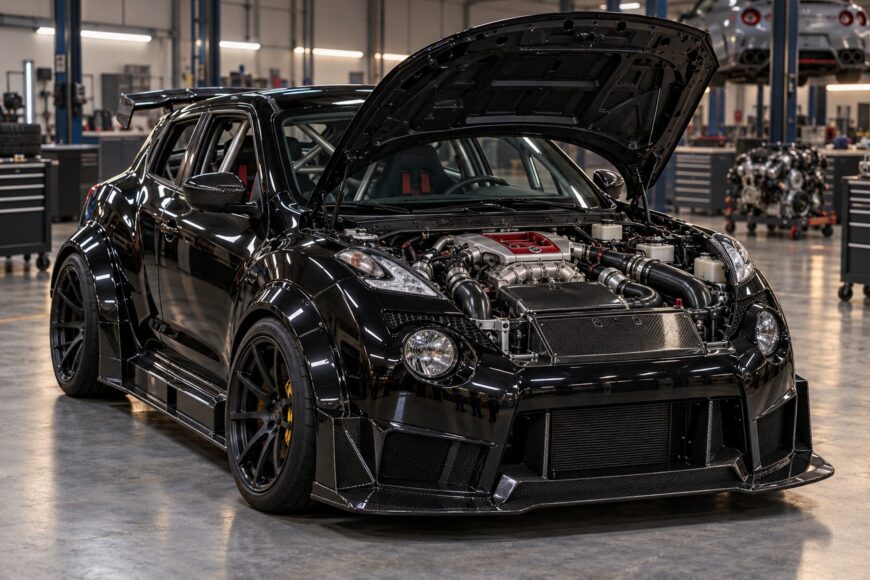
The Nissan Juke-R puts GT-R performance beneath a small crossover body, without gaining the everyday practicality of a crossover or the service access of a GT-R. Its familiar roofline hides a redesigned structure, a cramped engine bay, and hardware adapted to fit a much shorter car. The result is striking on a clear road and demanding almost everywhere else.
This was an extremely limited, heavily re-engineered machine, not a standard Juke with a larger engine dropped in. Specification matters, too: the early Juke-R was rated at 485 hp, while the later Juke-R 2.0 was quoted at 600 hp. Treating those figures as interchangeable can distort both a performance comparison and an assessment of an individual car.
- What the Nissan Juke-R Really Is
- GT-R Hardware Inside a Shorter Crossover
- Performance Figures and the 485-versus-600-hp Confusion
- Why the Juke-R Is Hard to Live With
- Buying and Inspecting a Juke-R
- Myths, Trade-Offs, and the Real Meaning of ‘Crossover’
- Frequently asked questions
- What is the price of a Nissan Juke-R?
- How many Nissan Juke-R cars were made?
- What is the price of a Nissan Juke GT-R?
What the Nissan Juke-R Really Is
The Juke-R began with the shape of Nissan’s small crossover and a far more ambitious mechanical brief. A standard Juke platform could not accommodate the GT-R-derived V6 powertrain and driveline as a straightforward conversion. The project therefore changed the structure that supports the engine, occupants, and driven wheels.
Its floor was redesigned, the engine-bay bulkhead was reinforced, and a safety cage was installed. The cage has a structural role as well as a protective one: it helps stiffen a body whose original floor layout was extensively altered. These are fundamental changes, rather than the usual mounting work associated with an engine swap.
That distinction matters when judging an example for sale or planning a repair. Familiar Juke exterior panels do not make the structure beneath them familiar to a Juke workshop. The Juke-R is best understood as an extremely limited, purpose-built conversion with a recognizable silhouette, rather than a normal production trim.
GT-R Hardware Inside a Shorter Crossover
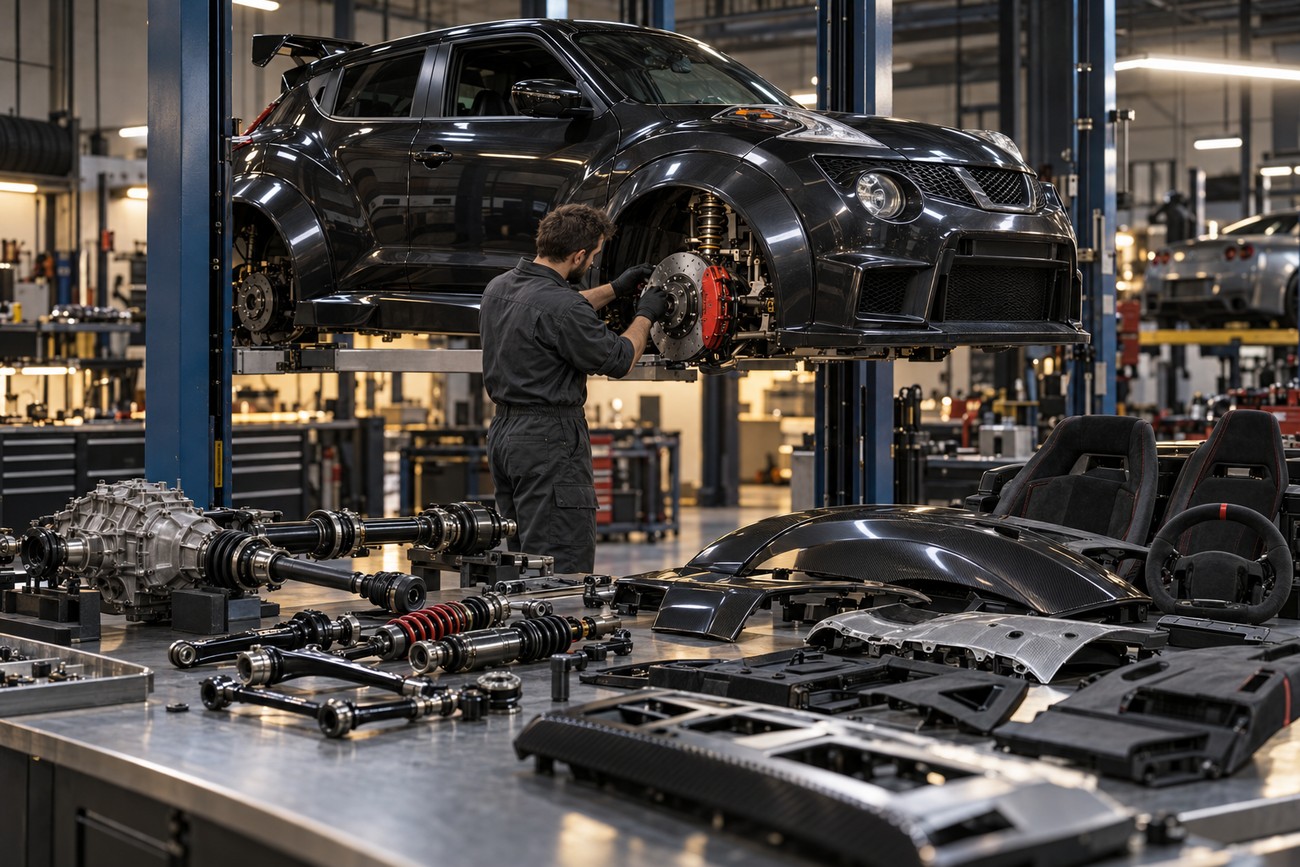
The headline component is a 3.8-liter twin-turbocharged V6, but fitting the engine was only part of the engineering problem. Nissan also had to package GT-R-based transmission and all-wheel-drive hardware, the prop shaft, differentials, and the electronics that make those systems work together. In a short Juke body, each component affects the position of the next.
The drivetrain assembly had to be shortened by approximately 250 mm to fit. GT-R-related subframes and bespoke mounting solutions helped locate the hardware within the revised structure. The conversion also required its control systems to function as a complete driveline, rather than as a collection of transplanted parts.
This has a direct consequence for repairs. A component’s GT-R origin does not guarantee that a replacement will bolt into a Juke-R: mounts, dimensions, wiring, and vehicle-specific adaptations may differ. Before ordering an expensive part, a workshop needs to identify what is fitted to that particular car and how it connects to the surrounding hardware.
Performance Figures and the 485-versus-600-hp Confusion
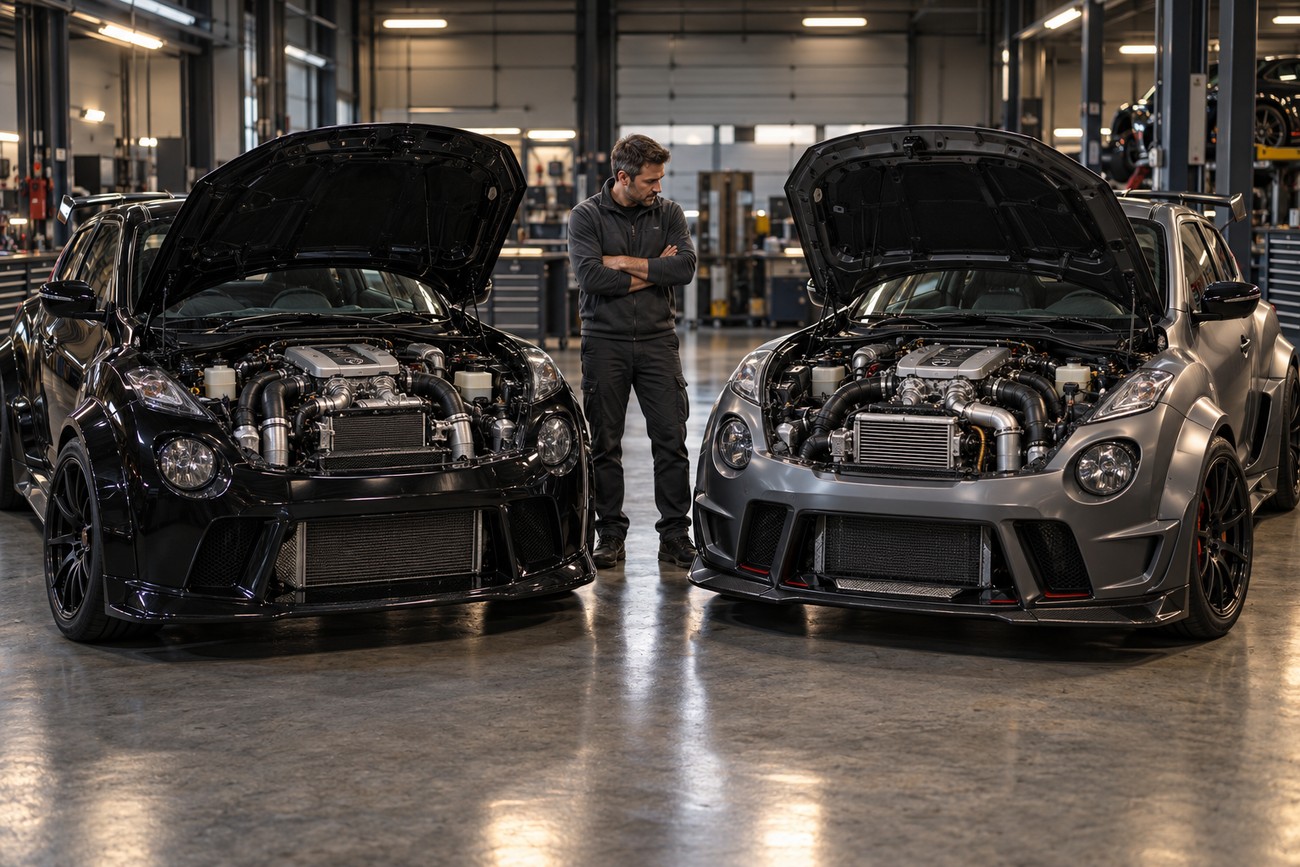
Nissan rated the early Juke-R’s 3.8-liter twin-turbocharged V6 at 485 hp. For that car, Nissan quoted 0–100 km/h in 3.7 seconds and a top speed of 257 km/h. Those figures explain the appeal: acceleration associated with a serious performance car arrives from a body shaped like a compact crossover.
The later Juke-R 2.0 was quoted at 600 hp. That number should not be applied retrospectively to every Juke-R, and a listing that gives only the model name leaves an important specification unresolved. Confirm the version and the documentation for the individual vehicle before relying on any quoted output.
Acceleration and top speed also leave out much of the driving experience. They say little about braking consistency, cooling under repeated hard use, tire life, or behavior on damaged pavement. For an owner, those limits can matter more often than the car’s ability to deliver a single rapid run.
Why the Juke-R Is Hard to Live With
The V6 fills a tight engine bay, making access to some service points more difficult than in a GT-R. Work that looks routine on a less crowded car may require substantially more preparation here. A standard Juke service schedule cannot account for the GT-R-derived and individually adapted components behind the Juke-R’s bodywork.
Its stiff suspension and low-profile tires leave little tolerance for broken roads. The widened body measures approximately 1,910 mm across and carries 20-inch forged RAYS wheels; the extra width and wheel package serve the chassis rather than everyday ease of use. Surface changes that a regular crossover absorbs can demand a slower, more careful approach in the Juke-R.
Heat, noise, and vibration are more noticeable than in a standard Juke, while the cage and mechanical packaging restrict cabin comfort and luggage usefulness. The seating position still feels crossover-like, which can make the available acceleration seem abrupt until the driver adjusts. Familiar outward proportions do not make it a practical substitute for a GT-R on a long trip or a rough commute.
Buying and Inspecting a Juke-R
Start with identity, not a power claim. Establish whether the car is an early 485-hp Juke-R or a later 600-hp Juke-R 2.0, then seek build records that connect the vehicle to its stated specification. Verify the major GT-R-derived drivetrain components and document any later changes, especially where a replacement may have required custom fitting.
A physical inspection should examine the redesigned floor, welds, safety cage, and subframe attachment areas for damage, repair, or corrosion. Check the cooling system and look for evidence of overheating or sustained track use. Given the packaging, this calls for someone able to assess the whole conversion, rather than an inspection based solely on an ordinary Juke checklist.
Budget for the car that was built, not the badge on its tailgate. Major parts may be GT-R-derived, but others were fabricated or adapted for this installation, and neither source guarantees a direct replacement. Service access and parts identification can add difficulty even when a familiar Nissan component is involved.
Public owner feedback is scarce, so broad reliability claims deserve skepticism. Historical early technical data cite a mass of approximately 1,425 kg, but that is not a verified weight for every car; confirm an individual example’s specification if weight is material to the purchase. Provenance, condition, and the quality of past work offer firmer evidence than a repeated headline figure.
Myths, Trade-Offs, and the Real Meaning of ‘Crossover’
The Juke-R was created in an extremely limited series, not as a mass-market Juke model. Likewise, 600 hp describes the later Juke-R 2.0, while the early Juke-R was rated at 485 hp. Both distinctions matter because the name alone tells you less about a car than its build documentation.
An engine swap cannot reproduce the Juke-R’s redesigned structure, shortened driveline, all-wheel-drive integration, and electronics. Those changes also explain a hidden ownership cost: specialized body, interior, and drivetrain parts may be difficult to source. Even a GT-R-derived item needs to be checked against the adaptations on the car in front of you.
“Crossover” describes the outline more accurately than the utility. Cabin space, luggage room, refinement, and poor-road tolerance were compromised to make the mechanical package fit and perform. Claims about a single definitive production total also warrant care; without verified factory documentation, early cars, later Juke-R 2.0 examples, and claims concerning individual builds should not be collapsed into one number.
Because so few cars exist, common buying questions need answers tied to a specific vehicle. Names used in listings, reported build totals, and registration status are all worth checking against documents rather than assuming they apply to every Juke-R.
Frequently asked questions
Pricing and production claims require documentation for a specific car. Early Juke-R and later Juke-R 2.0 specifications should not be treated as interchangeable. Registration and road legality depend on the individual car’s paperwork and the jurisdiction where it will be used.
What is the price of a Nissan Juke-R?
There is no dependable single market price for a Juke-R. The exact version, documented provenance, originality, condition, and availability of an individual car all affect its value. Ordinary Juke prices are irrelevant, while GT-R prices cannot account for the Juke-R’s rarity or its specialized repair demands.
How many Nissan Juke-R cars were made?
A universal production figure should not be repeated without verified factory documentation. Any proposed total needs to define whether it includes early Juke-R cars, later Juke-R 2.0 examples, and vehicles described as individual builds. If a seller quotes a number, ask what records support it and which versions it includes. For a buyer, proof of a particular car’s origin is more useful than an unsupported overall count.
What is the price of a Nissan Juke GT-R?
“Nissan Juke GT-R” is commonly used to refer to the Juke-R, rather than to a separately priced standard Juke model. There is therefore no distinct, dependable Juke GT-R list price to use as a benchmark. A valuation should identify the actual vehicle and establish its version, documentation, and condition.







