
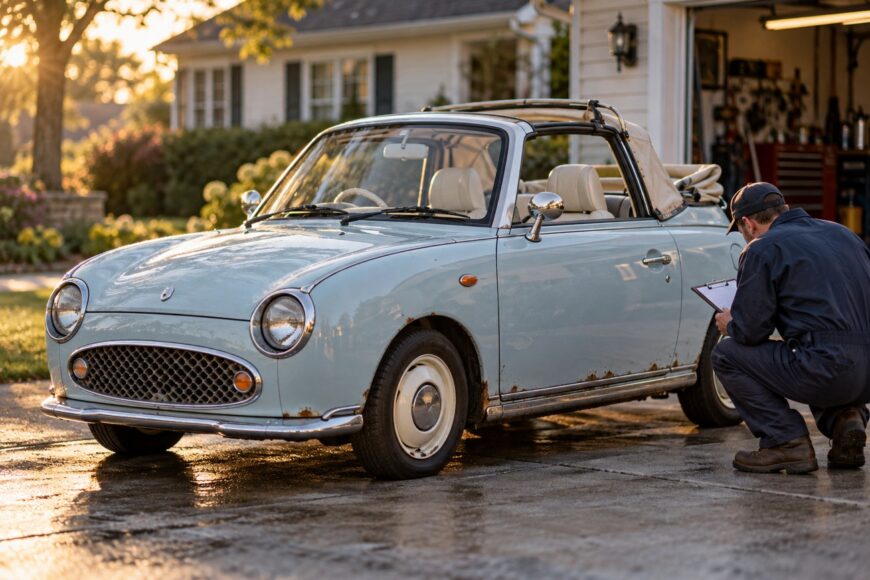
The Nissan Figaro combines distinctive retro charm with the risks of buying a 1991 imported convertible. Its pastel color, low advertised mileage, and collectible image can distract from the issues that determine whether the car is usable: corrosion, roof operation, age-related deterioration, and reliable documentation.
Condition deserves priority over appearance. A Figaro with fresh paint may still need structural rust repairs, while a dry-looking roof can leak when the mechanism operates, the car is driven, or the body is washed. Treat the model as an old Japanese import requiring a careful inspection and realistic parts support.
- Nissan Figaro specifications at a glance
- What the Figaro is really like to own
- Inspecting a Nissan Figaro: rust, roof, and age-related faults
- Import history, paperwork, and parts support
- Tyres, wheels, and safety priorities
- How rarity, condition, and resale value fit together
- Buying mistakes and myths to avoid
- Frequently asked questions
- What is the rarest color of the Nissan Figaro?
- What documents should I verify before registering an imported Nissan Figaro?
- How can I confirm that a replacement Figaro part really fits?
Nissan Figaro specifications at a glance
These factory figures identify the car accurately, although they cannot predict the condition of an individual import.
| Specification | Factory detail |
|---|---|
| Market and year | Built for the Japanese market in 1991 |
| Engine | MA10ET, 987 cc turbocharged inline-four petrol engine |
| Power | 76 PS at 6,000 rpm |
| Torque | 105.9 N·m at 4,400 rpm |
| Transmission | Three-speed automatic only from the factory; no factory manual gearbox |
| Drivetrain | Front-wheel drive |
| Dimensions | 3,740 × 1,630 × 1,365 mm |
| Wheelbase | 2,300 mm |
| Kerb weight | About 810 kg |
| Front suspension | Independent struts |
| Rear suspension | Four-link layout |
| Brakes | Ventilated front discs and rear drums |
| Factory tyre size | 165/70 R12 77H |
What the Figaro is really like to own
The Figaro’s approximately 810 kg body makes modest power feel adequate around town. The MA10ET turbocharged inline-four produces 76 PS and 105.9 N·m, while front-wheel drive keeps the layout simple. Its compact dimensions also make parking and narrow urban roads easy to manage.
The three-speed automatic defines the driving experience. On fast roads, it can hold higher engine speeds, and sustained motorway travel may feel busier than in a modern car. This is a normal design characteristic of the factory transmission, rather than automatic proof of a fault.
Rear seating is highly restricted. The Figaro is a compact 2+2 convertible based on the Nissan March/Micra K10 platform, so the rear row is best treated as occasional-use space. Adults, luggage, and long trips quickly expose the limits of the cabin.
The front independent struts and rear four-link suspension are familiar period engineering, yet age matters more than the layout on an individual car. Worn bushes, joints, dampers, and steering components can make the lightweight body feel unsettled. A short drive should include uneven surfaces, braking, steering input, and checks of the automatic transmission’s response.
Inspecting a Nissan Figaro: rust, roof, and age-related faults
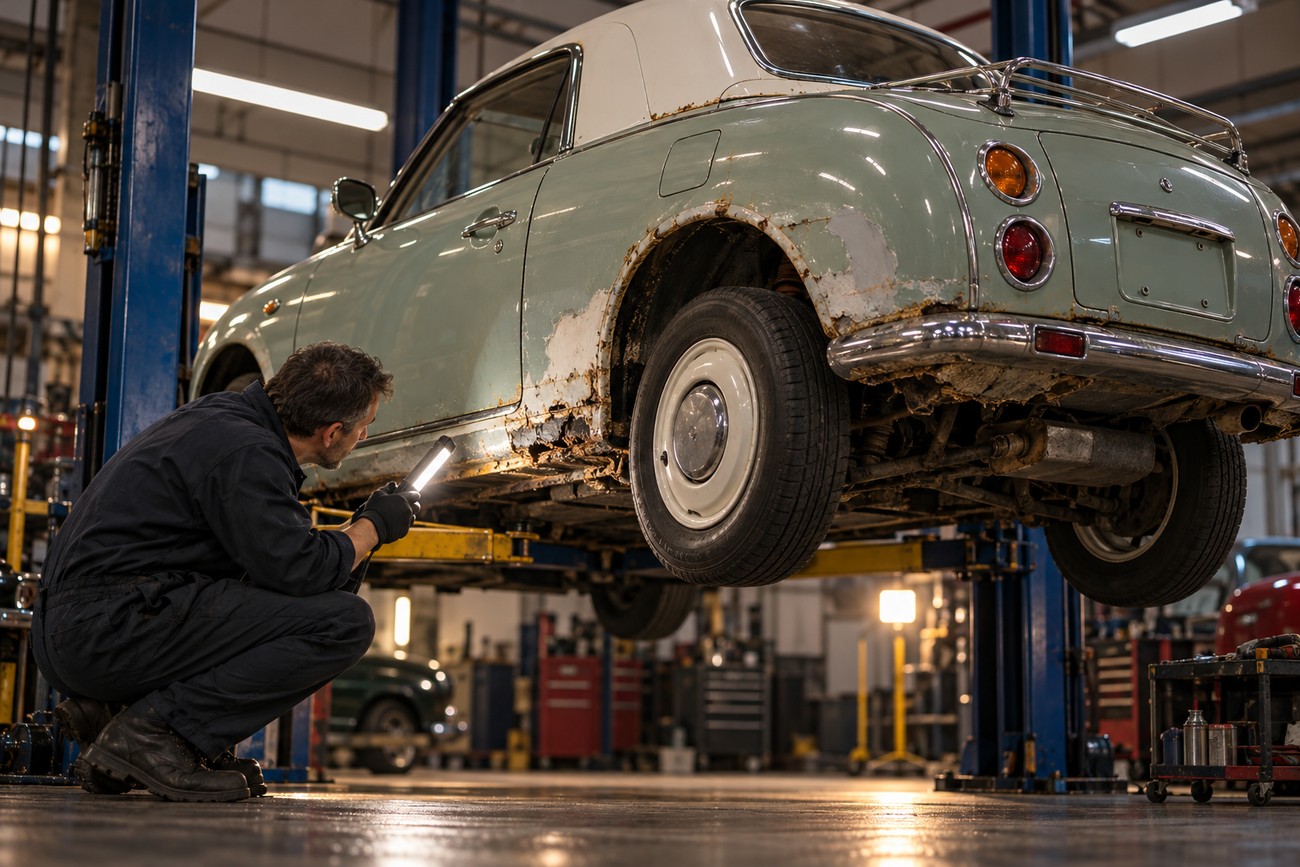
Corrosion is one of the main reasons to inspect a Figaro on a lift. Pay particular attention to the sills, wheel arches, lower door areas, and rear-window frame. Cars used without effective rust protection may have damage in places that photographs and a quick walk-around cannot show.
Paint quality provides limited evidence about the underlying structure. A freshly painted body can conceal previous repairs or corrosion in structural areas, so inspect seams, drain points, underside surfaces, and repair transitions. Ask for photographs or invoices from restoration work, then compare them with what is visible underneath.
A roof that appears dry while parked can still leak after a complete opening cycle, a road test, or a wash. The fabric, mechanism, latches, and seals need to be checked as one system.
Operate the roof fully from its closed position and back again, watching for hesitation, uneven movement, damaged fabric, poor alignment, and weak latching. Check the cabin after washing the car, and drive it before concluding that the seals work. Fabric shrinkage and age-related damage can prevent correct sealing even when the roof looks presentable.
Roof repairs may involve the fabric, mechanism, latches, or seals, so the visible material is only part of the assessment. Low mileage does not remove age-related risks affecting tyres, hoses, rubber parts, seals, electrical components, and other deteriorating materials.
A specialist familiar with Japanese imports and corrosion is preferable to an OBD scan alone. The Figaro’s age and simple mechanical architecture mean that physical inspection, service evidence, and a road test often reveal more than electronic fault-code checking.
Import history, paperwork, and parts support
Many Figaros are imported, and their service, repair, and storage histories may be incomplete. Request the available import records, previous registration documents, service invoices, inspection reports, and evidence of major body or roof work. Gaps do not automatically disqualify a car, although they should affect your risk assessment.
Check that the VIN or chassis identity is consistent across the vehicle, import paperwork, title, and registration records. Confirm the requirements of the jurisdiction where you plan to register it, including rules affecting a 1991 vehicle. Resolving an identity or paperwork mismatch after purchase can be more difficult than identifying it before payment.
Some original parts are difficult to source. Specialist clubs and owner communities can provide useful technical references, supplier leads, and information about workable repairs. This support can matter when a general parts search produces a visually similar component with a different fit or specification.
The Nissan March/Micra K10 platform gives the Figaro some shared mechanical ancestry, yet it does not guarantee direct interchangeability. Confirm every replacement part against a catalog or part reference and the exact chassis application before ordering.
Tyres, wheels, and safety priorities
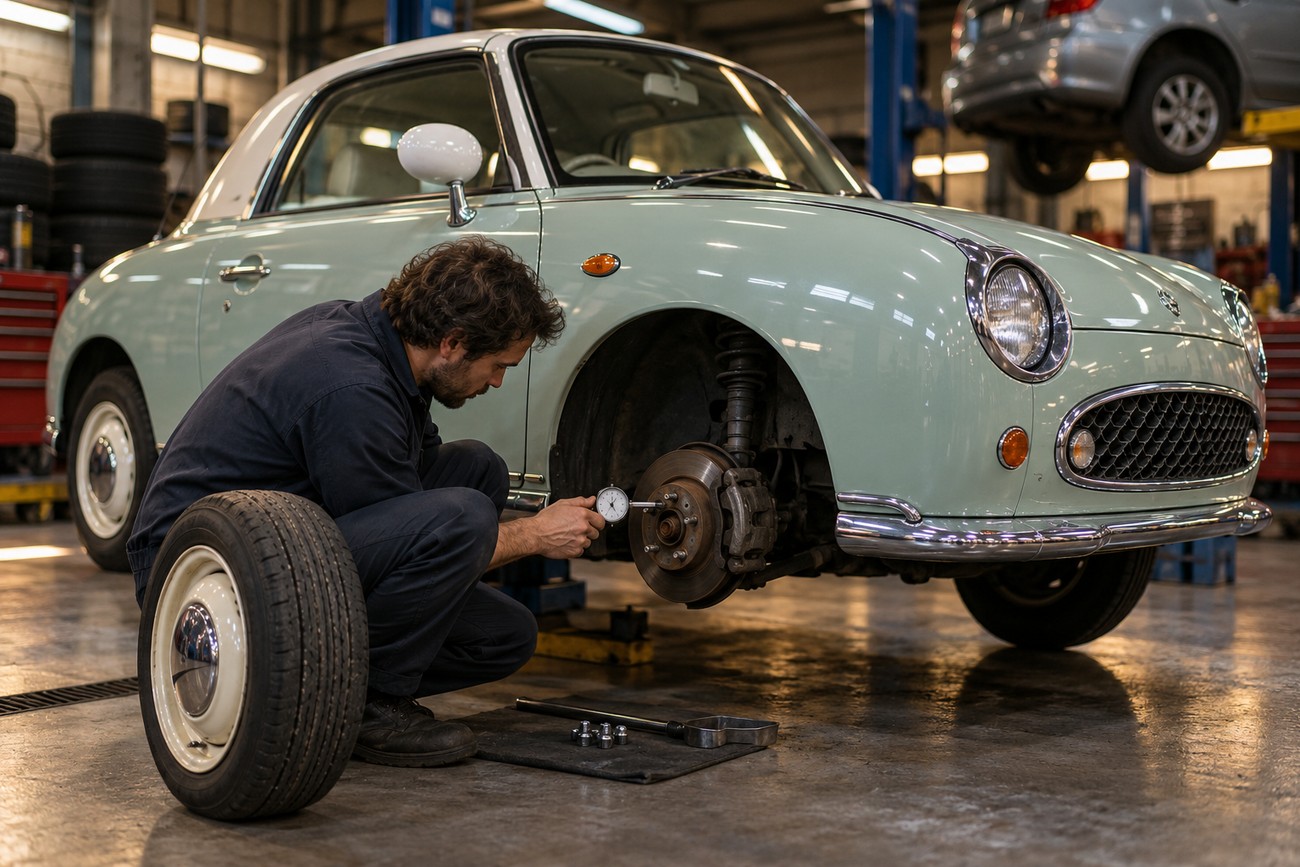
The factory tyre specification is 165/70 R12 77H. Correct load and speed ratings should be confirmed before buying replacements, since the correct dimensions alone do not establish suitability. Availability of appropriate 12-inch tyres should be checked before committing to a car.
Larger modern wheels can alter ground clearance, effective gearing, and suspension loads. They may also change steering feel, tyre sidewall behavior, and the relationship between the wheel and surrounding components. Treat an advertised wheel upgrade as a modification requiring inspection, rather than assuming it is a factory-equivalent choice.
The braking system uses ventilated discs at the front and drums at the rear. Inspect disc condition, drum operation, hydraulic components, brake hoses, and parking-brake function. Because the car weighs about 810 kg, tyre grip, brake condition, and steering-joint wear have a substantial effect on safety and control.
Give priority to tyres, brakes, and steering joints before cosmetic upgrades. A clean interior or desirable color cannot compensate for degraded running gear, while an unusual wheel package may make future tyre replacement harder.
How rarity, condition, and resale value fit together
The Figaro was built for the Japanese market in 1991, with approximately 20,000 cars produced. Nissan’s official collection lists 20,000, while some sources cite 20,073. The difference does not materially change the practical conclusion: it is a limited-production model with a relatively narrow buyer market.
Limited production does not make every Figaro equally valuable. Corrosion, roof condition, documentation, and restoration quality usually carry more weight than a collectible label. Two cars with similar colors and odometer readings can require very different ownership budgets.
A low advertised mileage is less persuasive than sound bodywork and documented repairs. An old car may have covered little distance while its seals, hoses, tyres, electrical components, and roof materials continued to age. In this model, verified maintenance and careful storage evidence are stronger buying signals.
Resale demand is relatively narrow, and buyers tend to scrutinize the same expensive areas as you should. A well-documented, structurally sound car with a properly functioning roof is easier to explain to the next buyer than a cosmetically impressive example with uncertain repairs.
Buying mistakes and myths to avoid
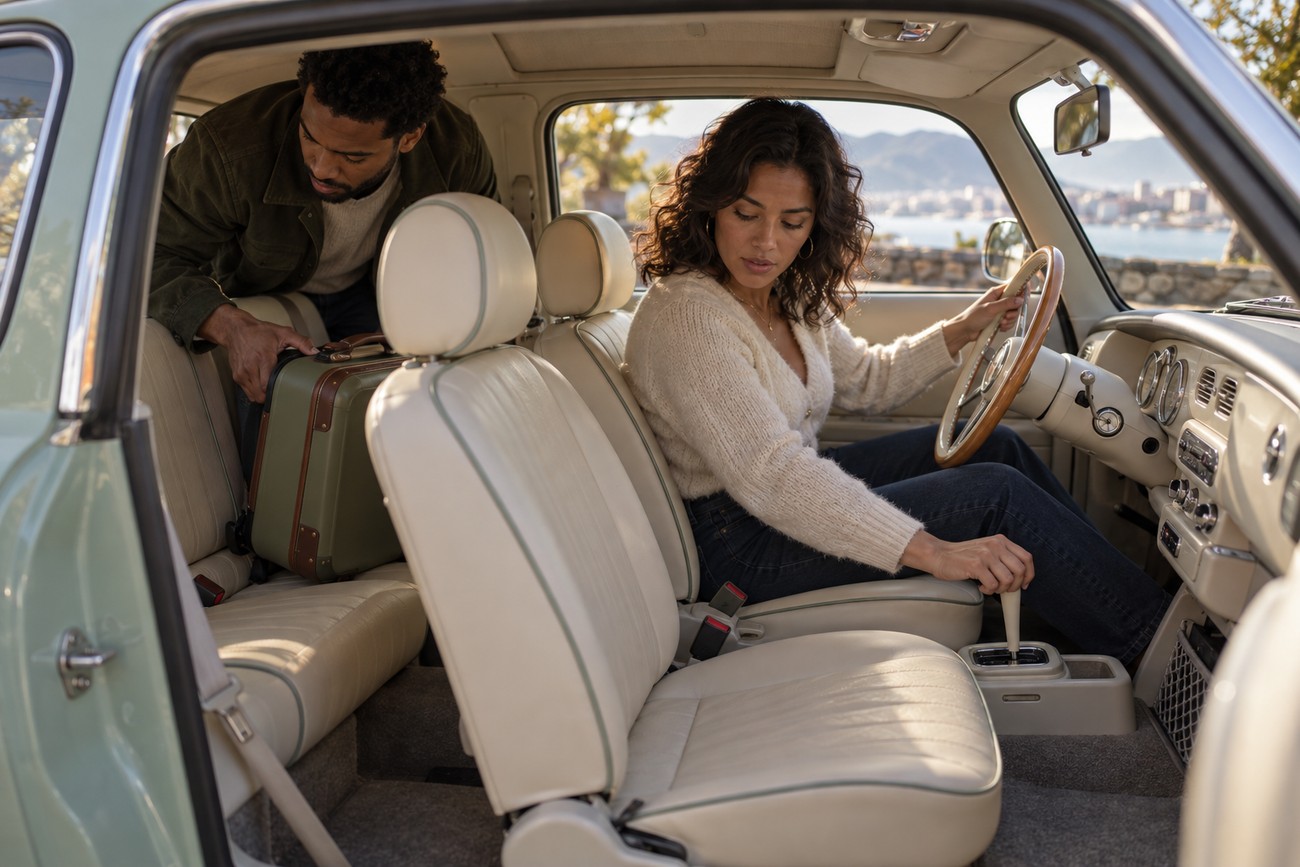
The Figaro is a full four-seat convertible: in reality, it is a compact 2+2 with very limited rear seating. Check the cabin with the people and luggage you expect to carry. A short viewing can conceal how quickly the rear area becomes impractical.
The Figaro came with a factory manual gearbox: reality is different. The factory specification included only a three-speed automatic. A manual-converted car would require separate documentation of the conversion, its parts, and its engineering quality.
Any wheel size shown in an advertisement is suitable: the factory tyre specification is 165/70 R12 77H. Larger wheels are deviations from the factory specification and can change clearance, gearing, and suspension loads. Check the complete wheel-and-tyre setup before treating it as an advantage.
Photographs, paint quality, and color are enough to judge a car: they are not. Inspect the underside on a lift, test the complete roof cycle, drive the car, and check for leaks after washing. Around 20,000 cars were produced, yet rarity alone does not establish value.
Frequently asked questions
These points address details that are often overstated in listings or overlooked during an import purchase.
What is the rarest color of the Nissan Figaro?
Available production information confirms the overall run, yet it does not establish a verified color-by-color production breakdown. Claims that one color is definitively the rarest should therefore be treated cautiously.
Color can influence buyer preference, but it does not prove condition or value. Originality, corrosion control, roof function, documentation, and restoration quality provide more reliable evidence when comparing cars.
What documents should I verify before registering an imported Nissan Figaro?
Match the chassis or VIN identity across the car, import records, title, and registration documents. Check that names, numbers, dates, and ownership details are consistent, and retain invoices or inspection records supporting major repairs.
Confirm the registration requirements of your jurisdiction before purchase, including any rules applying to a 1991 imported vehicle. A specialist registration service or local authority can clarify missing documents before they become a problem.
How can I confirm that a replacement Figaro part really fits?
Compare the supplier’s catalog or part reference with the exact chassis application and the vehicle’s specification. Shared Nissan March/Micra K10 platform components may be relevant, although platform similarity alone does not prove direct fitment.
Use specialist club knowledge to cross-check the reference, especially for roof, trim, electrical, and model-specific parts. Ask for dimensions, photographs, and application details before ordering a component that cannot easily be returned.







