
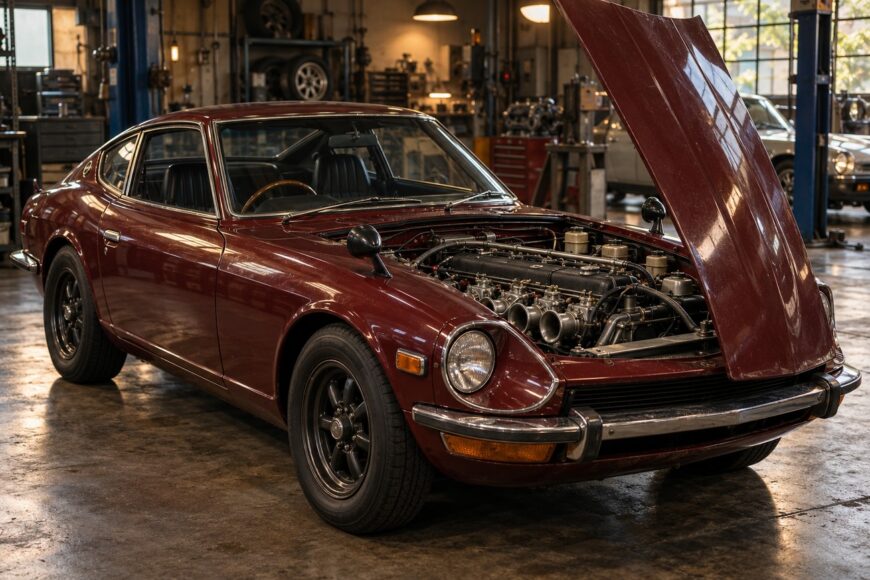
A Nissan Fairlady Z432 is not simply an ordinary Fairlady Z fitted with an S20 engine. It is a rare factory S30 specification that brought the Nissan/Prince S20 into the Z car, linking the coupe to the Prince Skyline GT-R lineage. That distinction matters whenever an engine-swapped car is presented as the genuine article.
The engineering is compelling: a high-revving, four-valves-per-cylinder straight-six in an early Z shell. Ownership is less romantic. Establishing a car’s identity takes evidence, original S20 parts are scarce, and corrosion or decades of alterations can overwhelm even a promising mechanical restoration.
- What the Fairlady Z432 Actually Was
- The S20 Engine: Why Two Liters Mattered
- Z432 and Z432R: Similar Badge, Different Priorities
- Authenticity Is More Than an S20 Swap
- The Hidden Cost of Owning a Z432
- How Collectors Judge a Z432’s Value
- Frequently asked questions
- How many Z432 were made?
- How much is a Nissan Fairlady Z?
- What does matching numbers mean on a Z432?
- Why can an apparently complete Z432 still be a risky purchase?
What the Fairlady Z432 Actually Was
The Z432 was a factory-built version of the S30 Fairlady Z, equipped with the Nissan/Prince S20, a 2.0-liter inline-six DOHC engine. Its identity belongs to the whole car, including its chassis and original specification. An S20 installed later in another S30 creates an interesting conversion, not an automatic Z432.
The badge describes the engine: 4 valves per cylinder, 3 carburetors, and 2 overhead camshafts. It also signals a different engineering purpose from the more familiar L-series Z cars. The S20 was a specialized, costly engine whose roots lay in Prince performance engineering, rather than an economical route to everyday torque.
That connection makes the Z432 a meeting point between the S30 road-car platform and the Prince Skyline GT-R lineage. Calling it merely a Japanese-market 240Z obscures the factory specification collectors are trying to preserve. The distinction becomes especially important when two outwardly similar Z cars have entirely different histories beneath their paint.
Both the Z432 and its Z432R derivative were built in small series and rank among the rarest S30-based Z cars. Rarity alone, however, does not settle the identity of a surviving example. Factory records, physical details, and the car’s subsequent history must agree.
The S20 Engine: Why Two Liters Mattered
The naturally aspirated S20 earned its reputation through cylinder-head design and revs, rather than displacement. A commonly cited Z432 road specification is about 160 PS at 7,000 rpm and about 18.0 kgm of torque. Those figures explain the period appeal: considerable output from a 2.0-liter engine, delivered high in the rev range.
Its association with the Prince Skyline GT-R lineage also explains why the engine holds meaning beyond a horsepower comparison. In the Z432, Nissan put that demanding performance hardware into a series-built sports coupe. The result rewards a driver willing to work with its operating range; it is less suited to effortless, low-speed cruising.
Accurate setup is central to that character. Valve-train adjustment and synchronization of the three carburetors affect noise, idle quality, and smooth running. An engine that feels temperamental may need careful diagnosis rather than a casual adjustment, particularly if original intake and exhaust hardware has changed over time.
Period significance should not be confused with modern ease of use. The S20’s appeal lies partly in how directly its performance depends on precise mechanical condition. Before buying, the useful question is whether the car has been maintained by people who understand that system and can document the work.
Z432 and Z432R: Similar Badge, Different Priorities
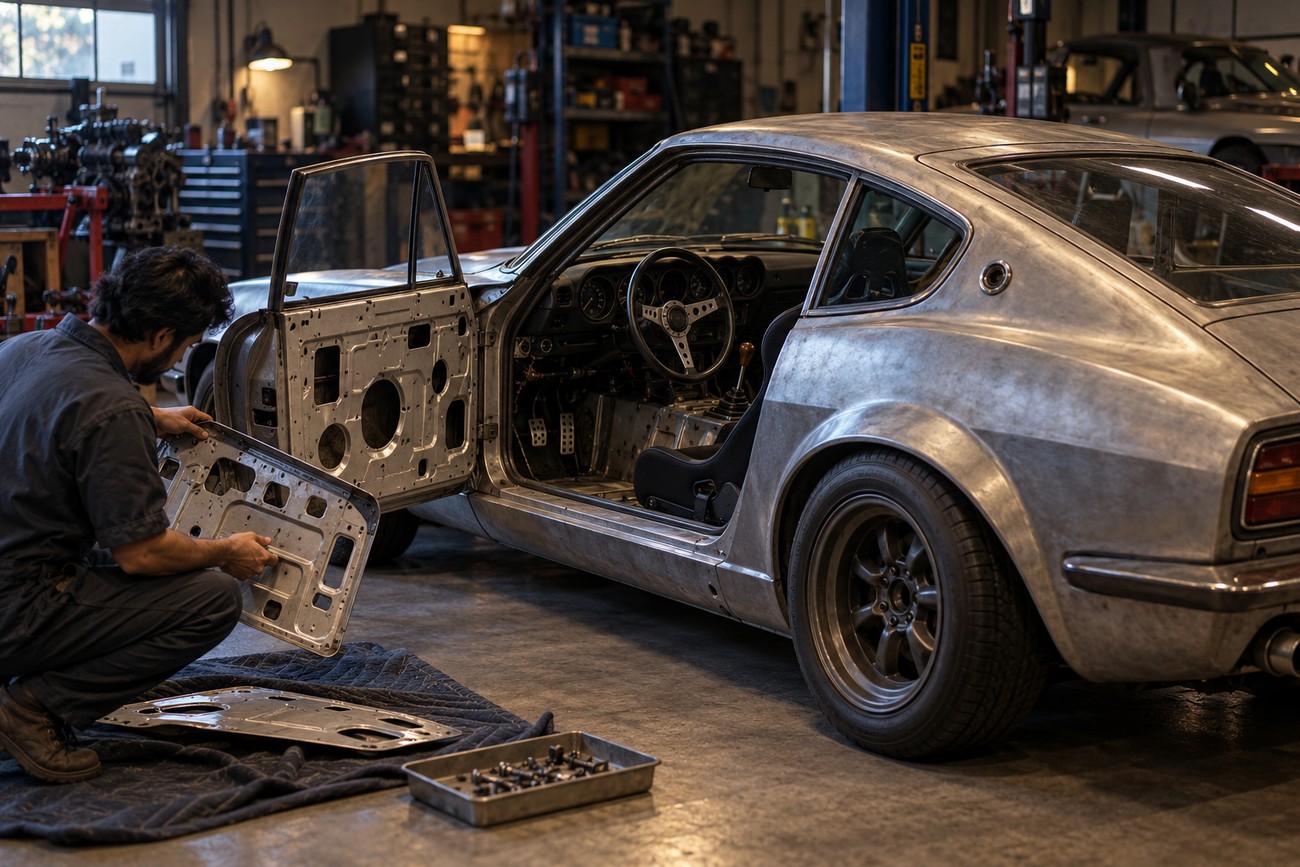
The Z432R was the rarer, competition-focused lightweight derivative. Where the Z432 brought the S20 to a roadgoing S30, the R placed greater emphasis on a lighter, simpler base for motorsport homologation. The shared engine should not obscure that difference in intended use.
Reduced sound insulation and equipment formed part of the Z432R approach, along with simplified trim. Selected versions used thinner panels or glass. Those details matter to a collector because replacing a missing lightweight component may be much harder than sourcing an ordinary S30 part that looks broadly similar.
Descriptions of an R as a uniformly stripped track car are too neat. Configurations and the condition in which cars survive vary; competition use and later repairs can also alter what remains. A sparse cabin or lightweight-looking panel is therefore a clue to investigate, not proof of factory specification.
The R’s competition purpose presents a preservation dilemma. Alterations made for racing can be historically meaningful, yet they can also conceal the loss of original equipment or structure. A careful assessment separates documented period changes from later attempts to make a car resemble the rarest version.
Authenticity Is More Than an S20 Swap
A credible Z432 claim starts with correspondence between chassis identity, engine identity, identification plates, documented history, and factory specification. No single feature carries the case. An S20 under the hood proves that an S20 is present; it does not establish how the car left the factory.
“Matching numbers” is useful only when the major identities can be connected to the car’s historical specification. Records and physical inspection should reinforce one another. A plausible engine stamp cannot resolve inconsistent plates, unexplained chassis work, or a history that begins long after the car was built.
Check the components around the S20 as a system. Carburetors, brackets, wiring routes, trim, fasteners, and body details can expose a conversion that looks persuasive from the engine bay alone.
Intake and exhaust pieces deserve the same scrutiny as visible badges. Correct-looking replacement or replicated parts may make a car attractive without establishing originality. Equally, an authentic chassis can have accumulated alterations that materially affect its collector value, even if its engine identity is sound.
A buyer should seek a specialist assessment and a clear account of changes, especially where old repairs complicate the evidence. That is a framework for reducing uncertainty, not a certificate produced by ticking boxes. If the seller’s claim depends chiefly on the installed engine, the claim remains incomplete.
The Hidden Cost of Owning a Z432
Polished sale descriptions rarely convey how difficult an S20 can be to restore correctly. Original-specification parts may have to come from old stock, specialist restoration, or custom manufacture. Each route brings questions about availability, accuracy, and whether the finished engine still reflects the car’s documented specification.
Routine attention matters too. Poor valve-train servicing can leave the engine noisy or less smooth, while carburetors that have fallen out of synchronization can make idle and response frustrating. A Z432 treated as an inexpensive retro grand tourer may quickly reveal the cost of deferred adjustments.
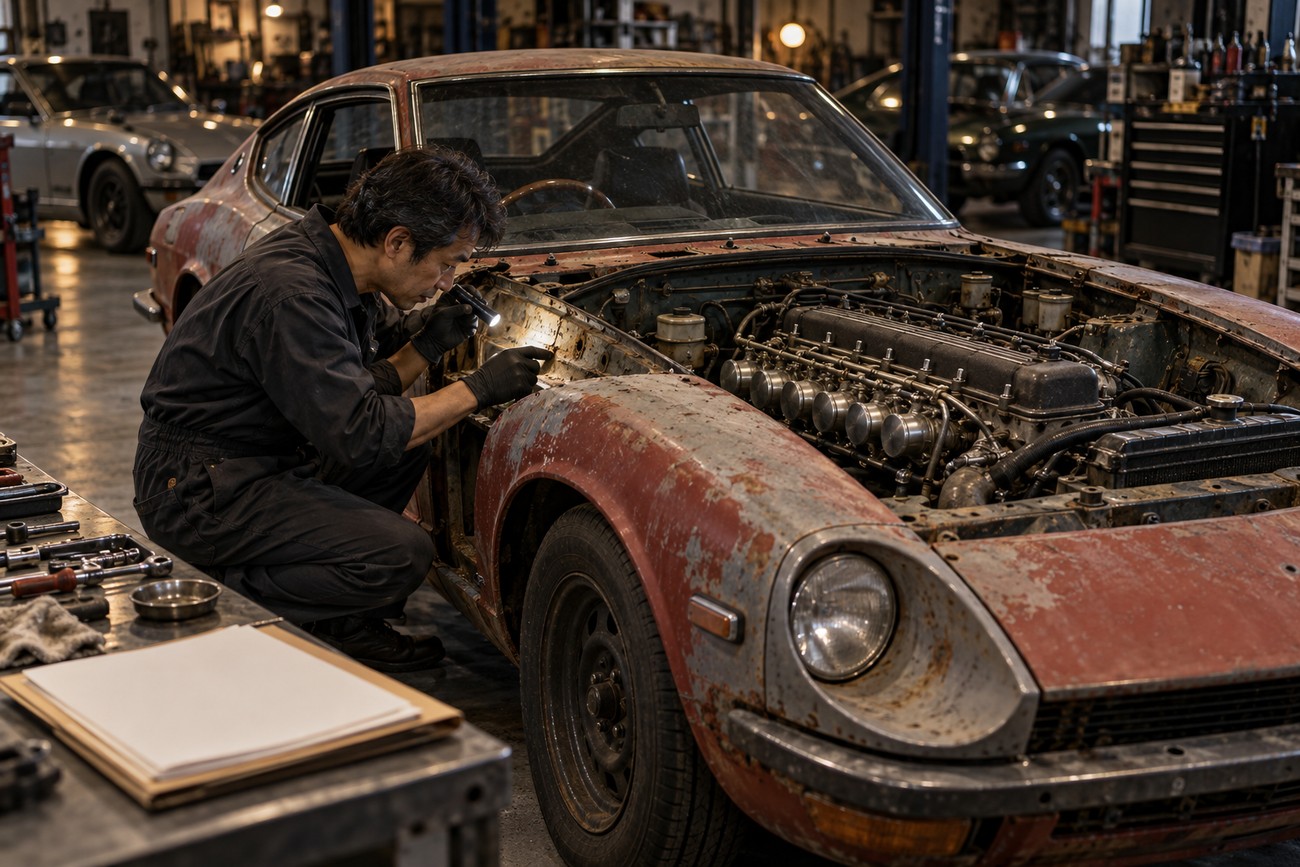
The body can be the greater financial hazard. Frame rails, floors, rear arches, and suspension mounting areas warrant close inspection for corrosion and earlier repairs. Fresh paint may cover structural work that is difficult to reverse, and sound-looking outer panels say little about the condition beneath them.
Accumulated modifications add another layer of expense. Wiring changes, substituted fittings, and undocumented body repairs can take years to understand and correct when original components are scarce. Before concentrating on the S20, establish whether the chassis is sound and whether its history supports the restoration decisions already made.
How Collectors Judge a Z432’s Value
There is no responsible single price for a Fairlady Z432. The broader Fairlady Z market includes cars with different engines, specifications, and histories, so an ordinary S30 comparison can mislead. For an S20 car, verified provenance and factory-correct specification carry particular weight.
Collectors consider body and chassis originality, matching numbers, correct S20 hardware, condition, and documented restoration quality together. A sound original shell may matter more than the mere presence of an expensive engine. Conversely, a car with attractive presentation can command less confidence if its identity or structural repairs are uncertain.
Even seemingly objective description fields need care. Enthusiast and auction accounts sometimes report Z432 or Z432R mass at approximately 1,040–1,100 kg, but figures vary with market, equipment, and condition. A quoted weight should not be used as a shortcut to identify a particular car.
Replicas and partial conversions can be convincing, and they may have genuine appeal as driving cars. Their collector standing is different from that of a documented factory Z432. The strongest purchase case joins verifiable identity to an original, sound structure and a transparent account of every substantial restoration decision.
Frequently asked questions
Production totals depend on how Z432 and Z432R cars are counted. Valuations likewise depend on a car’s identity and condition, rather than a generic Fairlady Z price. The questions below address those distinctions and the evidence needed to assess a car.
How many Z432 were made?
The Z432 was produced in a small series, and the Z432R was rarer. Published totals can differ according to whether an account includes R cars and how it interprets market records or surviving documentation. Without a clearly defined counting method and reliable supporting records, one exact total would suggest more certainty than the evidence warrants.
How much is a Nissan Fairlady Z?
There is no single meaningful price for every Nissan Fairlady Z. A figure for a more common L-series car is not a sound valuation for a factory S20-equipped Z432. For the latter, a buyer needs to assess provenance, originality, body and chassis condition, and the correctness of its S20 specification before a comparable sale becomes useful.
What does matching numbers mean on a Z432?
Matching numbers means the major factory identities have a documented relationship consistent with the car’s history and specification. Specialists compare engine and chassis information, plates, records, and physical details rather than accepting one stamp at face value. That evidence supports authenticity; it does not excuse serious corrosion or extensive non-original work.
Why can an apparently complete Z432 still be a risky purchase?
Visual completeness shows that the expected parts appear to be present, not that they are original to the car. Replicated components, an undocumented conversion, concealed corrosion, or earlier structural repairs may only become apparent through records and close inspection. The practical difference is whether the car’s appearance can be verified against its identity and history.







