
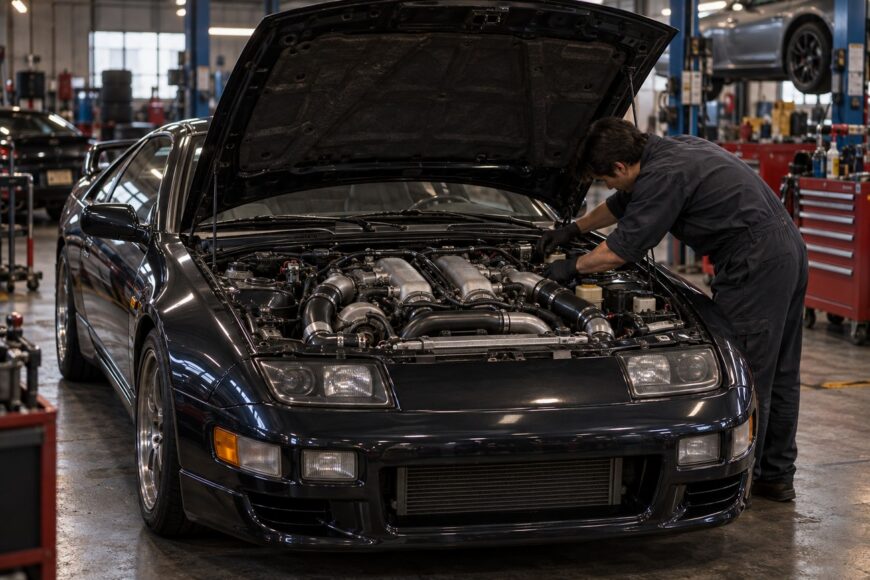
The Nissan 300ZX Twin Turbo pairs a strong, engaging V6 with an engine bay that can turn a small repair into a substantial labor job. A hose or connector may be inexpensive on its own; reaching it can mean moving intake or turbo plumbing first. That distinction matters more to an owner than the engine’s reputation in isolation.
The useful question is whether a particular Z32 has been maintained well enough to justify the work its packaging demands. The VG30DETT’s basic construction is sound, but service history, aging rubber and wiring, and faults hidden behind other components determine whether ownership feels manageable or relentless. A tidy exterior and a smooth test drive cannot settle those issues.
- Why the Z32 Engine Bay Feels Like a Nightmare
- The Routine Jobs That Become Major Repairs
- The Age-Related Failures Hiding Under the Intake
- How to Inspect a Used 300ZX Twin Turbo Before Buying
- Common Myths That Make Z32 Ownership More Expensive
- What Actually Determines Repair Cost and Value
- Frequently asked questions
- How much is a Nissan 300ZX Twin Turbo worth?
- How much does it cost to rebuild a 300ZX Twin Turbo engine?
- What are some common problems with the Nissan 300ZX Twin Turbo?
- Why is the 300ZX so hard to work on?
Why the Z32 Engine Bay Feels Like a Nightmare
The VG30DETT is a 3.0-liter, 60-degree V6 with DOHC, 24 valves, and twin turbochargers. Nissan fitted that hardware, its intake system, intercooler plumbing, and numerous accessories into a low sports-car nose. Space left over for hands and tools is limited, especially around the back and sides of the engine.
The core has a cast-iron closed block with piston oil-cooling jets. That construction helps explain why the basic engine has a stronger reputation than the surrounding systems. It does not make a deteriorated hose, connector, or seal easier to reach.
The upper intake manifold obstructs the rear cylinder bank, while turbo and intercooler components crowd other approaches. A technician may have to remove neighboring parts before reaching the actual fault, then check everything disturbed during reassembly. Labor grows even when the failed part is modest.
Calling the entire car unreliable because of its crowded bay misses the point. Packaging and age create much of the ownership risk, and deferred maintenance compounds both. A well-documented car can be sensible to maintain; one that has survived on quick fixes can be expensive to put right.
The Routine Jobs That Become Major Repairs
Oil and filter service is relatively straightforward on a Z32 Twin Turbo. That can give a misleading impression of the work ahead. Jobs behind the intake or around the timing system involve a different level of access and deserve a different labor allowance.
The upper intake manifold obstructs the rear cylinder bank and may need to be removed for rear spark-plug service. Access depends on exactly what must be removed on the car in front of you, but this is no place to assume that every plug will come out like one in an open engine bay. A quote for a seemingly simple ignition job should account for access and any aged connections disturbed along the way.
Timing-belt, water-pump, and thermostat replacement requires substantial front-engine disassembly when handled as a comprehensive service. Doing related work while that area is open can avoid paying for overlapping access later. It also makes the scope of a claimed “belt service” important: a belt alone does not establish that the surrounding components were addressed.
An unknown timing-belt history is a serious buying risk, regardless of how well the engine currently runs. Ask for the date, mileage, and itemized work rather than treating a seller’s assurance as proof. If the history cannot be established, plan the service before relying on the car for regular driving.
The Age-Related Failures Hiding Under the Intake
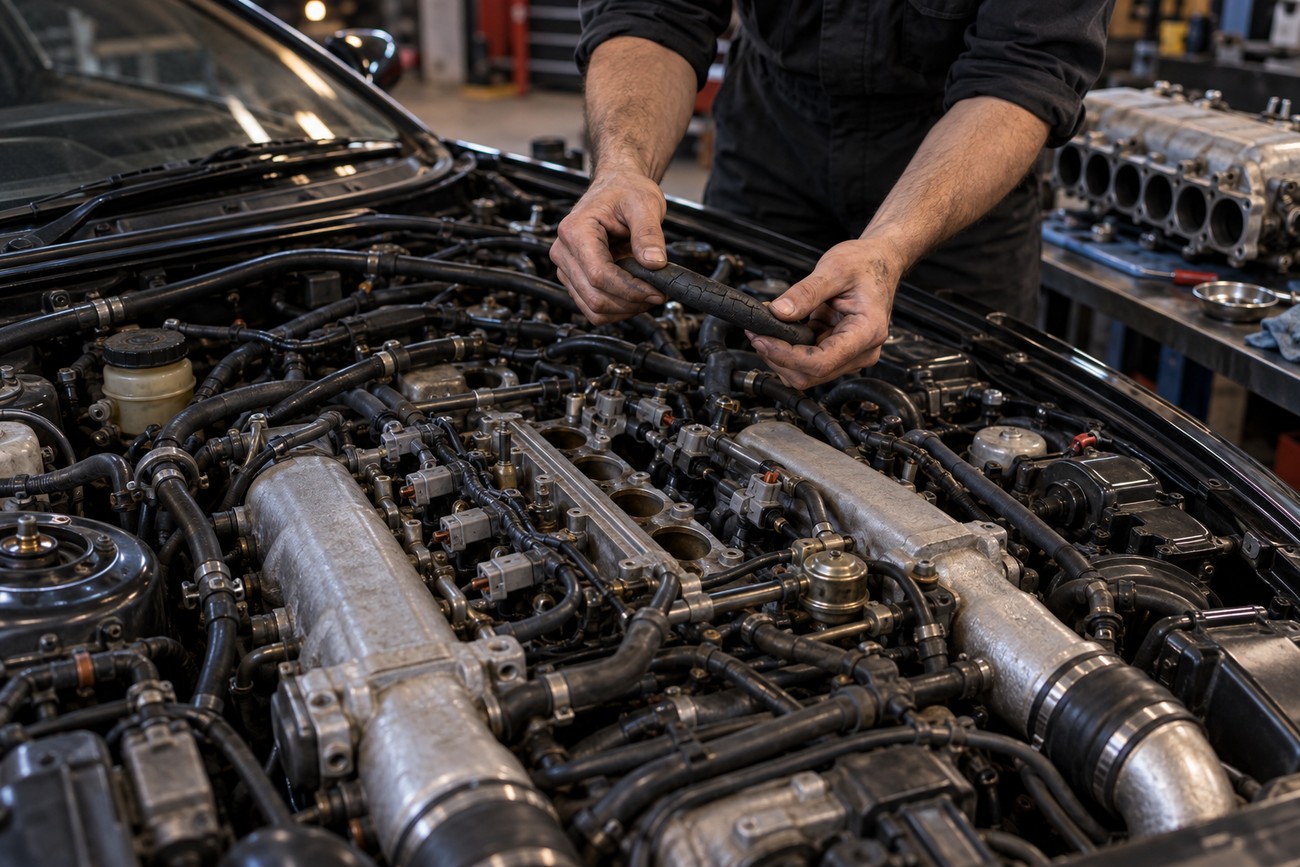
Early injectors have a reputation for failure and clogging; later-type replacements are commonly used. A single poor-running cylinder may point to one injector, yet the others may be the same age, with similarly old connectors. Replacing one part without checking the rest can leave the underlying reliability problem untouched.
Vacuum and coolant hoses harden and crack with age. Leaks under the intake are particularly frustrating because their symptoms can be easier to notice than their source. Before authorizing a repair, establish which line has failed and inspect the nearby rubber that will become accessible during the job.
Corroded connectors and deteriorating wiring add uncertainty to fuel and ignition diagnosis. An electrical fault can resemble a failed component, so replacing parts solely on the basis of a symptom is costly. Check connector condition and wiring integrity alongside the injector or sensor being tested.
The power-steering pump is positioned above the alternator, allowing fluid leaks to damage the alternator. Look for wetness and residue below the pump, even if charging appears normal during an inspection. Catching the leak early may prevent a steering repair from becoming an electrical one as well.
How to Inspect a Used 300ZX Twin Turbo Before Buying
Begin with evidence of engine condition, preferably through an inspection by someone familiar with the Z32. Compression readings matter as a set: compare every cylinder rather than accepting a few reassuring numbers. Roughly 5% cylinder-to-cylinder variation is a desirable owner benchmark, not a universal factory pass/fail limit; test conditions and the applicable service specifications still matter.
Next, verify timing-belt work with a date, mileage, and documentation showing what was replaced. Inspect injector operation, connectors, visible vacuum and coolant hoses, and fluid traces around the power-steering pump and alternator. Paint, wheels, and engine-bay detailing tell you little about those less visible liabilities.
Compression consistency and dated service records deserve attention before a polished engine bay does. Clean surfaces cannot show whether an inaccessible hose is brittle or whether a claimed timing-belt job included its related parts.
Ask how long the car has sat and what was done before it returned to use. After long storage, owners commonly budget for the timing belt, water pump, fluids, and aged rubber lines before full operation. A car that starts and idles after storage has cleared only an initial hurdle.
Finish beyond the engine bay. Inspect lower body edges and rear quarter panels for rust, especially on cars exposed to snowy climates, and examine the underside rather than judging the visible paint alone. Corrosion and accumulated mechanical work can change the buying decision even when the advertised asking price initially looks attractive.
Common Myths That Make Z32 Ownership More Expensive
The claim that a strong VG30DETT needs only ordinary maintenance confuses engine construction with the condition of an aging car. Hoses, seals, wiring, connectors, and fuel-system parts can demand substantial work while the basic engine remains healthy. Budgeting only for oil changes leaves little room for that distinction.
“Every 300ZX Twin Turbo makes 300 hp” is also too broad. Japanese-market output is commonly listed at approximately 280 PS, depending on the cited specification; export specifications are commonly listed at approximately 300–308 hp/PS. Those are market-specific figures using different units and must not be combined into one universal rating. Verify the car’s market specification before relying on a seller’s number.
Owners do not invent the access problem. The intake, front-engine components, and turbo plumbing can require removal of adjacent hardware to complete a repair. Yet a cramped bay is not proof that every example is failing; maintenance history determines how often an owner has to pay for that access.
A functioning alternator does not make a power-steering leak harmless. Because the pump sits above it, fluid can reach the alternator before an obvious charging fault develops. A dry charging-system test and an active fluid leak are separate findings, and both need attention.
What Actually Determines Repair Cost and Value
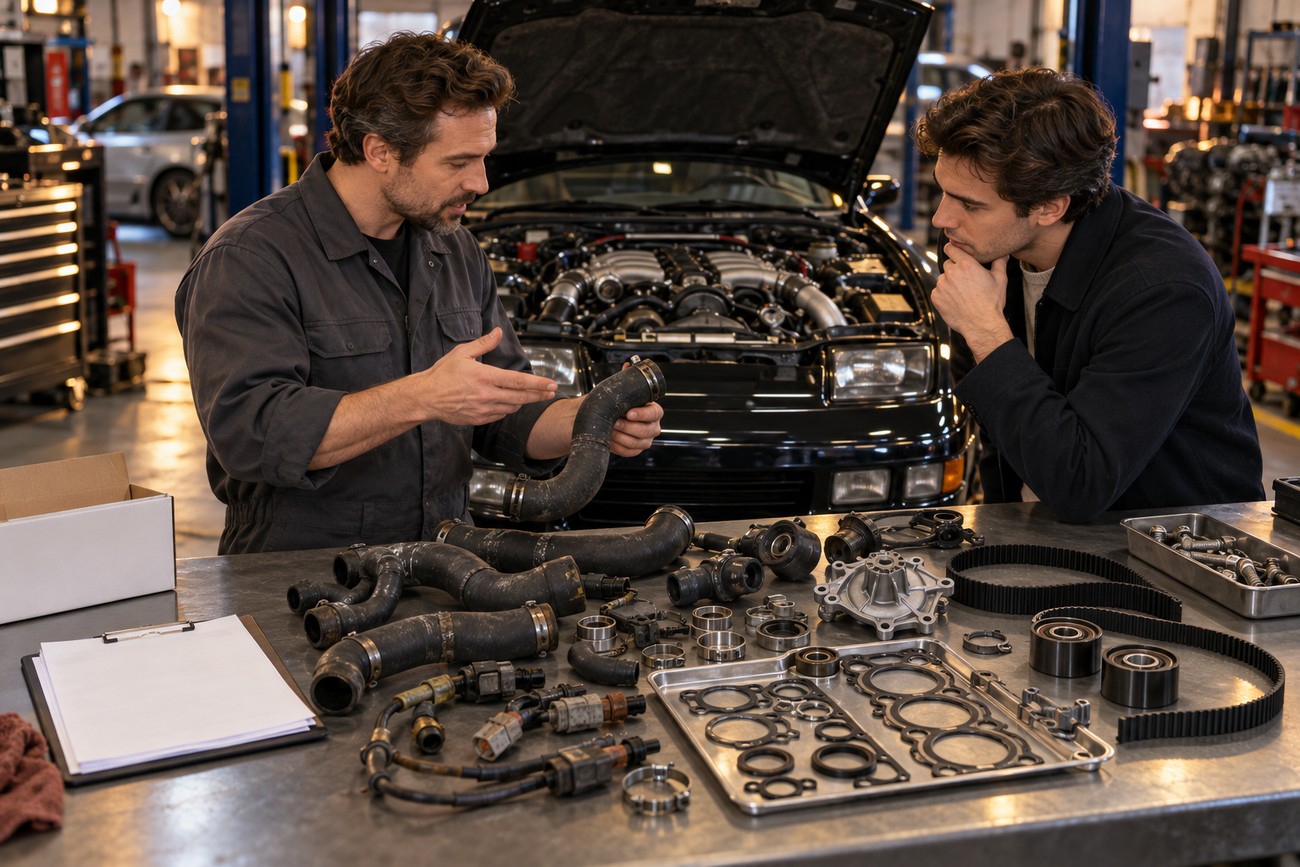
On a Z32 Twin Turbo, labor to reach a component can cost more than the replacement part itself. Repair estimates should therefore describe the access work, parts disturbed, and checks required after reassembly. A low quote that covers only the failed item may omit work the car needs once it is opened up.
Deferred maintenance changes the economics more than a single fault does. A car with documented timing service, sound hoses, and healthy electrical connections offers a clearer starting point than one with an unknown history, even if both drive well briefly. If internal engine damage is suspected, confirm it before discussing a rebuild; routine renewal and internal repair are different scopes of work.
Parts selection also affects the result. Naturally aspirated (NA) and Twin Turbo (TT) versions differ in engine, electronics, and equipment, so random substitution is risky. Match components to the car’s specification and check what previous repairs or modifications have changed.
Value follows the work left for the next owner. Documented maintenance can justify paying more than you would for a cosmetically sharper car with an undocumented belt and neglected rubber. The best purchase is rarely established by an asking price alone; it is the car whose condition and remaining work you can assess with reasonable confidence.
Frequently asked questions
How much is a Nissan 300ZX Twin Turbo worth?
There is no defensible single price from engine specification alone. Compare the asking price with documented maintenance, compression results, rust condition, originality or quality of modifications, and the work needed before regular use. An undocumented timing belt or long storage should affect what you are willing to pay, even if the car presents well.
How much does it cost to rebuild a 300ZX Twin Turbo engine?
A credible rebuild estimate needs a confirmed diagnosis and a defined scope; a universal figure would be misleading. It should identify internal damage and machine work, then address the condition of the turbo system, fuel delivery, and age-related supporting parts. Ask what is included before comparing estimates, since an engine-only job and a car returned to reliable service are different outcomes.
What are some common problems with the Nissan 300ZX Twin Turbo?
Common concerns include aging injectors, cracked vacuum or coolant hoses, corroded electrical connections, undocumented timing-belt service, and power-steering leaks that can affect the alternator. Symptoms alone may not identify the failed part, so a pre-purchase inspection should test the relevant systems rather than assume every rough-running car needs an engine rebuild.
Why is the 300ZX so hard to work on?
The V6, two turbochargers, intake, intercooler plumbing, and accessories leave limited access to several service points. Reaching one component may require removing others first, which raises labor and creates more connections to inspect during reassembly. Diagnostic equipment and parts identification also need to match the car: 1990–1995 cars generally use OBD-I, while 1996 cars generally use OBD-II.







