
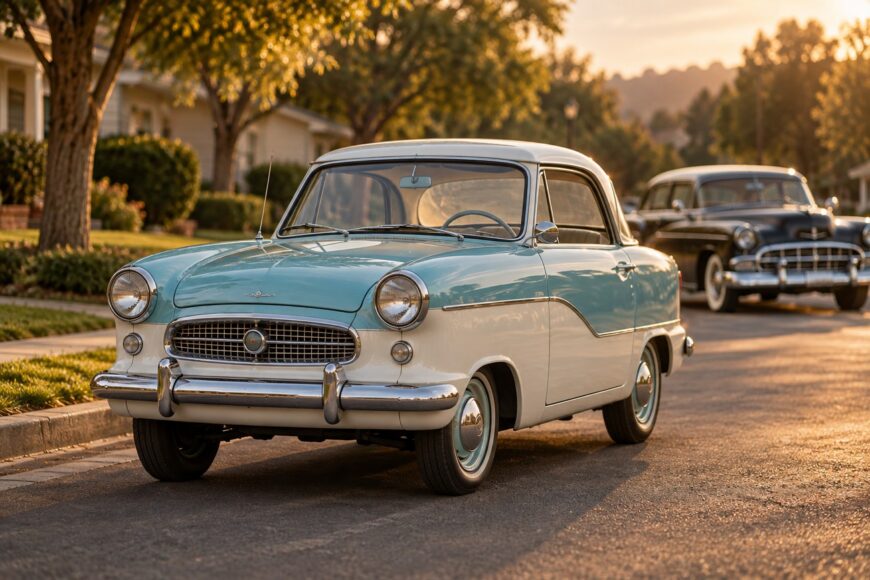
The Nash Metropolitan began with an American contradiction: a small car designed for the United States and built largely in Britain at a time when Detroit favored length, chrome, and engine displacement. Produced from 1953 to 1962, it was a two-door 2+2 subcompact aimed at buyers who wanted easier parking, lower running costs, and a car suited to crowded streets.
Its charm remains easy to understand. The Metropolitan is compact, distinctive, mechanically simple, and historically important as an early American-market car assembled overseas. Ownership also brings slow performance, limited comfort, corrosion risk, and difficult parts sourcing. It makes most sense as a collector, short-trip, exhibition, or club-event car; treating it as a modern daily commuter leads to predictable disappointment.
- The American Idea Behind a British-Built Car
- Early and Late Metropolitan: What Changed
- What It Is Like to Drive a Metropolitan Today
- The Restoration Trap: Rust, Parts, and Improvised Repairs
- Buying One Today: Originality Matters More Than Fresh Paint
- Myths, Historical Importance, and the Final Verdict
- Frequently asked questions
- How much is a Nash Metropolitan worth today?
- Was the Nash Metropolitan one of the worst cars ever made?
- Was the Nash Metropolitan an American-made car?
- How can you tell whether a Nash Metropolitan is original?
The American Idea Behind a British-Built Car
Nash wanted a small car for a market increasingly dominated by large American vehicles. The company recognized that some drivers needed an economical second car, especially for urban use, yet the domestic industry offered few genuinely compact choices. The Metropolitan answered that gap with a narrow body, a modest engine, and a layout tailored to American expectations of the early 1950s.
The project was designed in the United States for the American market, while large-scale assembly took place in Britain. Austin supplied important mechanical expertise and components, including the four-cylinder engine used in early cars. That division makes the Metropolitan an American-British project: its commercial purpose and design direction were American, while its manufacturing and mechanical relationships were substantially British.
Calling it simply a British car loses the reason it existed. Calling it fully American ignores where it was built and the Austin connection. Club and museum sources often describe the Metropolitan as one of the early mass-market U. S. cars built in Britain, although the exact claim that it was the first varies by source and should not be treated as settled history.
The arrangement also explains the car’s unusual place in automotive history. It was an early example of an American company commissioning a small overseas-built model for domestic buyers, long before global sourcing became routine. Its total production is commonly estimated at about 95,000 cars, with minor source-to-source differences in rounding. That figure reflects a niche success rather than a mainstream American bestseller.
Early and Late Metropolitan: What Changed
The Metropolitan name covers materially different versions, so a buyer should identify the production period before judging performance or originality.
| Version | Engine | Approximate power | Performance character | Buyer implication |
|---|---|---|---|---|
| Early cars | Austin 1.2-liter four-cylinder | About 42 hp | About 70 mph (approximately 113 km/h) at the top end; modest acceleration | Best suited to calm local driving and period-correct ownership |
| Later cars | 1.5-liter four-cylinder | About 52 hp | More usable response, while still slow by modern traffic standards | Usually the easier choice for short road use, provided condition is equal |
The early Austin 1.2-liter four-cylinder produced about 42 hp. The Metropolitan’s low weight helped compensate for that modest output, and the car could reach about 70 mph, or approximately 113 km/h. Those figures describe its capability rather than a comfortable cruising recommendation, especially on roads where traffic moves faster and hills demand sustained power.
Later cars received a 1.5-liter four-cylinder producing about 52 hp. The extra capacity improves pulling power and makes joining ordinary traffic less stressful, particularly on inclines. It does not turn the Metropolitan into a modern traffic-speed vehicle, and condition matters as much as the engine size: a tired later car may feel less convincing than a well-sorted early example.
All versions retain the basic character of a front-engine, rear-wheel-drive car with a manual transmission and drum brakes. That mechanical simplicity can help a restorer understand and repair the vehicle, though it also limits braking confidence and refinement. The year-specific engine, trim, interior, and body details matter when assessing whether a later car is genuinely original.
What It Is Like to Drive a Metropolitan Today

A Metropolitan feels light and deliberate rather than energetic. Its low curb weight allows the engine to move the car adequately on level roads, but acceleration is slow, and hills expose the limited power quickly. Drivers accustomed to contemporary compact cars need to plan overtaking, merges, and climbs well in advance.
Speed brings another layer of compromise. Owners commonly report a noisy cabin and noticeable vibration, while the short body and narrow proportions make the car feel more exposed in modern traffic. The steering and braking have an old-fashioned response, and the drum brakes require a driver to leave more margin than modern disc-brake systems usually demand.
The 2+2 seating description is accurate, although the rear seats are best regarded as occasional seats. Rear legroom is severely limited, and even the front seating position reflects 1950s ergonomics. Pedal placement, visibility, controls, and seat support can all require an adjustment period, particularly for a driver used to modern crash protection and cabin isolation.
Early cars lack modern crash protection and should not be assessed by contemporary safety expectations. Their structure and available restraint equipment belong to another era. Short trips, exhibitions, and club events are sensible uses; regular high-speed commuting asks too much of the car and gives the driver too little safety margin.
The Restoration Trap: Rust, Parts, and Improvised Repairs
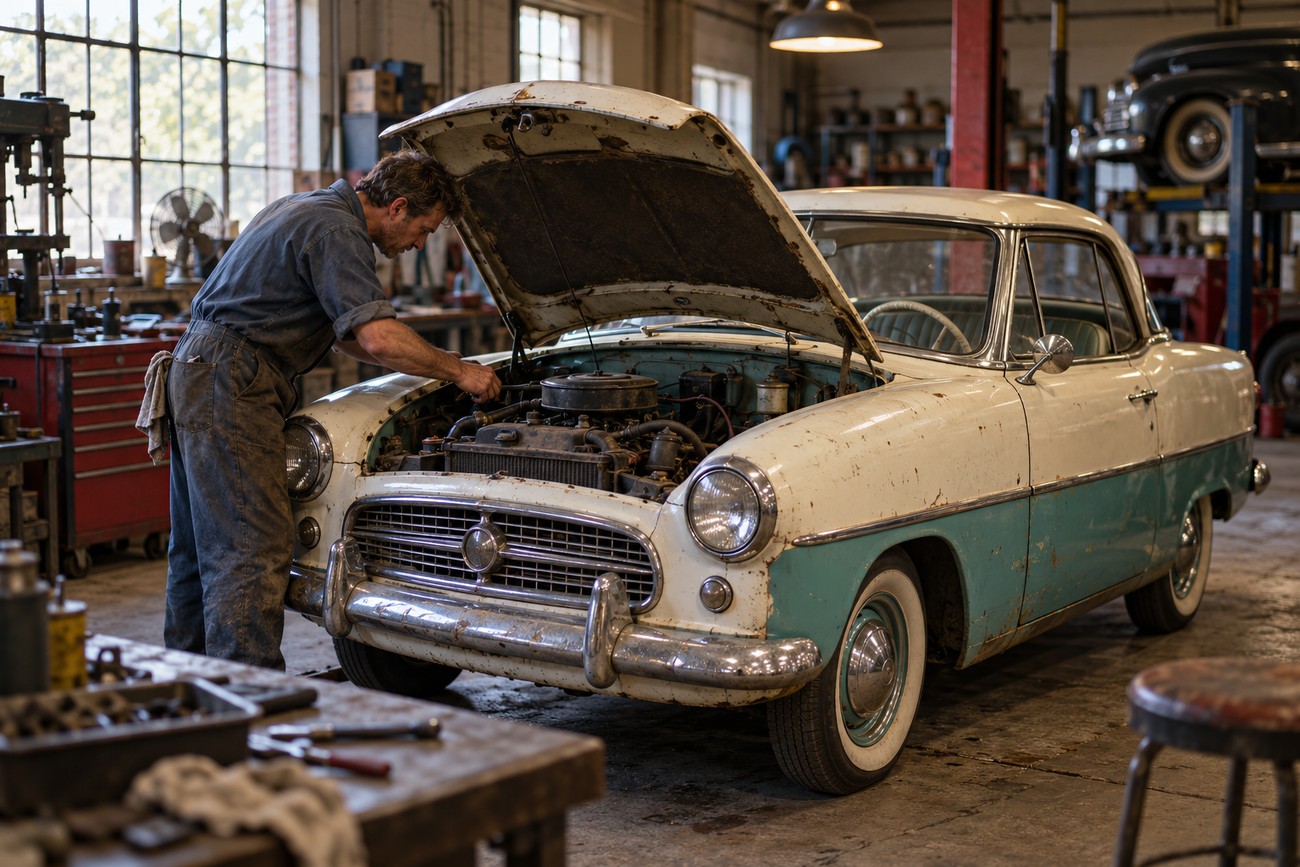
Rust is the first serious buying risk because paint can conceal the condition of the metal beneath it. Inspect the structural areas, floor sections, seams, wheel arches, and hidden cavities rather than accepting a glossy exterior as evidence of a sound car. Corrosion that has reached important metal can demand extensive welding and may also affect the body’s geometry.
Mechanical problems are easier to describe than to budget. Unrestored examples commonly show oil leaks, deteriorated gaskets, and aged rubber components. These faults may be manageable individually, yet a car that needs seals, hoses, brake work, wiring repairs, and cooling-system attention at the same time can quickly become a substantial project.
Structural metal and parts completeness deserve inspection before paint, upholstery, or even an engine that starts. A running Metropolitan with missing trim can be a harder restoration than a rough-looking car that retains its correct components.
Parts support exists, but it is uneven. Some components may require specialist suppliers, used parts, or a patient search, and chrome or decorative pieces can become especially difficult during restoration. A missing small item may have little mechanical importance while creating a disproportionate problem for an owner trying to finish an original-looking car.
Modified cars need careful scrutiny. An engine swap or electrical conversion may have been done competently, but uncertain wiring, brakes, and cooling systems create risks that a tidy engine bay can hide. Before evaluating the asking price, inspect the body and structure first, confirm that important parts are present, and assess mechanical work only after those two risks are understood.
The cheapest Metropolitan is rarely the cheapest one to own. A low purchase price can represent deferred welding, missing trim, incomplete interior work, and years of improvised repairs. A more complete, honest car with documented work is often the safer foundation, even if its paint is less impressive.
Buying One Today: Originality Matters More Than Fresh Paint
Start with identity and completeness. Compare the VIN or identification plate with the claimed production year, then check whether the engine, interior, trim, and body details belong to that period. Metropolitan versions differ in engine, equipment, and finishing details, so a seller’s broad description of “original” deserves verification.
Cosmetic freshness can be misleading. A recent paint job may cover corrosion or simplify the appearance of a car assembled from parts, while faded upholstery and honest surfaces may belong to a substantially more complete example. Originality and completeness often matter more than superficial restoration quality because replacement trim and year-correct components can be difficult to source.
A running project may suit a buyer who can weld, research parts, and tolerate long delays. A presentable driver should have sound structure, dependable brakes, usable cooling, and coherent electrical work even if its finish is imperfect. A properly restored collector car still needs inspection, since attractive workmanship does not prove that hidden metal or mechanical systems were handled correctly.
Use matters as much as condition. Many owners reserve these cars for short drives, shows, and club events rather than daily transportation. The Metropolitan rewards patience and mechanical sympathy; a buyer who needs quiet highway travel, strong braking, and predictable modern traffic performance should choose a newer small car instead.
Myths, Historical Importance, and the Final Verdict
The Metropolitan was not a technical predecessor to the Mini. It was a separate American-British project from the early 1950s, created around an American-market requirement and assembled in Britain. The resemblance lies mainly in their small-car roles and British connection, not in a direct technical lineage.
It was also not a cheap, mass-market bestseller in the usual American sense. Production remained niche, with about 95,000 cars commonly cited across all versions. Nor was it entirely American: its design and market identity were American, while British manufacturing and Austin-supplied mechanical involvement were central to the finished car.
The simple rear-wheel-drive layout, manual gearbox, and drum brakes make the Metropolitan relatively approachable in concept. They do not provide modern comfort, braking, refinement, or safety. Its slow acceleration, cramped rear compartment, noise, vibration, and exposure to rust are fundamental ownership considerations rather than minor defects to be polished away.
The right buyer sees a memorable historical artifact with usable basic mechanics and accepts its limits. The wrong buyer sees a charming bargain that can replace a contemporary commuter. For short outings, shows, and club events, a complete and structurally sound Metropolitan can be rewarding; for fast roads, long trips, or trouble-free everyday use, a newer small car is the rational choice.
Frequently asked questions
How much is a Nash Metropolitan worth today?
Value depends on condition, originality, completeness, documentation, and restoration quality rather than on the model name alone. A structurally sound, complete car with year-correct components and documented work generally has a stronger position than a freshly painted project with missing trim.
Inspect the car as a finished ownership proposition. A running engine does not offset serious corrosion, uncertain wiring, or absent decorative parts, and a partially restored example may require more expenditure than its appearance suggests. Comparable cars should be judged by the quality of their metalwork and restoration, not by paint alone.
Was the Nash Metropolitan one of the worst cars ever made?
No objective universal ranking supports that verdict. The Metropolitan was designed for compact American-market transportation in a period when expectations, traffic, and safety standards differed sharply from those of today.
Its slow performance, noise, weak modern crash protection, and limited space make it a poor contemporary commuter. Those shortcomings describe a mismatch between the car and present-day use more accurately than they establish that the original design was a failure. In its intended role, its light weight, compact size, and simple mechanical layout had clear practical logic.
Was the Nash Metropolitan an American-made car?
It was designed in the United States for the American market and marketed as a Nash, while large-scale assembly took place in Britain. Austin’s mechanical involvement, including the early four-cylinder engine, further separates the car’s American identity from its manufacturing origin.
The most accurate description is an American-British project: American in purpose and design direction, British in major production and mechanical participation. Calling it exclusively American or exclusively British leaves out the reason the Metropolitan is historically unusual.
How can you tell whether a Nash Metropolitan is original?
Begin with the identification plate or VIN and establish the claimed production year. Then compare the engine, interior, trim, dashboard details, and body components with the equipment expected for that year. A correct-looking badge or fresh paint is weak evidence on its own.
Look for coherent aging and consistent workmanship across the car. Mismatched trim, an engine from another version, altered wiring, and body details from different production periods may indicate a restoration assembled from several cars. Documentation, receipts, and photographs of structural repairs can help distinguish a genuinely preserved example from a cosmetically improved one.







