
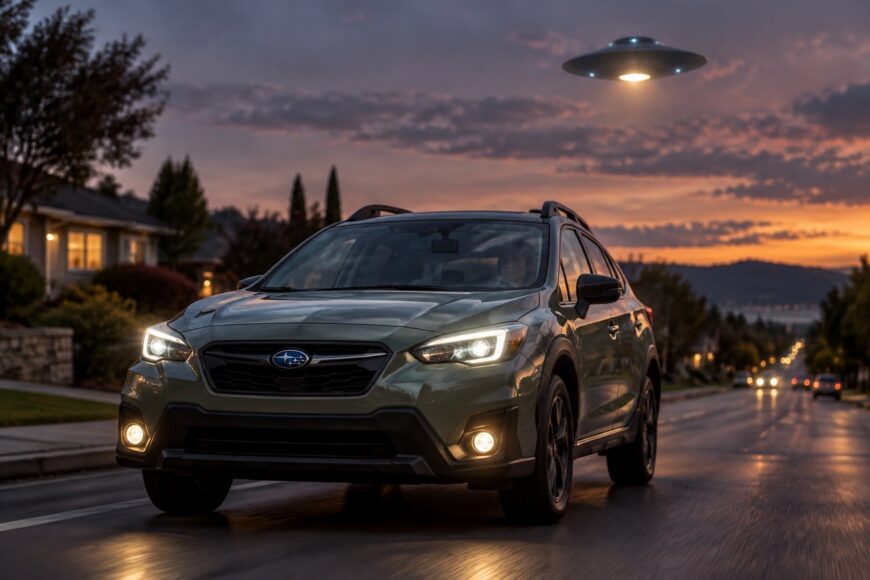
A bright shape appears above the road in a Subaru Crosstrek dashcam clip. At the wheel, it may have seemed to dart across the sky; on playback, it is a small mark whose distance and speed are hard to judge. The witness’s experience matters, but the recording can support only what its pixels and surrounding context show.
Before calling the shape an object in the sky, the footage needs a closer look at the windshield, the moving vehicle, and the camera’s processing. Aircraft and drones also belong among the possibilities. A careful review can narrow those possibilities without dismissing what the driver saw or promising an extraordinary explanation.
- Why a Subaru Crosstrek dashcam can make the sky look stranger
- Reflection, aircraft, drone, or camera artifact?
- Why the object may seem to move impossibly fast
- What turns a strange clip into usable evidence
- How to preserve and verify the Crosstrek footage
- What this UFO video can—and cannot—prove
- Frequently asked questions
- What should I do if the dashcam already overwrote the original clip?
- How can I compare the sighting with aircraft or satellite activity without proving too much?
Why a Subaru Crosstrek dashcam can make the sky look stranger
The Subaru Crosstrek has relatively high ground clearance and a broad windshield view. Dashboard and windshield reflections can be noticeable in its footage. A bright patch near the top of the image may come from outside the car, or it may be a reflection on the glass. The vehicle model itself says nothing about whether the sighting was unusual.
Automotive dashcams typically have a 140–170° field of view. That breadth preserves useful context, including the road and skyline, while making a distant point occupy few pixels. Perspective distortion also makes its apparent size and screen-crossing speed unreliable guides to its physical size or motion.
The first visual check is whether the mark behaves like part of the outside scene. Compare it with buildings, trees, and clouds as the Crosstrek moves, then look for a corresponding dashboard shape or interior light. A reflection may shift with the camera and glass rather than maintaining a consistent position relative to distant landmarks.
Reflection, aircraft, drone, or camera artifact?
Start with the surfaces between the scene and the sensor. Dashboard trim, windshield film, wipers, and interior lights can create shapes that resemble objects beyond the glass. Glare may intensify at a particular angle to the sun or a streetlight; in some circumstances, a small change in camera position makes it disappear.
If the mark appears to belong to the outside scene, inspect the whole sequence for recognizable behavior. Aircraft and drones are plausible candidates for sustained lights or paths, while birds and insects can cross the frame abruptly. None can be identified confidently from a vague silhouette or a single bright frame alone.
Compression artifacts can give an edge a block outline or make a faint feature flicker. At dusk or night, long exposure, noise reduction, and HDR can make small distant lights look larger, softer, or more mysterious. Checking the original footage frame by frame is more useful than treating a processed glow as the object’s true shape.
Why the object may seem to move impossibly fast
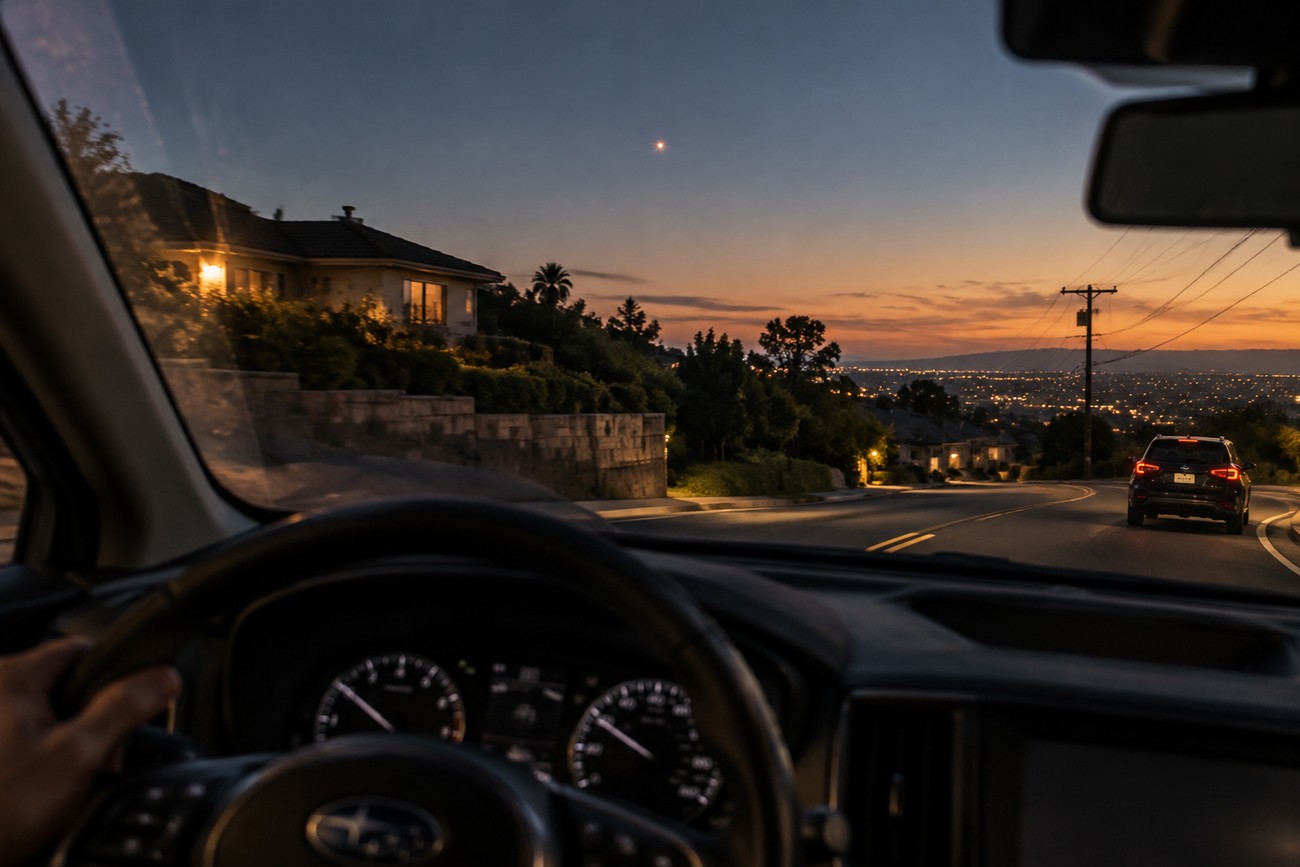
The Crosstrek is a moving viewpoint. As it passes nearby scenery, parallax can make a distant or stationary object appear to change direction or speed. A turn by the car can add a dramatic sweep across the image even if the object’s own motion is modest.
Judge angular movement against fixed reference points, not apparent screen-crossing speed alone. A roofline or distant pole can help show how the camera’s view changes between frames. With a 140–170° field of view, perspective effects further complicate any attempt to turn that apparent movement into a physical speed.
Brightness changes deserve a separate check. A light that dims, blooms, or briefly disappears may seem to jump when viewed frame by frame, particularly as exposure adjusts or the object passes behind an obstruction. Track its position through uninterrupted footage before describing a sudden maneuver; one frame cannot establish a trajectory.
What turns a strange clip into usable evidence
Keep the original file and establish its exact time, along with GPS data and vehicle speed when available. Record the camera’s field of view and consider exposure and shutter behavior, including whether they could blur a light; shutter settings may need to be inferred rather than read from the file. These details let someone else test an interpretation instead of relying on a cropped image.
Uninterrupted footage before and after the sighting is equally important. It can reveal an approaching aircraft, a recurring reflection, a vehicle turn, or a change in lighting that the striking moment conceals. If the mark appears only in a short excerpt, many of those checks become impossible.
One dashcam usually cannot establish distance, physical size, or confident identity without reliable reference points. A small nearby insect and a larger distant object can occupy similar areas of the image. Strong geometric identification generally requires at least two independent viewpoints or sensors that observe the event in a way that allows their measurements to be compared.
GPS can support comparisons with aviation schedules and weather, but its correctness and retention depend on the camera, its settings, and the export process. Check whether a displayed location or timestamp belongs to the original recording rather than an edited overlay. Even accurate coordinates place the car; they do not locate the object in three-dimensional space.
How to preserve and verify the Crosstrek footage
Save or lock the relevant loop-recording file promptly, since cyclic recording may overwrite it. Preserve the continuous lead-in and aftermath as well as the apparent sighting. Copy the untouched original recording file to safe storage before trimming a version for sharing.
Inspect the copied file’s timestamp and available metadata, then write down the approximate travel direction, location, weather, and lighting conditions while they are still clear. Note any discrepancy between the camera’s clock and a reliable time reference. That discrepancy matters when comparing the clip with activity elsewhere.
Use the recorded time and location to look for plausible aircraft activity, weather effects, and possible drone activity in the direction filmed. Treat each match as a candidate to test against the full path and timing. An absence of an obvious match does not establish what the image depicts.
A social-media copy is a poor substitute for the original: recompression can remove frames and fine details. Stabilization, sharpening, interpolation, and other automated enhancements may alter apparent shape or speed, so label any processed version clearly. For evidence-oriented preservation, a separate hash record can document the untouched file you retained; it does not validate an interpretation of the scene.
What this UFO video can—and cannot—prove
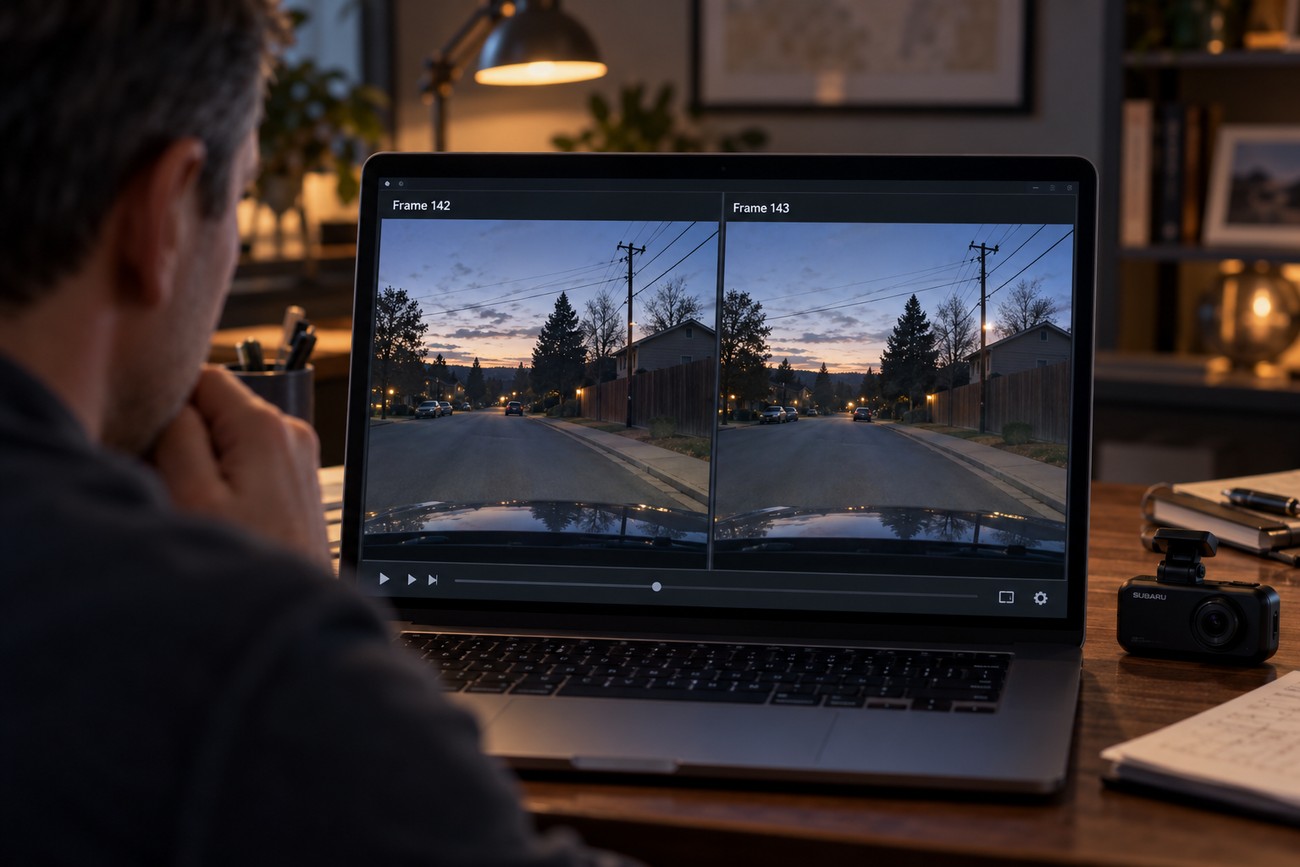
The recording may establish that an unusual-looking feature appeared in the Crosstrek’s dashcam footage at a particular time. With enough context, it may also show that the feature follows a path consistent with something outside the vehicle. Those are narrower conclusions than identifying its distance, size, or origin.
A dramatic apparent maneuver is not automatically anomalous. Parallax, optics, auto-exposure, and vehicle movement can all change how motion looks on screen. Likewise, a glowing ball may be an aircraft, drone, satellite, planet, reflection, or another ordinary source; appearance alone seldom settles which.
If the original remains ambiguous after those checks, “unresolved from this footage” is a useful finding. It respects the witness’s experience while stating the limit of a single camera. Independent observations could change that assessment, but the dashcam clip should not be asked to prove more than it records.
Frequently asked questions
These next steps depend on what footage and records still exist. Document gaps as carefully as you document possible matches.
What should I do if the dashcam already overwrote the original clip?
Stop recording to that memory card and check it immediately for a locked event file, an adjacent loop segment, or a copy previously exported to a phone or computer. Avoid saving new files onto the card while assessing recovery options, since further writes may reduce the chance of retrieving anything. If only an exported copy survives, preserve it unchanged and label its source, export history, and missing original clearly.
How can I compare the sighting with aircraft or satellite activity without proving too much?
Use the best-supported time, approximate viewing direction, vehicle location, and weather to generate candidates, then compare their expected paths and timing with the continuous clip. Account for an inaccurate dashcam clock and for the fact that the car may have turned. A close match provides supporting context, while a poor match rules out only that candidate under the information available; neither result identifies the image by itself.







