
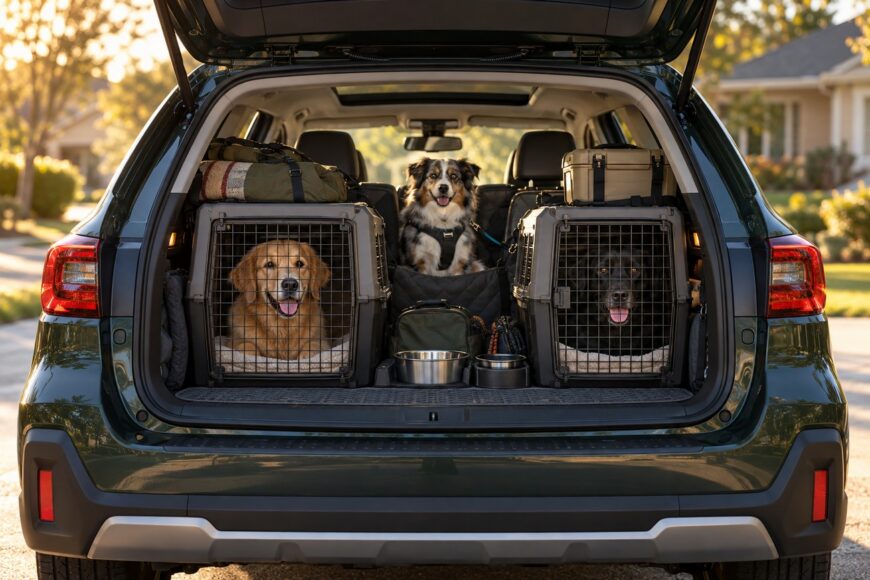
A Subaru Outback may accommodate three dogs, but fitting them inside is only the starting point. Safe placement also depends on restraint quality, usable width, ventilation, luggage, and whether any dog can reach the driver. A layout that looks workable in the driveway can become crowded once the dogs lie down, turn around, and share the available airflow.
The right arrangement depends on each dog’s size, temperament, crate dimensions, and the Outback’s model year and trim. In many vehicles, the practical starting point is two dogs in the cargo area and one secured on the rear row. That arrangement still requires careful separation, stable equipment, and enough room for people, water, and emergency gear.
- Can Three Dogs Fit in a Subaru Outback?
- Three Practical Outback Layouts for Three Dogs
- The Best Three-Dog Outback Layouts: Space, Safety, and Trade-Offs
- Restraints, Crates, and Barriers: What Actually Protects the Dogs
- Heat, Ventilation, Slipping, and Motion Sickness
- A Low-Mess, Low-Stress Setup for Long Drives
- Frequently asked questions
- Which Subaru Outback year should you avoid when moving three dogs?
- How should I measure my dogs and the Outback before buying crates?
- How can I introduce three dogs to a new Outback setup before a long trip?
- What should I do if one dog panics or becomes sick while the other two are calm?
Can Three Dogs Fit in a Subaru Outback?
The Outback’s wide cargo opening and folding second row make it more adaptable than a small sedan, yet cargo volume is a poor test by itself. Dogs need usable floor width, headroom, turning space, and a way to lie down without blocking one another. Crates and restraints also occupy space that vehicle brochures may count as open cargo volume.
Calculate the vehicle’s load as dogs plus crates or restraints, water and bowls, and human luggage. Check the payload listed for the specific year and trim, because the permitted load varies. Three dogs may fit physically while the combined weight of their equipment and luggage leaves little practical margin.
Measure the actual cargo floor and rear-seat area rather than relying on advertised liters. A crate may pass through the opening yet be too wide for the usable interior or leave too little clearance for another dog. Synthetic upholstery and plastic cargo floors can also make dogs slide during turns, reducing the usable comfort of the space.
Owner reports commonly describe two medium dogs as comfortable with the rear seats folded. Three medium or large dogs may become a width compromise, though this is anecdotal rather than a universal measurement. The test is whether every dog can settle safely, ventilation remains adequate, and the driver retains clear access without sacrificing essential luggage space.
Three Practical Outback Layouts for Three Dogs
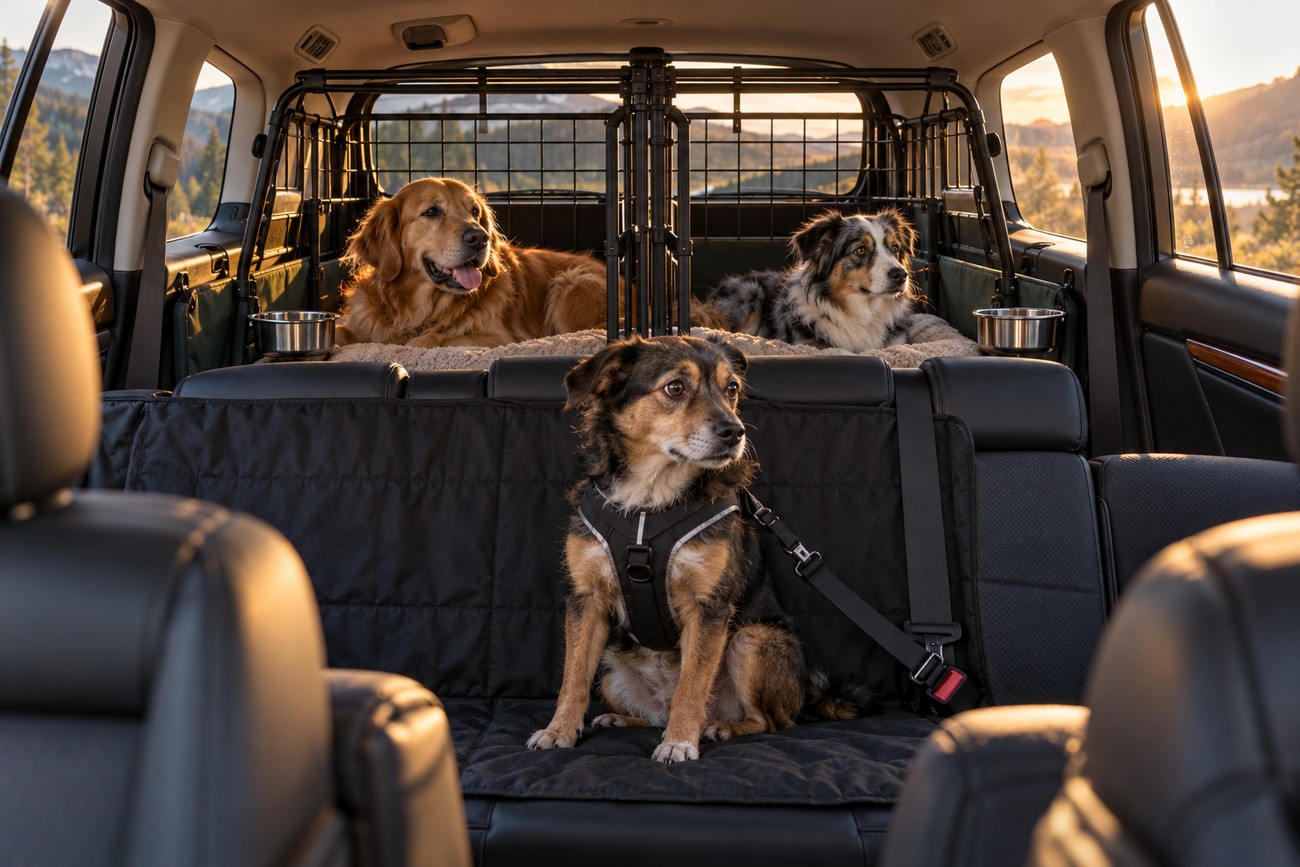
Start by assigning space according to size and temperament, then check whether the equipment fits the vehicle. A calm dog may travel well in the cargo area while an anxious dog needs more separation or closer supervision on the rear row. Separating a calm dog from a highly anxious or reactive dog can improve the ride for all three.
The most workable general arrangement is often two dogs in the cargo area and one secured on the rear row. The rear-row dog needs a suitable automotive restraint or a rigid carrier, while the cargo dogs need stable containment. A barrier can help divide the cabin, but it must not leave an open route toward the front seats.
All three dogs loose on the rear row usually create a poor compromise in width, restraint access, and driver separation. Dogs can slide into one another, interfere with seat-belt hardware, or move forward during a sudden stop. Even friendly dogs may become restless when road noise, motion, or restricted space changes their behavior.
Putting all three in the cargo area can work only when their combined size, crate dimensions, ventilation, and temperament allow it. Individual crates may reduce conflict and make each dog’s space predictable, but they also consume cargo capacity. Keep a clear route for loading and unloading, and never allow a cargo-area dog to climb through to the front seats.
The Best Three-Dog Outback Layouts: Space, Safety, and Trade-Offs
These layouts cover the main choices, but the correct option depends on the dogs, equipment, and remaining luggage space. Treat the table as a screening tool, then test the arrangement with the dogs present before a long trip.
| Arrangement | Fit and ventilation | Restraint needs | Luggage capacity | Driver-access risk | Best use case |
|---|---|---|---|---|---|
| Two dogs in cargo, one on the rear row | Often the most practical balance; check crate width, airflow, and the separation between rows. | Stable cargo containment plus a suitable automotive restraint or carrier for the rear-row dog. | Moderate; crates and dog gear reduce available cargo space. | Manageable only when the rear row and cargo area are properly separated. | Three dogs with mixed sizes or temperaments, where one dog benefits from separate rear-row placement. |
| All three in the cargo area | Works only when all dogs can lie down and airflow is not blocked by crates or bodies. | Individual rigid, crash-tested crates are preferable where they fit securely. | Low; crates, water, and emergency equipment may use most of the cargo area. | Lower when the cargo area is fully secured, but a barrier alone may not retain a dog in a crash. | Small or compatible dogs with suitable crate dimensions and limited human luggage. |
| Three individually secured on the rear row | Usually tight, especially for medium or large dogs; inspect width and restraint clearance carefully. | Each dog needs its own suitable automotive restraint or carrier, with no tangled connection points. | Higher cargo capacity, although rear-seat space is heavily committed. | High if the dogs can move forward or obstruct the driver. | Smaller dogs whose individual equipment fits and whose temperaments are compatible. |
For many owners, two dogs in cargo plus one secured on the rear row is the most realistic default. Reject it if the rear-row dog can reach the front, the cargo dogs cannot settle without blocking ventilation, or the equipment leaves no safe loading route. All-cargo travel may suit smaller, compatible dogs, while three rear-seat positions are usually the narrowest compromise.
Restraints, Crates, and Barriers: What Actually Protects the Dogs
Containment and crash protection are separate functions. A cover, mesh divider, or cargo barrier can keep dogs in a defined zone during ordinary driving, yet that equipment may not be designed or tested to retain a dog during a collision. Rigid, crash-tested crates or carriers generally provide more protection than ordinary soft harnesses or untested walking equipment.
Use a restraint designed for vehicle travel and attach it to suitable travel equipment according to the manufacturer’s instructions. A normal walking leash is not an automotive restraint. It can tangle, restrict movement unpredictably, or fail under forces it was never designed to handle.
Harness marketing can also create false confidence. A comfortable walking harness is not automatically a crash-tested system, and the connection point may be unsuitable for vehicle use. Check what part of the system was tested, how it attaches, and whether the equipment fits the individual dog.
Verify three separate points: the attachment point, the stability of the crate or carrier, and the dog’s exclusion from the front seats. A cargo barrier can perform one of those jobs while leaving the other two unresolved.
A pet barrier may zone the cabin and reduce distractions, but it is not necessarily a crash-rated dog restraint. If you use one, secure it as directed and combine it with an appropriate containment plan where possible. Leave no gap through which a dog can climb forward during normal movement.
Legal requirements vary by state and jurisdiction in the United States, and there is no universal federal dog-seat-belt law. Check the rules that apply to your route and destination. Legal compliance is only a baseline; equipment should also reduce foreseeable movement and driver distraction.
Heat, Ventilation, Slipping, and Motion Sickness
Dogs often reveal a poor setup through practical problems: sliding on plastic or synthetic upholstery, panting, barking, nausea, or repeated attempts to change position. Road noise, unfamiliar smells, restricted airflow, and close contact with another dog can increase anxiety. A non-slip liner and sensible separation can improve stability, though they do not replace restraint.
A parked vehicle interior can become dangerous from heat within minutes, even when outdoor temperatures appear moderate. Cool the cabin before loading the dogs, then maintain airflow throughout the drive. Air conditioning after departure cannot correct every risk created by loading dogs into a hot vehicle.
Use secured bowls, bottles, or another travel watering system that limits spills. An unsecured ordinary bowl can empty during braking, soak bedding, and leave dogs without usable water. Place water where each dog can reach it without putting its head through a restraint or blocking ventilation.
Plan water and walking stops approximately every 2–4 hours as practical guidance, rather than a legal requirement. The interval may need adjustment for age, health, weather, anxiety, and motion sickness. Stop safely before opening any door, and keep each dog restrained until the walking area is controlled.
A Low-Mess, Low-Stress Setup for Long Drives
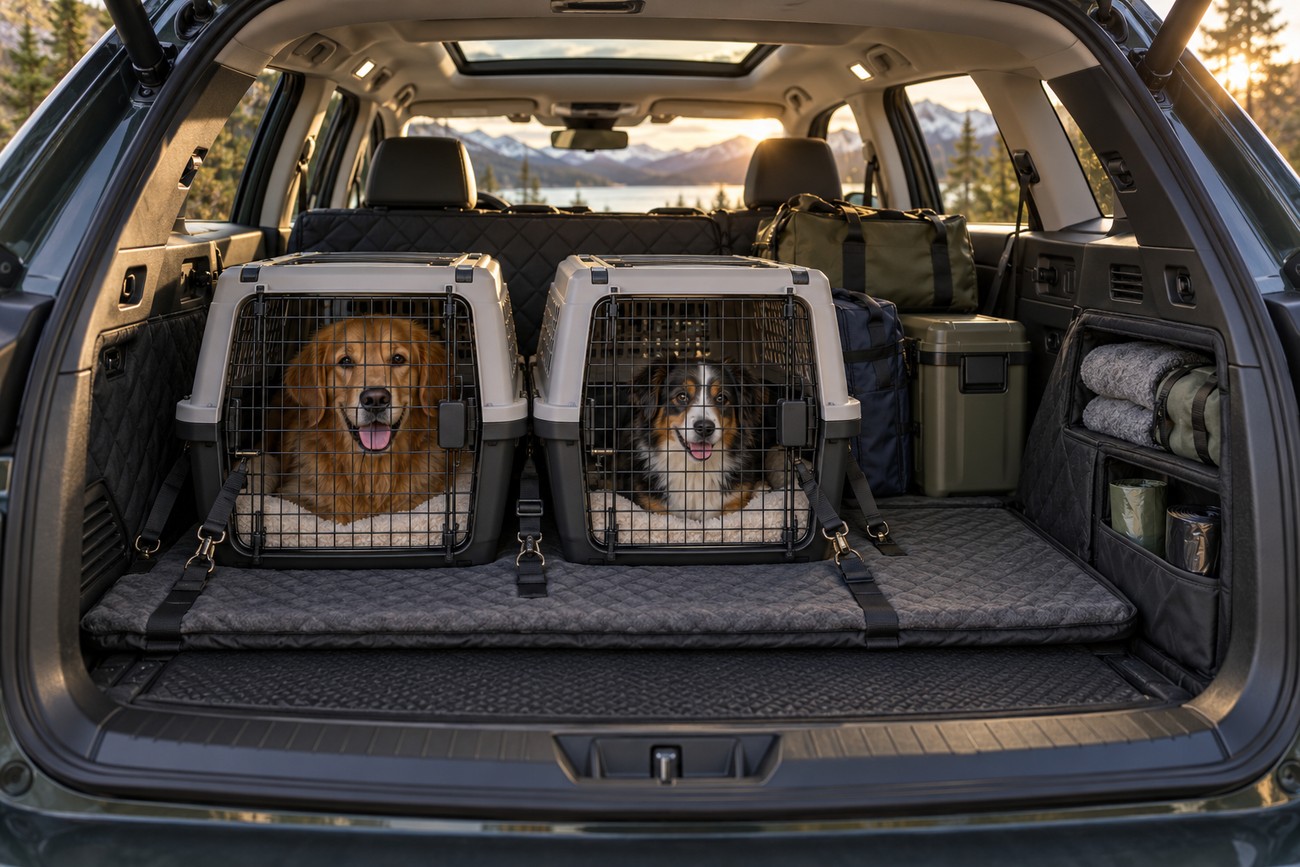
Begin with a non-slip liner under washable covers, then add bedding that will not bunch under the dogs’ feet. Covers reduce surface damage, yet hair, saliva, sand, odors, and scratches can still reach seams and plastic. Carry spare bedding and waste bags so one accident does not turn the rest of the journey into a cleaning problem.
Place crates or carriers so they cannot shift into one another during braking. Keep vents clear, leave access to doors and emergency equipment, and avoid stacking luggage against a crate. A comfortable dog layout can substantially reduce passenger and luggage capacity, so reserve space for water, first-aid supplies, food, and weather-appropriate gear.
Acclimate the dogs before attempting a long trip. Begin with the new restraint or crate at home, then use short stationary sessions in the Outback, brief drives, and gradually longer journeys. Introduce separation in stages if the dogs normally travel together, because a dog that tolerates another at home may react differently once the vehicle is moving.
Before departure, check the following:
- Inspect restraint attachments, crate stability, doors, and barriers.
- Cool the cabin and confirm that vents are not blocked.
- Test every dog’s ability to lie down and turn without crossing into another dog’s space.
- Secure water, food, bedding, and emergency equipment.
- Plan stops approximately every 2–4 hours, with safe walking areas.
- Confirm that no dog can reach the driver or obstruct mirrors and controls.
Frequently asked questions
Which Subaru Outback year should you avoid when moving three dogs?
There is no universal dog-specific Outback year to avoid. A better purchase decision compares the actual cargo dimensions, rear-seat access, vehicle condition, recall status, trim differences, and compatibility with the crates or restraints you intend to use.
Inspect the specific vehicle with a tape measure and, if possible, bring the dogs’ equipment to a test fitting. Confirm that doors, seat mechanisms, tie-down points, and ventilation work correctly. A well-maintained vehicle with suitable equipment may be safer for your dogs than a newer trim that cannot accommodate their containment system.
How should I measure my dogs and the Outback before buying crates?
Measure each dog while standing for floor-to-top height and nose-to-base-of-tail length. Then observe the dog turning and lying down, because a crate that fits standing may still prevent a natural change of position. Use those measurements to choose a crate that allows standing, turning, and lying space without excessive unused volume.
Measure the Outback’s usable opening, cargo-floor width, floor length, and the narrowest interior point where the crate will sit. Compare the crate’s outside dimensions with the opening, not only with the advertised cargo volume. Repeat the check with the second crate and with the rear seats in the exact position you plan to use.
How can I introduce three dogs to a new Outback setup before a long trip?
Use a staged sequence: allow each dog to investigate the crates or restraints at home, load them briefly while the vehicle is stationary, and reward calm behavior. Next, take short drives with one dog at a time, then use the planned combinations. Gradually increase drive length while watching for panting, drooling, agitation, or repeated attempts to escape.
Introduce separation before the trip rather than during a stressful journey. Test loading and unloading in the same order each time, and practice securing every dog before opening a door. If one arrangement repeatedly causes conflict, change the placement or equipment before attempting a long-distance drive.
What should I do if one dog panics or becomes sick while the other two are calm?
Stop at a safe location, keep the vehicle secured, and prevent the affected dog from entering the passenger area unrestrained. Preserve ventilation, offer water when appropriate, and allow the dog to settle before deciding whether to continue. Motion sickness, heat, anxiety, and medical problems can look similar, so repeated or severe symptoms warrant veterinary advice.
Reassess the layout rather than simply giving the dog more freedom. Isolate the affected dog in a suitable crate or restraint, increase separation from the other dogs, and reduce noise or visual stimulation where possible. If the dog cannot travel safely after a controlled adjustment, continuing the journey may be less responsible than arranging a different transport plan.







