
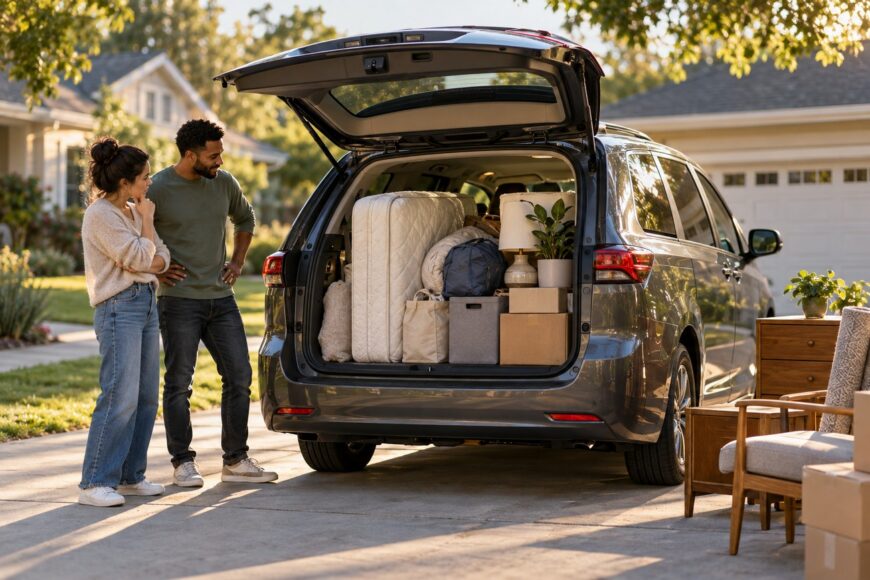
Moving an entire apartment in a Toyota Sienna is a calculation involving weight, shape, access, and trip planning. The cabin can offer substantial cargo volume, yet books, dishes, tools, appliances, and solid furniture may reach the vehicle’s payload limit while visible space remains unused. A liftgate that closes is no proof that the vehicle is within its weight, axle, tire, or braking limits.
The 2026 Sienna illustrates the gap between advertised volume and moving reality. It provides 2,860 L (101 ft³) behind the front row, but real furniture leaves gaps around wheel arches, seat mechanisms, and door openings. A bulky sofa may require diagonal loading or disassembly, while a dense collection of boxes may require several trips. In some moves, a cargo van is the safer choice; in others, a carefully planned series of Sienna trips works well.
- Can a Toyota Sienna Really Move an Entire Apartment?
- Audit the Apartment Before You Pack
- Configure the Sienna for Cargo, Not Passengers
- Load by Weight and Secure Every Layer
- Drive, Recheck, and Avoid Common Moving Failures
- When Multiple Trips or a Cargo Van Make More Sense
- Frequently asked questions
- How much cargo space is behind the third row in a Toyota Sienna?
- What year of Toyota Sienna should you stay away from?
- How do I find the exact payload limit for my Toyota Sienna?
Can a Toyota Sienna Really Move an Entire Apartment?
Sometimes it can move the contents of a small, lightly furnished apartment over several trips. The practical answer depends on the inventory, the number of passengers, the shape of the furniture, and the distance between the two addresses. A Sienna carrying a mattress, clothing, lamps, and lightweight storage boxes faces a different problem from one carrying books, kitchen equipment, tools, and solid wood furniture.
For the 2026 model, maximum cargo volume behind the front row is 2,860 L (101 ft³). The corresponding figures are 2,129 L (75.2 ft³) behind the second row and 949 L (33.5 ft³) behind the third row. These figures describe available volume in specific seat configurations; they do not promise that every part of that space can accept a rectangular piece of furniture.
The 2026 payload is approximately 615–708 kg (1,356–1,561 lb), including passengers, luggage, and accessories. Exact capacity depends on trim and vehicle-specific ratings, so these figures should not be applied automatically to another model year or an unidentified VIN. Capacity is limited by total weight and weight distribution, not volume alone.
Wheel arches, door openings, roof height, and the clearance needed to protect the interior reduce usable space. A full-height load can also remove rear visibility and make emergency equipment difficult to reach. If the cabin fills quickly with heavy items, several lighter trips are safer than forcing the remaining furniture into the vehicle.
Audit the Apartment Before You Pack
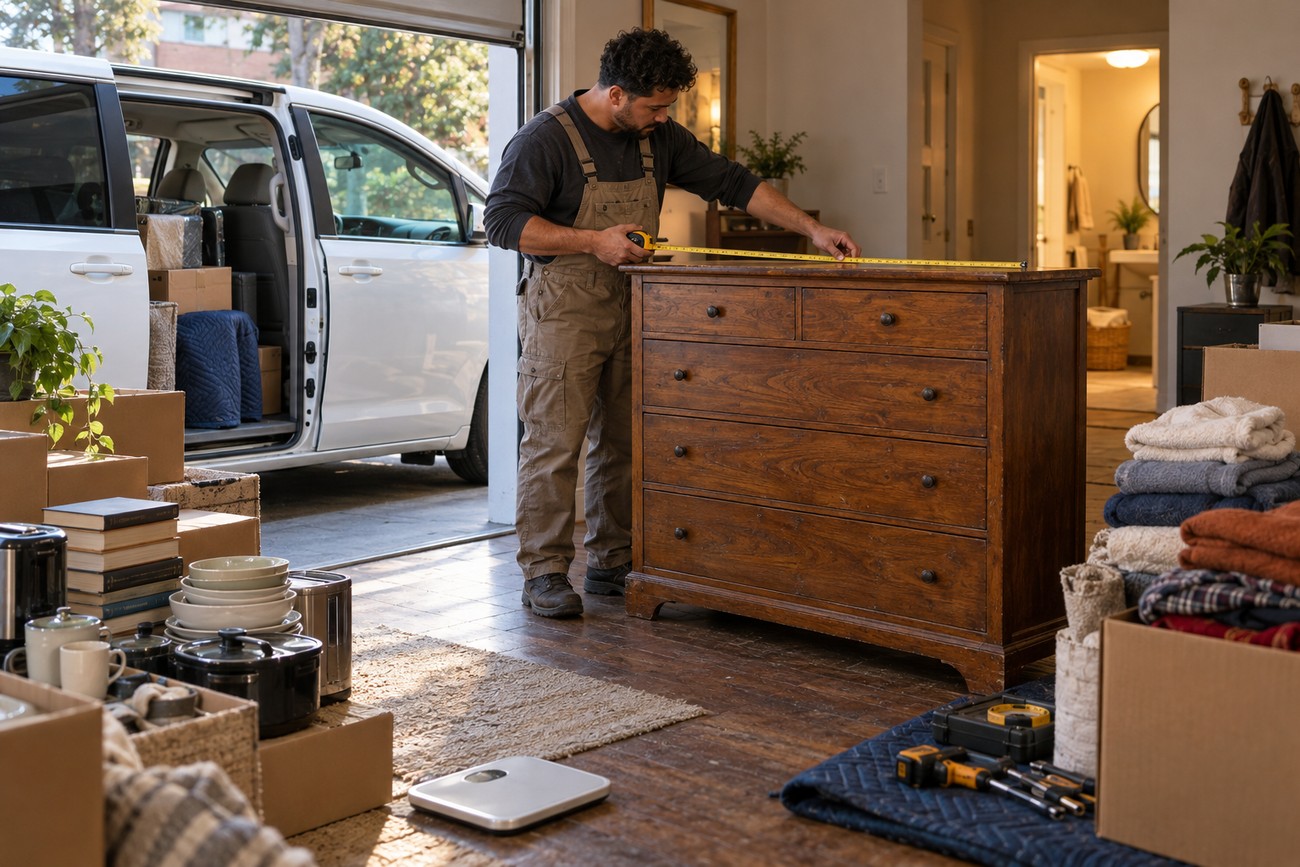
Start with an inventory based on mass and dimensions rather than box count. Separate books, dishes, tools, small appliances, large appliances, furniture, clothing, and soft goods. Dense household contents can approach the payload limit before the advertised cargo volume is filled, especially when passengers remain in the vehicle.
Measure the largest items before taking furniture apart. Record length, width, height, and weight where possible, then measure the Sienna’s rear and side-door openings, the route through the apartment, stairs, elevators, and the parking area. The 2026 Sienna is approximately 5,175 mm long, 1,994 mm wide, and 1,776 mm high, dimensions that matter in narrow driveways, garages, and loading zones.
A sofa, mattress, cabinet, or tabletop may fit within the theoretical cabin volume and still fail at the door. A folded-seat floor can appear flat while its folds, recesses, or seat mechanisms reduce usable length. Long items may need diagonal loading, partial disassembly, or a separate vehicle, and diagonal placement can consume space needed by several smaller boxes.
Use the inventory to divide the move into loads. Put fragile, heavy, or awkward pieces on a separate plan instead of hoping they will fit after ordinary boxes are loaded. Measuring the liftgate opening early also prevents a common failure: dismantling a cabinet only to discover that its panels still cannot pass through the vehicle.
Configure the Sienna for Cargo, Not Passengers
Choose the cargo configuration for the specific year and trim before loading. The exact second-row folding or removal arrangement depends on the Sienna’s year and configuration. Folding or removing second-row seating can materially improve capacity, while folds, mechanisms, and uneven areas may still affect long or fragile items.
Protect the loading base with moving blankets or firm padding that cannot bunch under heavy boxes. Wrap furniture where it contacts plastic, upholstery, windows, or painted trim. Glass panels should be isolated from hard edges, and straps should never rub directly against delicate door seals or interior surfaces during travel.
Load with a small clearance at the liftgate. A cabinet, box, or mattress pressed against the fifth door can damage the trim, obstruct the latch, or prevent the door from closing correctly. The same principle applies to side panels and windows: a tight fit may save space while transferring road movement directly into the interior.
AWD, hybrid equipment, and seven- or eight-passenger seating do not turn the Sienna into a cargo van. The vehicle still has physical limits imposed by its tires, brakes, suspension, axles, and weight distribution. Keep access to the jack, emergency equipment, and any required seat belts where possible, even if that means leaving a small section of the load lower or less dense.
Load by Weight and Secure Every Layer
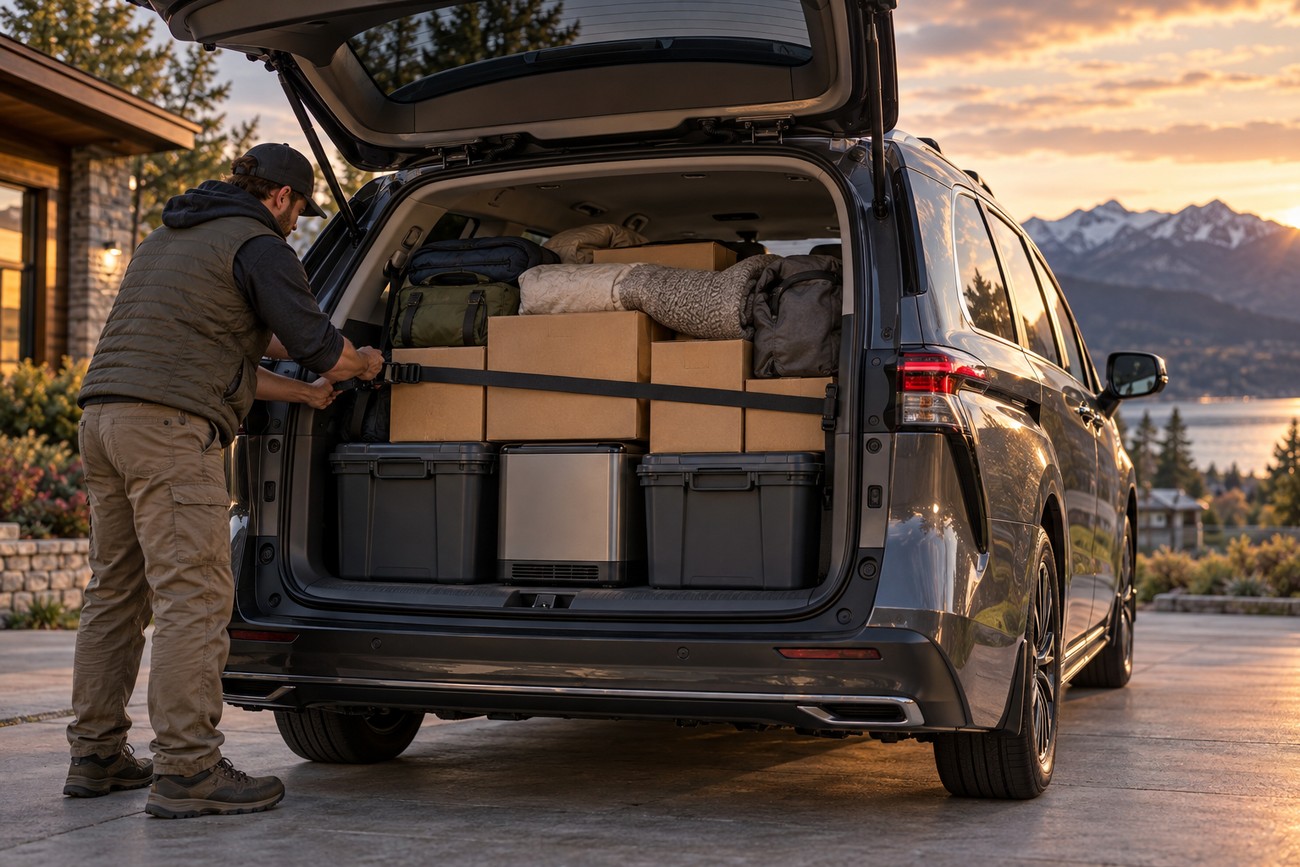
Load the heaviest items first, keeping them low and close to the vehicle’s center. Medium boxes can fill the spaces around them, and light or soft items should occupy the upper layer. This arrangement supports more predictable handling and reduces the chance that a high stack will move during braking or cornering.
Dense boxes placed far behind the rear axle can increase rear suspension load and make the vehicle feel less stable. Heavy items placed high can also shift their force abruptly when the Sienna changes direction. Toyota states that cargo capacity is limited by total weight and weight distribution, and all cargo must be secured.
Dense mass belongs low, central, strapped, and clear of the liftgate. Keeping the rear-most area light helps prevent a stack from acting like a lever during braking and turns.
Use tie-down straps with a suitable working load for the cargo. Elastic household cords can restrain a light blanket, yet they are unsuitable as the primary restraint for appliances, furniture, or stacked boxes. Place a barrier or padding between hard edges and the cabin, then check that the straps cannot slide into a door seal or press against glass.
Passengers, cargo, and accessories all count toward the payload limit. Weigh the heaviest boxes when their contents are uncertain, especially books, dishes, tools, and small appliances. Before departure, set tire pressure according to the vehicle placard rather than the maximum pressure printed on the tire sidewall.
Keep the load below the driver’s useful sight lines where possible. A full-height stack removes rear visibility and may block access to an emergency item. If the cargo moves, the straps loosen, the liftgate changes position, or the vehicle feels unstable, stop and unload or rearrange it before continuing.
Drive, Recheck, and Avoid Common Moving Failures
After loading, take a short test drive on local roads. Brake progressively, make gentle turns, and listen for shifting boxes or contact with the trim. Recheck the straps, padding, and liftgate after this first movement because a stack can settle even when it looked stable at the curb.
Drive with greater following distance and allow more time for braking. Avoid sudden lane changes and sharp cornering, particularly with a high or rear-heavy load. A shifting item can damage interior panels, seals, trim, or the liftgate, and a loose object can become a hazard inside the cabin.
The maximum towing figure found for the 2026 Sienna is 1,585 kg (3,494 lb), subject to the actual combination of people, cargo, equipment, and vehicle ratings. It cannot automatically be combined with a fully loaded cabin. Trailer selection requires compatibility checks and compliance with Toyota’s instructions, including the vehicle’s actual payload and hitch-related limits.
A hybrid system does not remove limits imposed by tires, brakes, suspension, axles, or weight distribution. Likewise, a closed door proves only that the latch engaged. It says nothing about the vehicle’s gross weight, axle loading, tire capacity, or the security of the items inside.
When Multiple Trips or a Cargo Van Make More Sense
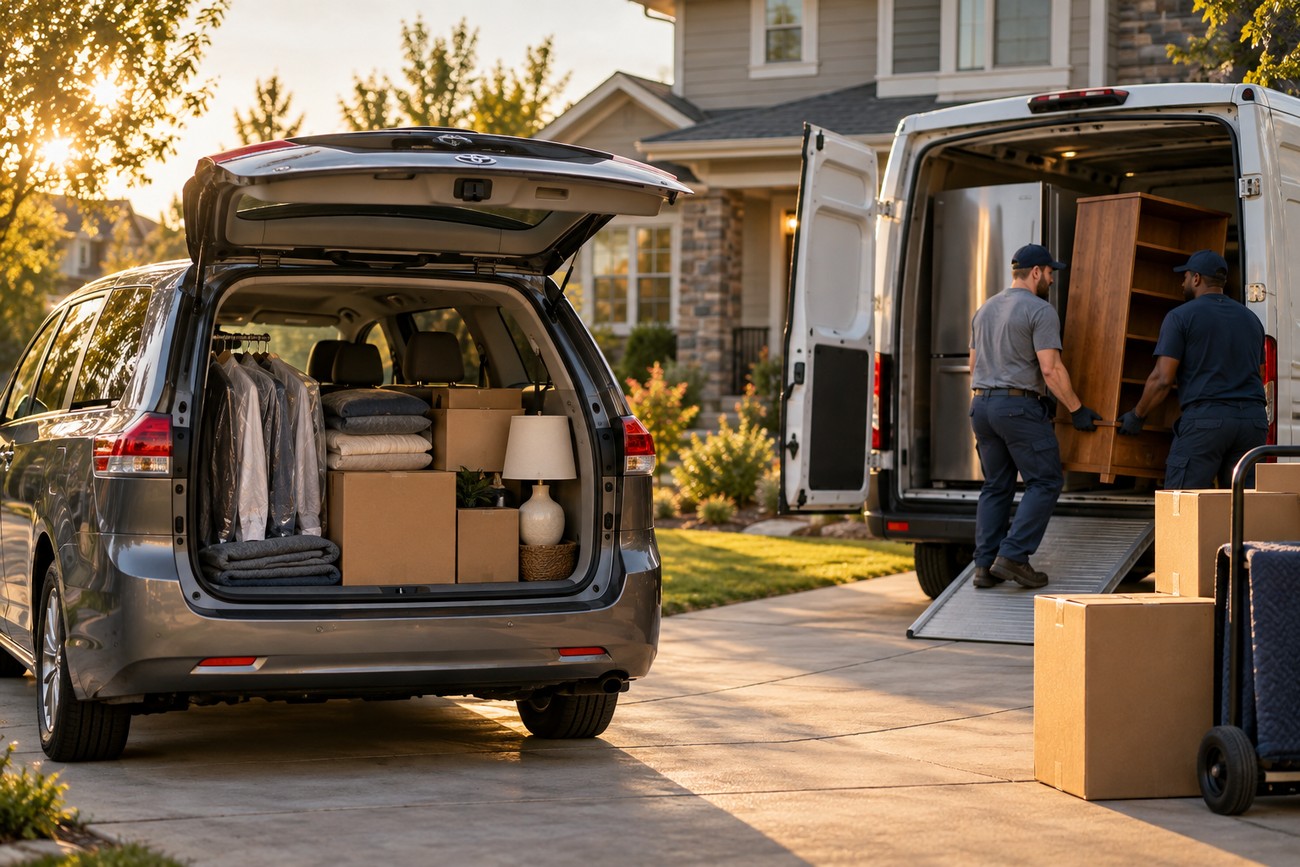
Choose multiple Sienna trips when the inventory is light but bulky, the route is manageable, and the vehicle can be unloaded between runs. Clothing, bedding, lamps, folded cartons, and lightweight household goods are often suitable for this approach. The payload still needs checking on every trip because the number of boxes alone does not show their mass.
A cargo van or professional movers make more sense when the load contains dense furniture, appliances, substantial books, or items that require extensive stacking. They are also preferable when narrow openings, stairs, long carries, or limited parking make repeated loading risky. Damage to a sofa, appliance, liftgate, or interior trim can outweigh the apparent saving from using one vehicle.
A trailer is another option only after confirming compatibility and the actual towing limit for the loaded Sienna. Passengers, cargo, accessories, and trailer equipment all affect the permitted combination. A stated maximum should therefore be treated as a vehicle-specific limit, not as an invitation to tow a heavy trailer while the cabin is full.
Use this final go/no-go check before leaving:
- Confirm the specific vehicle’s payload information and account for every passenger and accessory.
- Measure the largest item against the actual door opening and interior route.
- Keep heavy cargo low, central, padded, and restrained.
- Leave liftgate clearance and preserve access to essential equipment.
- Make a short test drive and stop if the vehicle feels unstable or the load shifts.
Frequently asked questions
How much cargo space is behind the third row in a Toyota Sienna?
The 2026 Toyota Sienna has 949 L (33.5 ft³) of cargo volume behind the third row. This is a separate seating configuration from the maximum 2,860 L (101 ft³) behind the front row, so the two figures should not be added together.
Behind the third row, the space is better suited to smaller boxes, soft goods, and daily luggage than to large furniture. Door-opening shape, wheel arches, and the need to keep items from pressing against the liftgate still determine what can actually be loaded.
What year of Toyota Sienna should you stay away from?
There is no responsible blanket model-year answer for a moving vehicle. Inspect the maintenance history, hybrid-system condition where applicable, recall status, accident damage, and the exact seat and payload configuration before buying or borrowing a Sienna.
For moving work, condition and vehicle-specific ratings matter as much as the model year. A well-maintained vehicle with a suitable configuration may be more useful than a newer example with unknown damage, neglected maintenance, or less practical seating and cargo arrangements.
How do I find the exact payload limit for my Toyota Sienna?
Use the certification label on the driver-side door jamb and the owner’s manual for that vehicle. The label and manual provide the vehicle-specific information needed to account for occupants, luggage, accessories, and other added weight.
Do not substitute the general 2026 payload range of approximately 615–708 kg (1,356–1,561 lb) for the rating of an unidentified Sienna. The vehicle’s own ratings and placard govern the practical loading decision, and the exact payload cannot be safely stated without vehicle-specific information.







