
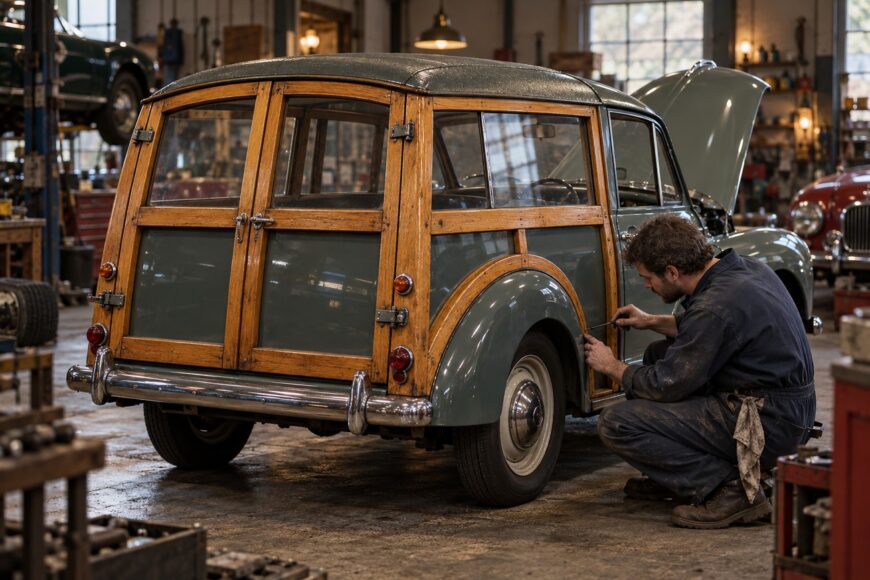
The Morris Minor Traveller earns its charm from the ash wood framing its rear body. That warm timber, upright profile, and compact three-door layout make it one of the most recognizable British classics. The same wood also creates the car’s central ownership responsibility: it forms part of the body structure, so deterioration can affect geometry, strength, and restoration cost.
A sound Traveller can be an unusually engaging usable classic, with simple rear-wheel-drive mechanics and a four-speed manual gearbox. A cosmetically attractive example with weak timber, hidden steel corrosion, or poor previous repairs can become an expensive restoration project. Engine year, structural condition, originality, drive side, and the reliability of the sales information all deserve equal attention.
- Why the Morris Minor Traveller Is More Than a Woody Wagon
- Morris Minor Traveller Engines and Model Changes
- What It Is Like to Drive and Own Today
- The Structural Inspection: Where Travellers Hide Their Costs
- Common Buying Mistakes and Misleading Listings
- Value, Originality, and Choosing the Right Traveller
- Frequently asked questions
- How much is a Morris Minor Traveller worth?
- How many Morris Minor Travellers were made?
- What should a buyer ask for before traveling to inspect a Traveller?
Why the Morris Minor Traveller Is More Than a Woody Wagon
The Morris Minor Traveller is a three-door estate version of the Morris Minor, built around a distinctive structural ash wood rear framework. The timber gives the car its familiar appearance, yet its role goes beyond visual character. Joints, fasteners, finish, and the points where wood meets steel all require regular inspection.
Underneath, the layout is straightforward: a front-mounted longitudinal petrol engine drives the rear wheels through a four-speed manual transmission. That mechanical simplicity makes routine repair relatively accessible, especially compared with the bodywork. Timber restoration demands different skills, accurate materials, and careful judgment about what can be repaired and what needs replacement.
The Traveller therefore rewards an owner who treats the wood as a working part of the body. Water ingress, weakened joints, failed fasteners, and trapped corrosion can develop behind an apparently presentable exterior. A polished car may still need substantial structural work before it is suitable for regular use.
Morris Minor Traveller Engines and Model Changes
The engine badge and model year are essential identification details because “Traveller” covers several technical eras. The figures below preserve the main distinctions without treating every example as mechanically identical.
| Engine era | Approximate timing | Quoted power | Available performance data |
|---|---|---|---|
| 803 cc | Early examples | Early figures vary by source and specification | No single comparable figure should be applied to every car |
| 948 cc | Traveller 1000, associated with 1956 onward | 48 bhp at 5100 rpm is commonly quoted | Approximately 123 km/h maximum speed is quoted in Traveller 1000 listings |
| 1098 cc | Introduced in 1962 | 48 bhp is quoted for Traveller 1098 references | 0–50 mph in 15.5 seconds |
Production chronology also needs care. Traveller 1000 is commonly dated 1956–1962 in supplied references, while later Traveller examples are separately listed into approximately 1970/1971. The 803 cc, 948 cc, and 1098 cc cars should therefore be assessed as related versions rather than one mechanically uniform model.
Specification cards can mix figures from different years, markets, or catalog sources. Confirm the engine identification, production date, gearbox details, and supporting records before comparing performance or judging whether a car has its correct power unit.
What It Is Like to Drive and Own Today
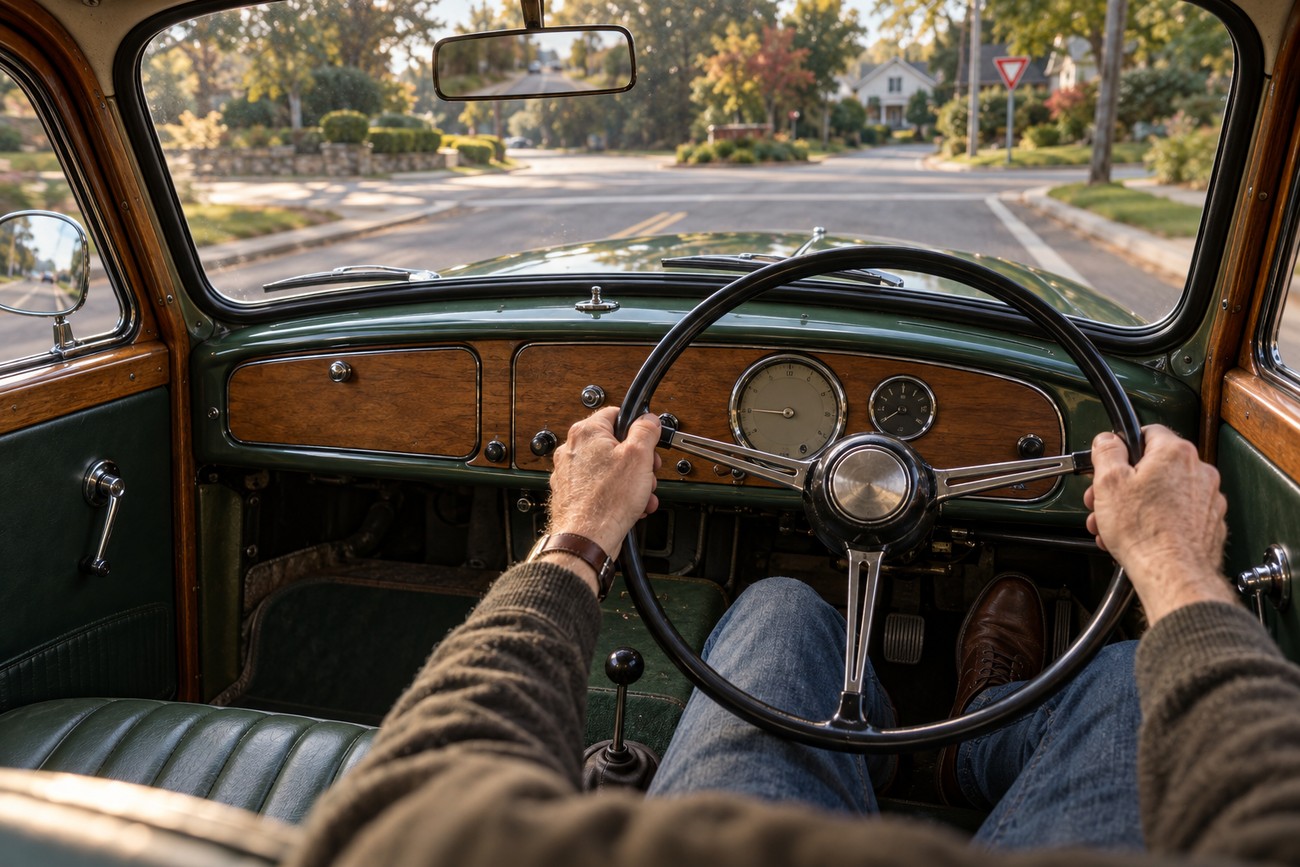
A Traveller 1098 is quoted at 0–50 mph in 15.5 seconds, which places its performance firmly in the historic-car category. Acceleration requires planning in modern traffic, particularly when joining faster roads or carrying a full load. Earlier engine versions should be expected to feel slower still, since the published figures are not interchangeable across the range.
The four-speed manual gearbox and rear-wheel-drive layout are easy to understand, but the driving technique differs from that of a contemporary car. Drum brakes need earlier, more deliberate application, while the soft classic suspension allows noticeable movement through corners and over uneven surfaces. Good condition matters greatly: worn brakes, tired suspension, or poor adjustment can make the original design feel worse than it should.
Simple mechanical systems are one of the Traveller’s strongest practical qualities. Many mechanical jobs are accessible to a competent classic-car specialist, and the car’s construction is easier to understand than that of a modern vehicle. Body restoration can dominate ownership costs, however, because timber, steel interfaces, correct parts, and finish quality require more than routine servicing.
Usability also depends on specification and previous work. A carefully restored 1098 may cope with occasional modern-road use, while a neglected early example is better treated as a slower touring car. Right-hand-drive and left-hand-drive cars bring different driving positions, controls, parts histories, and market expectations.
The Structural Inspection: Where Travellers Hide Their Costs
Begin the inspection underneath the timber and at every wood-to-steel joint. Look for darkened or soft wood, open joints, damaged fasteners, deteriorated finish, and areas where water could remain trapped. The lower sections deserve particular attention because road moisture and previous repairs can conceal deterioration from a normal standing-height view.
Inspect the timber from several angles rather than judging it by the outer varnish alone. Replacement sections may be perfectly legitimate, but their shape, joinery, fasteners, and relationship with the steel body should be clear. A car with documented, accurately executed replacement work is easier to assess than one carrying unexplained patches beneath fresh paint.
Corrosion can develop behind the wooden framework and around its attachment points, creating problems that are easy to miss during a brief exterior inspection. Check for disturbed panels, inconsistent gaps, distorted doors, and signs that the body no longer sits squarely. These clues may indicate previous impact damage, weakened timber, or repairs carried out without restoring the correct geometry.
The framework has structural importance for body integrity, so its condition should influence the entire buying decision. A bright exterior, new-looking varnish, or clean engine bay cannot compensate for rotten timber or corrosion trapped behind it. Arrange a specialist inspection when the seller cannot provide clear underside photographs, repair records, or access to the relevant joints.
A restored Traveller is not automatically original, fully sorted, or maintenance-free. Separate the quality of the restoration from the age of the materials, and ask which timber, fittings, fasteners, and steel sections were replaced. The most useful evidence is a coherent history showing what was done, by whom, and how the structure was checked afterward.
Common Buying Mistakes and Misleading Listings
The most expensive mistake is concentrating on the engine while giving the wooden body a quick visual glance. A smooth-running motor can be repaired or replaced more predictably than a badly restored structural framework. Inspect the lower timber, the joints, and the steel behind it before allowing engine condition to influence the purchase decision.
Clean paint also creates false confidence. Sellers may describe a car as restored when the work was mainly cosmetic, while an original car and a carefully rebuilt car have different implications for value, originality, and future maintenance. Ask for dated photographs, invoices, details of replacement timber, and evidence that the body was aligned during the work.
Confirm whether the car is left-hand drive or right-hand drive before arranging an inspection. Both configurations are found on the market, and the difference affects daily usability, controls, import history, and comparison with similar cars. The listing should also identify the engine era rather than using “Traveller” as the entire specification.
Catalog data deserves verification. An isolated sales card showing a 2025 model year or Euro 0 should be treated as a market-data or catalog error, not a factory specification for this historic model. Check the chassis and engine information against authoritative records, because different model years can carry materially different engines and equipment.
Value, Originality, and Choosing the Right Traveller
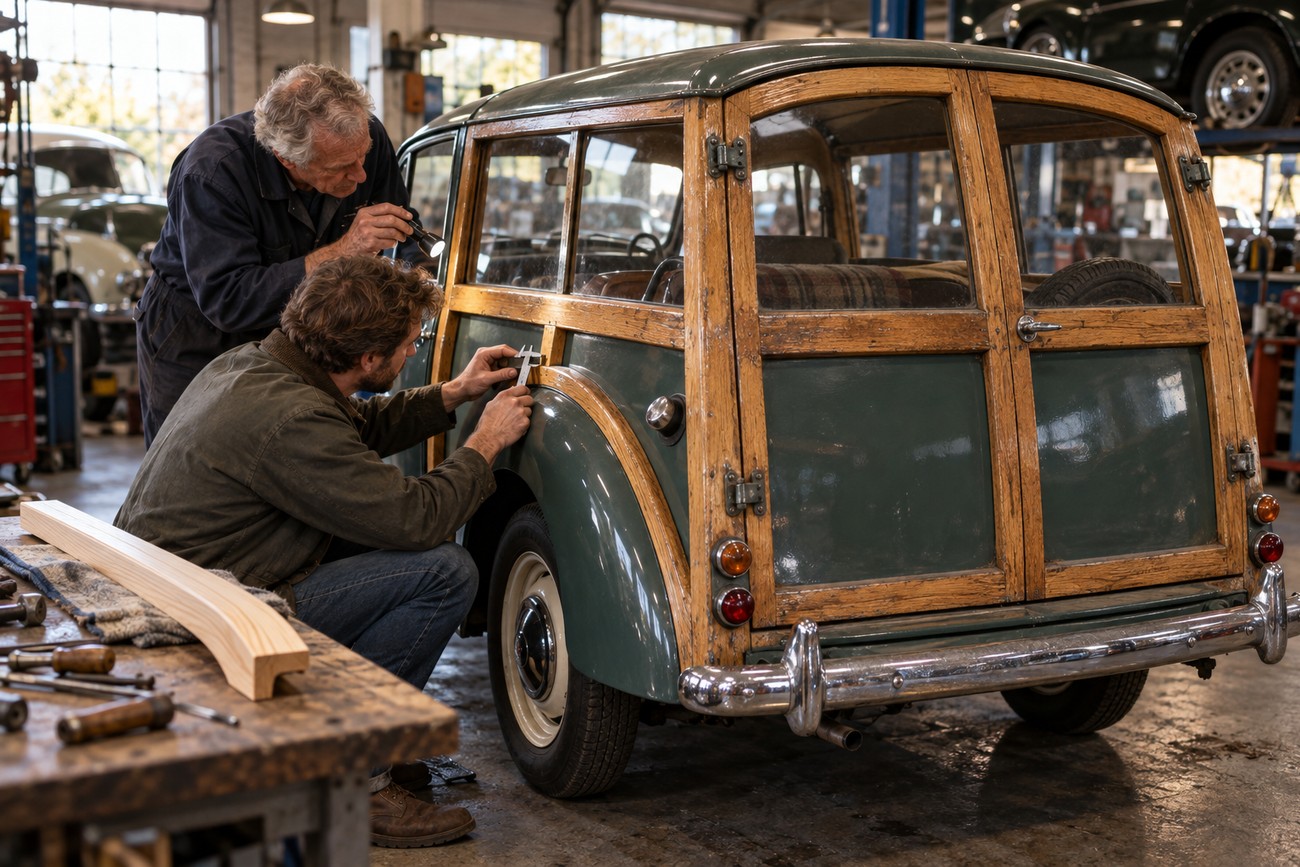
There is no single universal value for a Morris Minor Traveller. Timber condition, restoration quality, originality, engine era, drive side, fittings, and documented history must be assessed together. Paint and asking price offer only a starting point, especially when structural repairs may be hidden.
Collectors may place particular importance on original or correctly reproduced wood, period-correct fittings, and evidence that previous repairs respected the car’s construction. A replacement timber frame is not automatically a disadvantage; poor joinery, incorrect materials, or undocumented alterations are more significant concerns. The key issue is whether the work is structurally sound, visually appropriate, and properly recorded.
Parts availability also affects the sensible purchase choice. Simple mechanical components may be manageable, while correct bodywork, timber sections, and quality fittings can be difficult or expensive to source. A cheaper project only makes sense when its structural work, specialist labor, storage, and finishing requirements are understood in advance.
Choose a usable restored car when you want regular enjoyment and have reliable evidence of the work. Choose a project only when the timber, steel interfaces, geometry, and parts requirements have been assessed by someone familiar with Travellers. A documented, structurally sound car can justify a stronger valuation than a more original-looking example with uncertain repairs.
Frequently asked questions
How much is a Morris Minor Traveller worth?
Its value depends on timber condition, restoration quality, originality, engine era, drive side, fittings, and documented history. A presentable body with hidden rot should be valued very differently from a structurally restored car with clear records, even if both have similar paintwork.
Use a condition-based comparison: confirm the wood and steel inspection first, then adjust for originality, correct parts, engine specification, left-hand-drive or right-hand-drive configuration, and the quality of previous repairs. An asking price without that evidence is an incomplete valuation.
How many Morris Minor Travellers were made?
A production total should be tied to a defined model period and a reliable source. Traveller 1000 is commonly dated 1956–1962 in supplied references, while later Traveller examples are separately listed into approximately 1970/1971; combining all periods without stating the basis can produce a misleading figure.
Check whether a claimed total covers the Traveller alone, a particular engine era, or a wider Morris Minor estate range. Unverified numbers copied from a sales listing should not be treated as definitive factory production data.
What should a buyer ask for before traveling to inspect a Traveller?
Request clear photographs of the underside, lower timber, wood-to-steel joints, fasteners, door gaps, and any replacement sections. Ask for the engine identification, confirmation of left-hand-drive or right-hand-drive configuration, chassis details, and photographs showing the car before and during restoration.
Also request restoration invoices, parts information, and a written explanation of any structural repairs. If the seller cannot provide basic evidence or refuses access to the lower framework, arrange a specialist inspection before committing to travel or a deposit.







