
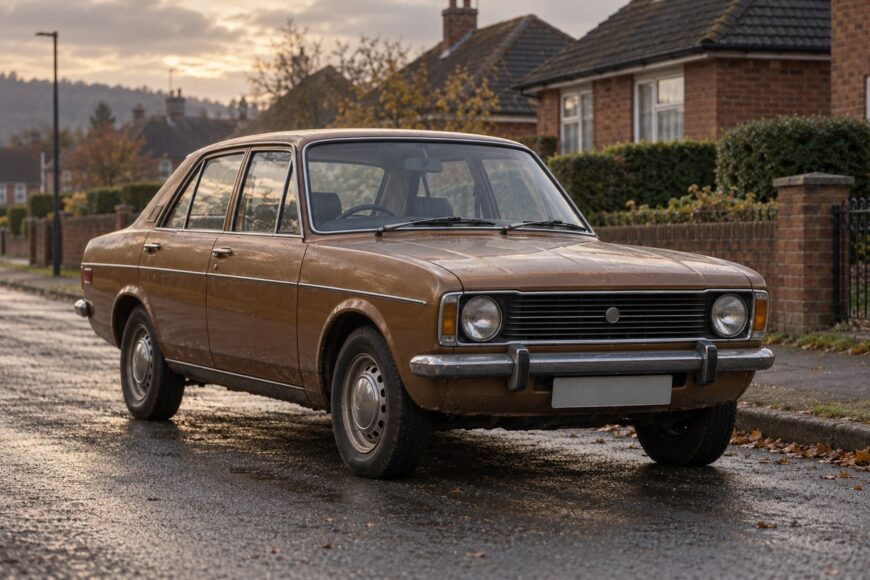
The Morris Marina has outlived its working life as a punchline. Yet the car British drivers encountered was an ordinary mass-market family vehicle, offered in useful body styles and several specifications. Its enduring reputation raises a fair question: did its faults justify the legend, or has the joke flattened a more complicated car?
The answer begins with what buyers expected from a new car in the early 1970s. The Marina offered a familiar mechanical layout, while critics found parts of its engineering old-fashioned and its handling unconvincing. Those complaints deserve more weight than a recycled claim that every Marina was hopeless. Equally, its everyday usefulness does not make the criticism disappear.
- Why did the Morris Marina become a punchline?
- An affordable family car built around compromises
- Morris Marina versions: what the badge does not tell you
- Was the Morris Marina actually a bad car?
- The mistake in buying the legend instead of the car
- The verdict: a flawed car, not a single-specification joke
- Frequently asked questions
- How many Morris Marinas are left in the UK?
- How can I check whether a Marina still has its original engine?
- What is considered the crappiest car of all time?
- Was the Morris Marina a good car?
- What is the crappiest car in the UK?
Why did the Morris Marina become a punchline?
The Morris Marina was produced from 1971 to 1980 as a mass-market British Leyland car. It was built for ordinary family transport, rather than as an obscure experiment whose defects only a handful of owners discovered. That broad presence helped make it a familiar target: people knew what the joke was about.
Its reputation grew from recognizable complaints. Commentators criticized the handling and the dated feel of its engineering, particularly in a new car whose rivals were setting different expectations. A practical saloon could still do its intended job while leaving a driver disappointed by its response on a winding road.
The Marina also became shorthand for wider dissatisfaction with Britain’s motor industry in the 1970s. That context matters, although it cannot explain away the car’s own shortcomings. Later retellings tend to compress a range of engines, bodies, and markets into one uniformly awful machine, which makes for a tidier joke than an accurate assessment.
Its mass-market reach shows that the Marina mattered to buyers and to British Leyland. It does not prove that owners were delighted with it. The useful distinction is between a car that attracted period criticism for identifiable reasons and the later claim that every example was equally dreadful.
An affordable family car built around compromises
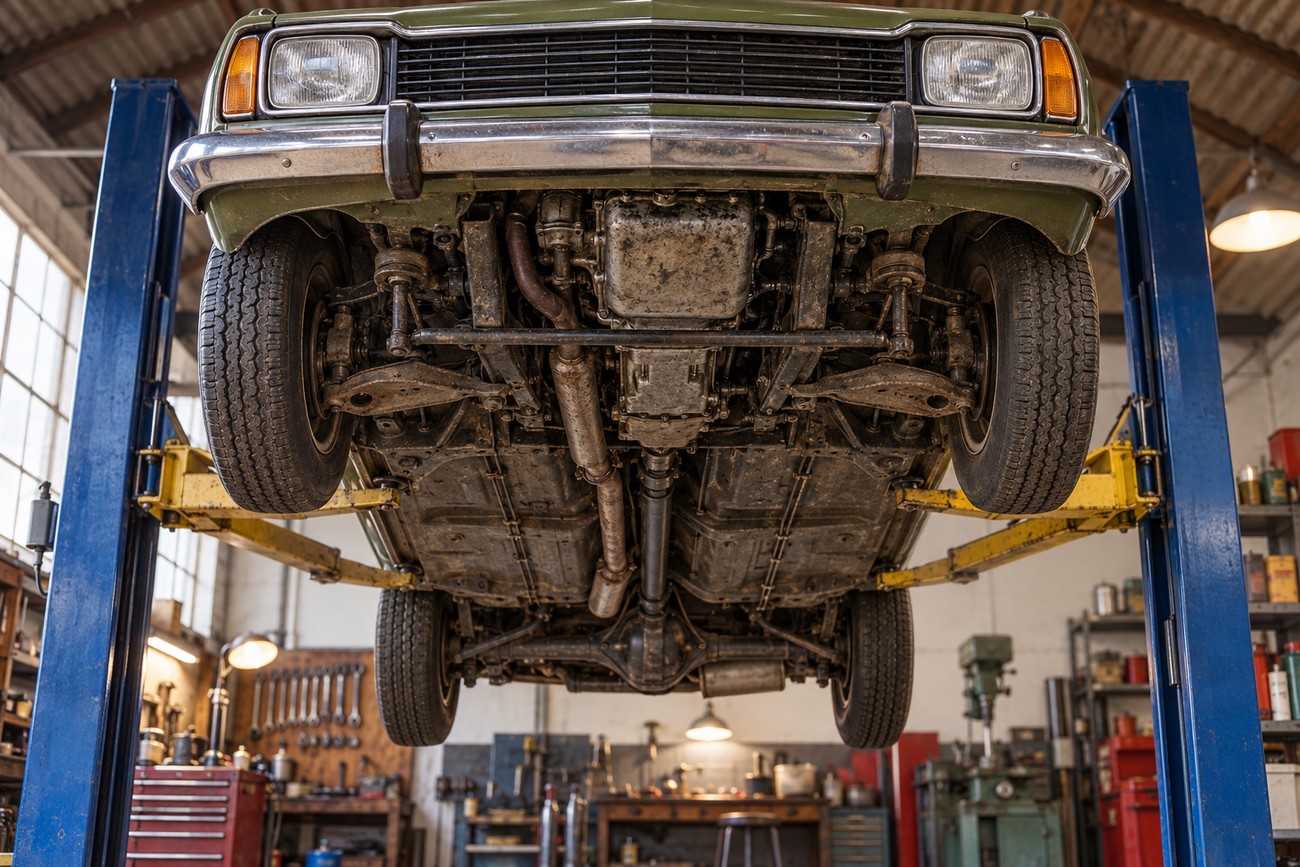
The Marina used a conventional front-engine, rear-wheel-drive layout. For a buyer or mechanic familiar with traditional family cars, that arrangement held few surprises. Familiarity, however, did little to answer criticism that the underlying design felt dated for a new model in the early 1970s.
Descriptions of its front torsion-bar suspension link the design to the earlier Morris Minor. That is a statement about its engineering lineage, not proof that every suspension component was identical or interchangeable. The connection helps explain why critics saw the Marina as a cost-conscious car assembled around established ideas.
Complaints about body roll and reluctance during quick changes of direction give that criticism a practical meaning. A driver making steady progress might find the car adequate, then notice its limitations when asking it to turn sharply or settle promptly after a maneuver. Such behavior is more relevant to the Marina’s reputation than simply labeling its layout old.
Engine, body style, condition, and setup also affect how an individual car feels. The sensible historical judgment is that the design invited handling criticism, without pretending every Marina behaved identically. A surviving example adds another complication: wear can exaggerate shortcomings that were present when it was new.
Morris Marina versions: what the badge does not tell you
The Marina name covered three body styles and distinct market specifications. Catalogue power figures are indicative rather than a specification for every car.
| Body or market | Powertrain distinction | What to check |
|---|---|---|
| Saloon, estate, and coupé | These were the principal body styles. | Confirm the body style and market before matching a car to catalogue information. |
| Commonly listed British petrol versions | A 1.3-liter version is often listed at about 60 hp; 1.8-liter versions appear at roughly 82–95 hp. | Figures vary by version and source, so verify the particular engine. |
| Listed diesel versions | Diesel cars contribute to catalogue summaries suggesting approximately 37–95 hp across listed petrol and diesel versions. | Do not treat that broad range as a rating for a single trim or year. |
| Australian-market variants | These included 2.6-liter and 2.8-liter straight-six engines. | The approximate 37–95 hp catalogue range does not describe these six-cylinder cars. |
The table illustrates why “a Marina” is an imprecise description in a driving review or a parts advertisement. Even among the commonly listed petrol versions, engine choice changes what a driver can reasonably expect. Australian specifications widen the distinction further.
Catalogue entries can disagree over individual versions and figures. If a precise output matters for identifying or restoring a car, use its documents and identification details alongside market-specific records. A convenient online listing is a starting point, not final evidence.
Was the Morris Marina actually a bad car?
By the standards critics applied to a new family car, the Marina had genuine weaknesses. Its dated chassis and recurring handling complaints give substance to the disappointment. “Britain’s worst car,” though, is a subjective verdict rather than a measurable specification.
A buyer seeking straightforward transport might have valued its familiar layout, choice of bodies, and accessible range of engines. Those are plausible reasons to choose a mass-market car; they are not evidence that its owners universally liked it. Production scale tells us that the Marina reached many buyers, not how satisfied each was.
Critics could reasonably expect more composed handling from a car introduced in the early 1970s. The most persistent objections concern the chassis and the way the car responds, rather than a claim that every engine lacked power. The commonly listed 1.3-liter and 1.8-liter versions alone show why engine output cannot stand in for the whole argument.
A single driving verdict also struggles to cover cars sold with different engines in different markets. That variation does not rescue the Marina from criticism of its basic design. It does make blanket descriptions of every example as equally slow or unpleasant rather careless.
The mistake in buying the legend instead of the car
For a prospective owner, the comic reputation is a poor inspection tool. Start by establishing the car’s market, body style, and engine, then compare those details with its documents and identification markings. British and Australian specifications differ notably, including the Australian 2.6-liter and 2.8-liter straight-six variants.
Inspect the individual car as an aging vehicle. Look closely at the body for corrosion and repairs, test the electrical equipment, and assess the suspension and its condition before attributing every odd movement to the original design. These are checks to make, not evidence of a known model-wide failure rate.
A parts listing headed simply “Morris Marina” is too broad to establish a match. Confirm the car’s market and engine identity before ordering, particularly when a previous repair or modification may have changed what is fitted.
Parts availability deserves similar homework. Check sources for the specific components your car needs, especially if originality matters, rather than assuming either that everything is readily available or that nothing can be found. Age and accumulated repairs may make a particular Marina a restoration project instead of a car ready for regular use.
A sound, correctly identified example gives you a clearer basis for deciding whether its character suits you. A poorly documented car with serious work outstanding will not become easier to own because its reputation is amusing. Condition and verified specification carry more practical weight than the joke.
The verdict: a flawed car, not a single-specification joke
The Marina’s mockery has an engineering basis. A mass-market car with a design widely criticized as dated, and handling that could feel untidy during quick maneuvers, was bound to attract pointed comment. Its prominence made those shortcomings especially easy to remember.
The legend becomes less reliable when it treats every Marina as equally slow, equally unpleasant, or an outright failure from the outset. Saloon, estate, and coupé bodies, differing listed engines, and Australian six-cylinder variants resist that simplification. Its long-running joke should not be mistaken for a uniform technical specification.
Judging the Marina as a 1970s British Leyland product means taking its period faults seriously without inflating them. Deciding whether a surviving one is worth owning is a different exercise: identify it accurately, inspect it thoroughly, and judge the work it needs. The punchline cannot do any of those jobs.
Frequently asked questions
Counts, originality, and superlatives all need different kinds of evidence. These distinctions are useful when a neat answer would otherwise be misleading.
How many Morris Marinas are left in the UK?
No verified current count is available here. For a useful estimate, seek a dated, registration-based UK count that states which Marina records it includes, then distinguish cars licensed for road use from those recorded as off-road. Neither category is a complete census of surviving vehicles: a car may exist without appearing in the category being quoted.
How can I check whether a Marina still has its original engine?
Compare the vehicle documents and identification details with the engine’s markings, then look for historical registration, service, or ownership records that connect that engine to the car. An engine of the correct type and period supports a claim of period-correct specification; proving it is the engine fitted when new requires a traceable match to original or early records.
What is considered the crappiest car of all time?
There is no established “crappiest car of all time.” Such lists depend on whether the writer values reliability, safety, handling, value, or disappointment relative to expectations. The Marina is a frequent subject of the joke, but a meaningful comparison needs stated criteria and evidence for each contender.
Was the Morris Marina a good car?
It could serve as straightforward family transport, but its dated engineering and handling drew justified criticism. For a present-day buyer, “good” also depends on the condition of the particular car and the work required to keep it usable; a capable surviving example cannot erase the period criticism, and a neglected one cannot prove every Marina was bad.
What is the crappiest car in the UK?
No single car holds that title as an objective fact. If the question concerns a car to buy in the UK now, compare inspected condition, repair needs, parts prospects, and the vehicle’s intended use rather than relying on a national punchline. A sound Marina may be a better purchase than a badly deteriorated example of a model with a kinder reputation.







