
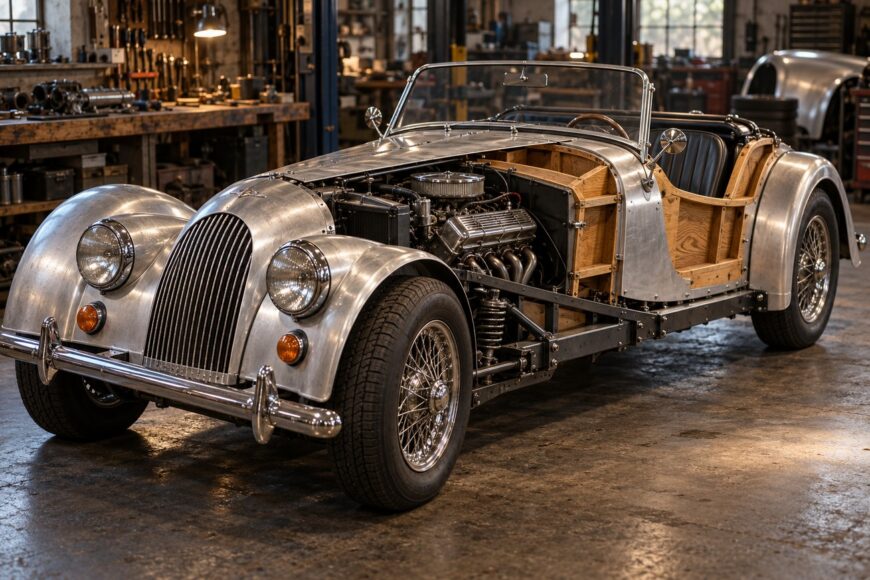
The Morgan Plus 8 combines three materials that seem to belong to different automotive eras: an ash body frame, hand-fitted aluminum panels, and a steel chassis carrying a V8. That unusual structure gives the car its lightness, visual character, and distinctive mechanical feel. It also creates inspection points that can remain hidden behind tidy paint and carefully restored trim.
Its appeal is immediate on the road. A Rover V8 gives these classic cars deep, flexible power, while the later BMW-powered version adds serious acceleration to an exceptionally light package. The buying risk sits underneath that soundtrack: moisture, frame corrosion, softened ash, mixed-metal contact, and repairs requiring several specialist skills can turn a charismatic car into an expensive project.
- The Morgan Plus 8 Is Not a Wooden-Chassis Car
- Rover V8 or BMW V8: How the Generations Differ
- Where Wood, Steel, and Aluminum Start to Fail
- A Pre-Purchase Inspection That Looks Beyond the Paint
- V8 Thunder Has a Maintenance Price
- Choosing the Right Plus 8, Not Just the Biggest Engine
- Frequently asked questions
- How can a buyer verify whether a Rover V8 has been modified?
- What can a Morgan specialist inspection reveal that a normal test drive cannot?
- Which structural areas should be checked first on a Morgan Plus 8?
The Morgan Plus 8 Is Not a Wooden-Chassis Car
The popular description of a Morgan as having a “wooden chassis” is technically inaccurate. The Plus 8 uses a steel ladder frame as its primary chassis, with the engine, suspension, and major running gear attached to it. Ash forms the wooden body frame, supporting and locating the aluminum body panels and helping establish the position of doors, interior fittings, and exterior trim.
The first Plus 8 appeared in 1968 after Morgan developed a strengthened Plus 4 base for the larger and more powerful engine. Installing the V8 required changes to the steering column, cooling system, and engine-bay packaging. Those alterations explain why the car should be understood as a specific engineering development rather than a simple engine installation in an unchanged platform.
Production continued through 2004, then returned for a separate generation from 2012–2018. Across that span, the Plus 8 name covered substantial changes in engines, transmissions, brakes, electrical systems, and corrosion protection. A classic Rover car and a late BMW car may share a silhouette and a name while presenting very different mechanical inspection priorities.
Rover V8 or BMW V8: How the Generations Differ
The engine badge is an important starting point, although it says less than the car’s complete history. Early Plus 8s used the 3.5-liter Rover V8, while some later or modified Rover-powered examples received 3.9- or 4.6-liter engines. The 2012–2018 generation used a 4.8-liter BMW V8 and a different overall mechanical specification.
| Version | Engine and transmission | Character and official data | Primary inspection priorities |
|---|---|---|---|
| Early Rover V8 | 3.5-liter Rover V8; four-speed manual in early cars | Light, direct, and mechanically simple by modern standards, with strong V8 response at modest vehicle weight | Steel-frame corrosion, cooling condition, original floors, brakes, steering, and evidence of previous repairs |
| Modified Rover V8 | 3.9- or 4.6-liter Rover engine in some examples; five-speed manual available from 1977 | More torque and potential performance, with behavior determined heavily by the quality of the conversion | Engine identity, displacement, mounts, wiring, cooling capacity, fan changes, drivetrain history, and overheating evidence |
| 2012–2018 BMW V8 | 4.8-liter BMW V8; six-speed manual or automatic transmission | Up to 270 kW/362 hp and 490 Nm; 0–60 mph in 4.5 seconds; official dry mass of 851 kg | Later-generation systems, transmission operation, brakes, tires, steering, cooling, and accident or modification history |
The early cars used a four-speed manual gearbox, and five-speed manuals appeared from 1977. The later generation offered a six-speed manual and an automatic transmission. These differences affect cruising, engine speed, drivability, and the way a fault presents itself during a road test.
The BMW-powered Plus 8 is lighter and quicker in official figures, yet it is not mechanically equivalent to a classic Rover V8 car. Its engine management, transmission, braking systems, electrical architecture, and body construction belong to a later specification. Choosing between them is therefore a choice of driving character and maintenance environment, rather than a simple decision about which car has more power.
Where Wood, Steel, and Aluminum Start to Fail
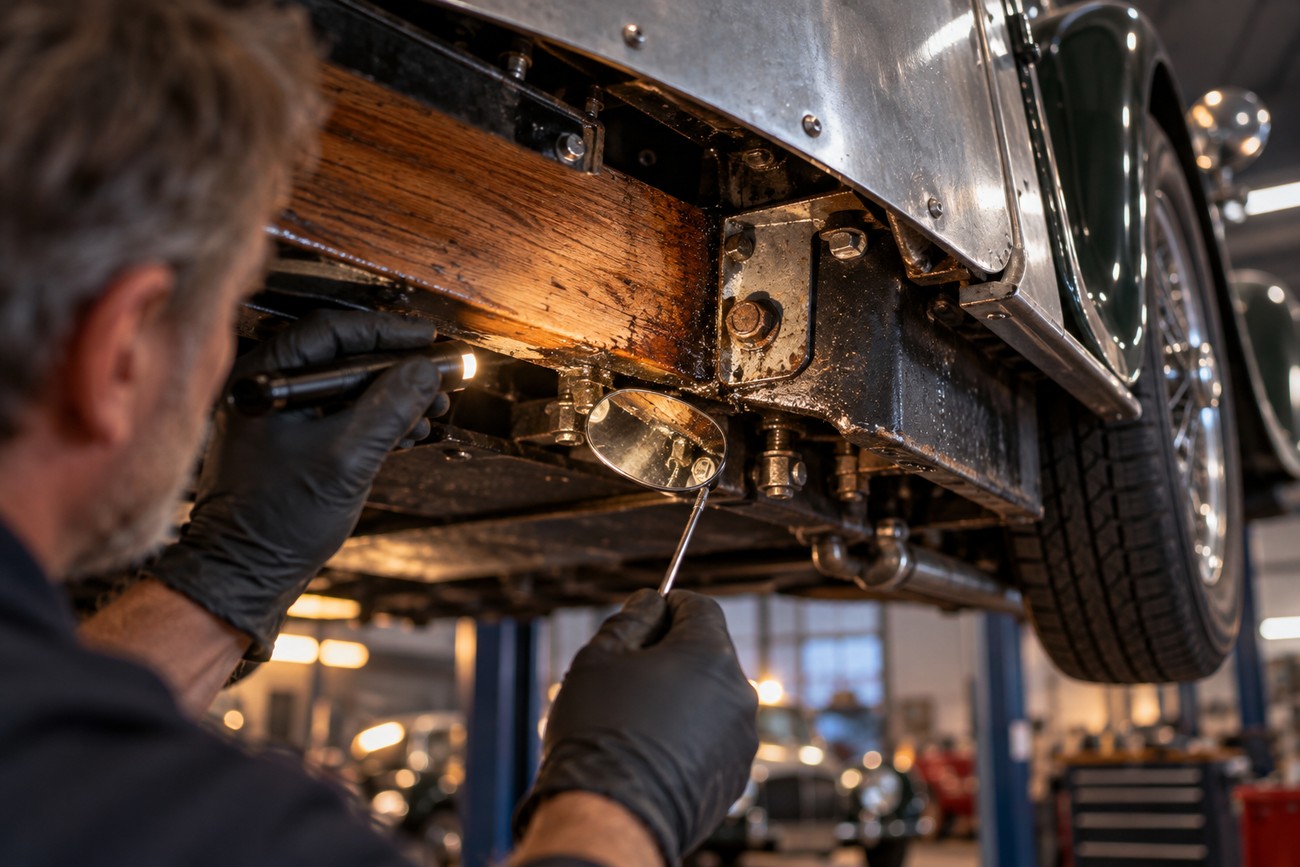
Water is the common factor linking the Plus 8’s three principal materials. The ash body frame, steel fasteners, steel chassis, and aluminum panels meet around joints, mounting points, and enclosed spaces where moisture can remain. Repeated wet use, poor drying, blocked drainage, or an earlier repair can create damage while the visible body still looks straight and polished.
Ash can soften or rot around fasteners, lower body areas, and points where the frame locates panels or interior components. The wood is not the vehicle’s primary load-bearing chassis, but deterioration changes the geometry of the body. Doors may sag, gaps may become uneven, and panels or trim may lose their intended support.
Aluminum bodywork also needs careful inspection. Aluminum does not develop steel rust in the same way, yet steel fasteners and steel-to-aluminum contact create opportunities for corrosion and moisture traps. Corrosion may lift paint, stain joints, attack fasteners, or remain behind a panel where a clean exterior offers little evidence of the underlying condition.
Some flex in an older Morgan body is not automatically a defect. A more useful assessment considers whether the door gaps are symmetrical, whether hinges and fasteners move under load, and whether accessible ash feels firm. A car with tidy trim can still have a weakened body frame, while a car with modest movement may remain sound if the structure is dry, secure, and geometrically consistent.
Older cars can also hide corrosion inside closed steel sections and behind body panels. This is why a glossy repaint has limited diagnostic value. Paint can conceal previous welding, filled corrosion, or moisture damage until trim, fasteners, floor sections, or selected panels are examined directly.
A Pre-Purchase Inspection That Looks Beyond the Paint
Begin underneath with the steel ladder frame, especially on cars built before 1986, when factory corrosion protection was often weak. Inspect the longitudinal frame rails, crossmembers, brackets, and suspension mounting points for scaling, distortion, repairs, and thinning metal. Corrosion around a suspension attachment deserves more attention than surface staining on an easily accessible panel.
Next, establish which floor construction the car has. Early steel floors may rust, while wooden floors can absorb water and deteriorate. Neither material should be treated as automatically superior; each requires a different inspection method. Look for dampness, soft areas, poorly finished replacement work, trapped debris, and evidence that water has entered from the lower body or cockpit.
Check the doors with the car standing on a level surface. Sagging doors, tight closing, uneven gaps, and loose hinges can indicate weakened wood around the hinge or mounting areas. Where ash is accessible, pressing it carefully with a fingernail provides a useful preliminary check: if the wood yields easily, moisture damage or rot is possible. This test cannot replace partial disassembly or specialist diagnosis.
The road test should cover brakes, steering, tires, and cooling rather than focusing on the V8 soundtrack. A light car with strong acceleration places significant demands on tire condition, brake balance, steering joints, and suspension mounts. During the drive, monitor temperature behavior in traffic and under load, then compare the result with the documented cooling-system specification.
A clean exterior proves very little by itself. Budget for a specialist Morgan inspection that can examine hidden frame sections, fastener areas, floor construction, accessible wood, and signs of previous body removal. The inspection cost is easier to assess before purchase than after discovering that a seemingly minor door or floor issue extends into the structure.
V8 Thunder Has a Maintenance Price
The Plus 8’s performance comes from the combination of V8 power and low vehicle mass. That formula creates the car’s immediacy, yet it also magnifies neglected maintenance. Worn tires, weak brakes, loose steering components, or poor suspension mounts have a larger effect on confidence when the car accelerates hard and changes direction with little insulating weight.
Modified Rover engines deserve particular scrutiny. Larger displacements, non-standard engine work, and altered fan or cooling systems can create overheating risks if the radiator, airflow, fan control, and plumbing were not matched to the conversion. A temperature gauge that appears normal during a short drive does not prove that the system will remain stable in traffic or on a warm day.
Repair economics are shaped by the construction. Replacing a damaged section of ash may require access that involves partial body disassembly, followed by work on the aluminum panels and their fasteners. If the same car also needs frame repairs, wiring corrections, or V8 cooling work, the job can require metalworking, woodworking, and older-engine expertise in one project.
Small body movement should be judged in context rather than treated as an automatic failure. Symmetry, secure fasteners, firm wood, sound mounting points, and consistent door operation provide a more useful picture. A well-documented car with limited age-related movement may be a safer purchase than a freshly painted example whose structural repairs cannot be explained.
Choosing the Right Plus 8, Not Just the Biggest Engine
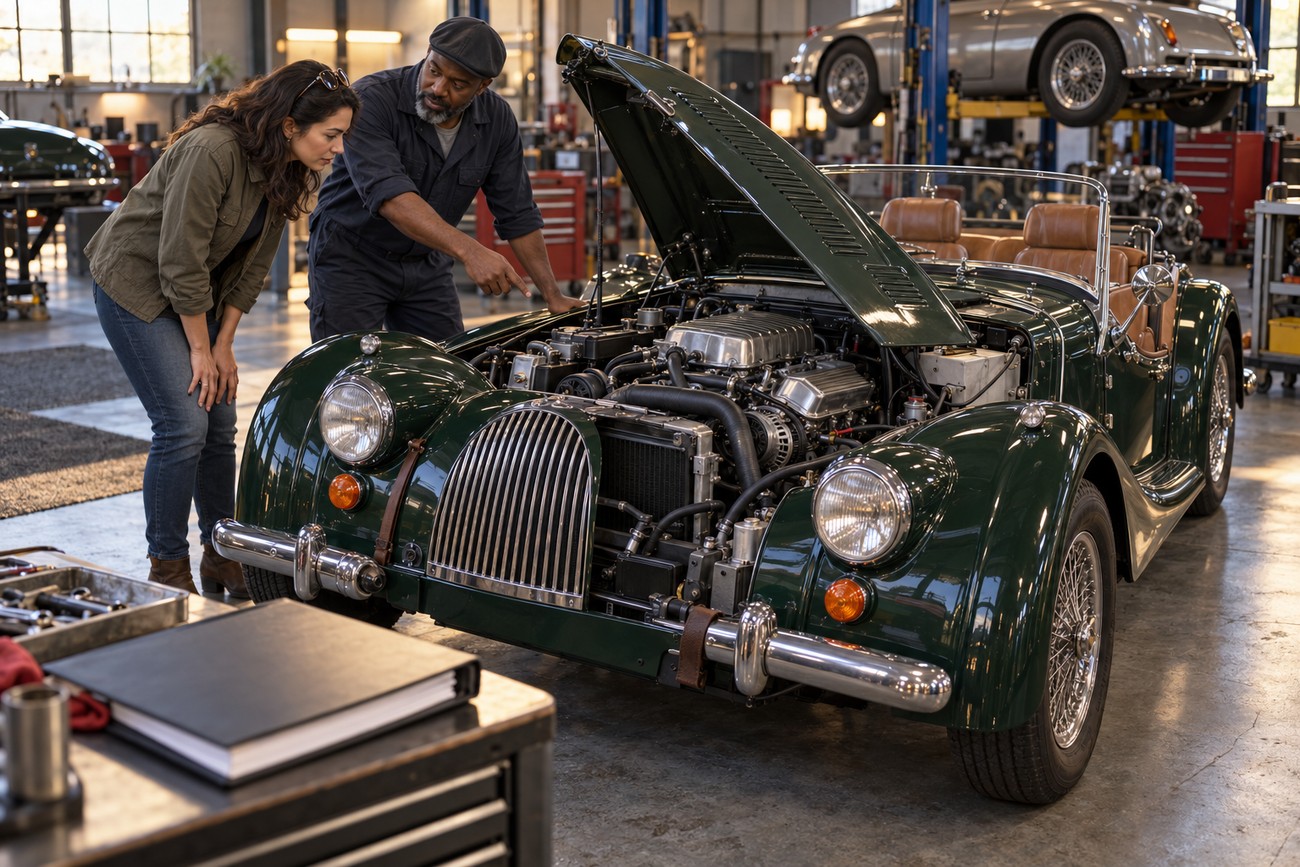
The best Plus 8 is usually the one with the clearest history and the most coherent specification. Engine size alone cannot establish the condition of the chassis, body frame, brakes, floors, or electrical system. A 3.9- or 4.6-liter Rover conversion may offer attractive torque, but it also changes the risk profile through its mounts, cooling system, wiring, exhaust, and drivetrain installation.
Ask for invoices, engine identification information, records of cooling-system work, and evidence of chassis or body repairs. Check whether the stated displacement matches the installed engine and whether modifications were completed as a coordinated package. A louder exhaust and an impressive engine bay can conceal unfinished work, improvised wiring, or a cooling system that was never properly validated.
The 2012–2018 BMW-powered Plus 8 suits a buyer who values modernized performance and the later car’s official figures: up to 270 kW/362 hp, 490 Nm, 0–60 mph in 4.5 seconds, and an 851 kg dry mass. A classic Rover car offers a different experience, with more mechanical variation and greater dependence on the quality of past maintenance. Neither choice removes the need to inspect the shared body-frame principles and running gear carefully.
A practical decision framework is simple. Choose a classic Rover car when its originality, repairs, cooling system, and structural condition are documented and consistent. Choose the later BMW car when its modern specification and sharper performance match your priorities, with equal attention to brakes, tires, steering, and cooling. In either case, budget for a specialist Morgan inspection before committing to the purchase.
Frequently asked questions
How can a buyer verify whether a Rover V8 has been modified?
Verify the engine through identification information, invoices, stated displacement, and records of cooling-system work. Compare those documents with the engine actually installed, including visible casting or identification details where accessible, and check whether the gearbox, mounts, exhaust, wiring, and cooling components correspond to the claimed conversion.
Badges, engine sound, and a seller’s description are useful clues, not proof. A 3.9- or 4.6-liter Rover engine can change the car’s heat load and installation requirements, so the buyer should establish who performed the work, what components were changed, and whether the car has a documented history of stable operation.
What can a Morgan specialist inspection reveal that a normal test drive cannot?
A specialist inspection can expose concealed frame corrosion, weakened ash around fasteners, hidden floor damage, and corrosion where steel contacts aluminum. It can also distinguish steel floors from wooden floors and identify altered cooling systems or repairs hidden behind trim and body panels.
A test drive mainly reports how the car behaves at that moment. It may reveal overheating, steering looseness, brake imbalance, or poor door operation, yet it cannot reliably confirm the condition of closed frame sections or wood behind the interior. Specialist access and, where justified, partial disassembly provide evidence that driving impressions cannot supply.
Which structural areas should be checked first on a Morgan Plus 8?
Start with the steel ladder frame, suspension mounting points, floor construction, and accessible ash around doors, hinges, fasteners, and lower body sections. Look for corrosion, soft wood, moisture, distortion, poorly finished repairs, and evidence of previous body removal.
Door symmetry, firm wood, secure fasteners, and sound frame sections should be assessed together. A clean repaint or a short test drive cannot confirm that concealed structural areas are free from corrosion or moisture damage.







