
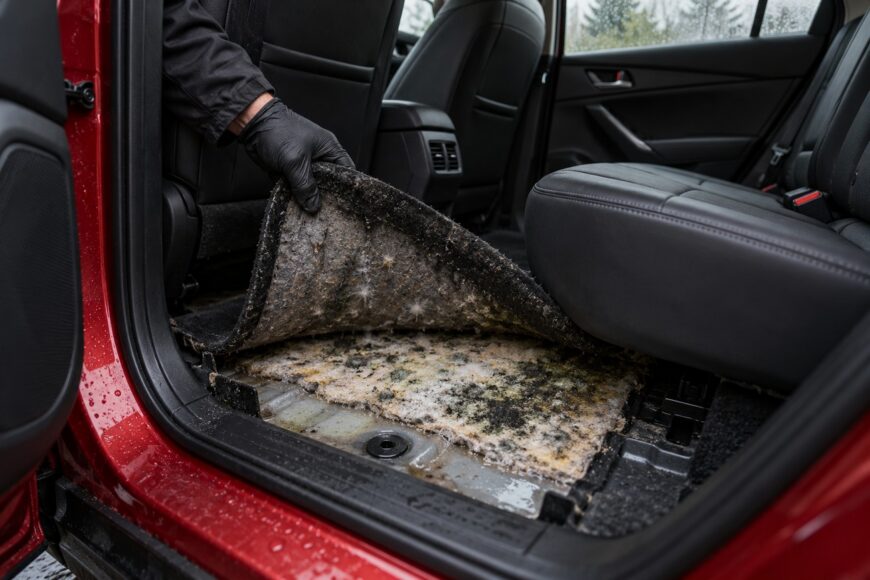
The musty smell returns after you clean the cabin, even though the Mazda CX-5’s carpet feels dry. Perhaps the windows fog from the inside after rain, or a damp patch reappears beneath a floor mat. Visible drying can be misleading: carpet backing, sound insulation, seat foam, and other porous trim can stay wet longer than the surface you touch.
Cleaning will have limited effect while water is still entering the vehicle. The useful sequence is to find and repair the leak, establish how far the water traveled, and then dry or replace affected materials. If water reached under-seat electrical areas, the inspection also needs to account for faults that may appear later.
- Why Mold Keeps Growing After a Mazda CX-5 Leak
- Where Water Hides in a CX-5
- A Practical Leak-and-Mold Inspection Sequence
- Drying and Cleaning: When Surface Treatment Is Not Enough
- Electrical and Safety Risks After Interior Water Damage
- Common Mistakes and Myths That Keep the Odor Coming Back
- CX-5 Leak Symptoms and the Next Place to Check
- Frequently asked questions
- How do I know whether a wet Mazda CX-5 needs the carpet removed?
- What is the biggest problem after a Mazda CX-5 leak?
- What is the biggest problem with the Mazda CX-5?
- How much does it cost to replace the DPF filter in a Mazda CX-5?
Why Mold Keeps Growing After a Mazda CX-5 Leak
Visible mold, a persistent musty odor, condensation, or damp materials indicate that moisture remains or has remained in the cabin. Standing water is not required. An odor alone cannot identify a particular mold species, but it is a sound reason to investigate the materials beneath the visible trim.
Warm, enclosed, poorly ventilated cabins with high humidity favor mold growth. Leaving wet mats inside a closed CX-5 adds moisture to the air, while evaporation from hidden layers can fog the glass. Ventilating the car may reduce that humidity, though it cannot stop a continuing leak.
Automotive carpet, carpet backing, sound insulation, felt, seat foam, and other porous trim can stay wet longer than the visible surface. Water held against the floor can also affect fasteners and nearby components. That is why an odor that returns after surface cleaning calls for an inspection below the carpet, rather than another fragrance or spray.
Where Water Hides in a CX-5
Door seals, sunroof or panoramic-roof drains, HVAC condensation, windshield sealing, wiring passages, and floor plugs are possible sources. The likely path depends on when the cabin gets wet: after rain, a car wash, air-conditioning use, or parking in a particular position. CX-5 owner reports frequently mention clogged roof drains after heavy rain, but that is not a universal diagnosis.
Water can travel away from the visible stain along wiring, thresholds, carpet backing, sound insulation, and hidden cavities. A wet rear footwell, for example, does not prove that water entered through the rear door. Following the highest damp point is more useful than treating the mold patch as the leak location.
Check beyond the main footwell. Moisture can collect beneath seats, in the cargo-area wells, and behind side trim while the exposed carpet looks normal. A seat cushion or foam layer may also retain water after the surrounding surface has dried.
If the CX-5 has a roof opening, inspection should include the drain channels and their route, rather than focusing only on the glass seal. A blockage or disconnected path can send water into trim and then across the floor. The entry point and the place where water finally pools may be some distance apart.
A Practical Leak-and-Mold Inspection Sequence
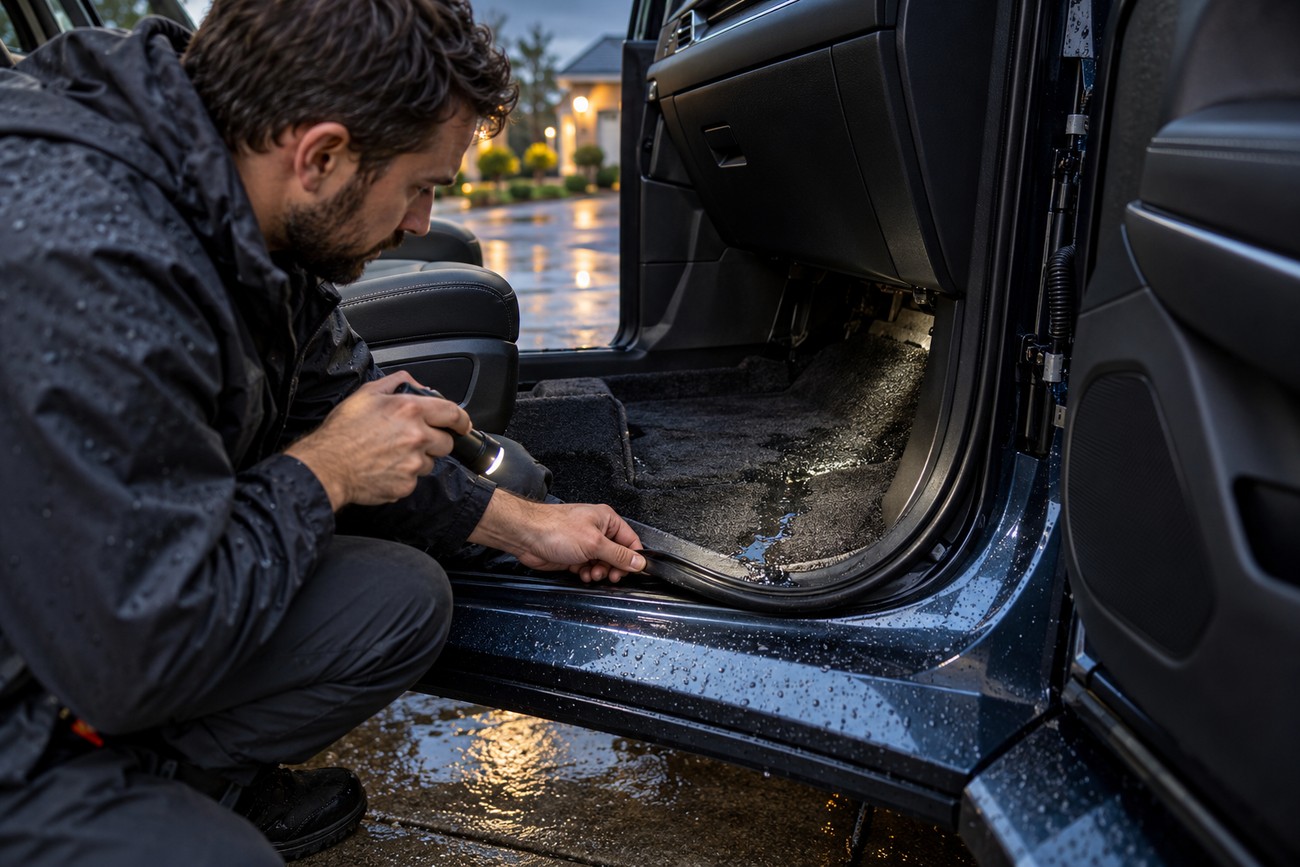
Start by recording when the smell, fogging, or dampness appears and which areas are affected. Remove wet mats from the cabin, then check the carpet edges, footwells, under-seat areas, and cargo wells without disturbing wiring. Photos of damp areas and any visible growth help you compare conditions after the next rain or controlled water test.
Trace moisture toward its highest accessible point. Inspect door and windshield seals, visible wiring passages, and floor plugs for signs of water entry or displaced sealing. If there is a sunroof or panoramic roof, check the drain channels along their full length; do not force debris deeper into a tube.
The visible mold location may be different from the water-entry point. A leak that appears only when the vehicle is parked on an incline can follow a different path across backing and insulation. If the symptom is intermittent, repeat the observation under the parking conditions that preceded it, rather than soaking the entire vehicle at once.
Stop short of probing connectors or moving under-seat restraint-system wiring casually. Where trim removal, drain access, or electrical areas exceed your tools and experience, ask a qualified repairer to isolate the leak and document which layers are wet. That record gives the drying work a defined scope.
Drying and Cleaning: When Surface Treatment Is Not Enough
A small, isolated wetting event may be manageable once the leak is fixed and you can confirm that the backing and adjacent layers stayed dry. Remove wet mats, provide safe ventilation, and check the area again after the cabin has been closed. If dampness or odor returns, widen the inspection before applying more cleaner.
Some DIY advice suggests a vehicle can be dried within 24 hours. That may be inadequate when carpet backing, sound insulation, or seat foam is saturated. Opening the doors for a day can dry exposed fabric while moisture remains trapped against the floor.
Expose and check the layer beneath the carpet before approving a drying job. Fabric that feels dry on top gives little evidence about insulation compressed against the floor.
Once the water source is repaired, deeply wet porous materials may need to be lifted or removed for forced drying and more than one cleaning cycle. Contaminated material that cannot be cleaned and dried reliably may need replacement, particularly if odor returns. Any disassembly near seat wiring should be handled with appropriate vehicle procedures.
Antibacterial sprays, fragrances, and surface cleaning do not remove moisture or contamination embedded in porous materials. Avoid household bleach and other harsh chemicals on automotive fabrics, foam, and plastics; they can damage finishes without reaching the wet layer. Choose products suitable for the material, and follow their directions after the leak and drying plan are established.
Electrical and Safety Risks After Interior Water Damage
Water under seats can affect electrical connectors, sensors, restraint-system wiring, and floor fasteners. A CX-5 that starts and drives normally may still have moisture in those areas. Contact corrosion can develop later, after the visible carpet has dried.
An airbag or restraint alert, intermittent electrical behavior, or an unusual seat-related fault deserves prompt professional inspection if the floor was wet. These signs do not establish which component failed. Do not unplug safety-system connectors or probe their wiring as a casual leak check.
Significant moisture exposure also warrants follow-up checks for corrosion and electronic faults over the following weeks. Keep a note of warning lights and changes in electrical behavior, alongside any recurring condensation or odor. A repairer can use that history to inspect affected areas without assuming every later fault came from the leak.
Common Mistakes and Myths That Keep the Odor Coming Back
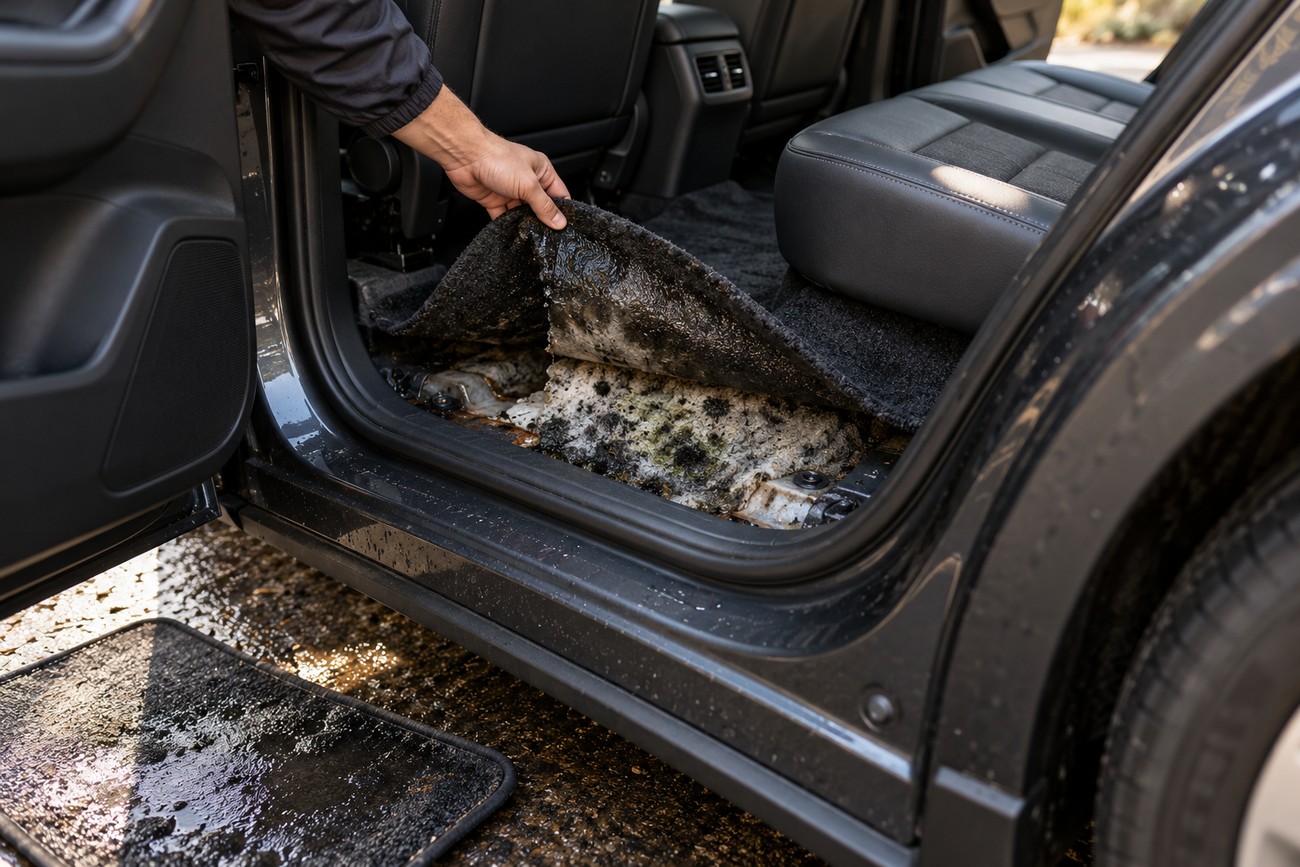
Leaving wet mats in a closed car keeps adding moisture to the cabin. Covering the smell with fragrance, meanwhile, can make it harder to tell whether drying has worked. Remove the mats, find the entry path, and check the materials that absorbed the water.
A dry-feeling carpet surface does not prove that its backing or insulation is dry. Likewise, an odor that disappears immediately after cleaning is not proof that contaminated porous material is clean. A smell that returns usually points to unresolved moisture, hidden contamination, or an unfixed leak.
If the smell intensifies when heating or air conditioning runs, include ventilation-related areas in the investigation. Retained moisture around the HVAC system or evaporator can contribute to a recurring odor; it does not, by itself, identify where rainwater entered the car. Treat the ventilation symptom and the cabin leak as related possibilities to check, rather than assuming one explains the other.
Finally, moisture-resistant interior materials do not make a cabin watertight after a leak or flooding event. Unsuitable chemicals can damage trim while leaving wet foam untouched. The durable result depends on source repair, access to hidden wet layers, appropriate cleaning, and confirmation that the cabin stays dry.
CX-5 Leak Symptoms and the Next Place to Check
These symptoms are investigation leads, not proof that a particular seal, drain, or component has failed.
| Symptom | Possible hidden moisture area | Next diagnostic focus |
|---|---|---|
| Recurring musty odor | Carpet backing, felt, seat foam, or cargo-area trim | Find where the odor is strongest and check beneath accessible trim after the leak is repaired. |
| Windows fogging from inside | Wet floor insulation or another damp cabin material | Check all footwells and cargo wells; fogging indicates excess moisture, not its entry point. |
| Damp floor without a puddle | Backing or insulation beneath apparently dry carpet and mats | Inspect carpet edges and trace dampness toward its highest accessible point. |
| Wet seat or under-seat area | Seat foam, floor insulation, and nearby electrical areas | Locate the water path and arrange qualified inspection if connectors or modules were reached. |
| Odor returning after HVAC use | Ventilation-related areas or damp cabin trim warmed by airflow | Check for retained HVAC moisture while continuing to investigate any cabin leak. |
Frequently asked questions
The answers below address decisions that depend on how deeply water entered the CX-5 and which systems were exposed.
How do I know whether a wet Mazda CX-5 needs the carpet removed?
Carpet removal becomes a strong consideration when the backing or insulation is wet, water has reached under the seats, or musty odor and interior fogging persist after the leak is fixed. If the surface dries but dampness returns when you press an edge or lift an accessible corner, a surface-only drying attempt is unlikely to verify the floor beneath it.
Have a qualified repairer assess the scope if lifting the carpet would involve seats or restraint-system wiring. The decision should be based on which layers are wet, not on the appearance of the carpet pile alone.
What is the biggest problem after a Mazda CX-5 leak?
The main leak-related problem is often water retained out of sight. It can sustain odor or mold growth, damage porous trim, and leave electrical areas exposed even after the original puddle disappears. The visible mold patch may be only one sign of a wider wet area.
Fixing the entry point is therefore the first repair decision. After that, determine how far water spread so the drying and cleaning work covers the affected layers rather than only the place where the stain appeared.
What is the biggest problem with the Mazda CX-5?
There is no single biggest problem that applies to every CX-5. Concerns vary with model year, powertrain, maintenance, climate, and the individual vehicle’s history. A cabin leak should be diagnosed on its own evidence rather than treated as proof of a model-wide defect.
For a CX-5 you own or are considering, review its service and repair history, check for current warnings, and inspect for signs of past water entry. A pre-purchase inspection can help distinguish a repaired leak from moisture that is still present.
How much does it cost to replace the DPF filter in a Mazda CX-5?
A diesel particulate filter replacement cost depends on the diesel variant, local parts availability, labor rates, and whether testing finds another fault that caused the DPF problem. A workshop needs the vehicle details and a diagnosis to provide a meaningful estimate; replacement should not be assumed from a warning alone.
The DPF is an exhaust-system component. It does not cause or treat mold inside the cabin, and a CX-5 leak should be investigated separately.







