
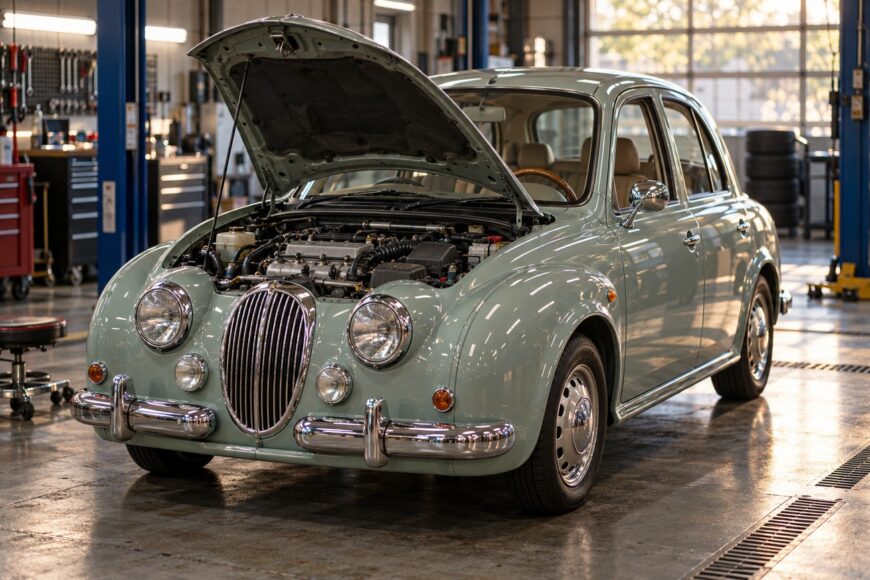
The Mitsuoka Viewt creates a visual paradox: a small Japanese car dressed to suggest a classic Jaguar, while its mechanical foundation comes from mass-market Nissan or Toyota hardware. That styling gives it presence far beyond its compact-car origins, but the badge does not identify the platform underneath.
The real buying dilemma is straightforward. Routine engine, suspension, and transmission servicing can often follow the underlying March, Micra, or Yaris, while damaged custom bodywork may require specialist parts or fabrication. Before buying, you need the chassis code, VIN, engine, drivetrain, and transmission details because appearance alone says little about parts compatibility or ownership cost.
- What the Mitsuoka Viewt Really Is
- Mitsuoka Viewt Generations and Mechanical Bases
- The K13 Viewt: Small-Car Hardware Under a Large Retro Image
- The Viewt’s Hidden Ownership Costs
- How to Inspect and Buy a Mitsuoka Viewt
- Viewt Myths That Can Lead to a Bad Purchase
- Frequently asked questions
- What should you do if a Viewt’s custom exterior panel is cracked?
- Why does the Viewt sometimes feel less lively than the March it is based on?
- What is the most beautiful Japanese car of all time?
- What car looks like a Nissan Skyline?
- What car looks like a Jaguar?
What the Mitsuoka Viewt Really Is
The first-generation Mitsuoka Viewt appeared in 1993 and was based on the Nissan March/Micra K11. Mitsuoka reworked the exterior with a long-looking hood, upright grille, separate-looking fenders, chrome details, and a formal rear treatment. The result resembles a small interpretation of a classic Jaguar, though the Viewt is not a Jaguar and is not presented as a licensed Jaguar.
The retro exterior is a Mitsuoka construction fitted over a mass-market compact-car base. That distinction matters during repairs: the engine and much of the running gear may be familiar Nissan hardware, while the visible panels, trim, and mounting arrangements can be specific to the Viewt.
Advertising sometimes calls the car a sedan because of its formal proportions and additional luggage section. Technically, its relationship remains with the compact March hatchback. The external luggage extension does not turn the car into a full-size sedan platform or make it mechanically comparable to a Jaguar.
This separation between image and engineering explains the Viewt’s appeal and its risk. You get distinctive styling without the mechanical complexity of an actual classic luxury car, yet the custom exterior can still create classic-car repair bills when parts are scarce or damaged.
Mitsuoka Viewt Generations and Mechanical Bases
The Viewt name covers several different vehicles. Treat the Nissan March/Micra K11, K12, K13, and the Toyota-based Viewt Story as separate cars for parts, engines, transmissions, and inspection purposes.
| Viewt version | Underlying vehicle | Engine or powertrain context | Parts-identification implication |
|---|---|---|---|
| First generation | Nissan March/Micra K11 | Early 1.0-liter and 1.3-liter engines | Use K11 and VIN information; custom exterior parts remain Mitsuoka-specific |
| Later K12-based versions | Nissan March/Micra K12 | After the March K12 update, 1.4-liter and 1.5-liter versions were available | Confirm the exact engine and automatic transmission before ordering parts |
| Third generation | Thai-market Nissan March K13 | Published specification includes a 1,198 cc engine and CVT | Use K13, VIN, and factory specification; do not assume K11 or K12 compatibility |
| Viewt Story | Toyota Yaris XP210 | Hybrid and gasoline versions | Search mechanical parts through the Toyota base, with separate research for Mitsuoka bodywork |
Early cars used 1.0-liter and 1.3-liter engines. After the March K12 update, the range included 1.4-liter and 1.5-liter versions, with different automatic transmission arrangements. Those changes affect acceleration, servicing, diagnostic equipment, and the way you should price a used example.
The third-generation Viewt used the Thai-market Nissan March K13. The current Viewt line is the Viewt Story, based on the Toyota Yaris XP210 rather than a Nissan platform. It is available with hybrid and gasoline powertrains, so a recent-looking Viewt may have a completely different mechanical identity from an older car.
For parts research, the chassis code is more useful than the registration year or the retro body design. A listing that says only “Mitsuoka Viewt” leaves out information essential to ordering filters, suspension components, transmission service parts, and electronic components.
The K13 Viewt: Small-Car Hardware Under a Large Retro Image
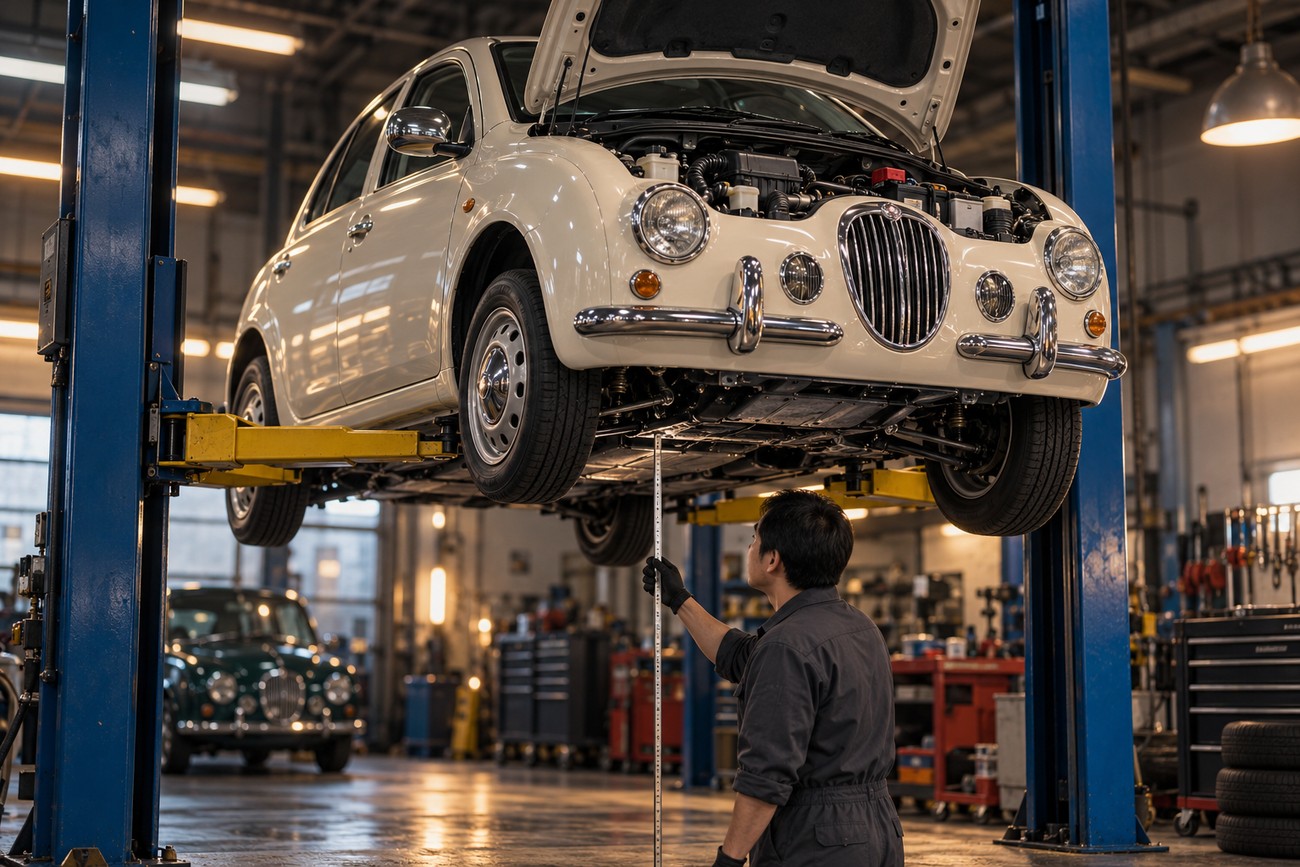
The published K13 specification uses a 1,198 cc inline three-cylinder engine producing 79 hp and 106 Nm. It drives through a CVT, the vehicle weighs 1,045 kg, and ground clearance is 140 mm. These figures apply to the K13 specification and should not be transferred to earlier or later Viewt generations.
In daily driving, that output suits urban traffic more comfortably than sustained high-speed work, especially when the car is fully loaded. Owners of early 1.0-liter versions report a noticeable lack of pulling power with four passengers aboard, and the added retro bodywork means the driving feel should not be judged from a lighter standard March alone.
The K13 measures 4,515 × 1,680 × 1,550 mm, with a 2,450 mm wheelbase and a 4.5 m turning radius. It has five seats, so the compact platform remains easy to place in city streets even though the styling makes the car look longer and more formal than its donor vehicle.
The CVT also changes the ownership routine. It needs the correct fluid and service procedure rather than treatment as a conventional automatic transmission. A test drive should include smooth takeoff, steady acceleration, and response under load, followed by verification of the exact transmission specification through the VIN or factory records.
The Viewt’s Hidden Ownership Costs
The Viewt can be inexpensive to maintain mechanically when parts are sourced through the underlying Nissan or Toyota model. That advantage ends at the custom exterior. Owners of early cars report cracks in exterior components, sometimes with small cracks spreading over time, while paint and chrome can lose their finish with age and weather.
Inspect the bonnet, fenders, grille surround, rear bodywork, and trim in strong daylight. A repaired crack may be less concerning than a panel that continues to flex or has water entering behind it. Custom damage can require a specialist part or fabrication instead of a direct replacement from Nissan or Toyota.
Heat around the bonnet is worth checking after a proper drive, because the compact engine bay can retain noticeable heat; treat it as an inspection clue rather than proof of a mechanical fault.
Owners also report that the bonnet area can become noticeably hot after driving because heat accumulates in the engine bay. The observation is not a universal defect diagnosis, but abnormal smells, damaged insulation, fluid seepage, or warning lights deserve further investigation.
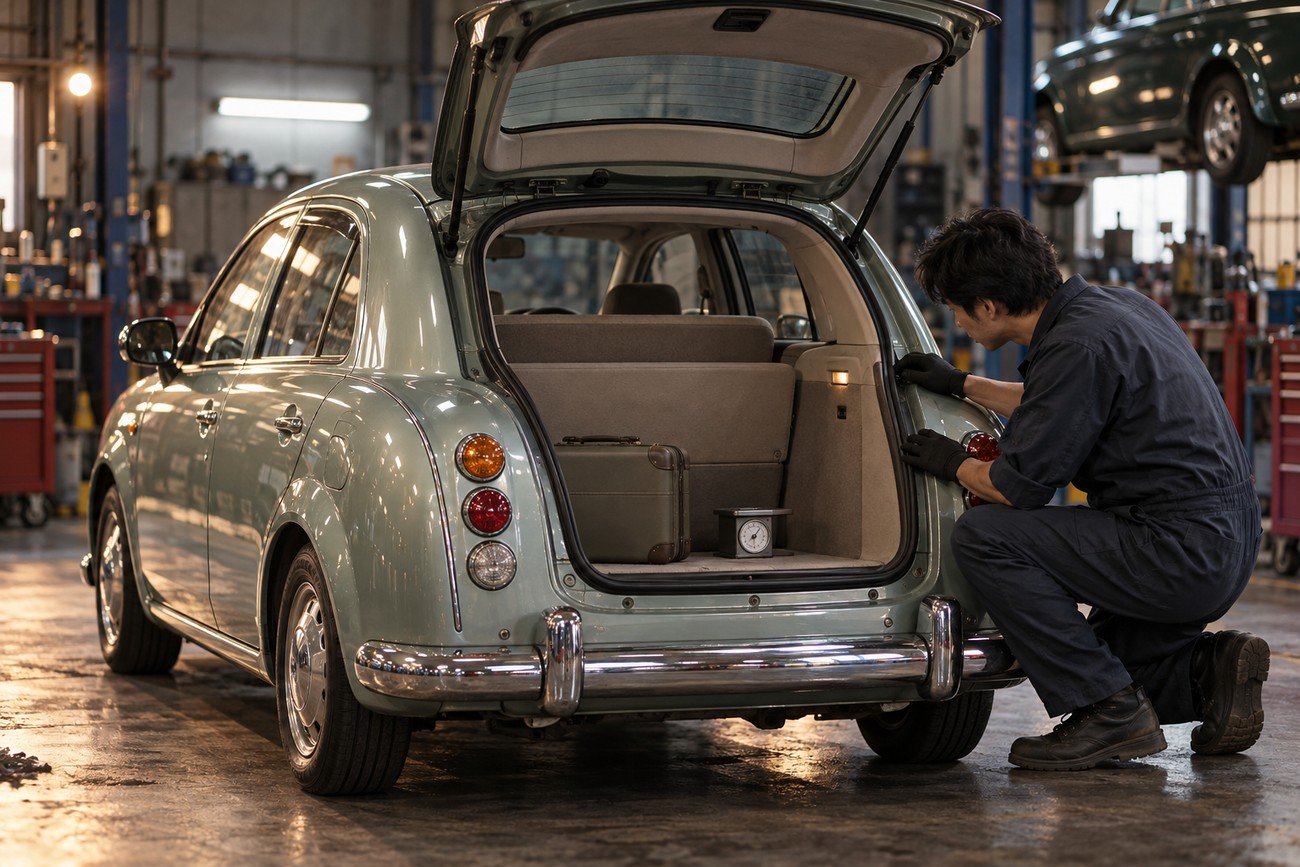
The additional luggage section creates another practical trap. Its front section has an approximately 10 kg load limit, and internal partitions can make the extended area unsuitable for large objects despite its formal appearance. Measure the usable space and inspect the hinges, seals, supports, and floor before assuming it provides normal sedan trunk capacity.
Interior materials can create a similar mismatch between appearance and expectation. Some wood-look panels are plastic imitation rather than natural wood, and worn trim may be difficult to match. The Viewt delivers a retro visual theme; it does not guarantee the materials or finishing quality of a premium Jaguar.
How to Inspect and Buy a Mitsuoka Viewt
Start with identity, not appearance. Confirm the chassis code, VIN, engine, drivetrain, transmission, and factory specification. K11, K12, and K13 codes are more useful for parts identification than the registration year, while a Viewt Story must be identified as the Toyota Yaris XP210-based model.
Use the confirmed base vehicle to price routine service items and mechanical repairs. Search consumables and many running-gear components through the underlying Nissan or Toyota model, then verify the part against the VIN. For a K13, confirm the CVT fluid and service procedure instead of allowing a seller or workshop to treat it as a conventional automatic.
Identify the chassis code and transmission before ordering parts, then inspect the joins, moisture traps, and repair history of the custom exterior panels separately; mechanical compatibility does not prove that the bodywork is sound.
Next, examine every connection between the Mitsuoka panels and the base body. Look for uneven gaps, cracked edges, trapped moisture, corrosion, fresh underseal, overspray, and fasteners that do not match. These areas can reveal previous repairs that a general inspection of the engine bay would miss.
Check paint fading, chrome pitting, panel cracks, bonnet heat, luggage-section supports, and the condition of the interior trim. A clean-running engine does not offset a damaged custom front end if replacement parts are difficult to source. Obtain a repair estimate for bodywork before negotiating, especially when the seller has priced the car by its styling rather than its condition.
Listings may omit the exact base generation, engine, drivetrain, and transmission. If the seller cannot provide reliable identification, treat the car as a parts and repair investigation rather than a straightforward used-car purchase.
Viewt Myths That Can Lead to a Bad Purchase
The first myth is that all Viewts share parts. They do not: the range spans Nissan March/Micra K11, K12, and K13 bases, plus the Toyota Yaris XP210-based Viewt Story. Mechanical parts must follow the confirmed donor vehicle, while exterior components may follow Mitsuoka-specific sourcing.
A second myth is that the large-looking rear section offers ordinary sedan luggage capacity. The extended shape can be visually convincing, but partitions and the approximately 10 kg limit for the front section restrict what you can carry. Treat it as a specialized luggage arrangement and inspect its condition before assigning practical value to it.
Retro styling also does not guarantee premium materials. Plastic imitation wood, aging chrome, fading paint, and cracked exterior components can coexist with an attractive design. The car’s visual character is genuine; the assumption of luxury construction is not.
Finally, the K13 figures of 1,198 cc, 79 hp, and 106 Nm apply to that specification only. They cannot describe every Viewt, and a reported urban fuel figure of about 13 km/l comes from one owner report rather than a universal rating. Performance and economy should be assessed from the actual base vehicle, engine, transmission, condition, and driving use.
Frequently asked questions
These questions cover the Viewt’s custom bodywork, performance, and design identity. The answers also reinforce why the underlying vehicle must be identified before purchase. Appearance alone cannot establish compatibility, practicality, or expected repair costs.
What should you do if a Viewt’s custom exterior panel is cracked?
First determine whether the panel can be repaired, whether a specialist replacement exists, or whether fabrication is required. Photograph the damage, inspect the panel’s mounting points and surrounding metal, and obtain a bodywork estimate before agreeing on the purchase price.
A small crack may be manageable if the panel is stable and dry. A spreading crack, distorted mounting area, moisture damage, or corrosion behind the overlay can make the repair substantially more expensive than the mechanical fault that brought you to the car.
Why does the Viewt sometimes feel less lively than the March it is based on?
The Viewt’s additional retro bodywork adds weight and can alter the way the compact car responds. Passenger load has a further effect, particularly on early 1.0-liter versions, where owners report noticeably weak pulling power with four passengers aboard.
Compare the car with the correct generation and engine rather than a light standard March with different equipment. On a K13, the 79 hp and 106 Nm specification, CVT behavior, vehicle condition, and load all shape the driving impression.
What is the most beautiful Japanese car of all time?
There is no objective single answer, because beauty depends on period, proportion, and personal taste. The Mitsuoka Viewt earns attention for its unusual Jaguar-inspired shape, while its appeal comes from combining that formal design with compact Japanese-car dimensions.
What car looks like a Nissan Skyline?
The Nissan Skyline itself is the clearest reference point, since its different generations have distinct rear-drive sports-sedan and coupe proportions. The Mitsuoka Viewt belongs to a different design idea: it resembles a classic Jaguar rather than a Skyline and is based on compact Nissan or Toyota hardware.
What car looks like a Jaguar?
The Mitsuoka Viewt is one of the clearest examples of a Japanese car with Jaguar-inspired styling. It uses retro exterior construction over Nissan March/Micra bases in earlier generations and Toyota Yaris hardware in the as highlighted by working professionals in the field.







