
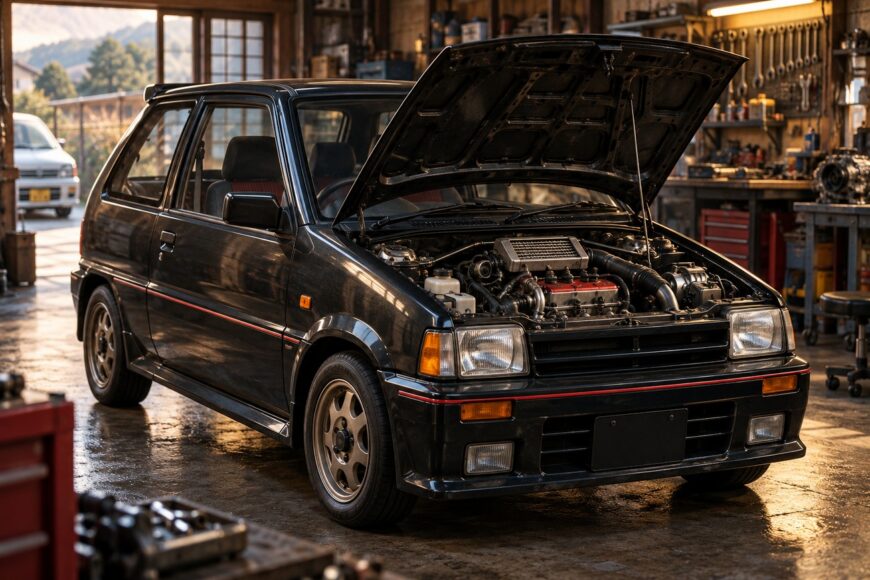
The Mitsubishi Minica Dangan was advertised with 64 PS in a body weighing little more than a modern motorcycle trailer. That figure gives the car its hot-rod reputation, yet buying one today means evaluating a decades-old turbocharged machine rather than chasing a specification-sheet number. The early Dangan ZZ and later ZZ-4 share the headline output, but their engines, torque curves, dimensions, weight, and parts requirements differ substantially.
The early car used approximately 548–549 cm³, while the post-1990 ZZ-4 grew to 657 cm³. Both came with a five-speed manual, and front- and four-wheel-drive layouts were available, so a badge or advertisement is not enough to identify the car. Claims of around 100 mph appear in secondary material, but no confirmed factory maximum-speed figure is established for a specific trim.
- Why the Mitsubishi Minica Dangan Was a Kei-Car Outlier
- Early ZZ vs. Dangan ZZ-4: What Actually Changed
- How Quick Is a 64 PS Dangan in the Real World?
- The Condition Problems That Matter More Than 64 PS
- Four-Wheel Drive, Highway Manners, and Parts Reality
- Dangan ZZ Buying Logic: Verify the Car, Not the Advertisement
- Frequently asked questions
- Which documents and identification marks should I request before importing a Dangan ZZ?
- What should I do if the seller cannot confirm whether the car is a ZZ or ZZ-4?
- How much does a Mitsubishi Minicab truck cost?
- How fast will a Japanese mini truck go?
Why the Mitsubishi Minica Dangan Was a Kei-Car Outlier
The 1989 Dangan ZZ combined a three-cylinder DOHC engine with an intercooled turbocharger in a very small kei-car package. Its headline output was 64 PS at 7,500 rpm, equivalent to approximately 63 mechanical hp or 47 kW. That distinction matters in English-language listings, where 64 PS is often written casually as 64 hp even though the units are not identical.
The cylinder head was the car’s most unusual technical feature. It used five valves per cylinder: three intake valves and two exhaust valves. The Dangan ZZ is regarded as the first production car with this configuration, giving it a genuine place in engineering history rather than a reputation based only on styling or marketing.
Five valves per cylinder helped the small engine breathe at high speed, while the turbocharger supplied the additional air needed for its output. The result was an engine designed to work hard near the top of the rev range. A peak at 7,500 rpm tells you more about the driving character than the 64 PS figure alone: the car rewards maintaining revs and selecting gears rather than relying on a broad modern turbo torque band.
The hardware also creates a maintenance obligation. A DOHC five-valve head and intercooled turbo do not prove durability in a used example. Oil quality, cooling performance, boost control, and previous servicing determine whether the engine remains an entertaining high-revving unit or becomes an expensive restoration project.
Early ZZ vs. Dangan ZZ-4: What Actually Changed
The later ZZ-4 retained the 64 PS headline, yet its larger engine produced substantially more torque at lower rpm. It also became longer, taller, and heavier after Japanese kei-car regulatory changes after 1990.
| Specification | Early Dangan ZZ | Dangan ZZ-4 |
|---|---|---|
| Regulatory era | 1989-era kei specification | After Japanese kei-car regulatory changes introduced after 1990 |
| Engine | Approximately 548–549 cm³, commonly identified as 3G81 | 657 cm³ 3G83 |
| Power | 64 PS at 7,500 rpm | 64 PS at 7,000 rpm |
| Torque | 74.5 N·m at 4,500 rpm | 96.1 N·m at 3,500 rpm |
| Approximate mass | About 640 kg | About 720 kg |
| Dimensions | Approximately 3,195 × 1,395 × 1,465 mm | Approximately 3,295 × 1,395 × 1,515 mm |
| Wheelbase | 2,260 mm | 2,265 mm |
How Quick Is a 64 PS Dangan in the Real World?
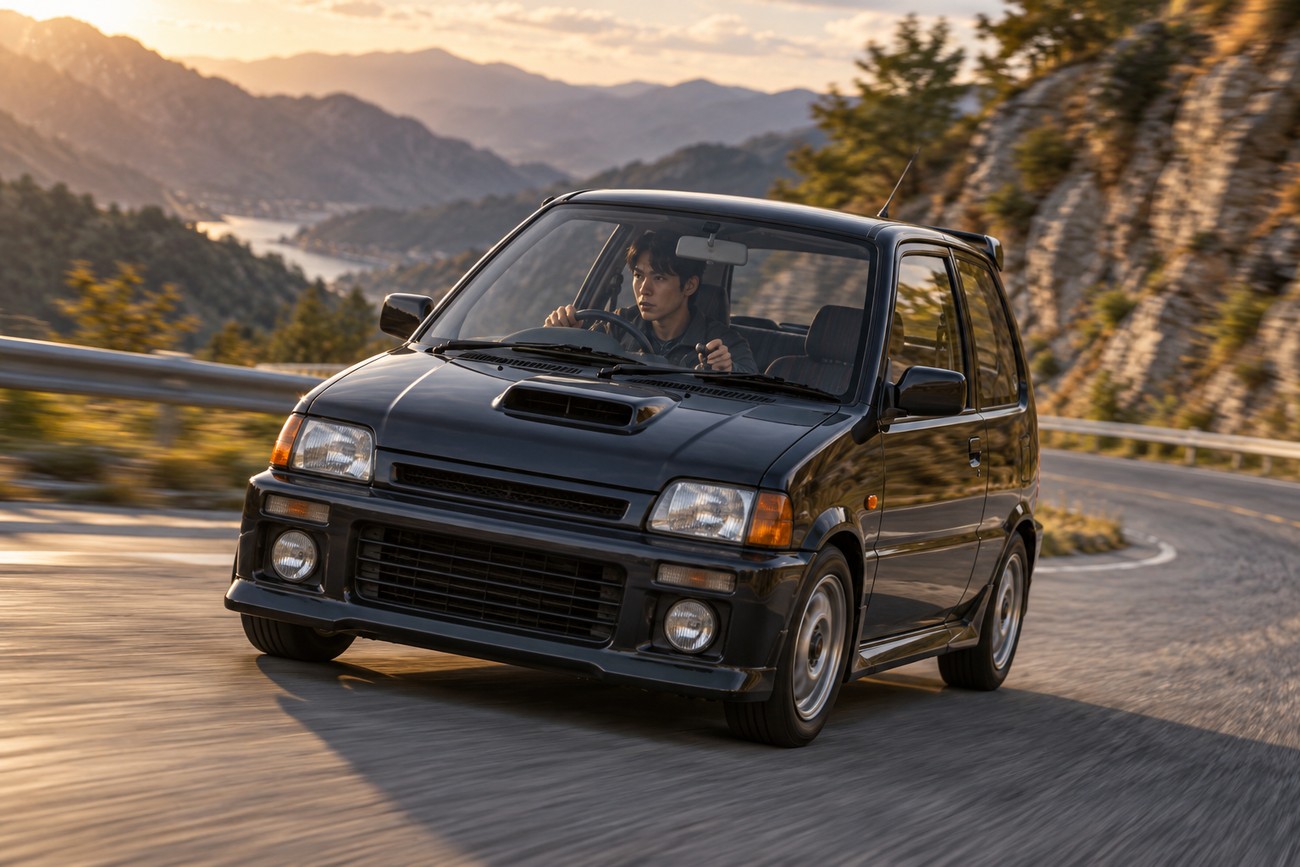
The early ZZ’s low mass gives its power considerable effect. At about 640 kg, it can feel more urgent than the output suggests, especially when the engine is kept in its working range. That sensation depends heavily on turbocharger health, gearing, tire condition, and whether corrosion or neglected suspension has compromised the car.
Its five-speed manual is central to the experience. The early engine makes 74.5 N·m at 4,500 rpm and reaches maximum power at 7,500 rpm, so acceleration involves using the gearbox and allowing the engine to rev. The ZZ-4 supplies 96.1 N·m at 3,500 rpm, which should make ordinary hills and intermediate acceleration less dependent on high engine speed, although its additional mass changes the balance.
Front-wheel-drive and four-wheel-drive versions existed. Four-wheel drive may improve traction on loose or wet surfaces, yet it also adds weight and mechanical complexity. It cannot compensate for worn tires, weak brakes, tired suspension, or aged rubber components.
Around 100 mph is sometimes repeated as a Dangan top-speed claim, but it should be treated as an unconfirmed secondary figure rather than a factory specification. The sensible way to assess performance is to judge the individual car’s boost behavior, compression, gearing, and mechanical condition. A healthy lower-performing example is more useful than a tired car supported by an impressive advertisement.
The Condition Problems That Matter More Than 64 PS
Age is the primary risk. Cooling systems, fuel systems, wiring, vacuum lines, and seals may have deteriorated even when the engine starts promptly from cold. A cold start demonstrates that the car can run under one condition; it does not establish oil pressure, compression, cooling capacity, or correct turbo operation.
A proper inspection should include compression testing, oil-pressure verification, and observation of smoke under boost. The turbocharger should build pressure progressively, without suspicious noise, excessive oil consumption, or a sudden loss of power. The cooling system deserves equal attention because overheating can damage a high-revving turbo engine quickly, especially when the service history is unknown.
Test boost-related behavior only after confirming cooling-system health. A brief strong pull can conceal overheating, weak oil pressure, or a failing hose, so performance testing should come after basic mechanical checks.
Look beyond the engine bay. Corrosion in structural areas, fatigued wiring, hardened vacuum hoses, and brittle fuel lines can be more economically serious than a single engine fault. Inspect brake lines, calipers, wheel bearings, suspension joints, driveshafts, and the condition and age of the tires before treating a successful road test as evidence of a sound car.
Parts identification must be precise. Confirm the chassis code, including H21A or H27A where applicable, model year, engine, and drivetrain before ordering components. A seller’s use of “Minica Dangan” does not identify every sensor, turbo component, gearbox part, or four-wheel-drive item.
Four-Wheel Drive, Highway Manners, and Parts Reality
Four-wheel drive adds shafts, differentials, joints, seals, and other service points. Those components can be difficult to inspect and costly to restore when a rare part is unavailable. A four-wheel-drive Dangan is therefore a specification choice with maintenance consequences rather than a universally superior version.
Highway behavior reflects the car’s original scale. The compact body, short wheelbase, high engine speed, and limited insulation make long-distance travel noisy. Crosswinds can also influence the car more than a larger vehicle, and the driver has less mass and tire width working in reserve.
One owner reported approximately 4,200 rpm at 62 mph and strong mountain pull. That is useful as an anecdotal indication of how one car behaved, though it is not a universal specification. Tire size, final-drive ratio, engine condition, and transmission condition can alter the experience substantially.
Rare 3G81 and 3G83 engines, turbo-system parts, and four-wheel-drive components are generally harder to source than parts for common modern kei cars. Before buying, identify the supply route for routine service items and major drivetrain components. A car that needs several unavailable parts can become uneconomic even if its basic engine remains repairable.
Dangan ZZ Buying Logic: Verify the Car, Not the Advertisement
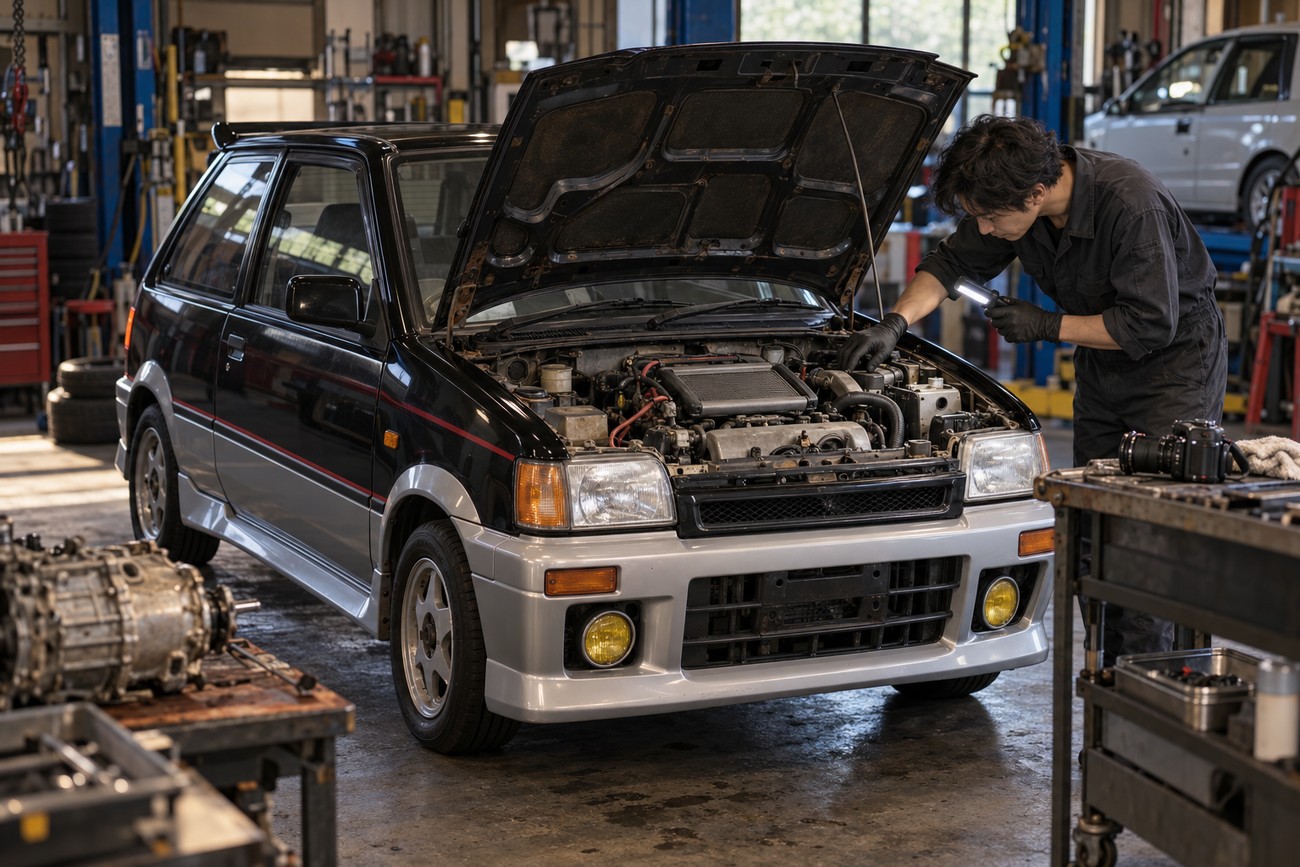
Use 64 PS as a starting point, never as the main buying filter. That figure can describe the early approximately 548–549 cm³ ZZ or the later 657 cm³ ZZ-4. Their torque figures, power rpm, dimensions, mass, engine designation, and likely parts requirements are different.
Ask for clear photographs of the identification plates, chassis marks, engine number, drivetrain, and transmission. Match those details with the model year and registration or auction documentation. H21A/H27A, the engine designation, and the drive layout should agree before you assign value to the car or order parts.
Inspect the car as a system. Confirm compression and oil pressure, check for smoke during boost, verify cooling stability, and examine the turbo plumbing. Then assess corrosion, wiring, hoses, brakes, suspension, tires, clutch, and four-wheel-drive hardware where fitted.
The five-valve cylinder head is an important historical distinction, yet it does not prove superior durability in a used car. A well-maintained example with ordinary-looking documentation is the stronger purchase than a neglected car advertised with performance claims that cannot be verified.
Frequently asked questions
These questions focus on identifying the correct Dangan specification before purchase. They also address documentation, condition, parts, and performance claims. The same verification principles apply whether the car is front-wheel drive or four-wheel drive.
Which documents and identification marks should I request before importing a Dangan ZZ?
Request the export certificate, auction sheet or registration records, model year, chassis code, engine number, drivetrain information, and photographs of the identification plate. The records should agree with the physical car, including whether it has the early approximately 548–549 cm³ engine or the later 657 cm³ 3G83.
Ask for evidence of the exact transmission and four-wheel-drive configuration, plus any service invoices covering cooling, turbocharger, timing-related work, and clutch maintenance. Matching documentation reduces the risk of ordering parts for the wrong H21A/H27A variant.
What should I do if the seller cannot confirm whether the car is a ZZ or ZZ-4?
Pause the purchase until the displacement, engine identifier, chassis code, model year, and drivetrain are verified. Do not value the car from the badge alone, because the early ZZ and ZZ-4 share the 64 PS headline while differing in torque, size, mass, and engine designation.
Until those details are confirmed, avoid ordering parts or committing to repairs based on an assumed specification. If the seller cannot provide clear identification records or photographs, treat that uncertainty as a material buying risk.
How much does a Mitsubishi Minicab truck cost?
That question concerns a different Mitsubishi vehicle, and no reliable price can be assigned without a country, model year, condition, mileage, and import status. A Minicab truck should not be used as a price reference for a Minica Dangan.
For either vehicle, compare documented condition and specification rather than a headline listing figure. Import taxes, transport, registration, and parts availability can change the final cost substantially.
How fast will a Japanese mini truck go?
There is no single dependable speed for every Japanese mini truck. Engine, gearing, load, tire condition, maintenance, and local market specification all affect its road performance.
The same caution applies to the Dangan: around 100 mph appears as a secondary claim, while no confirmed factory maximum-speed figure is established for a specific trim. A buyer should rely on verified mechanical condition and road testing rather than an unconfirmed top-speed number.







