
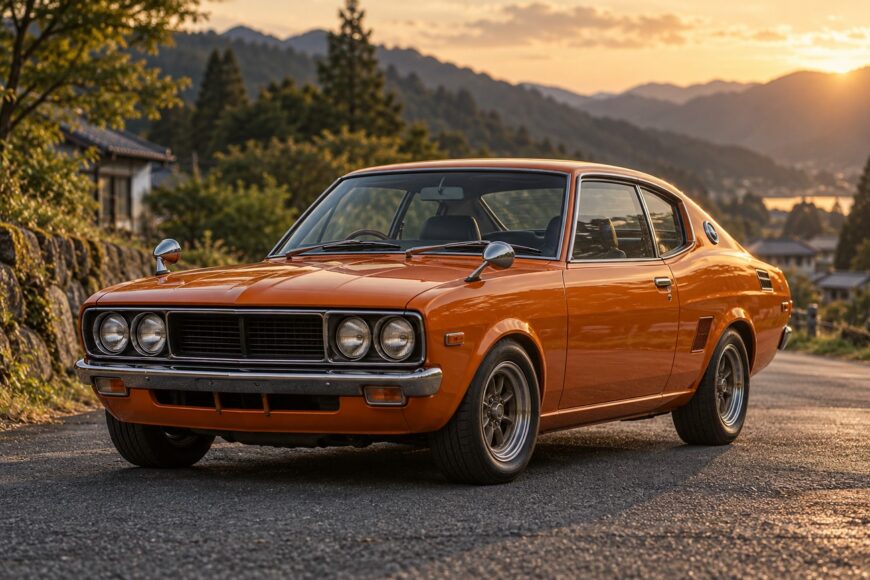
The Mitsubishi Galant GTO MR wears the shape of a Japanese muscle coupe: a long hood, a low roof, and styling that makes it look larger than it is. Underneath, it is a compact, light 1970s car with a high-revving 1.6-liter engine and the handling and safety limitations of its era. Its appeal lies in that combination, provided you do not expect a modern sports coupe.
The MR badge demands more scrutiny than the paintwork. A short production life shaped by emissions rules, approximately 835 cars built, and decades of repairs make original specification difficult to establish. Corrosion and scarce parts can turn a promising purchase into a prolonged restoration, even when the car looks convincing in photographs.
- What the Galant GTO MR Actually Was
- The Numbers Behind the 125-PS Coupe
- Why It Looks Like a Muscle Car—and Why It Is Not One
- The MR’s Short Life: Emissions Rules and Rarity
- Buying One Today: Verify the MR Before the Paint
- Restoration Reality: Rust, Parts, and Old-School Systems
- Frequently asked questions
- What does GTO stand for in Mitsubishi?
- Which model year of the Galant GTO MR is most desirable?
- What is the top speed of a Mitsubishi Galant GTO MR?
What the Galant GTO MR Actually Was
The Colt Galant GTO was a coupe based on the first-generation Galant and produced from 1970 to 1977. It brought American-influenced muscle-car styling into a size suited to Japanese roads and regulations. The MR was a distinct high-specification version within that range, rather than another name for every Galant GTO.
MR is historically expanded as Motorsports and Rally. The designation identifies the sought-after performance specification, whose 1.6-liter 4G32 DOHC engine is central to its identity. A later GTO can share much of the silhouette without being mechanically or historically equivalent.
Approximately 96,000 cars were built across the Galant GTO range. That figure describes the whole model family; it should never be used as the MR production total. For a buyer, the distinction affects everything from how a listing is assessed to what constitutes a correct restoration.
The “muscle coupe” description captures Mitsubishi’s design ambition, though it can obscure the car’s scale. The MR offered an assertive shape and a distinctive engine in a compact package. Its rarity today reflects a specific, short-lived variant, not a mass-market performance model hiding behind a familiar badge.
The Numbers Behind the 125-PS Coupe
These commonly cited specifications put the MR’s proportions and engine in context.
| Specification | Mitsubishi Galant GTO MR |
|---|---|
| Engine | 1.6-liter 4G32 DOHC |
| Induction | Twin Solex carburetors |
| Output | 125 PS at 6,800 rpm |
| Length, width, height | 4,125 mm long, 1,580 mm wide, and 1,310 mm high |
| Wheelbase | 2,420 mm |
| Curb weight | Approximately 980 kg |
Those dimensions explain a common first impression: the styling suggests a substantial GT, while the actual car occupies a compact footprint. At approximately 980 kg, it did not need a large engine to feel responsive. The DOHC engine’s quoted output arrives high in the rev range, so its character is better understood through revs and low mass than through the effortless pull associated with a big-displacement muscle car.
The 2,420 mm wheelbase contributes to the coupe’s sense of immediacy, though specifications alone cannot promise how a surviving example will drive. Tires, suspension condition, alignment, and past modifications all matter. Treat the numbers as a guide to the original concept, then judge the individual car on the road and underneath.
Why It Looks Like a Muscle Car—and Why It Is Not One
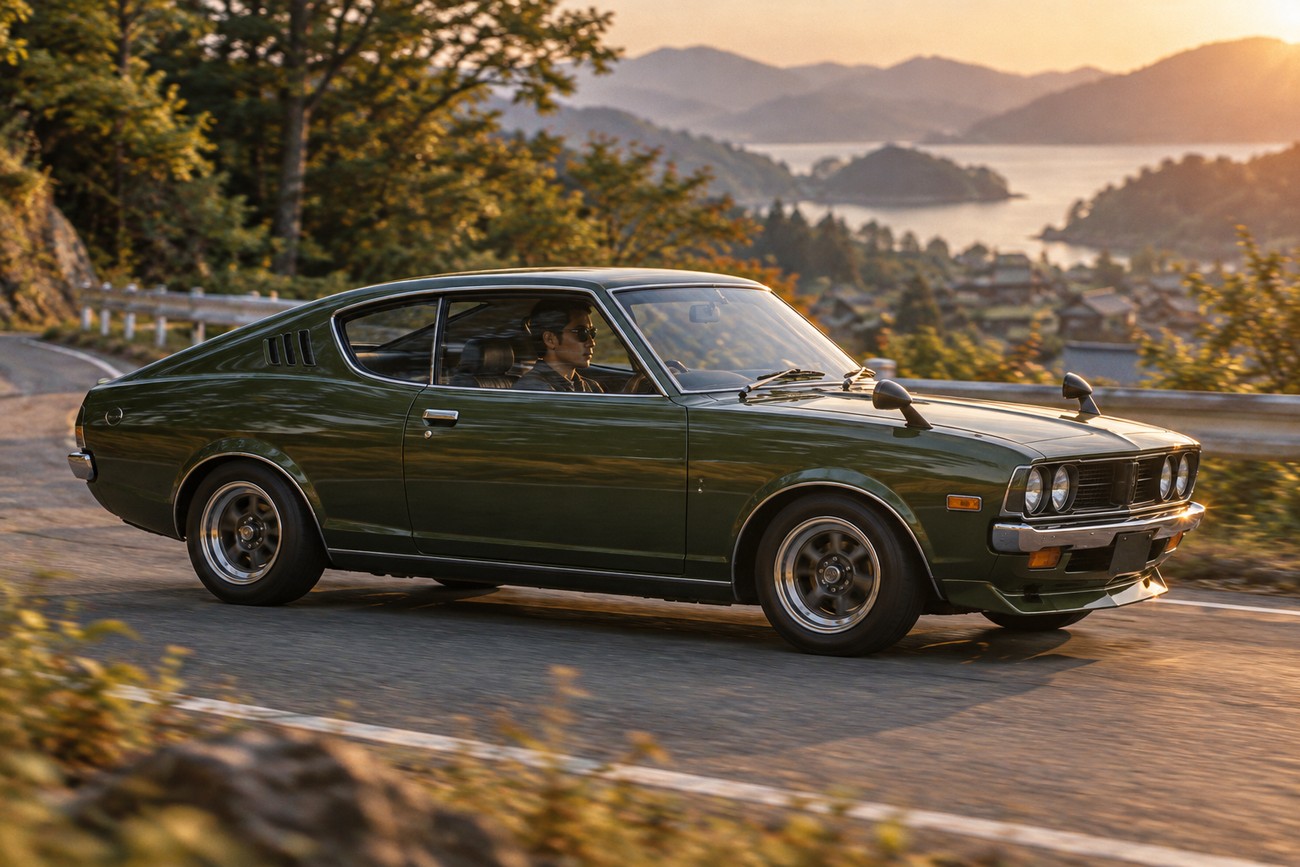
The Galant GTO’s broad visual cues borrow from American performance coupes, compressed into a Japanese format. Its low roof and assertive profile do much of the work. The MR adds an engine that rewards revs, giving substance to the sporting image without turning the car into a full-size American muscle car.
Low mass and a 2,420 mm wheelbase help explain why an MR can feel lively. They also mean that responses may be more immediate than its appearance suggests. A driver expecting the planted behavior of a modern sports coupe, however, is using the wrong reference point.
The rear suspension used a solid rear axle with leaf springs, not independent rear suspension. That is original engineering, not a fault to diagnose from a photograph. Road surfaces and abrupt inputs can expose the limitations of a period chassis, particularly when worn components or unsuitable tires complicate the picture.
Brakes, stability, and passive safety belong to the same era as the suspension. Leave more room in traffic and assess the condition of the complete car before relying on its performance. The pleasure is in driving a light historic coupe with an expressive engine, with the judgment that older hardware requires.
The MR’s Short Life: Emissions Rules and Rarity
The MR’s disappearance cannot be explained simply as a verdict on buyer demand. The 4G32 MR became obsolete around January 1973 because of stricter emissions standards. That regulatory change curtailed the particular engine specification that defines the version.
MR production is commonly cited at approximately 835 cars. The figure is best treated as an approximate historical total, rather than a precise count of survivors. Either way, it describes a far smaller group than the approximately 96,000 cars built across the Galant GTO range.
Later Galant GTO versions continued with different engines and chassis codes. Their existence is one reason broad claims such as “1970–1977 MR” deserve examination: the full coupe range lasted through 1977, while the original MR specification did not. A registration date or GTO badge alone cannot settle the identity of a particular car.
This short window has a practical consequence for collectors. An apparently small departure from original specification may involve components that are difficult to replace with correct ones. The history that makes an MR desirable also makes evidence of its identity and configuration unusually valuable.
Buying One Today: Verify the MR Before the Paint
Begin with identity. Check the chassis information and supporting records against the car, then establish what engine is fitted. The correct 1.6-liter 4G32 DOHC specification and twin Solex carburetors deserve direct inspection; a badge or seller’s description is insufficient evidence.
Many surviving GTOs have been repaired or modified, and later versions can be confused with an MR. An engine swap, changed induction, or incomplete paperwork does not automatically make a car undesirable, though it changes what you are buying. Ask for clear photographs of identification details and mechanical components before committing to an in-person inspection.
Inspect cosmetic work with the same skepticism as mechanical claims. Paint can conceal corrosion or repairs, while missing badges, glass, and interior fittings may prove difficult to source. If provenance is incomplete, describe and value the car according to what can be verified, rather than accepting an MR identity on appearance alone.
Restoration Reality: Rust, Parts, and Old-School Systems
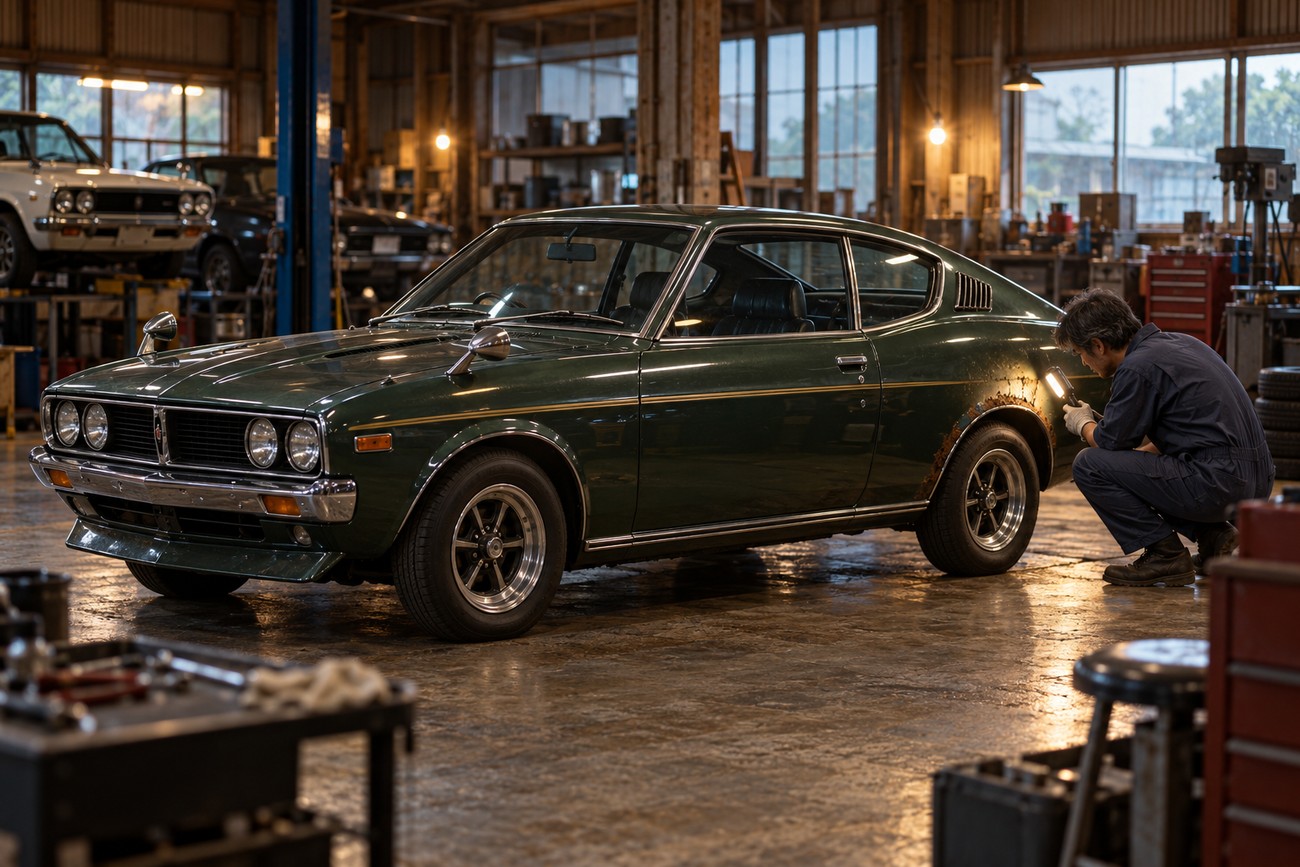
Corrosion is the first budget threat. Examine wheel arches and the surrounding body closely, including areas hidden by trim or repairs; a clean exterior photograph cannot establish sound metal. Bodywork can also create a chain of parts needs once glass, seals, and fittings must come off.
Original OEM parts are scarce, particularly chrome, glass, badges, and interior components. A mechanically tired but complete car may therefore offer a clearer restoration path than a freshly painted shell missing distinctive pieces. Record what is present before assuming that small omissions will be easy to correct.
Owners report that the high-revving engine benefits from careful carburetor and ignition adjustment. Treat that as practical ownership experience, rather than a measured failure rate. Enthusiasts also report electrical and aging fuel-system troubles, so an inspection should include starting, running, wiring condition, and signs of old fuel-system repairs.
Separate deterioration from original design. The solid rear axle with leaf springs belongs on the car; worn mounts, damaged components, or poor repairs do not. A sound MR should be evaluated as a period machine that has survived, rather than as a modern chassis waiting to be revealed by restoration.
Frequently asked questions
The names and performance claims attached to the GTO can make listings harder to interpret. These distinctions help keep a badge, a model year, or a published speed figure from carrying more weight than the evidence supports.
What does GTO stand for in Mitsubishi?
GTO is commonly expanded as Gran Turismo Omologato. It is the name used for the broader coupe range, while MR is a separate designation historically expanded as Motorsports and Rally. Seeing “GTO” on a car therefore does not establish that it is an MR.
Which model year of the Galant GTO MR is most desirable?
Collectors generally focus on MR cars from 1970 through 1972, before the 4G32 MR became obsolete around January 1973 under stricter emissions standards. That makes an early car worth investigating, though year alone does not guarantee originality. Condition, documented identity, and the survival of correct components should decide how strongly any example appeals.
What is the top speed of a Mitsubishi Galant GTO MR?
No single dependable top-speed figure is established by the historical material used here. A quoted result may depend on specification, gearing, vehicle condition, and test conditions, so repeating one number without its source would imply more certainty than the evidence allows. The better-supported performance reference is the MR’s commonly stated output of 125 PS at 6,800 rpm.







