
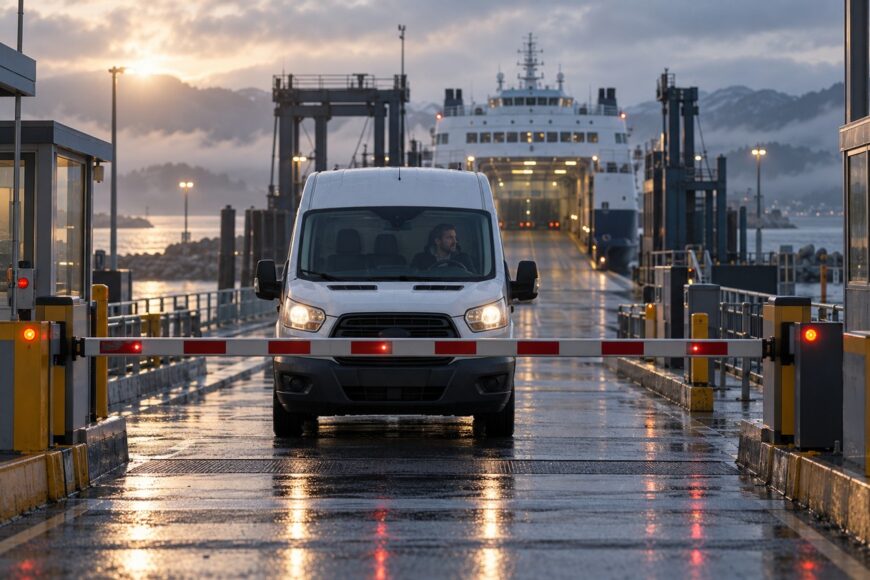
The sailing time printed on a ferry ticket is not necessarily the deadline for taking a vehicle onto the ship. Vehicle check-in often closes earlier, and missing the last sailing can turn a late drive into an unplanned night at or near the terminal.
A Ford Transit also has no single ferry size. Its length, height, mirrors, roof equipment, and commercial or camper classification can affect the booking category. Accurate measurements and a realistic arrival buffer matter as much as the navigation app’s estimated driving time.
- The Ferry Departure Time Is Not Your Real Deadline
- Why Your Ford Transit May Be in the Wrong Ferry Category
- What to Do After Missing the Last Ferry
- The Mistakes That Turn a Late Arrival Into an Overnight Failure
- Where to Wait or Sleep When No Ferry Remains
- Frequently asked questions
- Which Ford Transit year should you avoid for ferry travel?
- What exactly should I ask the ferry operator when I know I will be late?
- How can I prove the Transit dimensions if the booking details are disputed at the terminal?
The Ferry Departure Time Is Not Your Real Deadline
Vehicle check-in commonly closes before the ferry’s scheduled departure. The exact cutoff depends on the route, operator, season, and booking type, so the time shown on a ticket should never be treated as the only deadline that matters.
A navigation app usually calculates arrival at the port or terminal entrance. It may not allow for traffic, fueling, a sanitary stop, security checks, registration, a vehicle queue, or the time needed to find the correct loading area. A van that reaches the port shortly before departure can still arrive after vehicle registration has closed.
A ticket for a specific sailing does not guarantee vehicle loading after vehicle registration has closed. Staff may move the booking to a later sailing, apply the operator’s no-show rules, or require a new ticket, depending on the fare and available vehicle space.
Before leaving, ask the operator for the exact “vehicle-booking check-in cutoff,” rather than simply asking when the ferry departs. Keep that time with the booking confirmation and plan to reach the terminal with a buffer for the full approach process, not only the final miles on the road.
Why Your Ford Transit May Be in the Wrong Ferry Category
The name Ford Transit does not identify one transport size. Across versions, a Transit may be approximately 5.05–6.70 m long, 2.06–2.28 m wide with mirrors, and 1.96–2.78 m high. Those differences can place similar-looking vans in different ferry categories.
Ferry categories are based on the vehicle’s actual length and height and, in some cases, its commercial status. A long-wheelbase or high-roof version can require a different fare from a shorter van, even when both are described simply as a Transit in an online listing or by a driver.
Measure the vehicle in transport-ready condition. A roof rack, solar panel, storage box, ladder, or other addition can increase the measured height or width and may move the vehicle beyond a standard car or van category. Mirrors and external equipment also matter where the operator uses maximum overall dimensions.
Staff need the loaded vehicle’s true height and length, rather than the model name. A roof-mounted accessory can trigger a category correction at the terminal if the booking was made from the base vehicle specification.
A converted camper or commercial Transit may also be classified differently from an ordinary passenger vehicle. Operators apply their own descriptions and fare rules, so confirm how the specific vehicle will be treated before payment, especially if it has a permanent conversion, business use, or unusual bodywork.
What to Do After Missing the Last Ferry
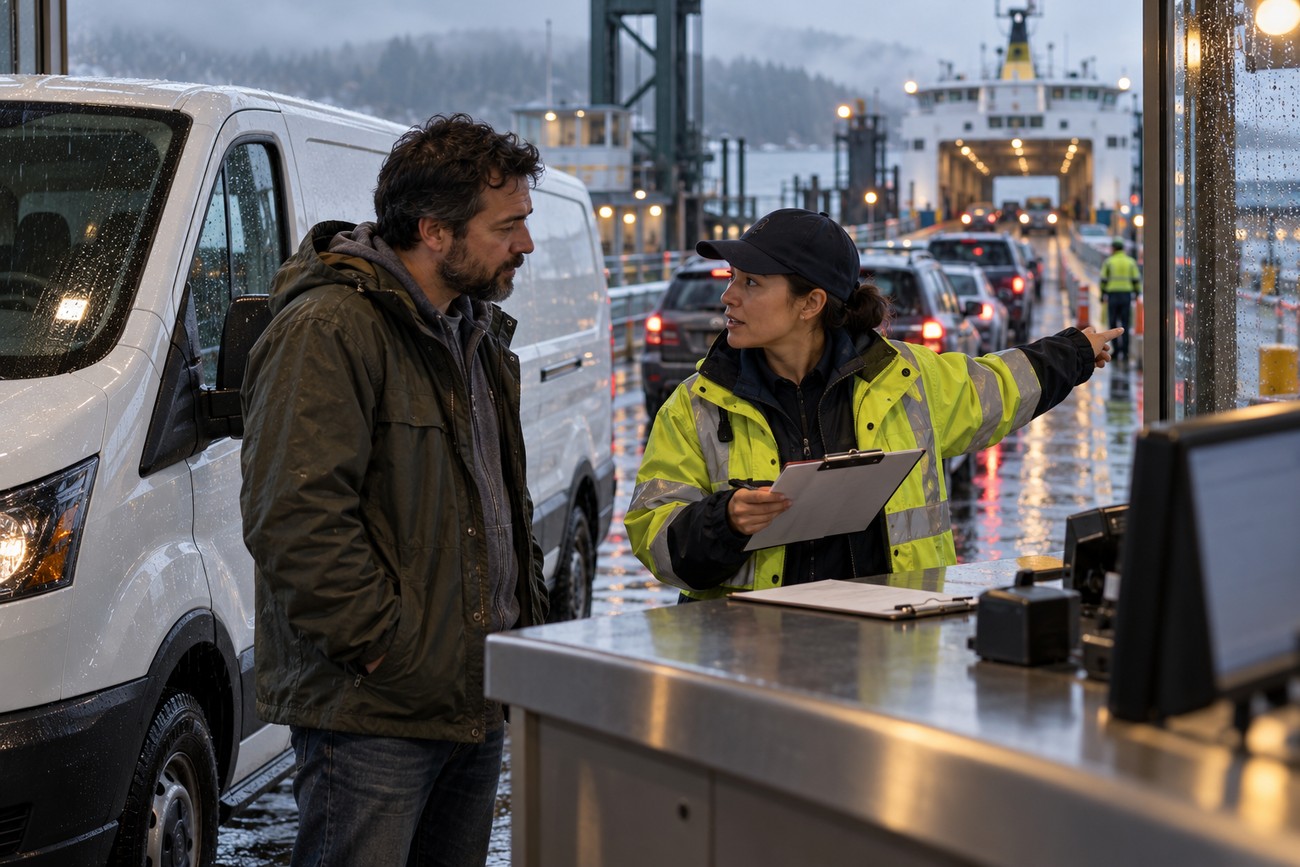
Contact the operator immediately, preferably before the vehicle check-in deadline has passed. Explain that you are late for a vehicle booking and ask whether the booking can be preserved, whether the next sailing has vehicle space, and where you should wait safely.
Rebooking may depend on the fare terms and available vehicle space. It may involve a fee or require a new ticket, and free automatic transfer is not universal. The next sailing can also be full, particularly on busy routes, so an assumption that you will simply board in the morning can create another delay.
If no suitable sailing is available, compare the remaining options in practical terms: a later ferry, a land detour, accommodation or camping, or waiting in an operator-approved area. Check the effect on fuel, driving hours, onward bookings, and any passengers who need a place to stay.
A call made before vehicle check-in closes may preserve the booking or produce specific instructions. After a no-show, the available options are usually more limited. Follow staff directions before leaving the vehicle queue, since some terminals have restricted turning space for long vans or direct late vehicles to a separate waiting area.
The Mistakes That Turn a Late Arrival Into an Overnight Failure
The first mistake is planning to arrive at the scheduled sailing time instead of the vehicle check-in cutoff. Build the journey around the earlier deadline and allow time for traffic, fueling, sanitary stops, terminal access, security, registration, and the vehicle queue.
The second is entering a generic Transit description during booking. Use the exact length and height of the loaded vehicle, including roof-mounted equipment, and provide the relevant commercial or camper information where the operator requests it. A wrong category can lead to a correction, extra charge, or delay at the terminal.
The third is leaving the line for fuel or food without speaking to terminal staff. On some systems, the vehicle’s place is tied to its position in the queue. Obtain permission and ask where you can return before moving the van.
Use a short pre-departure routine: measure the Transit in its transport-ready condition, photograph the vehicle identification or weight plate, save the measurements with the booking, and confirm the vehicle check-in cutoff. Carry enough fuel, water, and phone charge to handle a delay near the terminal.
Where to Wait or Sleep When No Ferry Remains
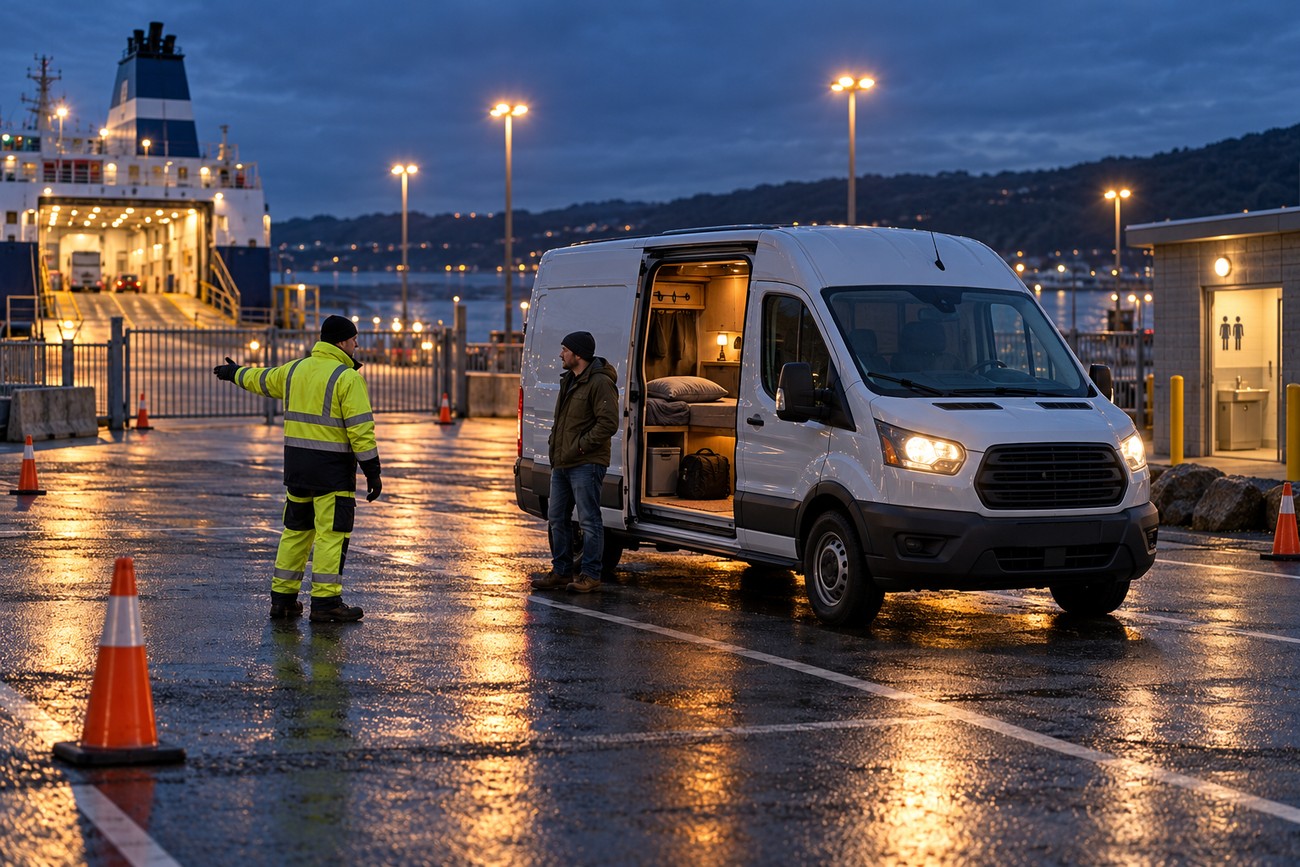
Ask the operator for a permitted waiting location before assuming the terminal can be used overnight. Sleeping in a vehicle at a ferry terminal is not automatically permitted, and rules may differ between the approach road, holding area, parking lot, and port-controlled land.
Parking rules, passenger disembarkation, toilet access, and overnight permissions depend on the specific port and operator. Staff may require passengers to leave the vehicle, direct vehicles to another area, or prohibit overnight waiting altogether. Follow posted instructions and do not block loading lanes or emergency access.
An unplanned night can add accommodation, parking, food, booking-change, and onward-connection costs. A hotel may also have a late check-in policy, while a campsite or legal parking area may be outside the terminal and unsuitable for a large van without prior confirmation.
For the last sailing, keep a simple off-terminal backup plan: enough fuel to reach an approved location, drinking water, a phone charger or power bank, and the contact details for the operator and nearby accommodation. Treat terminal sleeping as a possibility requiring permission, rather than as the default fallback.
Frequently asked questions
These answers cover specific edge cases that can affect a Transit booking, a late arrival, or a dispute at the terminal.
Which Ford Transit year should you avoid for ferry travel?
No single Ford Transit model year should be avoided for ferry travel. Ferry suitability depends on the specific version, its actual dimensions, added equipment, and the booking classification used by the operator.
Check the vehicle’s length and height in its loaded condition, including roof equipment, then compare those figures with the operator’s vehicle categories. The model year may help identify the specification, but it does not establish one universal ferry size or fare.
What exactly should I ask the ferry operator when I know I will be late?
Use a direct script: “I have a vehicle booking for [sailing]. I will arrive late. What is the vehicle-booking check-in cutoff, is there space on the next sailing, and what are the transfer conditions?”
Also ask where you may wait if boarding is refused, whether the booking will be treated as a no-show, and whether passengers must leave the vehicle. Record the staff member’s instructions and any fee or new-ticket requirement before leaving the terminal approach.
How can I prove the Transit dimensions if the booking details are disputed at the terminal?
Keep one file containing the vehicle specification, the measured loaded dimensions, roof-equipment details, the booking confirmation, and photographs of the vehicle. Include a clear photograph of the identification or weight plate and images showing any rack, box, ladder, or solar equipment that affects the dimensions.
This documentation lets the operator assess the actual vehicle instead of relying on the generic word “Transit.” It may not override the operator’s tariff rules, but it can clarify whether the booking used the correct length, height, and vehicle classification.







