
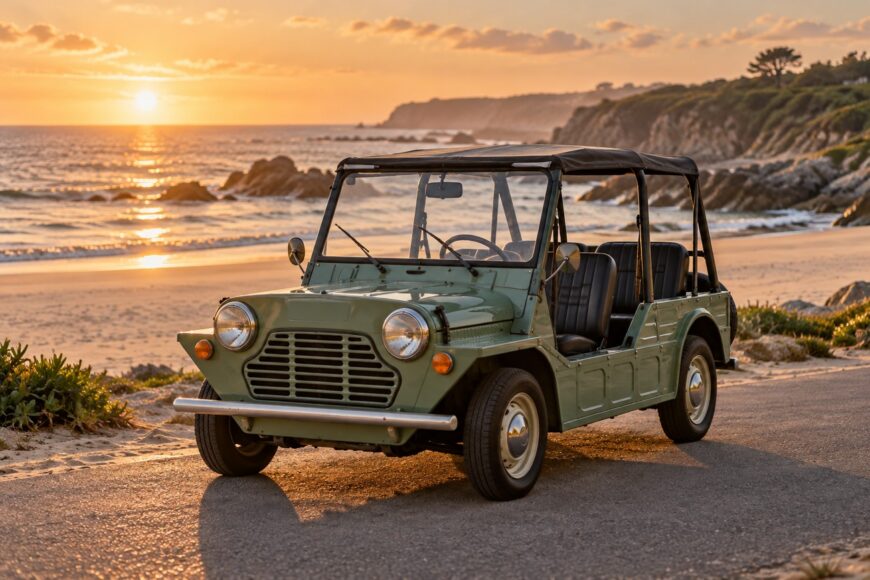
The Mini Moke looks like a carefree beach buggy, yet its roots are in a lightweight military-oriented utility vehicle. That contradiction explains much of its appeal and most of its limitations: the open body, low sides, and doorless access were practical decisions before they became holiday styling.
Buying one therefore requires more than admiring the silhouette. The right choice depends on the exact version, your climate, road conditions, expected speeds, passenger needs, and whether another vehicle is available for ordinary transport. A classic petrol Moke, a later reworked model, and a modern Electric MOKE can look related while offering very different ownership experiences.
- Why the Mini Moke was built as an open utility vehicle
- Mini Moke versions compared: engines, speed, and character
- The Electric MOKE: a new product, not just an old Mini on batteries
- What the Mini Moke is really like on roads, sand, and slopes
- Buying a Mini Moke: checks that matter more than the badge
- Who should buy a Mini Moke—and who should not
- Frequently asked questions
- How much does a Mini Moke cost?
- How much is a Mini Moke worth?
- How can I tell whether a Moke is a classic Mini Moke or a modern Electric MOKE?
Why the Mini Moke was built as an open utility vehicle
BMC originally developed the Mini Moke as a lightweight utility vehicle for military use. The brief favored simplicity, low weight, and easy access over weather protection, refinement, or long-distance comfort. An open body reduced structural complexity, while the lack of conventional doors allowed occupants to get in and out quickly.
That layout made sense for a vehicle used around bases, on private ground, or wherever rapid access mattered. It also kept the sides visually and mechanically simple. The Moke was never conceived as a modern off-roader with substantial suspension travel, high ground clearance, or protective bodywork.
The beach-car identity came later, helped by the Moke’s friendly shape and open-air driving position. Warm climates made its exposed cabin more tolerable, while resorts and private communities valued the easy entry and relaxed pace. The same features that looked charming on a sunny coastline could become serious disadvantages in cold weather, heavy rain, or normal traffic.
Understanding the original purpose prevents a common buying mistake. The Moke’s minimal construction is functional utility design, not evidence that every component was intended for demanding terrain or luxury leisure use. Its character comes from doing a small job in a distinctive way, rather than from broad capability.
Mini Moke versions compared: engines, speed, and character
Specifications vary by generation and market, so the figures below should be treated as a guide to the main configurations rather than a universal specification sheet.
| Configuration | Powertrain and output | Transmission and drive | Headline performance | Best-suited use |
|---|---|---|---|---|
| Early petrol version | 948 cc, about 37 hp | Manual transmission; front-wheel drive | Modest acceleration, especially on climbs | Short trips on level, relatively good roads |
| Alternative petrol version | 848 cc, about 34 hp | Four-speed manual; front-wheel drive | Up to 105 km/h | Leisure cruising where traffic speeds are manageable |
| Later reworked petrol version | 1.1-litre engine, about 70 hp | Manual or automatic, depending on version; front-wheel drive | More usable performance than early cars | Short road journeys with fewer compromises |
| Modern Electric MOKE | 33 kW, about 44 hp, 100 Nm | Electric drive; market specification may vary | Around 80 km/h or 50 mph | Warm-weather cruising, resorts, and short local trips |
The early 948 cc engine produced about 37 hp, while another commonly cited configuration used an 848 cc engine with about 34 hp and a top speed of up to 105 km/h. Those figures describe a light, low-speed utility car rather than a machine designed to merge effortlessly into fast-moving traffic or climb difficult terrain.
Later reinterpreted versions with a 1.1-litre engine producing about 70 hp improved the basic experience. Depending on the version, buyers could find a manual or automatic transmission, along with upgraded suspension and brakes. That does not make every later car equivalent to a modern compact vehicle, because condition, gearing, equipment, and market specification still matter.
Appearance is an unreliable way to identify the mechanical package. A restored classic may carry later components, while a newer product may deliberately preserve the historic outline. Ask for the chassis or vehicle documentation, engine details, transmission type, and equipment list before drawing conclusions from paint, seats, or accessories.
The Electric MOKE: a new product, not just an old Mini on batteries
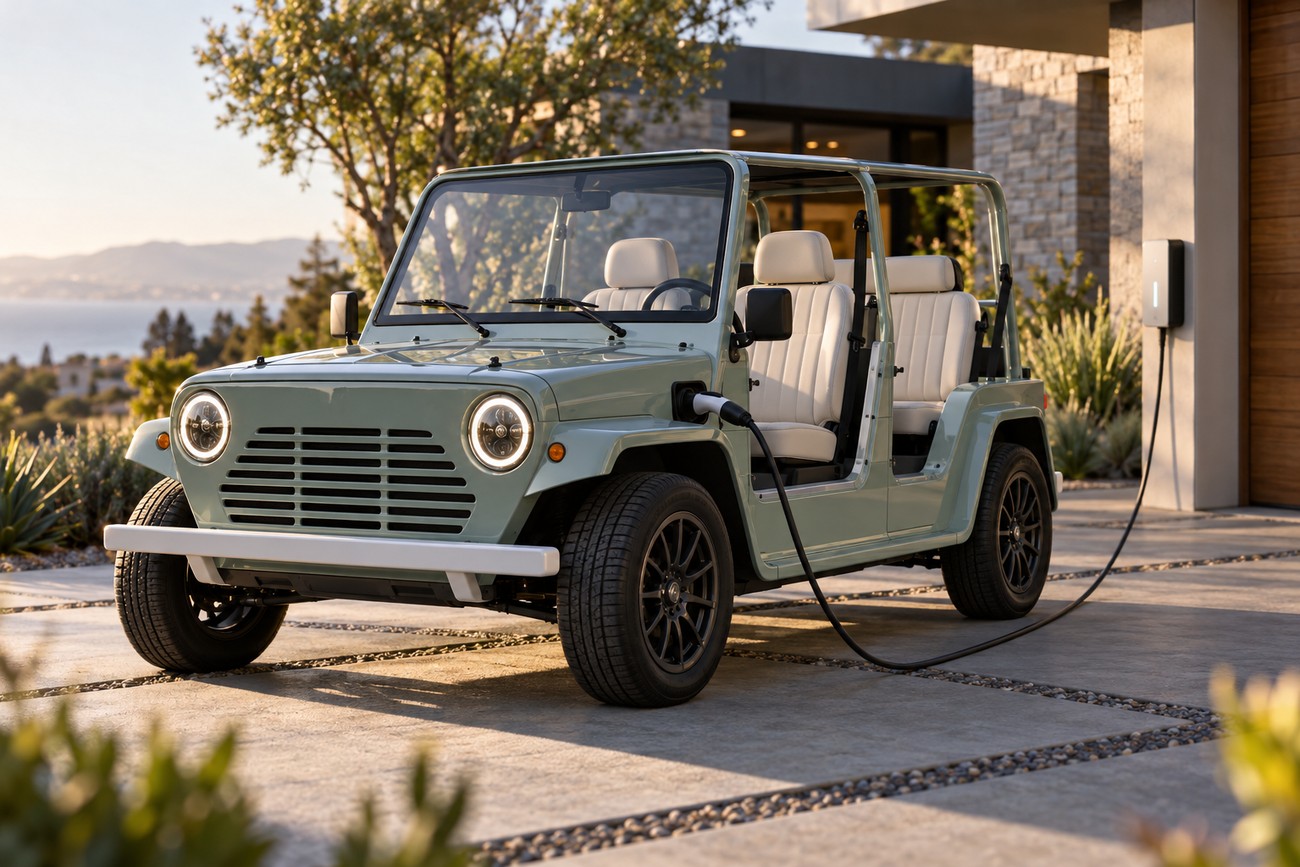
MOKE International says the brand was relaunched in 2018, and the Electric MOKE was launched in 2022. This is a modern product line with its own engineering, equipment, and specifications, rather than a straightforward conversion of an old BMC-era Mini Moke. MOKE International also states that production is fully in the United Kingdom.
The stated electric specification is 33 kW, about 44 hp, and 100 Nm, with a 23.5 kWh battery. The claimed range is 170 km, while the reported top speed is around 80 km/h or 50 mph. Figures can vary by market, so the exact vehicle documentation remains more useful than a generic online description.
That top speed defines the vehicle’s role. It suits local roads, resort areas, private communities, and calm coastal routes where traffic moves at compatible speeds. It leaves little margin for buyers who expect the Electric MOKE to behave like a conventional full-size road car on faster routes.
The electric drivetrain should make low-speed progress feel more immediate and quieter than an old small petrol engine, but it does not remove the fundamental compromises. The cabin remains open, storage remains limited, and the car’s usefulness still depends heavily on weather, road quality, charging access, and the availability of another vehicle.
What the Mini Moke is really like on roads, sand, and slopes
Early Mokes used 10-inch wheels and had approximately 16.2 cm of ground clearance. Those numbers help explain why the beach-buggy image can be misleading. Small wheels are vulnerable to holes and sharp changes in surface, while modest clearance leaves limited room for rough ground, deep ruts, or unexpected obstacles.
Front-wheel drive can work well on firm, level surfaces, yet it offers little help when the driven front tires lose grip on loose sand or mud. The early 948 cc, 37 hp configuration was poorly suited to steep climbs and difficult terrain. Owners and reviews commonly identify loose sand, mud, and steep inclines as weak points across the concept.
A short run across packed beach access roads is very different from sustained driving on soft sand. Weight distribution, tire condition, surface moisture, and slope can turn a pleasant-looking route into a recovery problem. The Moke should be treated as an open road cruiser that can tolerate some imperfect surfaces, rather than as a miniature SUV.
Weather is the other major limitation. The open body, nearly vertical windscreen, and minimal enclosure expose occupants to wind, rain, and cold. Noise rises quickly with speed, and wet-weather comfort can deteriorate before the trip is complete. A roof or side protection may help, but it does not transform the cabin into a sealed passenger compartment.
Storage and passenger practicality are similarly restricted. The Moke can carry people and small items for a short outing, yet it is a poor match for regular shopping, luggage, child equipment, or varied daily errands. Its greatest strengths appear when the journey itself is the point and the route is short, warm, and relatively smooth.
Buying a Mini Moke: checks that matter more than the badge
Start by identifying the vehicle precisely. Establish whether it is a classic petrol Mini Moke, a later reworked version, or a modern Electric MOKE. Confirm the engine or motor, transmission, drive system, battery information where relevant, and the market in which the vehicle was built or sold.
On an older car, inspect the body and chassis before being distracted by fresh paint or attractive upholstery. Look carefully for corrosion, poor repairs, and signs that cosmetic restoration has concealed structural work. Then assess the suspension, brakes, steering, drivetrain, and engine operation. Simplicity does not guarantee cheap repairs when components are old or difficult to source.
Verify identity and paperwork before inspecting cosmetic restoration. Corrosion and electrical faults become expensive surprises when the vehicle’s history, specification, or legal status is uncertain.
Electrical condition deserves a deliberate check. Wiring, instruments, lights, charging equipment, and battery-related systems can create problems that are difficult to diagnose from a short test drive. For an Electric MOKE, confirm the stated battery specification, charging arrangements, available records, and any market-specific equipment before comparing it with a petrol car.
Documentation and legal history should be checked before money changes hands. Registration requirements, permitted road use, safety equipment, and classification depend on the jurisdiction and the exact vehicle. A car with unclear identity or incomplete records may be difficult to register, insure, or resell even if its mechanical condition appears acceptable.
Parts availability can also change the ownership equation. A classic example may look mechanically simple while age-related wear, rare parts, corrosion, and electrical faults make maintenance more expensive than expected. A sensible inspection therefore prioritizes identity, paperwork, structure, and working systems before judging originality or visual finish.
Who should buy a Mini Moke—and who should not
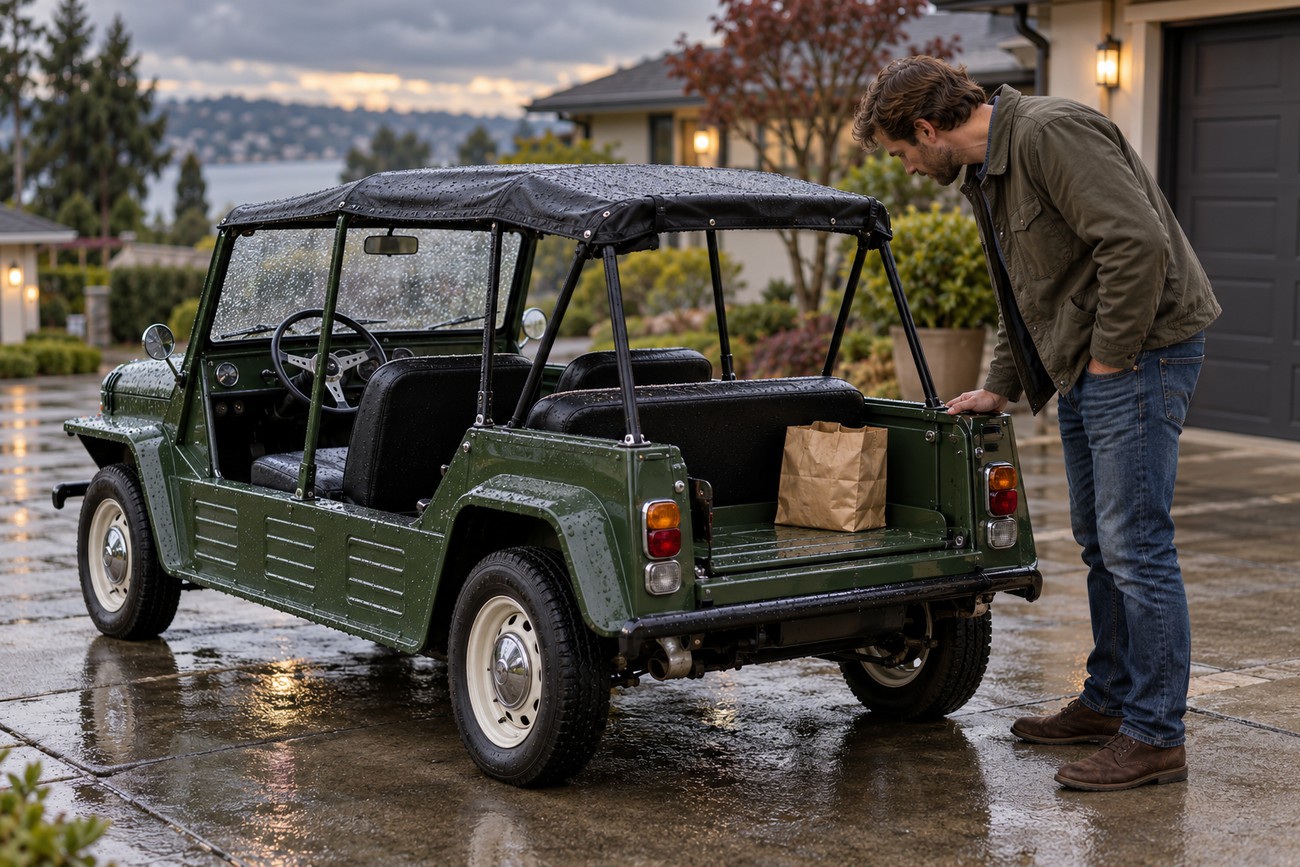
The Mini Moke makes sense as a niche warm-weather cruiser for short trips, resorts, private communities, and good roads. It rewards owners who value open-air driving, easy access, distinctive design, and a relaxed pace. Those benefits are real, provided the vehicle is used within its narrow operating envelope.
It is a poor choice as the only daily vehicle for anyone who needs reliable weather protection, meaningful storage, or normal traffic performance. Early petrol cars can feel slow, while the Electric MOKE’s limited top speed may disappoint a buyer expecting a conventional road car. The open cabin also turns seasonal weather into a daily ownership issue.
The most common error is choosing by appearance alone. Before buying, confirm that you have suitable roads, a climate that supports open driving, realistic expectations about speed, enough space for the passengers and luggage you actually carry, and access to another vehicle when conditions are poor.
- Choose a Moke for short, low-speed trips in a warm climate.
- Check that your usual roads are firm and relatively smooth.
- Accept limited storage and substantial wind, rain, and noise exposure.
- Match the exact petrol or electric specification to your traffic needs.
- Keep another vehicle available if you need dependable all-weather transport.
Frequently asked questions
The answers below focus on version, condition, documentation, and intended use. These factors matter more than the shared open-body design. They also help separate a classic petrol Moke from a modern Electric MOKE.
How much does a Mini Moke cost?
There is no single universal Mini Moke price. A classic petrol car, a later reworked example, and a modern Electric MOKE belong to different markets, so their asking figures should not be compared as though they were equivalent products.
Compare the exact version, condition, corrosion, originality, documentation, market, and mechanical or electrical state. For an electric model, battery and charging details also matter. A cheaper listing may represent an incomplete restoration or a vehicle with uncertain legal history, while a higher asking figure may reflect a better-documented and mechanically usable example.
How much is a Mini Moke worth?
Defensible value depends on what the vehicle is, how well it works, and how confidently its history can be established. Originality can matter for a collectible classic, while a usable later car may be judged more heavily on its mechanical condition, upgrades, and parts support.
An advertised figure is only a seller’s starting position. Corrosion, missing documentation, rare parts, electrical faults, and non-working systems can reduce real value substantially. A sound inspection and comparison with genuinely similar vehicles provide a better guide than the badge, paint, or restoration claims alone.
How can I tell whether a Moke is a classic Mini Moke or a modern Electric MOKE?
Begin with the powertrain and documentation. A classic Mini Moke uses a historic petrol configuration, while the modern Electric MOKE uses an electric motor and battery and belongs to the post-2018 MOKE International product line, with the Electric MOKE launched in 2022.
Check the manufacturer information, production context, vehicle identification, motor or engine specification, and charging equipment where applicable. Do not rely on the shared open-body shape: modern vehicles can preserve the classic appearance, while older cars may have been reworked with later mechanical parts.







