
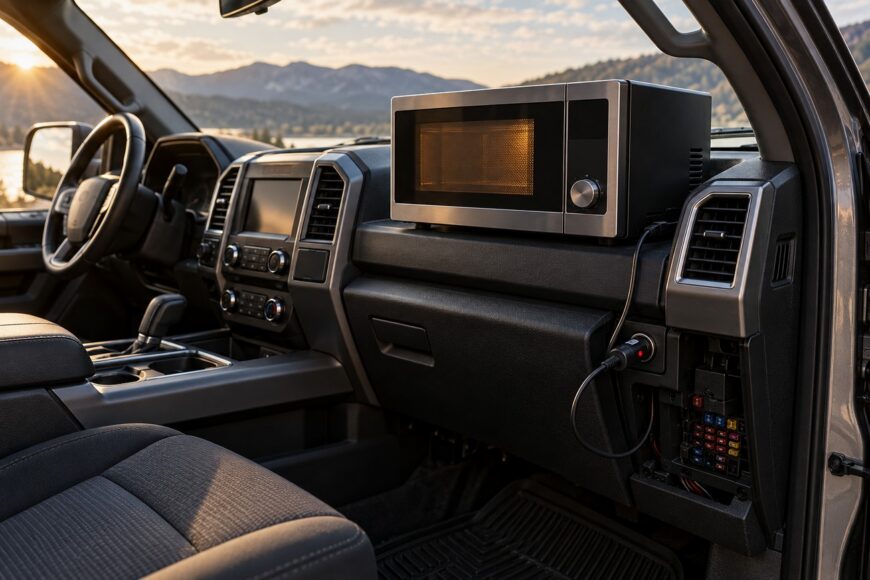
An F-150 may advertise several kilowatts of available power while its ordinary cabin outlet is limited to 150 watts. Plugging a microwave into that outlet can blow the fuse or put the outlet into a failure-protection state.
The practical answer depends on the truck’s trim, the type of outlet, the inverter capacity, the battery-side current, and the required runtime. A 1,200-watt microwave is a substantial electrical load, so the presence of household-style outlets does not mean every F-150 can run one safely.
Before connecting the oven, identify the actual power system installed in the truck. A total system rating describes the vehicle’s available supply, while each outlet and circuit still has its own limits.
- The First Check: Which F-150 Power Outlet Do You Have?
- F-150 Power Systems Compared: 150 W, 2.4 kW, 7.2 kW, and 9.6 kW
- How Much Power Does a 1,200-Watt Microwave Really Need?
- What a Working Microwave Setup Requires
- Why the Inverter Trips and the Battery Dies Fast
- Frequently asked questions
- How do you turn on the 120-volt outlet in a Ford F-150?
- How many amps does a microwave use in an RV?
- What should I check when the microwave inverter shuts down?
The First Check: Which F-150 Power Outlet Do You Have?
The standard F-150 cabin 12-volt outlet is rated at 150 watts. That is suitable for modest accessories, while a typical 1,200-watt microwave requires many times more power. Connecting the oven through a simple 12-volt socket adapter will overload the outlet.
Ford’s stated consequence of exceeding the standard limit is practical and important: the fuse may blow, or the outlet may enter a failure-protection state. Replacing a fuse without correcting the load can produce the same failure again and can place unnecessary stress on the vehicle’s wiring.
Some F-150 versions have dedicated 120-volt outlets or broader external-power systems. Those outlets are supplied by different equipment and must be checked against their own circuit ratings. They should not be treated as extensions of the ordinary 12-volt cabin socket.
The truck’s total kilowatt figure also requires careful interpretation. A system rated for several kilowatts does not mean every individual outlet can deliver that amount, or that a microwave can be connected anywhere without checking the circuit, inverter, and operating conditions.
F-150 Power Systems Compared: 150 W, 2.4 kW, 7.2 kW, and 9.6 kW
These figures describe different types of capability. They are useful for identifying the truck’s power system, but they are not interchangeable microwave ratings for every outlet.
| F-150 power system | Published capability | Outlet or system description | Microwave-use caveat |
|---|---|---|---|
| Standard F-150 cabin outlet | 150 watts | 12-volt cabin outlet | Cannot run a 1,200-watt microwave; exceeding the limit may blow the fuse or disable the outlet. |
| Equipped F-150 Hybrid/PowerBoost | Up to 7.2 kW | Up to six 120-volt outlets, depending on version and equipment | This is a system capacity, not a guarantee that every outlet supports the microwave’s load. |
| Base F-150 Lightning external power | 2.4 kW | Eight 120-volt outlets | Use only an outlet and circuit rated for the microwave, with other loads kept within the system limit. |
| Higher-output F-150 Lightning configurations | Up to 9.6 kW | Higher-capacity external power, depending on trim or options | Available power depends on the installed configuration and individual outlet ratings. |
| Reported Lightning 240-volt outlet | Configuration-dependent | Mentioned in non-primary descriptions for some higher configurations | Verify the specific vehicle’s official documentation before relying on this capability. |
How Much Power Does a 1,200-Watt Microwave Really Need?
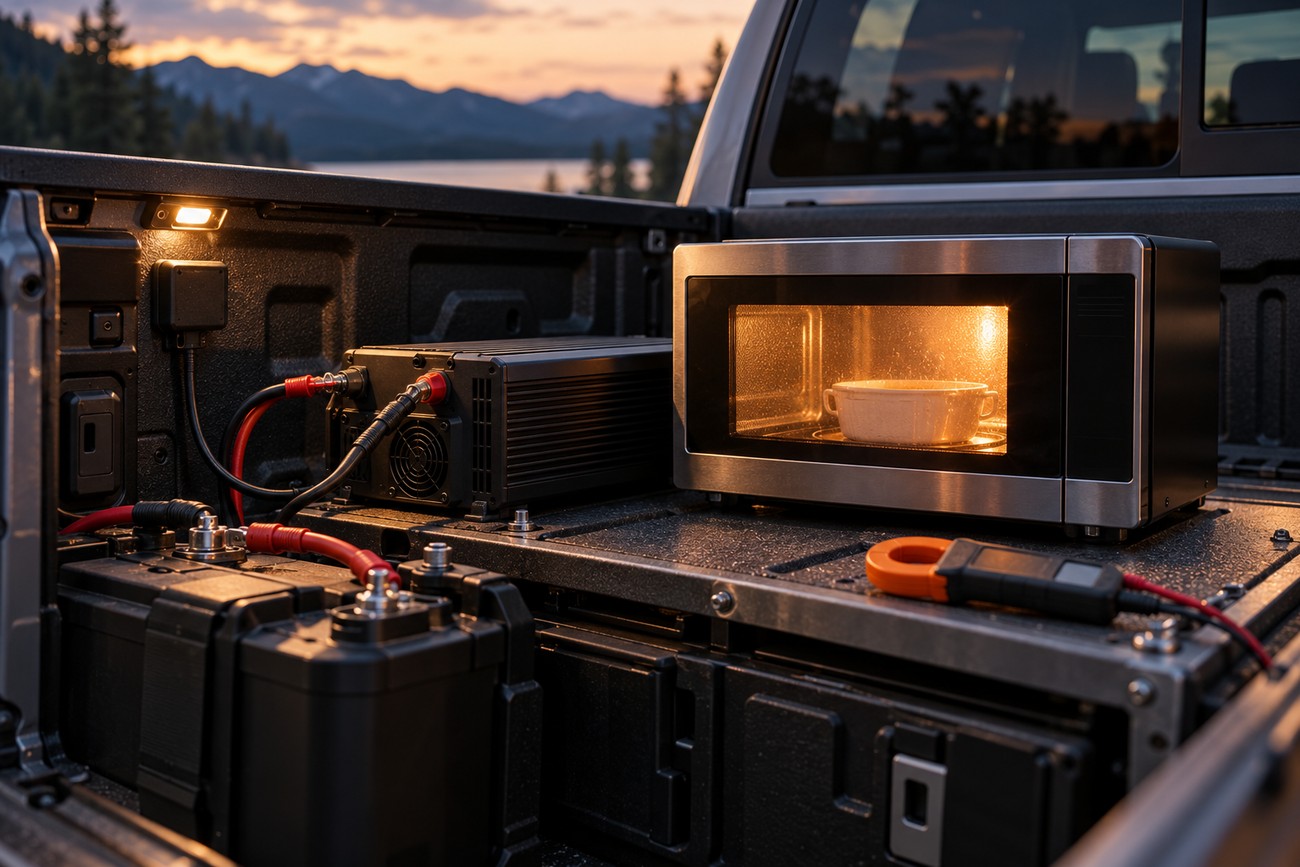
A 1,200-watt microwave rating may describe its cooking output rather than its exact AC input. The actual input should be checked on the appliance label or in its documentation. After inverter losses, a microwave drawing about 1,200 watts from the AC side can require approximately 100–115 amps from a 12-volt battery.
A roughly 1.5-kilowatt inverter is commonly recommended for a 1,200-watt microwave when other major loads are not operating. That margin helps the inverter handle startup or impulse demand, which can cause an undersized unit to overheat or shut down even when its continuous rating appears close to the microwave’s label.
The microwave’s cooking setting can also mislead you. A lower-duty cycle, such as defrost, may reduce heating time, yet the electrical demand during the powered portion of the cycle can remain close to the level produced by that model at higher power.
That is why a suitable setup requires more than matching two wattage numbers. The inverter, cables, connections, battery condition, and available ventilation all have to tolerate the sustained DC current and the microwave’s changing load.
What a Working Microwave Setup Requires
Start with a capable 120-volt outlet or a properly sized inverter output. The standard 150-watt cabin outlet cannot run a 1,200-watt microwave. A suitable outlet must also have a circuit rating that covers the microwave’s actual input load and leaves room for normal operating variation.
For an inverter-based installation, the battery-side cables and connections must be sized for approximately 100–115 amps or more under the relevant load conditions. Long, undersized, or poorly terminated cables can create voltage drop and heat, causing the inverter to shut down even when its advertised wattage appears sufficient.
Keep other major loads off while the microwave operates. Refrigeration, heating equipment, chargers, and camper accessories can consume available capacity and make a marginal system unstable. The truck’s trim, installed equipment, battery state, and operating mode should be verified before use.
External power delivery and vehicle charging are separate functions. A truck that can supply selected external loads does not automatically support every kitchen appliance, and its ability to accept charging power does not define the rating of its external outlets.
Why the Inverter Trips and the Battery Dies Fast
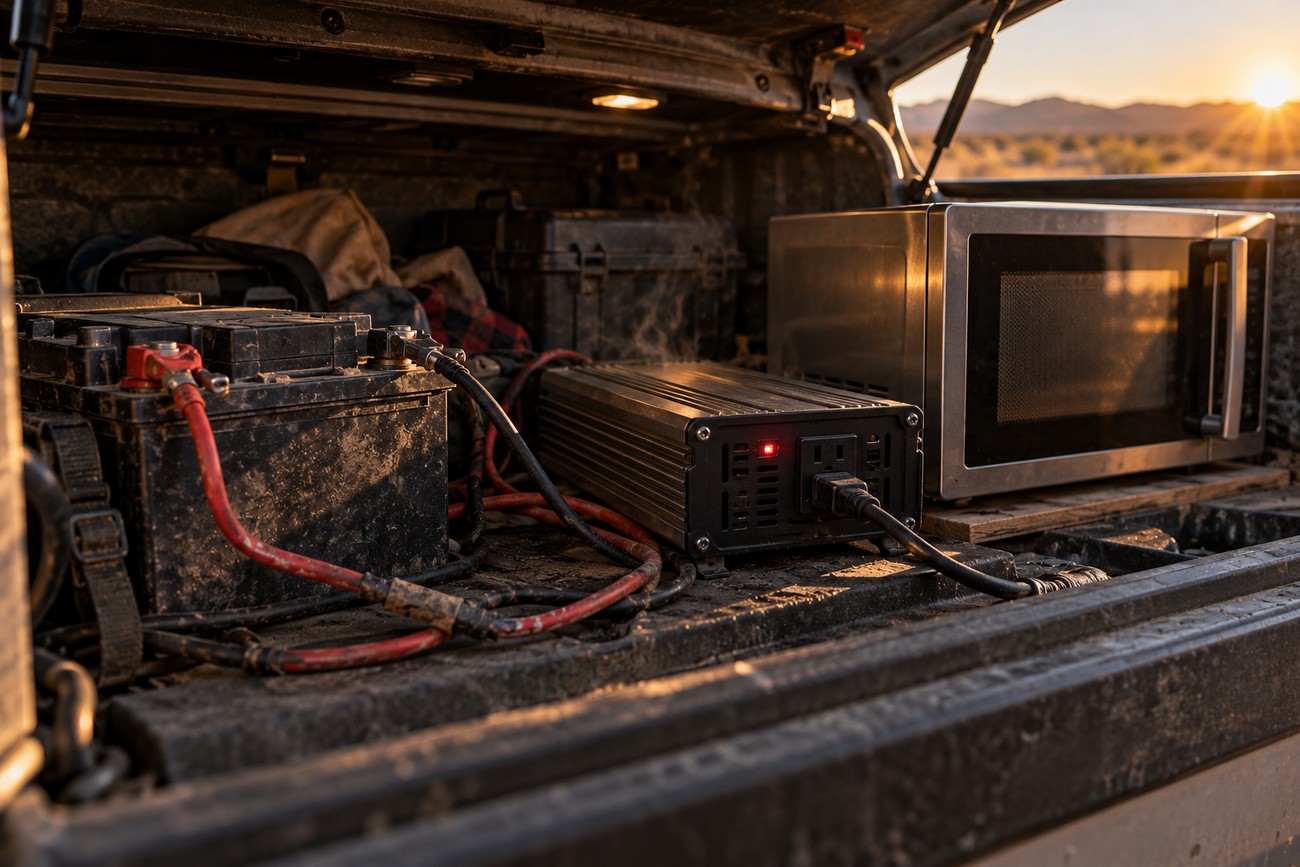
An inverter may shut down because of thermal protection, excessive current, or low input voltage. Heat is especially difficult to manage when the unit is enclosed in a compartment or operated near other warm equipment. Protective shutdown is a warning that the system conditions exceeded the inverter’s limits.
High battery-side current also exposes weaknesses in cables and connections. Voltage drop can become substantial with undersized conductors, long cable runs, loose terminals, or corroded connections. The resulting low voltage may trip the inverter even though the battery seems adequately charged at rest.
Battery depletion is another predictable limitation. In an inverter-based setup, a 1,200-watt microwave may consume approximately 25–33 amp-hours in 15 minutes. Actual consumption depends on the microwave’s duty cycle, inverter efficiency, battery condition, and the other loads operating at the same time.
A short cooking session can therefore become a demanding event for a camper battery or auxiliary electrical system. If the battery is already partly discharged, runtime can be much shorter, and repeated high-current use can leave insufficient energy for essential equipment.
Frequently asked questions
How do you turn on the 120-volt outlet in a Ford F-150?
Use the outlet controls and activation procedure specified for your particular F-150 version. Outlet activation, ignition requirements, and vehicle-state requirements vary between standard trucks, Hybrid/PowerBoost models, and Lightning configurations.
Check the owner’s manual before diagnosing a failed microwave setup. Confirm that the vehicle is in the required operating state, the outlet switch is enabled if fitted, and the connected load is within that outlet’s rating. A 120-volt label alone does not confirm that the circuit can support a 1,200-watt microwave.
How many amps does a microwave use in an RV?
On a 120-volt AC circuit, a microwave drawing 1,200 watts requires roughly 10 amps before allowing for power-factor and appliance-specific differences. That reading describes the microwave-side circuit and should not be compared directly with battery current.
Through an inverter from a 12-volt battery, the same microwave can require approximately 100–115 amps after inverter losses. The battery cables, fuse protection, inverter rating, and battery condition must therefore be assessed using the much higher DC current.
What should I check when the microwave inverter shuts down?
Check the load rating first, including the microwave’s input power and the inverter’s continuous and surge capability. Then inspect cable size, cable length, terminals, fuses, and connections for voltage drop or heat.
Measure battery voltage under load, confirm that the inverter has adequate ventilation, and switch off competing loads. If the inverter still trips after those checks, the microwave’s input demand or the inverter’s protection threshold may be incompatible with the installation.







