
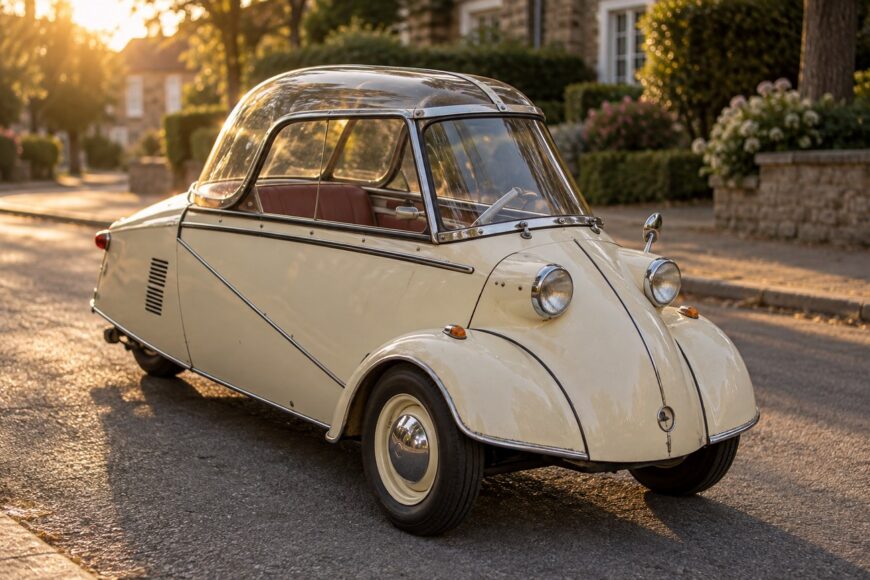
The Messerschmitt KR200 wears a canopy that suggests an aircraft cockpit, yet beneath it sits modest three-wheeled machinery: a small two-stroke engine, tandem seats, and a single driven rear wheel. Its shape still draws a crowd. Living with one calls for a different kind of attention, from mixing fuel correctly to learning a gearbox that rewards patience.
That tension is central to its appeal. The KR200 was built for economical personal transport, while its unusual cabin made the journey feel unlike one in an ordinary small car. Its origins also explain why the famous name on the nose tells only part of the story.
- Why an Aircraft Name Appeared on a Bubble Car
- The Canopy, Tandem Cabin and Three-Wheel Layout
- A Two-Stroke Engine With an Unusual Reverse
- KR200 Specifications: Period Claims and Practical Ranges
- What It Is Actually Like to Drive
- Buying One: Inspect Beyond the Famous Silhouette
- Frequently asked questions
- How much is a Messerschmitt KR200 worth?
- What paperwork do I need to register an imported KR200?
- How should I store a KR200 between occasional drives?
Why an Aircraft Name Appeared on a Bubble Car
Fritz Fend designed the Kabinenroller, the light enclosed three-wheeler from which the KR200 developed. Messerschmitt was associated with its earlier production, giving the car a name closely tied to aviation. That connection matters to its history, but it does not mean the aircraft company designed the complete vehicle.
KR200 production ran from 1955 to 1964. After Messerschmitt’s involvement ended, Fahrzeug- und Maschinenbau Regensburg (FMR) produced it. A surviving car therefore needs to be identified by its year and individual details, rather than treated as though every KR200 came from the same manufacturer at the same moment.
The design made sense in an era when low running costs and a small footprint had strong appeal. Its enclosed cabin offered a different experience from an exposed motorcycle, while using far less space and machinery than a conventional car. Those priorities shaped the compromises an owner still encounters: little room for belongings, modest performance, and mechanical systems that demand familiarity.
The Messerschmitt name can obscure that distinction in sale descriptions. For a prospective buyer, the more useful question is whether a particular KR200 retains the parts and features appropriate to its version. The answer tells more about the vehicle than an aviation association alone.
The Canopy, Tandem Cabin and Three-Wheel Layout
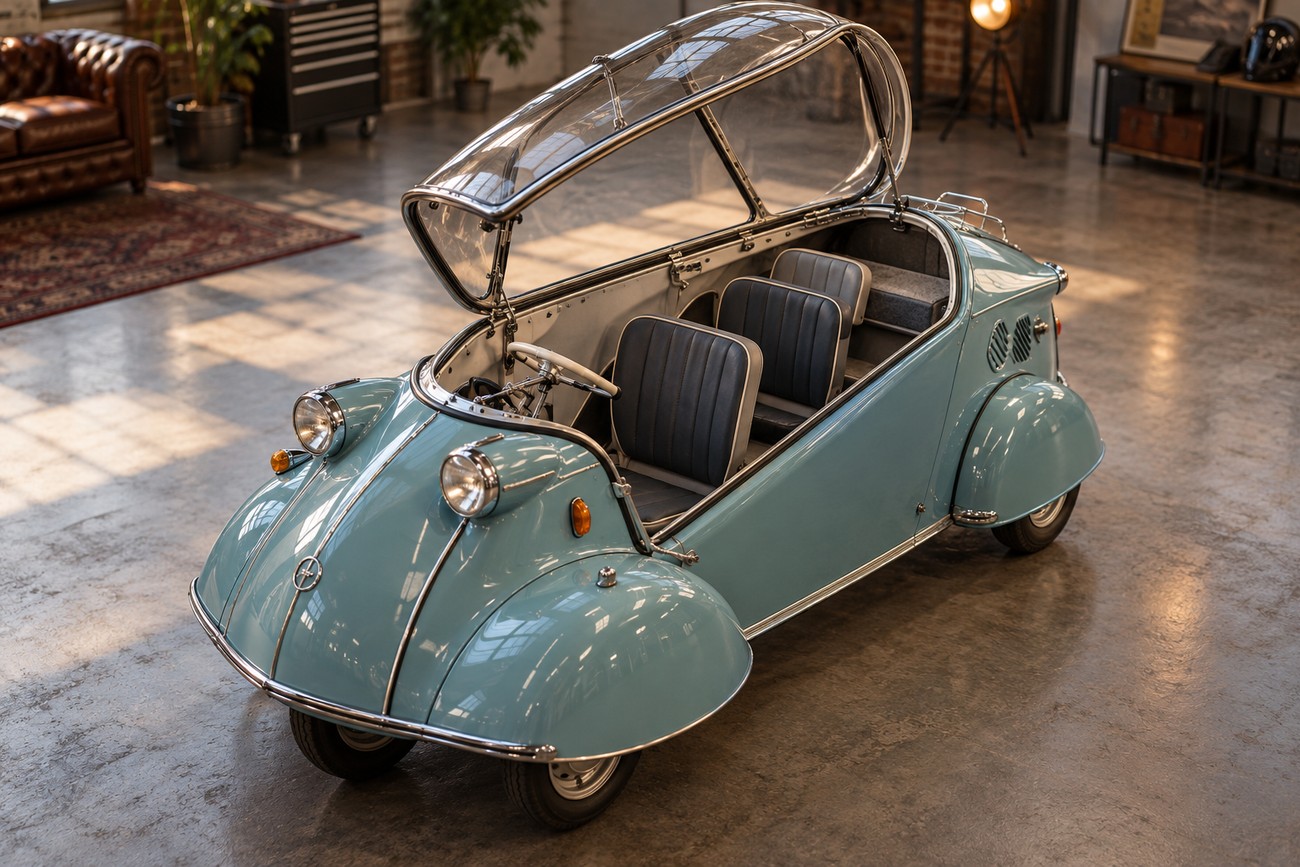
The opening canopy is the KR200’s defining feature and its main access point. Beneath it, two occupants sit in tandem, keeping the body exceptionally narrow. At approximately 2.82 m long, 1.22 m wide, and 1.20 m high, with a wheelbase of about 2.03 m, the car occupies little road space but offers little spare cabin space in return.
Entry takes more planning than opening a side door, especially in a tight parking spot or for someone with limited mobility. The passenger sits behind the driver, and luggage capacity is restricted. “Two seats” describes the arrangement accurately; it says little about how comfortable two adults and their belongings will be over a long day.
Two independently suspended front wheels steer the car, while the single rear wheel receives the drive. The narrow body and canopy give the KR200 its distinctive profile from almost any angle. Inside, however, engine vibration, cooling-fan noise, and the smell of two-stroke exhaust can be more apparent than occupants of a conventional car expect.
That intimacy with the machinery is part of the experience for many owners. It also makes the KR200 a better match for deliberate outings than for someone seeking the quiet, easy access, and carrying space of a modern city car. A careful look at the cabin is as important as admiration from outside it.
A Two-Stroke Engine With an Unusual Reverse
The KR200 uses a nominal 191 cc Fichtel & Sachs single-cylinder two-stroke, with fan-assisted air cooling and a Bing carburetor. Some references round the displacement to 192 or 200 cc. Its two-stroke design uses cylinder ports rather than the valve gear of a small four-stroke car engine, so fuel preparation and engine condition deserve particular attention.
The supplied technical specification calls for a 1:25 oil–gasoline mixture. Fuel without the correct oil can damage the engine, while a car left standing may need fuel-system, ignition, and carburetor attention before it starts reliably. Owners should confirm the specification for their individual machine and avoid treating an easy start after storage as a substitute for inspection.
A four-speed unsynchronized gearbox sends drive through an enclosed roller chain to the single rear wheel. Shifts require the driver to match engine speed with care; forcing the lever as if it belonged to a modern synchronized gearbox invites grinding and wear. Chain condition, tension, lubrication, and its enclosure also affect noise and reliability.
Reverse is the most unusual part of the drivetrain. The electrical system changes the direction in which the engine rotates, allowing the car to travel backward through the gearbox rather than through a conventional reverse gear. That makes sound electrical components important to an everyday maneuver, not merely to starting and lighting.
KR200 Specifications: Period Claims and Practical Ranges
Published figures describe different versions and conditions, so they are best read as guides to a specific car rather than a universal KR200 specification.
| Item | Reported specification | Why it varies or matters |
|---|---|---|
| Engine and output | Nominal 191 cc Fichtel & Sachs two-stroke; approximately 9.7–10.2 hp in club documentation | Versions and settings differ; some museum descriptions round output to about 9.5–9.9 hp. |
| Top speed | About 90 km/h in club data; up to 105 km/h in museum or commercial descriptions | Version, load, engine condition, and road conditions affect the result. |
| Fuel consumption | 3.2 L/100 km promotional claim; approximately 4.5 L/100 km in a club technical table | A catalog figure should not be taken as a guaranteed result for an older car. |
| Dimensions | Approximately 2.82 × 1.22 × 1.20 m; wheelbase about 2.03 m | These approximate figures convey its small footprint, not generous interior space. |
| Weight | Approximately 230–240 kg unladen; permissible gross weight 420 kg | Occupants and luggage must fit within the remaining permitted load. |
| Gearbox and drive | Four-speed unsynchronized gearbox; enclosed chain to one rear wheel | Electrical reversal of engine rotation provides reverse travel. |
What It Is Actually Like to Drive
A KR200 asks the driver to participate. Its four unsynchronized forward speeds call for measured shifts and an ear for engine revs. Once learned, that rhythm suits the car’s character; hurried changes make an otherwise pleasant drive noisy and can add wear to the gearbox.
Low unladen weight helps the small engine move the car, but it does not create a large carrying reserve. Against approximately 230–240 kg unladen, the permissible gross weight is 420 kg. Two occupants and their belongings can use much of that allowance, so load is relevant both to performance and to what the car can reasonably carry.
Narrow 8-inch wheels and a wheelbase of about 2.03 m make ruts, uneven surfaces, and crosswinds worth noticing. Tire pressures should be checked against the documentation for the particular version. A published top speed—about 90 km/h in club data, or up to 105 km/h in other descriptions—says little about a comfortable pace on an imperfect road with passengers aboard.
Nor should its lightness be mistaken for modern crash protection. The narrow, three-wheeled layout and 1950s construction leave occupants more exposed in a serious impact, particularly from the side. Sensible speed, suitable roads, and close attention to brakes and tires preserve the pleasure of driving it without assuming it will behave or protect like a contemporary car.
Buying One: Inspect Beyond the Famous Silhouette
Begin with identity. Check the chassis number against the available documents, establish which engine is fitted, and compare the car’s features with its stated year and version. KR200s changed during their 1955–1964 production run, so an attractive restoration deserves the same scrutiny as an apparently untouched example.
Next, examine the canopy’s fit, operation, and condition, along with its seals. Look closely at the frame, body panels, and interior components rather than concentrating on paint from a few steps away. These parts can be harder or costlier to source than routine items for the nominal 191 cc engine.
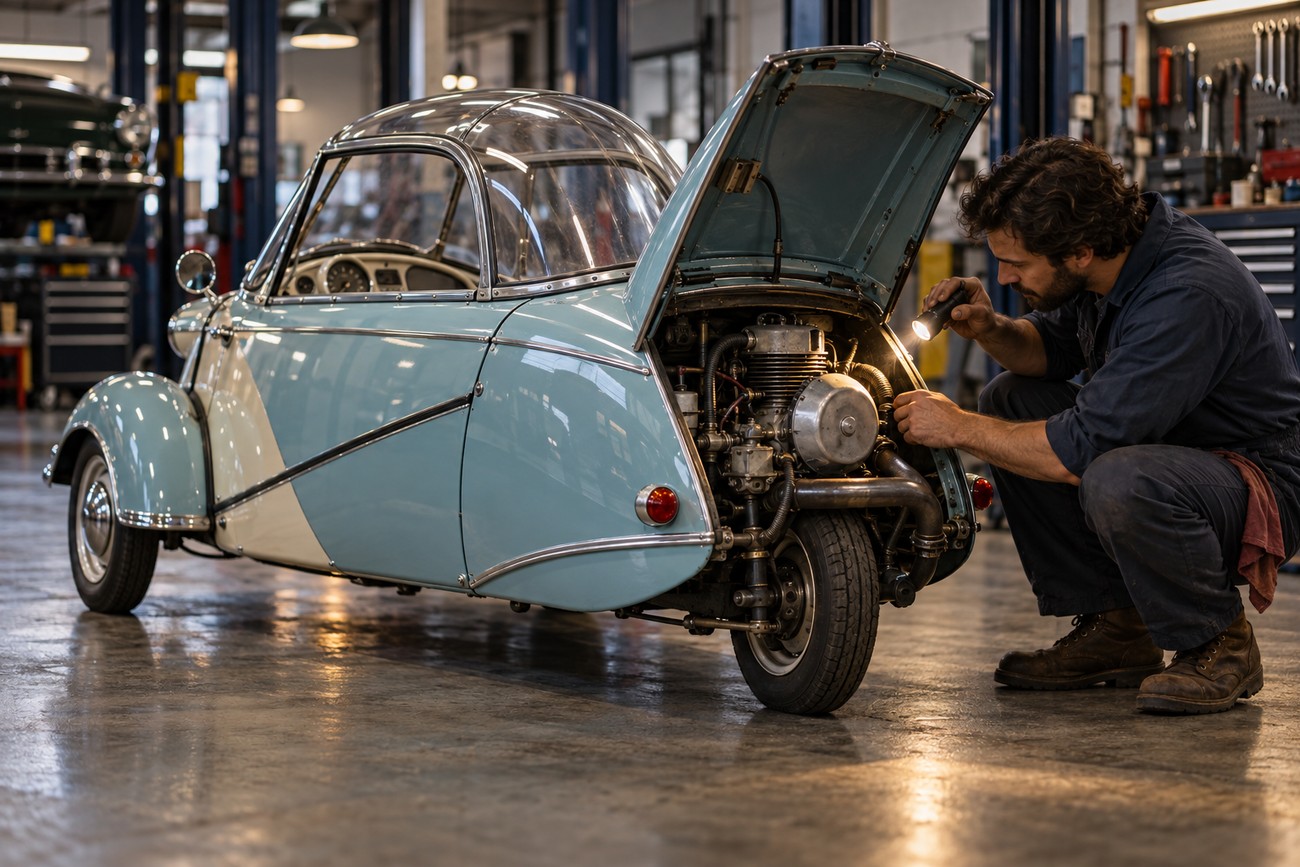
Mechanical checks should still be thorough. Assess compression, ignition, and carburetor behavior; confirm that the owner uses the specified 1:25 oil–gasoline mixture. Inspect the enclosed drive chain for condition and tension, and check that the brakes operate properly. After a long lay-up, a brief demonstration run may reveal less than a careful inspection.
Finally, test the gearbox and electrical reverse under appropriate conditions, listening for problems rather than expecting modern shift quality. A claimed 105 km/h is a published upper figure, not evidence of a healthy cylinder, sound chain, or effective brakes. The strongest purchase is one whose identity, completeness, and mechanical condition can each be assessed on their own merits.
Frequently asked questions
Value, paperwork, and storage depend on the individual car as much as on the KR200 model name. These checks help turn an appealing purchase into one you can register, maintain, and use.
How much is a Messerschmitt KR200 worth?
Estimate value from recent comparable cars that actually sold, rather than a single asking price. Compare year and version, originality, completeness, documented mechanical condition, and the state of scarce parts such as the canopy and trim. Local supply and registration prospects also matter, so there is no useful universal price for every KR200.
What paperwork do I need to register an imported KR200?
Start with proof of ownership and documents that clearly match the chassis identity. Before shipping or paying for a car, check the destination’s import, registration, insurance, and licensing requirements. Rules for a three-wheeler can differ from those for a conventional car and vary by jurisdiction; resolving that classification early can prevent an otherwise sound purchase from becoming difficult to use.
How should I store a KR200 between occasional drives?
Follow the fuel-system storage guidance appropriate to the car, maintain or disconnect the battery as appropriate, and protect the tires from prolonged underinflation. Before the next drive, inspect for leaks, check tire pressures and brakes, and verify a fresh 1:25 oil–gasoline mixture against the specification for your machine. Allow time for fuel-system and ignition checks if it has stood for a long period.







