
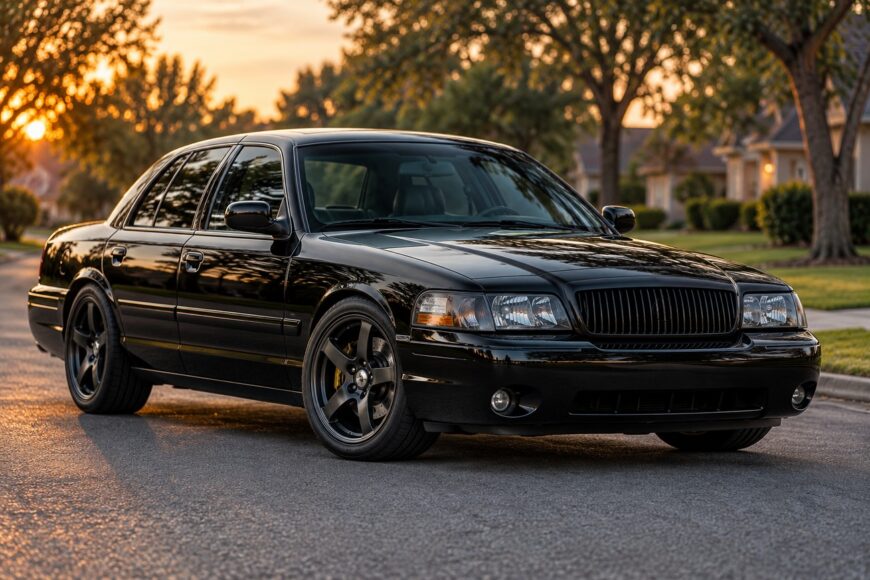
The Mercury Marauder presents itself as a sinister V8 sedan, yet its hardware belongs to an older full-size American formula: rear-wheel drive, a solid rear axle, a four-speed automatic, substantial mass, and a long body. The result has presence and mechanical character, though its performance is shaped as much by its age and architecture as by its engine.
Built only in 2003–2004, the Marauder remains distinctive because Mercury gave a factory performance identity to a Panther-platform sedan rather than leaving the work to aftermarket owners. The sensible buying decision is clear: accept four-speed gearing, difficult urban dimensions, scarce 18-inch tires, and aging rear air-suspension components in exchange for a rare factory-built Mercury with a naturally aspirated V8 and genuine road presence.
- What the Mercury Marauder actually is
- The hardware behind the dark-panther image
- How fast and usable is it today?
- The ownership compromises people discover late
- What to inspect before buying a Marauder
- Marauder myths that lead to bad buying decisions
- Frequently asked questions
- What is the Ford equivalent of the Mercury Marauder?
- How rare is a Mercury Marauder?
- How much does a Mercury Marauder cost today?
- Why is the Marauder more than a black Crown Victoria?
What the Mercury Marauder actually is
The Marauder is a rear-wheel-drive sedan on the Ford Panther platform, produced only in 2003–2004. Its basic layout connects it to large Ford and Lincoln sedans of the period, yet Mercury gave the car a more deliberate performance presentation and a substantially different character from an ordinary fleet-oriented Panther sedan.
Its identity comes from the combination of the 4.6-liter DOHC V8, darker exterior treatment, 18-inch wheels, larger brakes, sport-oriented chassis details, and limited-slip rear axle. Those parts matter because they distinguish a genuine Marauder from a regular Panther sedan with badges, wheels, and cosmetic alterations. Documentation and actual hardware remain more useful than appearance alone.
The car’s police-car reputation is understandable. Panther-platform police vehicles established a durable image for rear-wheel-drive strength and serviceability, and some Marauder components reflect that broader engineering family. A civilian Marauder is still a Mercury model, rather than a factory Crown Victoria Police Interceptor, and its equipment should be verified by VIN and inspection.
Some reviews cite approximately 11,000 cars, although that figure is not confirmed here by official production statistics. The practical meaning of the model’s limited production is clearer than any disputed total: specific trim, wheels, body pieces, and interior parts can take more effort to locate than shared Ford or Lincoln powertrain components.
The hardware behind the dark-panther image

Power comes from a 4.6-liter naturally aspirated DOHC Modular V8 with 32 valves, an aluminum block, and aluminum heads. The official rating is 302 hp at 5,750 rpm and 318 lb-ft at 4,250–4,300 rpm. Some catalogs list 300 hp or 295 bhp; those figures reflect rounding or different rating terminology, rather than separate engines.
The transmission is a four-speed automatic with overdrive. The 4R70W is identified for 2003, while some sources identify the 4R75W for 2004. That distinction is worth confirming by VIN because model-year assumptions and advertisement descriptions are not reliable substitutes for the transmission actually installed in a particular car.
A 3.55 final-drive ratio helps the Marauder use its V8 torque, while the limited-slip differential helps maintain traction. The rear suspension combines a solid rear axle with Watt’s linkage and air springs for load leveling. Watt’s linkage controls lateral axle movement, though it does not turn the solid axle into an independent rear suspension.
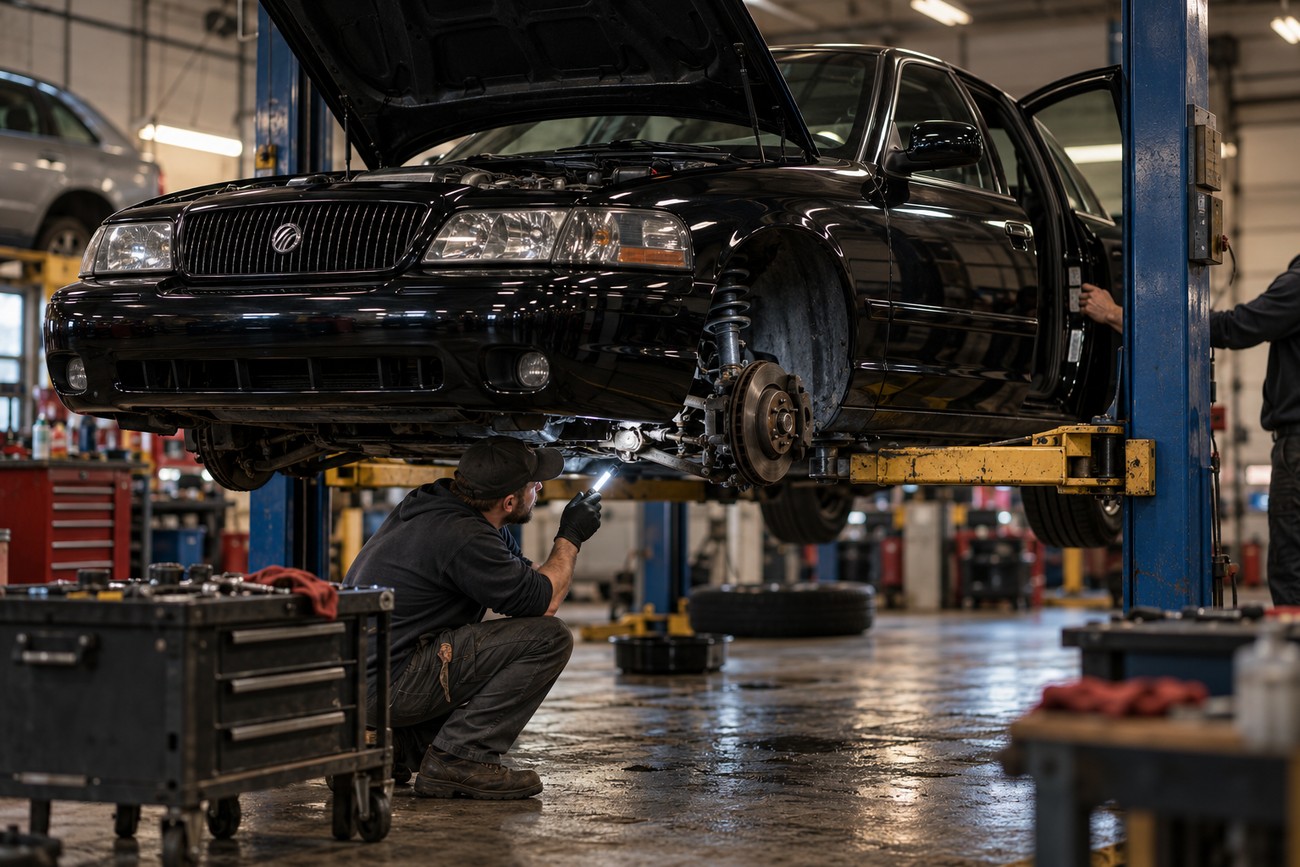
Stopping hardware includes 12.4-inch front and 11.1-inch rear ventilated disc brakes, with 18-inch wheels fitted as standard. This specification gives the car a more serious mechanical foundation than a standard sedan, while also creating long-term costs: replacement wheels, correct tires, brake parts, and Marauder-specific suspension components deserve separate checks.
How fast and usable is it today?
A test specification lists the Marauder at 4,282 lb, with a 114.7-inch wheelbase and an overall length of approximately 212 inches. Those dimensions give it a stable, substantial feel on open roads, yet they also make the car physically demanding in tight streets, crowded parking areas, and narrow garages.
The 3.55 gearing gives the engine useful leverage from a standing start and during passing. The four-speed automatic leaves larger gaps between ratios, however, so the V8 can feel more deliberate during acceleration than its output figure suggests. On the highway, the engine also runs at noticeably higher rpm than modern V8 sedans using five- to ten-speed transmissions.
The solid rear axle contributes to the Marauder’s traditional character. On smooth pavement, it supports a composed, heavy sedan feel; over broken surfaces, axle movement can be more apparent, especially when the rear suspension or air springs are tired. The long body and large wheels also transmit more road texture than the car’s dark styling may lead a buyer to expect.
Fuel use is shaped by the same fundamentals: a large, heavy sedan, an engine that develops its peak power at higher rpm, and a four-speed automatic. The 19-gallon fuel tank gives useful range between stops, while the official brochure lists five seats. That makes the Marauder practical for long-distance passengers and luggage, provided the driver accepts its turning circle, parking footprint, and old-school operating costs.
The ownership compromises people discover late
The original-size 18-inch tires are a recurring ownership expense. Suitable replacements can be expensive and increasingly difficult to source, particularly when the owner wants the correct size, load rating, and speed rating. Fitting arbitrary inexpensive tires can alter handling, clearance, and safety margins, while preserving the original wheels does not guarantee easy access to suitable rubber.
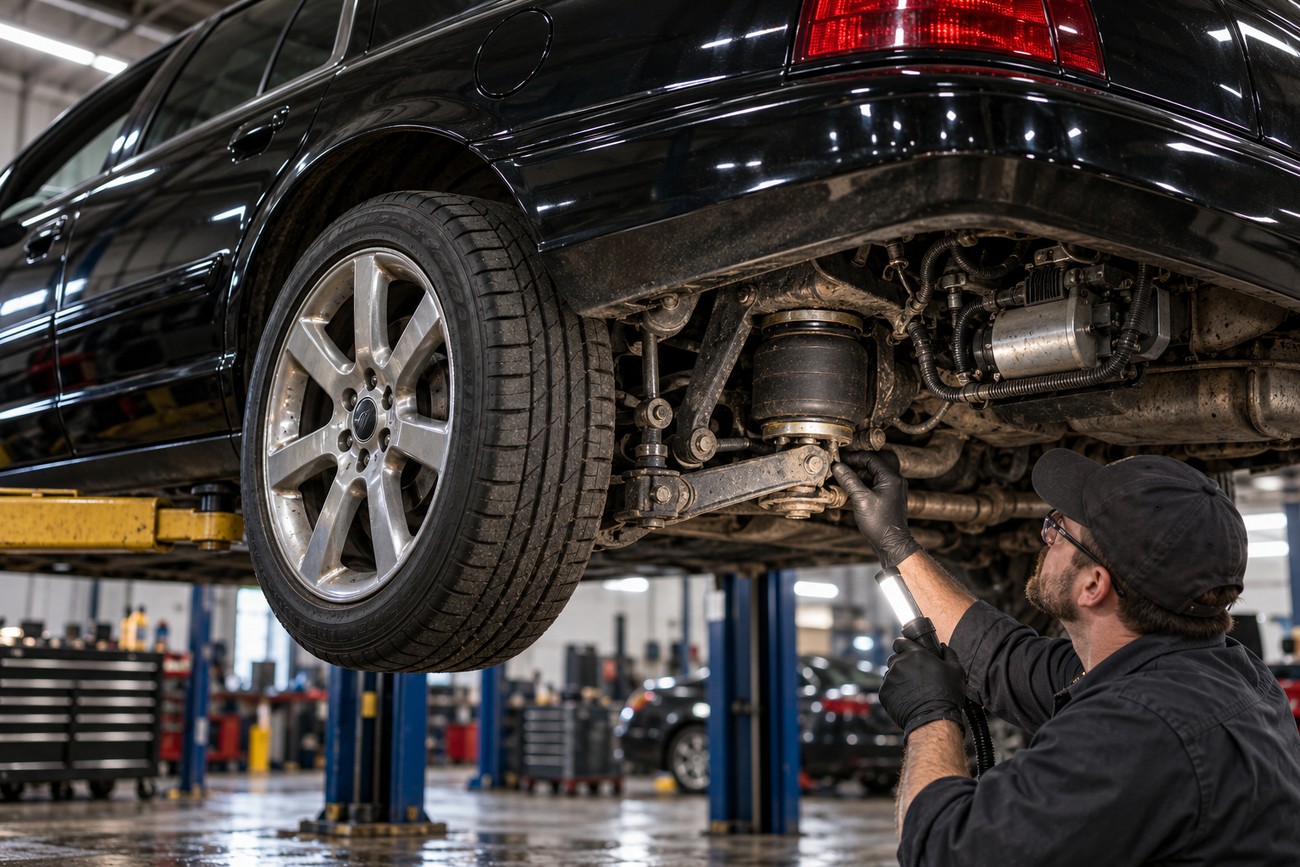
The rear air suspension is the most important age-sensitive system. Air springs can leak, causing the car to sag, and the compressor may run excessively while trying to restore ride height. Continued operation under those conditions can overheat the compressor and turn a relatively contained leak into a larger repair.
Checking that the car sits level once is insufficient; cycle the system repeatedly and listen for compressor overrun, because a marginal air spring or height sensor may behave normally for a short inspection.
The air springs provide a real benefit by maintaining ride height under load. That benefit comes with aging bags, lines, a compressor, and height sensors that require diagnosis. A Marauder converted to conventional springs may reduce future air-system work, though it also changes the original specification and should be judged carefully if originality matters.
Owners also report weak factory lighting, worn interior materials, and small electrical faults. These issues may seem minor beside the V8, yet they affect night driving, daily usability, and restoration cost. Fuel consumption adds another permanent compromise, since the car’s weight, aerodynamics, gearing, and high-rpm power delivery remain part of its design.
What to inspect before buying a Marauder
Start with the VIN, title history, service records, and the car’s actual equipment. Verify the transmission designation and model-specific parts by VIN rather than trusting an advertisement, especially for the 2003 4R70W and the 2004 4R75W distinction. Check whether the body, wheels, brakes, interior, and trim match a genuine Marauder instead of a standard Panther sedan converted for appearance.
Inspect the engine from a cold start. Look for stable idle quality, clean throttle response, unusual valvetrain or accessory noise, and evidence of neglected maintenance. Compression testing or equivalent diagnostic work is worthwhile on a car whose badges may command a premium, because a strong-looking exterior says little about cylinder condition, cooling performance, or the health of the DOHC V8.
Drive the transmission through all shifts, including light-throttle and firm-throttle operation. Check for delayed engagement, slipping, harsh shifts, or unusual behavior under load. Listen to the rear axle during acceleration, deceleration, and steady cruising, inspect the fluid condition, and confirm that the limited-slip differential operates as expected without treating axle noise as an automatic characteristic of the model.
Test the air suspension several times during the inspection. Measure whether the car maintains its ride height, inspect both air springs and their lines for leaks, observe compressor operation, and check the ride-height sensors. A car that is level when parked may still have a slow leak or a compressor that is working beyond its normal duty cycle.
Finish with the brakes, wheels, tires, lighting, and electrical equipment. Confirm tire size, load rating, and speed rating, inspect 18-inch wheels for damage, and check the brake discs and calipers rather than assuming the larger hardware is healthy. Marauder-specific body, interior, wheel, brake, and suspension pieces can be harder to find than shared Ford or Lincoln powertrain parts, so missing trim should be priced as a sourcing problem before purchase.
Marauder myths that lead to bad buying decisions
The first myth is that every Panther-platform performance sedan carries the full Crown Victoria Police Interceptor parts package. The Marauder is a civilian Mercury model, and its police-platform reputation does not prove that it has every police suspension, cooling, electrical, or structural component. VIN verification and inspection of the actual assemblies are essential.
A second myth treats the Panther platform as a guarantee of cheap ownership. Shared powertrain parts may be accessible through Ford and Lincoln supply channels, which can help with routine mechanical work. Model-specific wheels, trim, body panels, interior pieces, and air-suspension parts can still be scarce or costly, especially when originality is important.
The 4.6-liter engine’s architecture is related to the Mustang Mach 1, but that connection does not make the Marauder a Mustang sedan. The vehicles use different calibration, cooling, mass, and transmission contexts. The Marauder’s 4,282-lb test specification and four-speed automatic define a different performance experience from a lighter, more aggressively configured sports car.
Watt’s linkage is another source of exaggerated claims. It helps control lateral movement of the solid rear axle, which improves axle location, while the rear wheels remain connected by a single axle assembly. Likewise, the 3.55 gearing and limited-slip differential improve traction but increase the importance of axle oil condition and careful diagnosis of whine, clunks, or vibration.
Frequently asked questions
These questions cover the Marauder’s relationship to the Crown Victoria, its limited production, current value, and distinctive factory equipment. They also clarify why appearance alone is not enough when identifying or pricing one.
What is the Ford equivalent of the Mercury Marauder?
The Crown Victoria is the closest Ford platform sibling. That relationship identifies the Marauder’s broader Panther architecture, rear-wheel-drive layout, and family of shared service parts; it does not establish identical trim, calibration, brakes, suspension, wheels, or factory equipment.
A Crown Victoria can therefore help locate common mechanical components, while Marauder-specific parts still require separate confirmation. A buyer should compare the actual VIN, assemblies, and documentation rather than assuming that any Crown Victoria component is a direct Marauder substitute.
How rare is a Mercury Marauder?
Some reviews cite approximately 11,000 Marauders, but that figure is not confirmed here by official production statistics. The model was produced only in 2003–2004, so its limited availability is clear even without treating the approximate total as a definitive factory record.
Rarity affects ownership in two directions. It can preserve interest in an original car, while making correct wheels, trim, interior parts, and body components harder to locate. Condition and completeness usually matter more than an unsupported production number.
How much does a Mercury Marauder cost today?
There is no single reliable price for every Marauder. Value depends heavily on originality, mileage, rust, air-suspension health, tire condition, service records, and the presence of scarce model-specific trim.
A lower-priced car may carry deferred costs in the compressor, air springs, tires, axle, brakes, lighting, or interior. A buyer should estimate those repairs before comparing asking prices, because a complete, documented example can be financially different from a cosmetically impressive car assembled from ordinary Panther parts.
Why is the Marauder more than a black Crown Victoria?
The Marauder is a factory Mercury package with its own engine specification, calibration, gearing, limited-slip axle, brakes, wheels, suspension details, trim, and interior treatment. A black Crown Victoria can resemble it visually while lacking much of that equipment.
The distinction matters for both driving behavior and long-term value. Original documentation, VIN information, and inspection of the actual hardware can separate a genuine Marauder from a visual conversion, particularly when scarce factory parts have already been replaced or removed.







