

Turning a Mercedes Unimog into a camper offers a level of ground clearance and rough-terrain capability that ordinary vans cannot match. Portal axles, a strong chassis, and a high driving position create a useful platform for remote travel, especially where roads become tracks and recovery support is limited.
Those advantages do not solve the difficult parts of the conversion. Payload, axle loads, center of gravity, cab comfort, frame movement, fuel use, service access, and registration can decide whether the finished vehicle is safe and usable. A Unimog camper is therefore a chassis-engineering and systems-planning project, rather than a simple exercise in attaching a living box to a truck.
- Why a Unimog Is a Compelling—and Difficult—Camper Base
- Choose the Chassis Before Designing the Living Space
- Calculate Payload, Axle Loads, and Center of Gravity
- Build a Living Module That Can Survive Frame Flex
- Design Autonomy Without Turning the Camper Into a Weight Trap
- Legalize, Service, and Test the Finished Conversion
- Frequently Asked Questions
- How much does an Unimog camper conversion cost?
- What is the best Unimog model for a camper conversion?
- How much does it cost to transform a van into a camper?
Why a Unimog Is a Compelling—and Difficult—Camper Base
The Unimog differs from an ordinary truck or van through its portal axles and unusually high ground clearance. This helps keep the axle tubes above obstacles and can preserve clearance under the loaded vehicle. It also gives the platform a distinctive stance and considerable potential on rough terrain.
Capability still depends on the exact version, wheelbase, suspension, loaded clearance, overhangs, total mass, and protection of vulnerable components. A short-wheelbase service chassis, an older U-series vehicle, and a military-derived truck may behave very differently after conversion. The Unimog badge alone does not guarantee the same payload, handling, or off-road result.
A tall, heavy living module raises the center of gravity and can increase body roll on pavement or slopes. Extra weight also changes braking, steering response, suspension behavior, and the clearance available once the vehicle is fully loaded. The vehicle may remain capable off-road while becoming tiring and less confident during long road transfers.
Noise, vibration, cab space, seating position, and ventilation shape everyday use more than engine power does. Fuel use can make long transfers expensive, while specialist service may be difficult to find. Marketing often presents the Unimog as an expedition vehicle with few compromises; practical ownership exposes trade-offs in comfort, weight, cost, service, and legal conversion.
Choose the Chassis Before Designing the Living Space
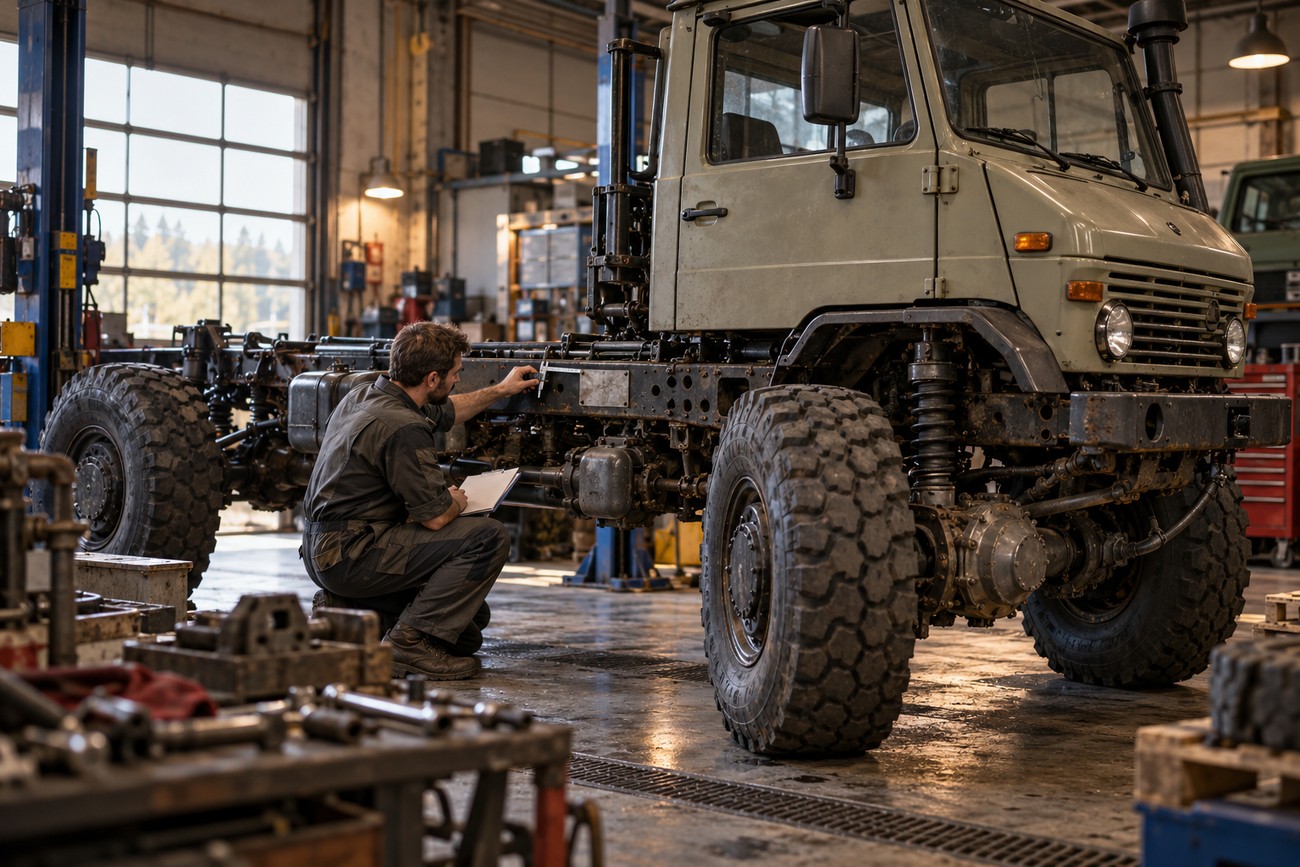
Begin with the donor vehicle, not the floor plan. Older U-series, military, service, and civilian chassis can differ substantially in payload, layout, condition, maintenance history, parts support, and available mounting space. A vehicle that appears inexpensive may require extensive work before the camper construction even starts.
The chassis data plate and supporting documentation are the starting points for the permitted gross vehicle mass and axle loads. Check these limits against the intended loaded vehicle, using the rules that apply where the conversion will be registered. An advertisement or a model name is not a substitute for documented limits.
Inspect the condition of the frame, axles, suspension, brakes, driveline, wiring, and attachments. Also identify filters, grease points, connectors, inspection covers, and other routine service locations. Specialized Unimog parts can be expensive and may not be available through ordinary parts stores, so parts access and service history belong in the purchase decision.
Wheelbase and rear overhang deserve early attention. They affect interior space, departure angle, axle loading, turning behavior, and the location of tanks and heavy equipment. A suitable donor is the one that supports the intended loaded mass and route while remaining serviceable, registrable, and affordable to maintain.
Calculate Payload, Axle Loads, and Center of Gravity
Use the specific chassis documentation and local regulations to establish the permitted gross vehicle mass and axle loading. Then prepare a mass budget that includes the module, subframe, water, batteries, spare wheel, winch, tools, heating, electrical equipment, fuel, food, clothing, and luggage. Payload disappears quickly once these items are counted together.
Total mass is only one part of the calculation. A vehicle can remain below its overall limit while placing too much load on one axle or concentrating weight at the rear. Draw the proposed equipment on the chassis, estimate its position, and review both axle distribution and the resulting center of gravity before selecting cabinetry or finishes.
Water tanks, batteries, generators, compressors, tools, and recovery equipment should be positioned low and deliberately, close to the central part of the vehicle where possible. Adding them after the interior is designed often produces a tall or rear-heavy camper. Such a layout can increase body roll, reduce handling confidence, and make the rear suspension work harder.
Static calculations are not enough for an off-road vehicle. Bumps, diagonal articulation, braking, steep slopes, and recovery work create dynamic loads beyond the parked load. The loaded vehicle must be assessed for clearance, stability, axle loading, braking, and access to vulnerable components, rather than judged as an empty chassis in a workshop.
Keep a reserve for real use. A camper that meets its limits only before carrying drinking water, tools, spare parts, and personal equipment is already too heavy for its intended purpose. The most useful luxury is often spare payload and predictable handling, rather than another appliance or a more elaborate interior.
Build a Living Module That Can Survive Frame Flex
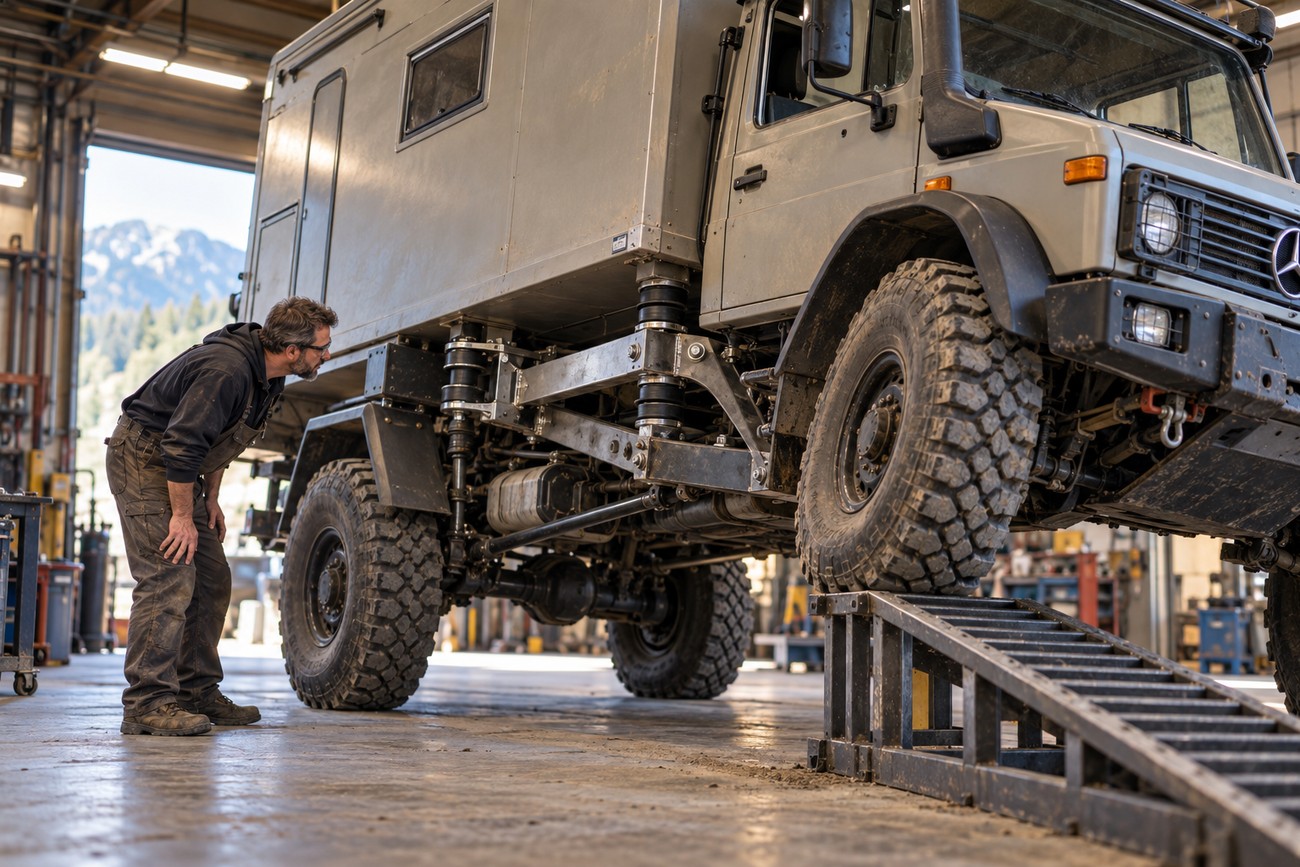
The Unimog chassis can articulate and twist as the axles move over uneven ground. A rigidly bolted body may resist that movement, transferring stress into the frame, mounting points, or the living module. Cracks, distorted panels, damaged fasteners, and failed seals can follow even when the installation looks strong while parked.
Builders commonly use a three-point or equivalent engineered subframe so the module can accommodate chassis twist. The correct arrangement depends on the chassis, body dimensions, intended loads, and recovery use, so the mounting system should be designed as a structural interface rather than copied from a different truck.
Reserve the final module layout around articulation, maintenance access, and low-mounted heavy equipment before choosing cabinets or finishes. Interior decoration is easy to change; a poorly placed tank or inaccessible service point can compromise the whole vehicle.
Keep the module as light as the intended use allows. Lightweight construction protects payload margin and helps control the center of gravity, while unnecessary luxury adds mass in places that are difficult to remove later. Mounting hardware, structural joints, doors, seals, and external storage must also tolerate vibration and dynamic loads from bumps, diagonal articulation, and recovery work.
Plan access around the finished body. Filters, grease points, connectors, inspection covers, and maintenance hatches must remain reachable without dismantling furniture or removing stored equipment. The best expedition layout is one that allows ordinary servicing before a minor problem becomes a field repair.
Design Autonomy Without Turning the Camper Into a Weight Trap
For remote travel, energy balance, thermal insulation, heating, ventilation, and water capacity usually matter more than engine power alone. Every tank, battery, inverter, generator, appliance, and spare system consumes payload and may increase fuel use. Define the travel pattern first, then size the systems around actual demand.
Insulation and heating deserve early engineering attention. A poorly insulated module can be cold, damp, and expensive to heat, while inadequate ventilation creates condensation and stale air. Saving money on sound and vibration insulation can also make the cab and living space tiring during long transfers, particularly on rough roads.
Comfort begins in the cab. Correct seat position, effective ventilation, controlled noise, and reduced vibration have more effect on a long drive than decorative interior upgrades. The high seating position may provide good visibility, but climbing into the cab and remaining there for many hours can be physically demanding.
Use reliable, serviceable systems with clear access to fuses, pumps, filters, valves, and electrical connections. Remote areas offer limited support, so a simple system that can be diagnosed and repaired is often more valuable than a complex installation with several hidden dependencies. The autonomy plan should include tools, spare parts, and a way to isolate failed circuits or appliances.
Legalize, Service, and Test the Finished Conversion
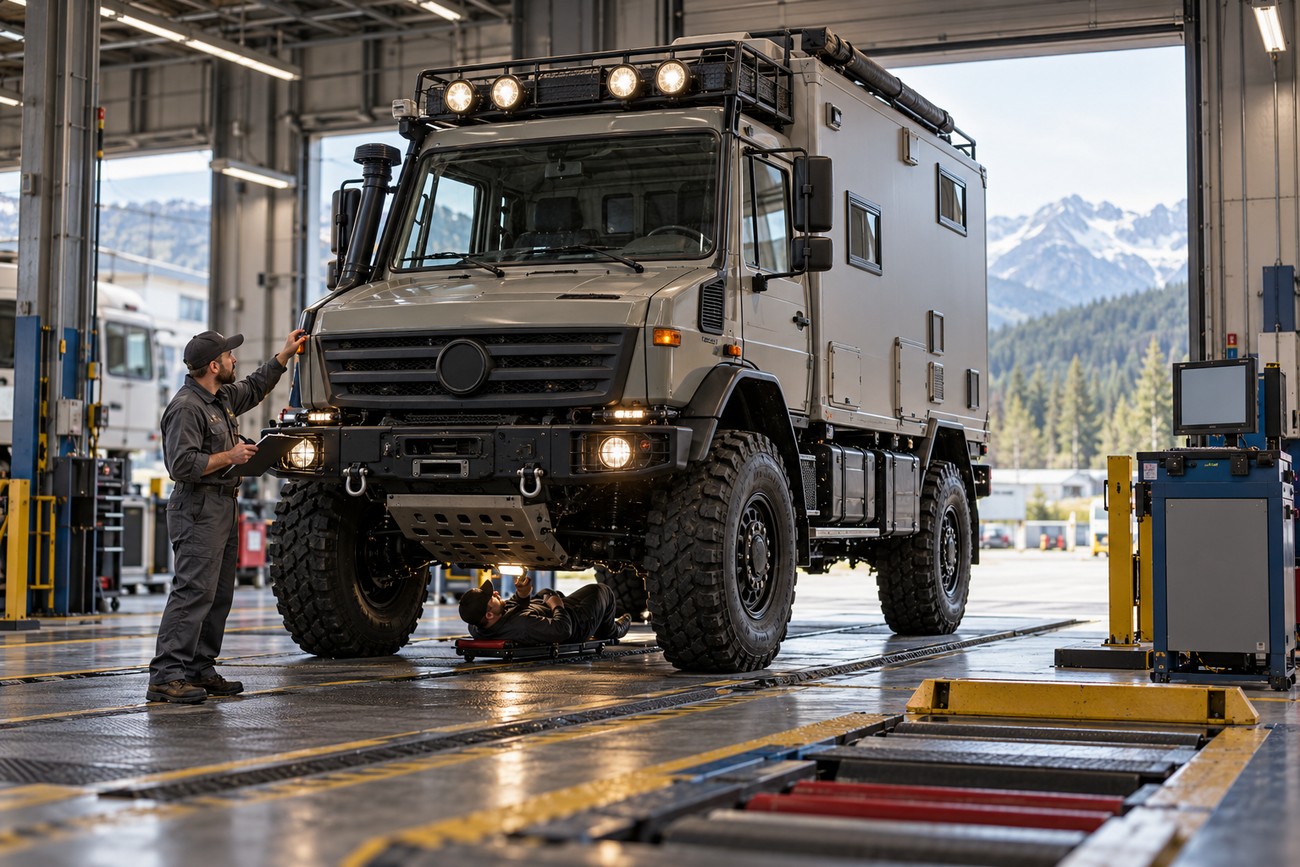
Check conversion approval requirements before fabrication begins. Local rules may require evidence concerning brakes, lighting, mounting points, dimensions, axle loads, gross vehicle mass, and the classification of the finished vehicle. In some jurisdictions, a separate examination of the modified vehicle is required.
Registration and certification can become a major project cost. Early discussions with the relevant authority or qualified inspection professional can prevent a finished module from failing because of a mounting detail, unrecorded mass, lighting position, or dimensional issue. The legal route should influence the design from the beginning.
Service planning continues after registration. Specialist Unimog service is not available everywhere, and complex axles or attachments may be difficult to repair in the field. An expedition body can obstruct access to maintenance points and make routine work slower, especially if the builder has placed storage, tanks, or electrical equipment over service covers.
Expect long road transfers to be slower, noisier, and more expensive than travel in a conventional camper. Large mass, high seating, and high fuel consumption affect the practical range of a trip even when the vehicle is excellent on rough ground. The route should therefore include realistic fuel, maintenance, and recovery planning.
Test the finished vehicle in its genuinely loaded configuration before remote travel. Include water, tools, spare equipment, food, and luggage, then check handling, braking, body roll, clearance, suspension behavior, service access, and system reliability. A Unimog is worth the complexity when its off-road ability is genuinely needed and the owner accepts the cost of engineering, servicing, comfort, and legal compliance.
Frequently Asked Questions
The donor vehicle, structural mounting, payload, and legal requirements shape the conversion from the beginning. These factors also influence the budget, model choice, and suitability of the finished camper. The following answers address common planning questions.
How much does an Unimog camper conversion cost?
There is no useful universal price because the budget depends on the donor vehicle, its condition, the structural conversion, engineering approval, interior systems, specialist labor, and required repairs. Start by pricing the inspected chassis and essential mechanical work, then add the subframe and module, utilities, interior, certification, and a separate reserve for unexpected faults.
This sequence prevents the common mistake of spending the available budget on cabinetry before accounting for brakes, axles, mounting, wiring, heating, and legal requirements. A cheap donor can become an expensive project if parts are scarce or service access is poor.
What is the best Unimog model for a camper conversion?
The best model is the one whose documented axle limits, chassis condition, wheelbase, service history, parts access, and registration prospects match the intended loaded vehicle. Older U-series, military, service, and civilian chassis all require individual assessment; there is no universally best Unimog for every camper.
Screen candidates using records and an inspection rather than off-road reputation. Confirm the legal mass, inspect the structure and running gear, identify local service support, and sketch the module and equipment positions before purchase.
How much does it cost to transform a van into a camper?
Van-conversion pricing cannot be transferred directly to a Unimog project. A van may require interior work and vehicle-system upgrades, while a Unimog commonly adds structural mounting for frame articulation, heavier-duty equipment, axle and mass analysis, specialist fabrication, and potentially more demanding certification.
The two platforms solve different travel problems. A van generally offers easier road manners, service access, and lower conversion complexity; a Unimog offers unusual clearance and off-road potential at the cost of weight, comfort, fuel, and engineering effort.







