
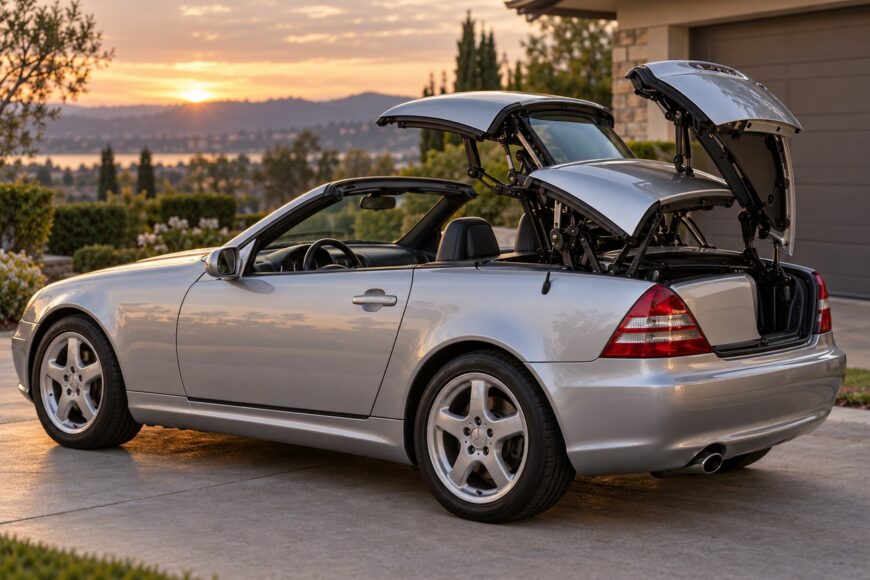
The Mercedes-Benz SLK R170 is an affordable two-seat roadster whose fully metal folding roof is both its defining engineering achievement and its greatest age-related liability. The Vario Roof gives the car a more solid closed-car environment than a traditional soft-top and transforms its character at the press of a center-console button.
Age changes the buying priorities. Roof operation, water ingress, electrical supply, and maintenance history deserve more attention than a low odometer reading, because a little-used hydraulic system can still suffer from old seals, hoses, wiring, and sticky mechanisms. The R170 makes sense as a compact roadster only when the roof works properly and the owner accepts specialist maintenance.
- Why the Mercedes SLK R170 still matters
- How the Vario Roof works—and why it fails
- R170 engine versions and published performance ranges
- Everyday practicality and age-related ownership pain
- How to inspect a used SLK R170 before buying
- R170 myths that mislead buyers
- Frequently asked questions
- What exactly is the Mercedes Vario Roof?
- Which years of the Mercedes-Benz SLK R170 should I avoid?
- Why is the SLK R170 so cheap?
Why the Mercedes SLK R170 still matters
The Mercedes-Benz SLK R170 was the first-generation SLK, produced from 1996 as a two-seat roadster. Its compact dimensions, rear-wheel-drive layout, and relatively formal Mercedes interior gave it a different character from many small soft-top convertibles of the period.
The defining feature was the Vario Roof: a fully metal, powered retractable hardtop operated by a button on the center console. The roof folds into the rear of the car, bringing the trunk lid and its locking sequence into the same mechanical operation.
This construction made the R170 an important alternative to traditional fabric-roof roadsters. A metal roof can provide a more solid closed-car environment and greater resistance to weather exposure, although it also introduces hydraulic cylinders, position sensors, microswitches, locks, and additional wiring.
The result is a car with a clear engineering identity rather than a simple open-air version of a conventional coupe. That identity remains the reason to buy an R170, provided the example has been maintained as a complete mechanical system.
How the Vario Roof works—and why it fails
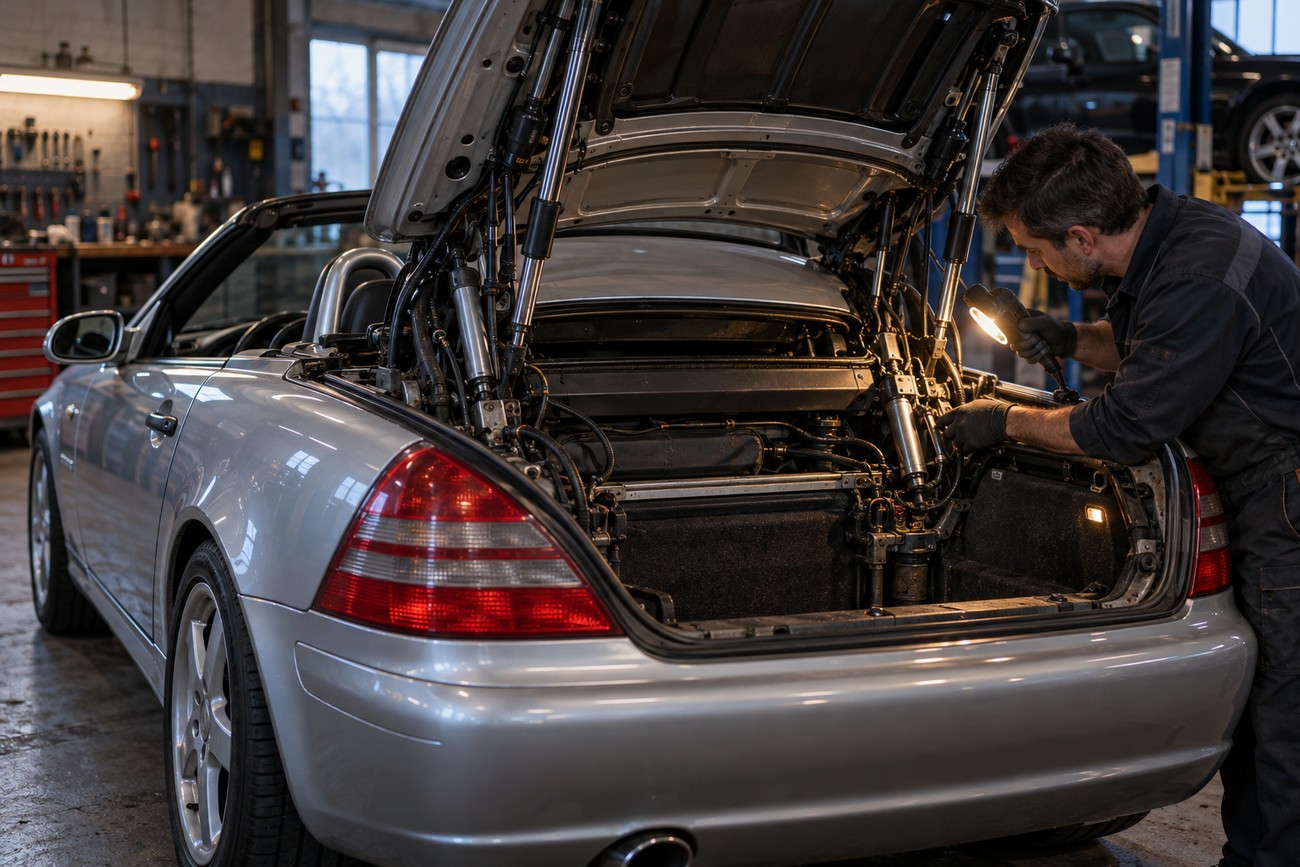
The Vario Roof is a coordinated sequence rather than a single electric motor lifting a panel. The roof is integrated with the trunk lid, and the mechanism uses five hydraulic cylinders to move the roof sections and associated bodywork in the correct order.
A complete cycle is commonly quoted at approximately 25 seconds. During that operation, the car must confirm the position of the trunk lid, roof sections, locks, and latches through sensors and microswitches. The hydraulic system must also maintain sufficient pressure while the electrical supply powers the control system.
That dependency explains why a roof can stop halfway through its movement. Low battery voltage, a hydraulic fault, a failed position sensor, a misbehaving microswitch, or a lock that does not confirm its position can interrupt the entire cycle. The pump may receive blame even when the real fault is a signal or alignment problem.
Age adds further complications. Hydraulic hoses and seals can deteriorate, plastic components and guides can wear, and wiring can become brittle or damaged. Water ingress around seals or blocked drains may then affect the trunk, cabin, or electrical connections.
Access to some components is awkward because parts of the mechanism sit behind trim, inside the trunk, or beneath interior coverings. Diagnosis may therefore require more disassembly than the symptom initially suggests, especially when a previous owner has fitted improvised repairs or bypassed part of the original system.
R170 engine versions and published performance ranges
The R170 was sold with different engines and outputs depending on model year and market. The figures below provide useful orientation, while the exact specification should be verified from the vehicle identification number and local documentation.
| Version | Engine and output | Published performance | Important caveat |
|---|---|---|---|
| SLK 200 Kompressor | Four-cylinder; 136–163 hp | Varies by version | Output depends on year and market. |
| SLK 230 Kompressor | Four-cylinder; approximately 193–197 hp | 0–100 km/h in approximately 7.4–8.2 seconds; top speed approximately 223–231 km/h | Acceleration and top speed vary by version and source. |
| SLK 320 | V6; 218 hp | Varies by version | Equipment, transmission, market, and model year affect published data. |
The car is compact by modern standards, with typical dimensions of approximately 3,995 mm in length, 1,715 mm in width, 1,265–1,270 mm in height, and a 2,400 mm wheelbase. These proportions help the R170 feel manageable on narrow roads and easy to place in traffic, although the short cabin and limited storage remain central to its character.
Everyday practicality and age-related ownership pain
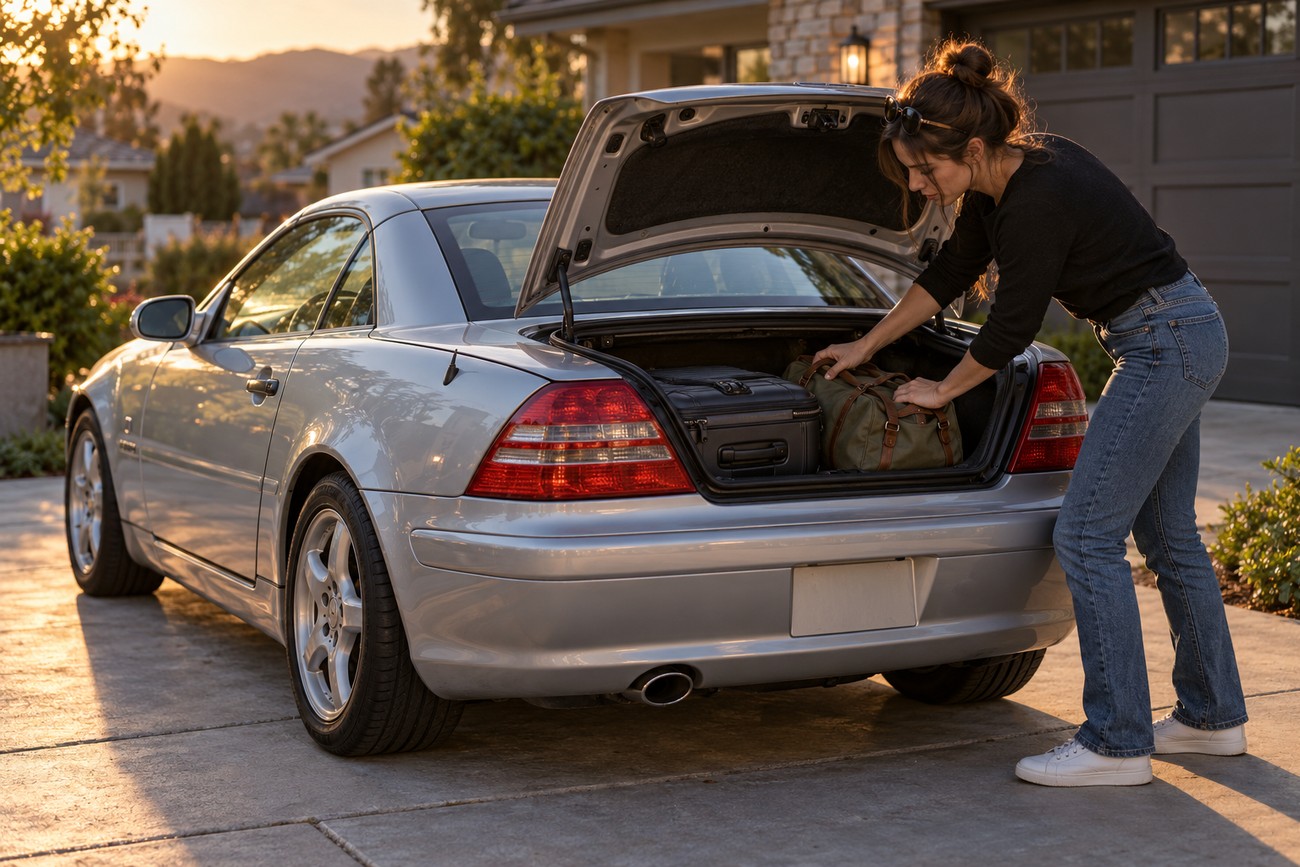
The R170 offers two seats, a low driving position, and a roof that changes the car from a closed configuration into an open one without storing a separate fabric top. Its practical limitation is luggage space. The boot is commonly listed at approximately 145 liters with the roof raised, while some catalogues give up to approximately 350 liters with the roof folded.
Published maximum figures differ by source and measurement method, so buyers should treat the boot as variable rather than relying on one headline number. With the roof raised, the available space can be especially restrictive for longer trips. The roof’s position directly changes how much luggage the car can carry.
Water in the trunk or cabin is another recurring age-related concern. Deteriorated seals, blocked drains, and poorly aligned panels can leave moisture in recesses beneath the carpets, where it may remain hidden until corrosion, odors, or electrical problems appear.
Owners also report roof rattles, squeaks, and knocks caused by worn guides, bushes, locks, or related fittings. Good used roof parts can be difficult to source, and access to the mechanism can make repairs demanding. On an older R170, roof condition can matter more than mileage because low use does not preserve seals, hydraulics, plastic parts, or wiring.
How to inspect a used SLK R170 before buying
Begin with the roof, before discussing the car’s cosmetic condition or taking a road test. Check that the battery is healthy, then operate the Vario Roof through several complete open-close cycles. A single successful demonstration proves very little because an aging system may work once and fail when voltage drops or a component reaches a different position.
Listen for uneven hydraulic operation, pauses, grinding, knocks, or unusual movement. Watch the trunk lid and roof sections together, checking that each stage starts and finishes cleanly. The cycle should complete without manual assistance, warning lights, repeated button presses, or unexplained hesitation.
A roof-cycle fault should first be treated as a synchronization problem until the position signals, latches, trunk-lid status, and electrical supply have been checked. Replacing the pump without confirming those signals can leave the original fault untouched.
Inspect the trunk recesses, carpets, seals, and drains for moisture or water marks. Lift carpets where possible and look for staining, corrosion, damp insulation, or evidence that water has been diverted away from its normal path. Check the cabin floor and door areas as well, since a dry visible surface does not prove that the underlying channels are clear.
Ask for documented roof-service history, including work on hydraulic components, seals, sensors, or wiring. Examine fasteners, brackets, hoses, trim, and wiring for non-factory repairs, sealant, drilled mounting points, or parts that appear to have been forced into position. Such evidence does not automatically reject the car, but it calls for a deeper inspection and a realistic repair budget.
Finally, judge the whole car rather than the odometer alone. A low-mileage example with neglected seals and a dormant hydraulic system may require more recommissioning than a higher-mileage car that has received regular roof maintenance. A specialist inspection is sensible when the seller cannot demonstrate repeatable operation or explain previous repairs.
R170 myths that mislead buyers
Myth: every R170 has a 350-litre boot. Reality: the commonly quoted figure is approximately 145 liters with the roof raised, while some catalogues list up to approximately 350 liters with it folded. The maximum varies between sources and measurement methods, and the car’s useful luggage space changes with roof position.
Myth: a metal folding roof is maintenance-free. Reality: the Vario Roof depends on five hydraulic cylinders, sensors, microswitches, locks, seals, drains, wiring, and correct trunk-lid positioning. A hardtop reduces some soft-top concerns, yet it creates a complex system with its own age-related failure points.
Myth: all R170 versions perform alike. Reality: listed SLK 200 Kompressor versions range from 136–163 hp, the SLK 230 Kompressor is listed at approximately 193–197 hp, and the SLK 320 uses a 218 hp V6. Market, model year, equipment, and transmission affect both specifications and published performance.
Myth: the roof folds in an instant. Reality: the commonly quoted cycle is approximately 25 seconds, and the operation depends on system condition. A slow, noisy, or interrupted cycle is useful diagnostic evidence rather than a harmless characteristic.
Frequently asked questions
The R170 rewards buyers who assess the complete car as an aging mechanical system. These answers address the points that most often cause confusion during research and inspection.
What exactly is the Mercedes Vario Roof?
The Vario Roof is Mercedes-Benz’s powered retractable metal hardtop used by the R170. It is operated from the center console and folds into the rear body structure rather than being removed and stored separately.
Its significance lies in the coordinated sequence: the roof, trunk lid, hydraulic cylinders, locks, sensors, and electronic controls must all confirm their positions. The system is therefore closer to an integrated electromechanical mechanism than to a simple detachable hardtop.
Which years of the Mercedes-Benz SLK R170 should I avoid?
There is no reliable blanket year blacklist that replaces inspection of an individual R170. Condition, roof-service history, water ingress, battery health, previous repairs, and the quality of maintenance provide more useful buying evidence than a single model year.
Compare several cars where possible and reject examples with an incomplete roof cycle, unexplained moisture, or improvised repairs unless the purchase price and repair plan reflect the risk. A well-maintained car from a less desirable year can be a safer purchase than a neglected example with a stronger specification.
Why is the SLK R170 so cheap?
Purchase prices are held down by the car’s age, two-seat layout, limited luggage space, and the potential cost of recommissioning a neglected roof system. Buyers may also discount cars with uncertain electrical, hydraulic, or water-ingress histories.
A low entry price does not guarantee low ownership cost. The sensible comparison is between the car’s total condition and the cost of restoring reliable roof operation, dry interiors, sound seals, and properly functioning electrical systems.







