
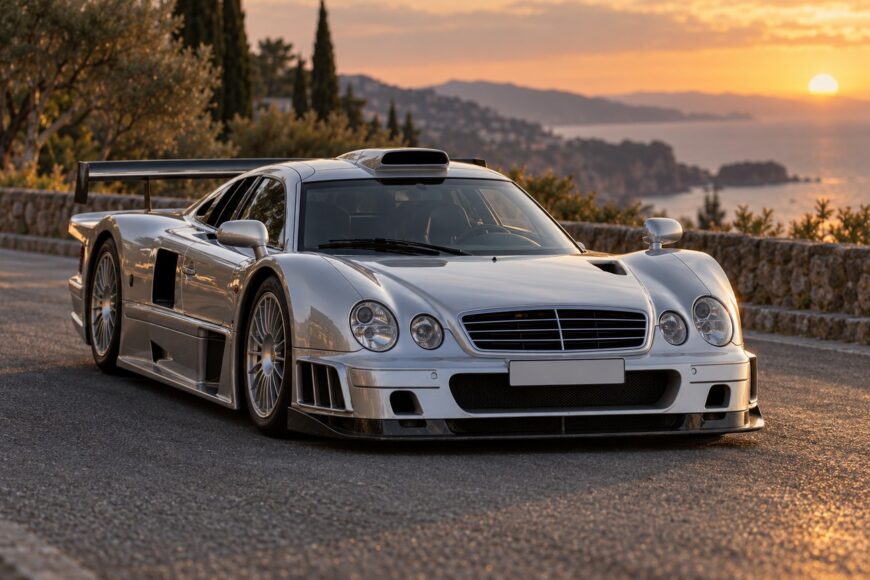
The Mercedes CLK GTR wears license plates, but its carbon-fiber structure, mid-mounted V12, and six-speed sequential transmission belong to the world of GT1 racing. Road equipment made it registrable in some markets; it did little to soften the compromises built into the car.
That distinction shapes the buyer’s dilemma. A CLK GTR can be preserved as a significant homologation car or driven cautiously as a rare roadgoing machine. Its acceleration and tiny production run explain part of the appeal, but its value also rests on how closely it preserves a racing program’s engineering decisions.
- The Mercedes CLK GTR Is a Race Car Adapted for the Road
- Engine, Performance, and the Road-Car Specification
- Mercedes CLK GTR Road Car vs. GT1 Race Car
- Why the CLK GTR Is So Difficult to Use on the Street
- Ownership Risks: Service, Registration, and Common Buyer Mistakes
- Rarity, Market Value, and the Myth of the $15 Million CLK GTR
- Frequently asked questions
- How many Mercedes CLK GTRs exist, including prototypes?
- What Mercedes is worth $15 million?
- What should be checked before buying a CLK GTR?
The Mercedes CLK GTR Is a Race Car Adapted for the Road
Mercedes developed the roadgoing CLK GTR as a homologation version of its GT1 prototype for FIA GT competition and the wider Le Mans-era GT1 program. It was conceived around racing requirements, then adapted for public-road use. The CLK name and front-end styling should not suggest a close mechanical relationship with an ordinary production coupe.
A carbon-fiber racing monocoque forms the car’s core. The V12 sits longitudinally behind the cabin, driving the rear wheels, while the body and cabin fit around that layout. Road adaptations changed equipment and calibration without turning the underlying architecture into that of a conventional grand tourer.
There is an important historical distinction in the “Le Mans car” description. The CLK GTR established the GT1 program in FIA competition; the related CLK LM was the car Mercedes took to the 24 Hours of Le Mans. Calling the road CLK GTR a Le Mans-related car captures its lineage, but saying the CLK GTR itself raced there would blur two different machines.
Engine, Performance, and the Road-Car Specification
The standard road car uses a 6,898 cc M297 V12 based on the M120, with four valves per cylinder. Its quoted output is approximately 612 hp at 6,800 rpm and approximately 775 Nm at 5,250 rpm. The engine’s position behind the occupants is as consequential to the driving experience as its power.
Drive goes to the rear wheels through a six-speed sequential transmission. Published road-car figures put acceleration at approximately 3.8 seconds from 0–100 km/h and approximately 9.9 seconds from 0–200 km/h. The standard car’s quoted top speed is approximately 320 km/h, or approximately 200 mph.
The GT1 race version used a 6.0-liter V12 with FIA-limited output of approximately 600 hp. The larger-capacity road engine therefore should not be treated as a detuned copy with identical specifications. The figures describe different operating requirements, even though the cars share their basic racing architecture.
Rare Super Sport versions are associated with approximately 7.3 liters and approximately 720 hp. The frequently repeated 346 km/h claim belongs with Super Sport or modified 7.3-liter cars, rather than the standard road-car specification. For a collector, confirming which engine and configuration a particular chassis actually carries matters more than the biggest figure attached to the model name.
Mercedes CLK GTR Road Car vs. GT1 Race Car
The road car and GT1 machine were built for different rules and operating conditions, but they share far more than a silhouette. The comparison shows where homologation changed the specification—and where it did not.
| Feature | Roadgoing CLK GTR | GT1 race car |
|---|---|---|
| Purpose | Roadgoing homologation version | FIA GT competition |
| Engine | 6,898 cc M297 V12 | 6.0-liter V12 |
| Output | Approximately 612 hp at 6,800 rpm | Approximately 600 hp, subject to FIA restrictions |
| Chassis | Carbon-fiber racing monocoque with minimal road adaptations | Carbon-fiber racing monocoque |
| Transmission | Six-speed sequential transmission | Race sequential transmission |
| Equipment | Road-use fittings and a more finished cabin | Competition-focused equipment |
| Operating environment | Public roads, subject to local approval | Race circuits and regulated competition |
The road equipment matters for registration, yet it cannot erase the high sills, restricted sightlines, stiff chassis, or specialist mechanical systems. That is why the CLK GTR feels unusually close to a race machine even among homologation specials. Buyers comparing it with a normal Mercedes production coupe are using the wrong reference point.
Why the CLK GTR Is So Difficult to Use on the Street
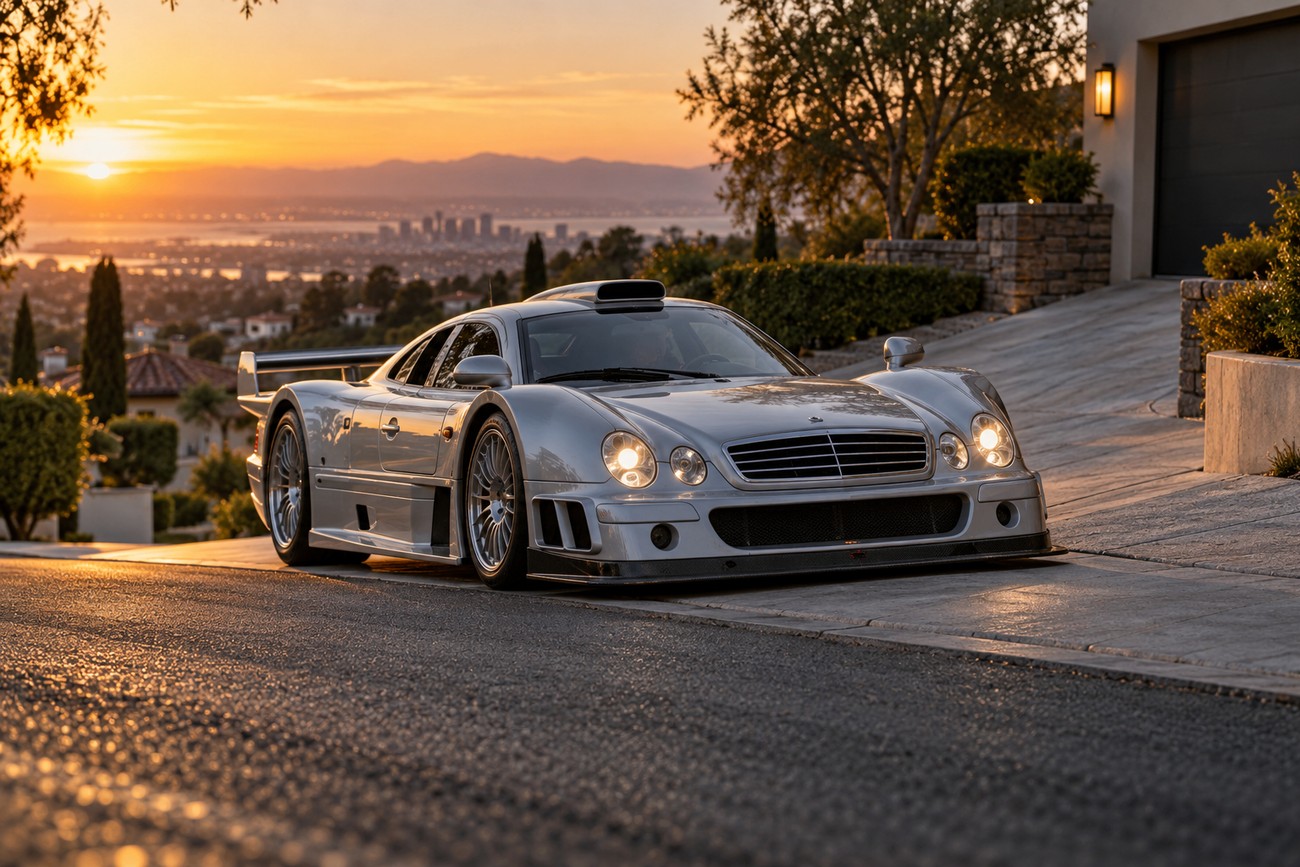
The suspension is exceptionally stiff, and ground clearance leaves little tolerance for ramps, speed bumps, or uneven pavement. A route that presents no problem in an ordinary sports car may require careful planning in a CLK GTR. Those limits follow from a low racing chassis; they are not defects that routine service can remove.
Getting aboard takes effort because the sill is high, the opening is narrow, and the seats are shaped for secure support rather than easy entry. Once seated, the driver faces restricted rear and diagonal visibility from the bodywork and small rear window. Parking and negotiating narrow streets consequently demand more space and patience than the car’s external dimensions alone might suggest.
Heat and noise remain prominent because the engine and exhaust sit close to the cabin, even in a road-equipped car. Slow traffic makes those traits harder to ignore while offering little of the airflow available at speed. The car’s low-speed responses can also feel less natural than its performance figures imply: its chassis and aerodynamics were optimized for fast driving.
Fuel use adds a practical constraint. Real-world city consumption can exceed 30 L/100 km, while highway consumption is approximately 6–7 km per liter. For most owners, however, the more significant limit on spontaneous use is the need to consider the route, traffic, and destination before leaving the garage.
Ownership Risks: Service, Registration, and Common Buyer Mistakes
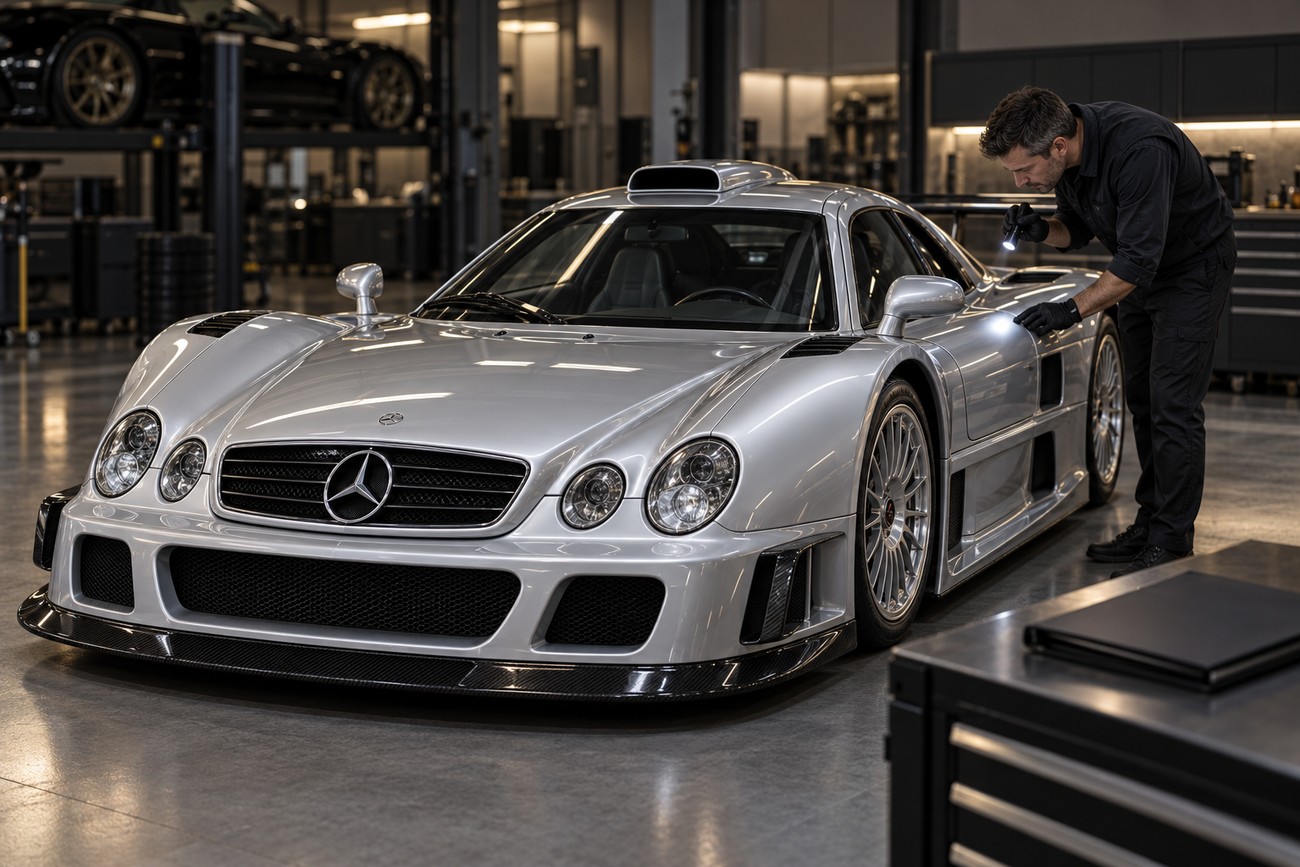
Maintaining a CLK GTR requires access to people who understand race-derived hardware, original electronics, and a carbon-fiber monocoque. Original parts are scarce, and repairs may involve AMG-related support or specialist racing workshops. A minor-looking problem can therefore mean lengthy downtime and a substantial bill.
Structural condition deserves particular scrutiny. Damage to the monocoque can become a major restoration problem, while aging composite or electronic components may be difficult to replace. Mileage alone gives an incomplete picture of a car that may have spent long periods stored, displayed, or exercised only occasionally.
Inspect the monocoque, cooling system, original electronics, and documented race-derived components before allowing cosmetic condition or low mileage to set the tone of a purchase.
Extended time in traffic warrants caution because the cooling package was developed around a racing design. A buyer should have a specialist check the system’s condition and behavior rather than assume that a running engine is ready for a congested city journey. Registration, inspection, and insurance also depend on the jurisdiction; existing plates in one market do not guarantee approval in another.
Non-original suspension, exhaust, electronic, or drivetrain changes may complicate diagnosis and weaken collector appeal, particularly when original parts and records are missing. Buying the car for regular driving without a realistic maintenance reserve is an equally costly mistake. Anyone intending to use its performance should first learn the sequential transmission and obtain suitable instruction for a powerful, race-derived car whose behavior changes at speed.
Rarity, Market Value, and the Myth of the $15 Million CLK GTR
Roadgoing production is commonly cited as 20 coupes and 6 roadsters. Published totals of approximately 25–26 also appear, depending on how prototypes and production cars are classified. These figures should be read alongside each source’s counting method rather than treated as interchangeable totals.
Market estimates for individual road cars are approximately $8–10 million or more, depending on provenance, condition, specification, and the market at the time. Transactions are too infrequent for a single number to describe every example reliably. Documentation, originality, and a credible service history carry unusual weight when the next repair may require scarce expertise or parts.
A $15 million headline should not be taken as the standard value of a roadgoing CLK GTR. An exceptional Mercedes race-car transaction, unusual provenance, or a rare specification may command a figure that says little about another chassis. Similarly, a claimed 346 km/h top speed points toward a Super Sport or modified 7.3-liter version, not every standard car.
The CLK GTR trades as a scarce Le Mans-related GT1 machine capable of road registration, rather than as an ordinary used Mercedes. That distinction supports its collector standing while also making careful identification essential: coupe, roadster, and Super Sport claims should be checked against the individual car’s records.
Frequently asked questions
These answers address three points that often get compressed into misleading headlines: production counts, values, and what an inspection must establish. With so few cars, the identity and records of an individual chassis matter more than a model-wide generalization.
How many Mercedes CLK GTRs exist, including prototypes?
Roadgoing production is commonly cited as 20 coupes and 6 roadsters. Prototype-inclusive totals are also reported as approximately 25–26, with variation in how particular cars are classified. When comparing published numbers, check whether the source counts completed customer road cars, prototypes, or another defined group.
What Mercedes is worth $15 million?
No $15 million figure should be applied automatically to a standard roadgoing CLK GTR. Exceptional Mercedes race cars or cars with unusual provenance may generate headline valuations, while roadgoing CLK GTR estimates are commonly approximately $8–10 million or more. A meaningful assessment must identify the specific chassis, its specification, condition, history, and the basis for the quoted figure.
What should be checked before buying a CLK GTR?
Start with specialist verification of carbon-monocoque integrity, then inspect the cooling system, original electronics, transmission, and other serviceable race-derived components. Match those findings to maintenance records and evidence of original specification; attractive bodywork and low mileage cannot establish structural or mechanical health.
Before committing, confirm that a qualified workshop can support the car and source what it may need. Check registration, inspection, and insurance requirements in the country where it will be used. Those practical findings can change the cost—and feasibility—of ownership more than a short test drive.







