
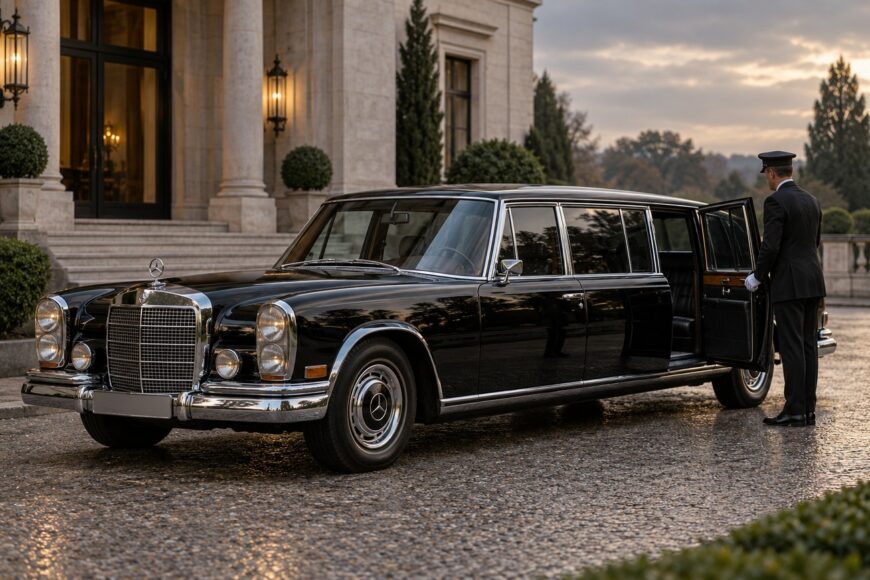
The Mercedes 600 Pullman carries the image of a ruler’s limousine: long doors, a private rear compartment, and a presence suited to state ceremony. Behind that image sits a demanding piece of engineering. Its V8, high-pressure cabin controls, and self-leveling suspension made it formidable in service and complicated to maintain decades later.
For a collector, the political story can be as difficult to assess as the machinery. A car advertised as a former leader’s limousine may have an imposing appearance and a plausible history, yet still lack records tying that claim to its chassis. Paint, upholstery, and an easy engine start reveal little about the condition of its hidden systems.
- Why the 600 Pullman became the dictator’s limousine
- Mercedes 600 body styles: saloon, Pullman, and landaulet
- The V8, high-pressure hydraulics, and a separate air suspension
- Famous owners, uncertain provenance
- What a glossy restoration can conceal
- What determines a Pullman’s value today
- Frequently asked questions
- What is the average price of a Mercedes-Benz 600 Pullman?
- How should a Mercedes 600 Pullman be stored between drives?
- What should be checked before transporting a six-door Pullman?
Why the 600 Pullman became the dictator’s limousine
The Mercedes-Benz 600, factory series W100, was produced from 1964 to June 1981. In Pullman form, its extended body gave the chauffeur and rear passengers distinct spaces. The arrangement suited official arrivals, where passengers needed room, privacy, and an unmistakable entrance.
Those qualities made the 600 attractive to heads of state. Ceaușescu, Tito, Castro, and Kim Il Sung are among the leaders associated with Mercedes 600 cars, although the body style of any car linked to them needs its own evidence. The same model also served clients outside politics, so its reputation describes a strand of its history rather than its entire clientele.
“The dictator’s limousine” endures because the car projected authority so effectively. Its length and controlled, quiet presentation turned a journey into part of a public occasion. That symbolism is historically meaningful; it does not identify the previous owner of a surviving chassis.
A photograph of a leader beside a 600 can establish a connection to a car of that type. To establish ownership of the particular Pullman offered for sale, a buyer needs records that identify the vehicle itself. The distinction matters most when a political association is being used to justify a premium.
Mercedes 600 body styles: saloon, Pullman, and landaulet
Body style determines what should be present on the car and what a restoration must preserve. A Pullman did not invariably have six doors.
| Version | Documented dimensions and layout | Identification and restoration implication |
|---|---|---|
| Standard 600 saloon | 3,200 mm wheelbase; four doors | Its shorter body should not be described as a factory Pullman. |
| Four-door Pullman | 3,900 mm wheelbase; four doors | Check the factory body record before treating its door count as evidence of a conversion. |
| Six-door Pullman | 3,900 mm wheelbase; approximately 6,241 mm long | Extra doors add mechanisms and body joints to inspect and restore. |
| Landaulet | Pullman-length body with a folding rear roof; seating and door layouts varied | Verify the original roof and body configuration; weather sealing adds another restoration concern. |
The Mercedes-Benz archive records 2,677 W100 cars in total, including 429 Pullmans and 59 landaulets. Some publications cite 487 Pullmans without using the archive’s stated breakdown. A production figure is useful for judging rarity only when its treatment of landaulets is clear.
The V8, high-pressure hydraulics, and a separate air suspension
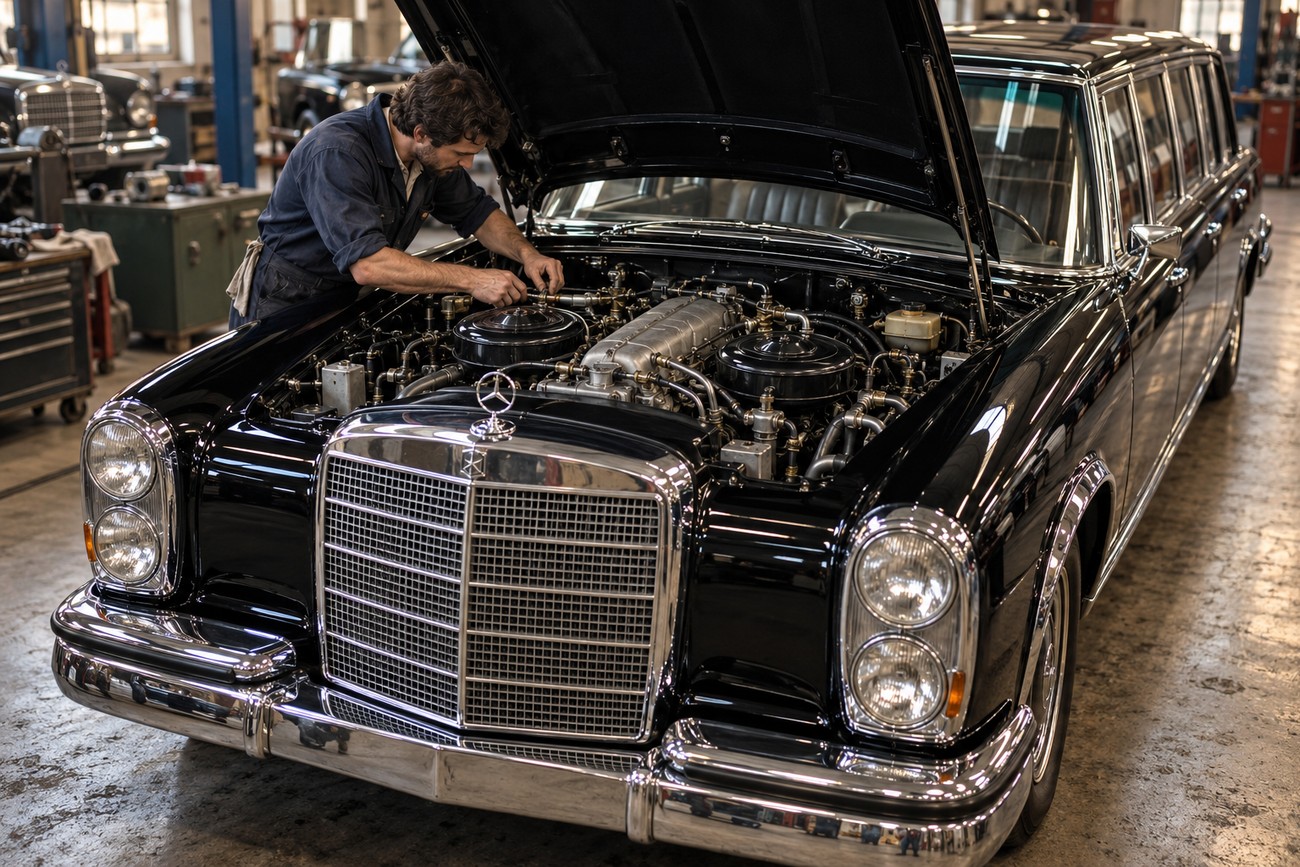
The M100 was a mechanically injected gasoline V8 displacing 6,332 cm³ and producing 250 hp and approximately 500 Nm. Its torque helped the large car move with composure, an important quality for a chauffeur-driven limousine carrying passengers and luggage.
Mercedes quoted 205 km/h and approximately 10 seconds from 0–100 km/h for the 600. Period Pullman tests reported approximately 12 seconds to 100 km/h. The factory figure for the 600 should therefore not be repeated as a measured result for every longer, heavier Pullman.
Approximately 150-bar hydraulics operated multiple body and cabin functions, including windows, seats, doors, and the trunk lid, plus the sunroof and partition where fitted. They also adjusted the dampers. A fault in the pressure supply or a leaking line can affect several controls, which makes a quick check of one working window a poor test of the system.
A nitrogen-charged accumulator helped retain hydraulic pressure after engine shutdown. That stored pressure matters because controls may work while the engine runs yet become weak or unresponsive soon after it stops. Aging seals and internal leaks can produce the same outward symptom, so the cause requires diagnosis.
The suspension is often described inaccurately as fully hydraulic. A separate pneumatic system provided self-leveling suspension; hydraulic pressure adjusted damper settings. Keeping those systems distinct prevents an air-suspension fault from sending a repairer toward the wrong parts and procedures.
Famous owners, uncertain provenance
Political ownership is part of the Mercedes 600 story, but names travel more easily than chassis records. Ceaușescu, Tito, Castro, and Kim Il Sung are associated with Mercedes 600 cars. That association alone establishes neither ownership of a particular survivor nor whether the car in question was a Pullman.
A period photograph can show that a leader used or appeared with a 600. It may not reveal the chassis number, and a later sales description can repeat an earlier assumption until it sounds settled. Stronger evidence is a continuous chain of chassis-specific registration, inventory, service, and transfer records that agrees with the car’s physical details.
Factory configuration deserves equal attention. A documented owner cannot make a later body alteration original, while an authentic factory Pullman does not acquire a famous past through resemblance to one in a photograph. Comparing the chassis identity with archive information helps separate both claims.
Production totals need similar care. The Mercedes-Benz archive lists 429 Pullmans and 59 landaulets among 2,677 W100 cars; other publications cite 487 Pullmans under a different or unexplained count. Neither a disputed total nor a ruler’s name substitutes for evidence about the individual vehicle being sold.
What a glossy restoration can conceal
Start an inspection with the chassis identity and the factory body configuration. Establish whether the doors, roof, seating layout, and partition agree with the records before assessing the quality of their finish. Later alterations can be expensive to reverse, especially when they involve Pullman-specific bodywork.
Next, examine the structure rather than relying on visible paint. Sills, door openings, partitions, and attachment areas in the extended body merit close attention for concealed corrosion or past repairs. The six-door Pullman’s approximately 6,241 mm length also makes access, lifting, parking, and transport practical considerations.
A running engine and polished paint cannot stand in for a control-by-control inspection: operate every fitted hydraulic function, then repeat the relevant checks after shutdown to see whether pressure is retained.
Records of hydraulic work should identify what was repaired, not merely describe a general overhaul. Seals, hoses, lines, and the nitrogen-charged accumulator age even on a car that sees little use. A specialist should investigate slow or erratic controls and confirm that the correct fluid and procedures have been used; casual substitution can create further trouble in a high-pressure system.
Assess ride height separately. Self-leveling is pneumatic, while damper adjustment is hydraulic, so a sagging car does not automatically point to the cabin hydraulics. W100 components are not automatically interchangeable with those of more common Mercedes models, making parts availability and a specialist’s diagnosis important before a purchase is agreed.
What determines a Pullman’s value today
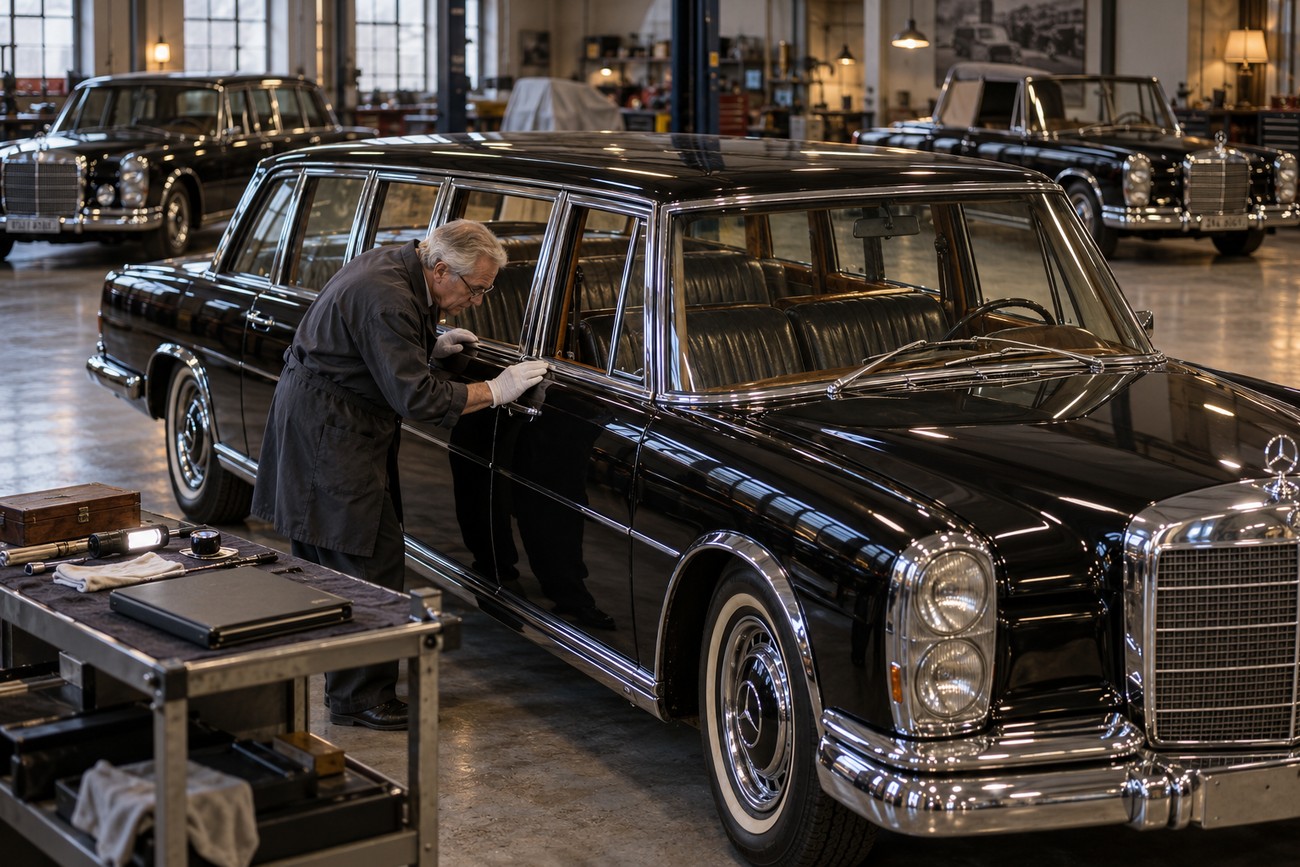
Factory body style, originality, condition, and documented ownership provide a firmer basis for value than a dramatic sales description. A four-door Pullman, six-door Pullman, and landaulet present different preservation and repair demands. Even rarity figures require definition: the Mercedes-Benz archive separates 429 Pullmans from 59 landaulets within 2,677 W100 cars, while some other sources cite 487 Pullmans.
A claimed connection to a ruler deserves consideration when records trace it to the chassis. Without that chain, it remains a claim rather than a verified part of the car’s history. Original fittings and coherent factory documentation may be more useful to a buyer than an unsupported name in an advertisement.
Mechanical condition can change the economics of ownership substantially. Hydraulic repairs may call for scarce W100-specific parts and specialist labor; the V8, bodywork, and pneumatic suspension bring their own costs. A purchase budget also needs room for secure storage and transport suited to the car’s size.
Compare cars based on the work still required to keep them functional, not solely on the quality of the finish. A less polished example with traceable repairs may be easier to assess than a gleaming one whose systems cannot be demonstrated. The gap between appearance and usability is where an apparently attractive purchase can become costly.
Frequently asked questions
Buying and caring for a Pullman involve questions that a production record cannot answer on its own. Price comparisons, time in storage, and transport arrangements all depend on the individual car’s configuration and condition.
What is the average price of a Mercedes-Benz 600 Pullman?
A single average price is unlikely to be useful without a carefully defined group of cars. Mixing four-door and six-door Pullmans with landaulets, varying restoration standards, and advertised asking prices can produce a figure that reflects none of them well. Compare documented sales of cars with similar factory bodies, condition, and provenance, then account for the work each still needs.
How should a Mercedes 600 Pullman be stored between drives?
Storage should include specialist oversight of fluids, leaks, battery condition, and suspension stance. Agree on periodic checks rather than assuming that a clean, idle car is ready to drive. A nitrogen-charged accumulator was designed to help retain hydraulic pressure after shutdown, but storage checks cannot establish its condition without proper testing.
What should be checked before transporting a six-door Pullman?
Give the carrier the documented dimensions of the particular car; a six-door Pullman is approximately 6,241 mm long. Confirm carrier capacity, loading clearance, and how the doors and hydraulic controls will be handled during loading and unloading. Those arrangements reduce avoidable handling risks, but they do not replace a specialist inspection of the car itself.







