
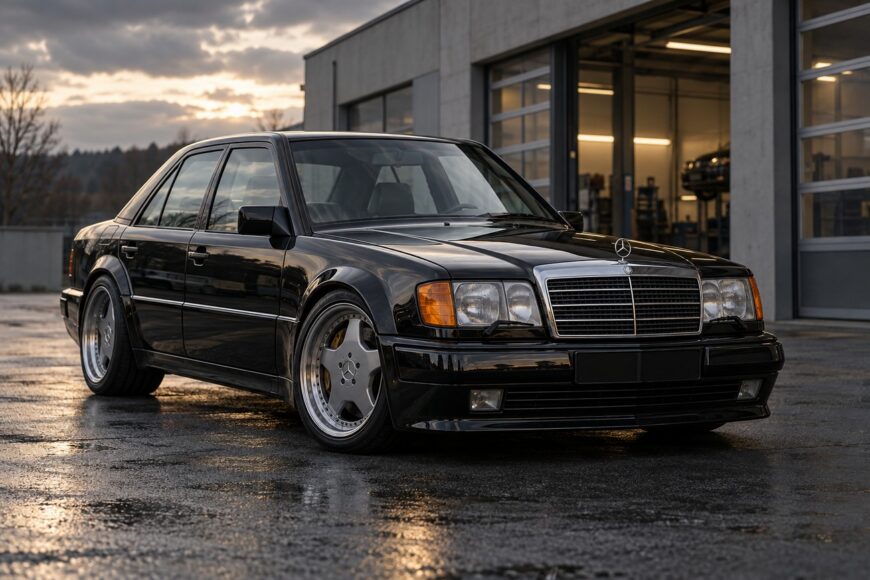
The Mercedes 500E is often described as a Porsche-built Mercedes. That shorthand captures something real, but it also distorts the engineering story. The car emerged from a joint Mercedes-Benz and Porsche project in which Porsche contributed to development, chassis work, body modifications, and assembly; it was not a complete Porsche-built car sold with a Mercedes badge.
That distinction matters because the 500E remains desirable for reasons beyond its M119 V8. Its revised chassis, wider track, stronger brakes, restrained appearance, and low-volume production gave it a character that ordinary W124 models did not share. Age has also made ownership demanding: scarce model-specific parts, expensive repairs, corrosion, and compromised examples can turn the famous Porsche connection into a costly distraction from the car’s actual condition.
- What the Mercedes 500E Actually Was
- How Porsche Helped Build the 500E
- Performance That Still Explains the Reputation
- The Ownership Problems Behind the Legend
- Buying a 500E: What the Porsche Badge Story Can Hide
- 500E Myths, Market Differences, and Collector Value
- Frequently asked questions
- Was the Mercedes 500E built by Porsche?
- Which Mercedes-Benz model was built by Porsche?
- Why is the 500E sometimes called the poor man’s Porsche?
What the Mercedes 500E Actually Was
The 500E was produced from 1990 to 1995 as a substantially reworked performance sedan. Its Mercedes-Benz M119 5.0-liter V8 was the visible headline, with European output commonly listed as 326 hp, approximately 240 kW. The engine alone, however, does not explain the model’s identity or reputation.
Mercedes gave the car a substantially revised chassis, a wider track, and upgraded brakes compared with a standard W124. Body and suspension changes were necessary to accommodate the larger engine and performance target while preserving the stable, understated character expected of a Mercedes sedan. Calling it an ordinary W124 fitted with a V8 misses the amount of engineering that went into the surrounding structure.
Early cars are commonly called 500E, while later facelifted cars are generally called E 500. The change in model designation does not mean every early or late car is identical. Market equipment, certification requirements, trim details, and production changes can affect the specification, so the badge alone is not sufficient to identify a particular car.
The result was a discreet high-performance sedan with a dense mechanical package and a more purposeful stance than other W124 variants. It retained the practical four-door format, yet its wider bodywork, larger brakes, and V8 installation created distinct parts and service requirements. That combination is why a sound example feels special even before it is driven hard.
How Porsche Helped Build the 500E
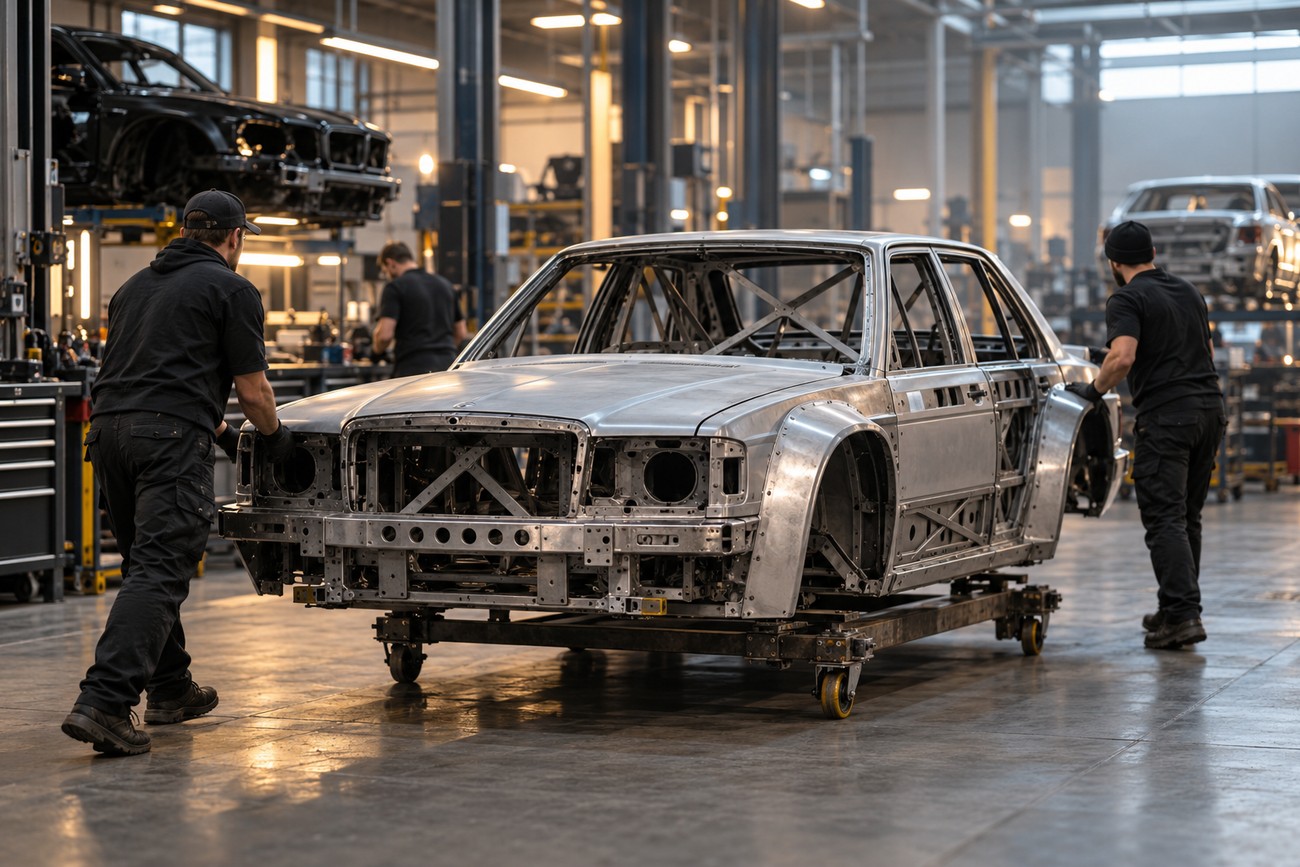
Porsche’s involvement was genuine and central to the production story. Mercedes-Benz and Porsche cooperated on development, chassis work, body-shell modifications, and assembly, using facilities associated with both companies. The process was more complicated than a conventional Mercedes production line because the car required specialist work in relatively small numbers.
Body shells were transported between Mercedes and Porsche facilities during the build process. The shells were modified for the 500E’s wider track and mechanical package, returned for further stages, and then completed through a labor-intensive production sequence. This movement between facilities is the factual basis for the Porsche connection, although popular retellings often compress the whole arrangement into the phrase “built by Porsche.”
Porsche’s contribution included chassis development, modifications, and assembly work. Mercedes remained responsible for the overall vehicle, its powertrain identity, and the final model program. Describing the car as entirely Porsche-built therefore assigns one company ownership of a project that was actually a carefully organized Mercedes-Porsche collaboration.
The famous production story is best understood as a low-volume cooperation between two manufacturers, rather than as a Porsche model assembled inside a Mercedes body.
The 500E was low-volume and labor-intensive by contemporary sedan standards. Enthusiast discussions often repeat a claim of approximately 18 days per body, but that figure is not consistently confirmed by strict production documentation. It is safer to use it as an indication of the car’s unusually involved production process, not as a precise factory timing record.
That nuance does not diminish Porsche’s role. It makes the story more accurate. The 500E is historically significant because Mercedes commissioned and developed a special W124, while Porsche provided important manufacturing and engineering capability for a project that did not fit ordinary mass-production methods.
Performance That Still Explains the Reputation
The factory 0–100 km/h figure is usually quoted at about 6.1 seconds. Independent tests can produce slightly different results depending on test conditions, transmission state, tires, and measurement methods. Even today, the number is sufficient to explain why the 500E was regarded as exceptionally quick for a discreet executive sedan.
Top speed is around 250 km/h for later European versions with the limiter. Early cars and market-specific versions can have different published figures because certification rules, equipment, and calibration were not identical everywhere. Performance comparisons are therefore most useful when the market and model year are known.
The V8’s power is only part of the driving experience. The wider track, revised chassis, stronger brakes, and stable high-speed behavior give the car a composed quality that is difficult to reproduce by simply installing a larger engine in a regular W124. It feels planted and deliberate rather than nervous or theatrical.
That balance explains why enthusiasts continue to value the 500E. A modified standard W124 may match or exceed its acceleration, but it does not automatically reproduce the factory suspension geometry, braking capacity, body structure, or integration of the original car. The appeal lies in how the systems work together, with the V8 supplying effortless speed rather than defining the entire experience.
The Ownership Problems Behind the Legend
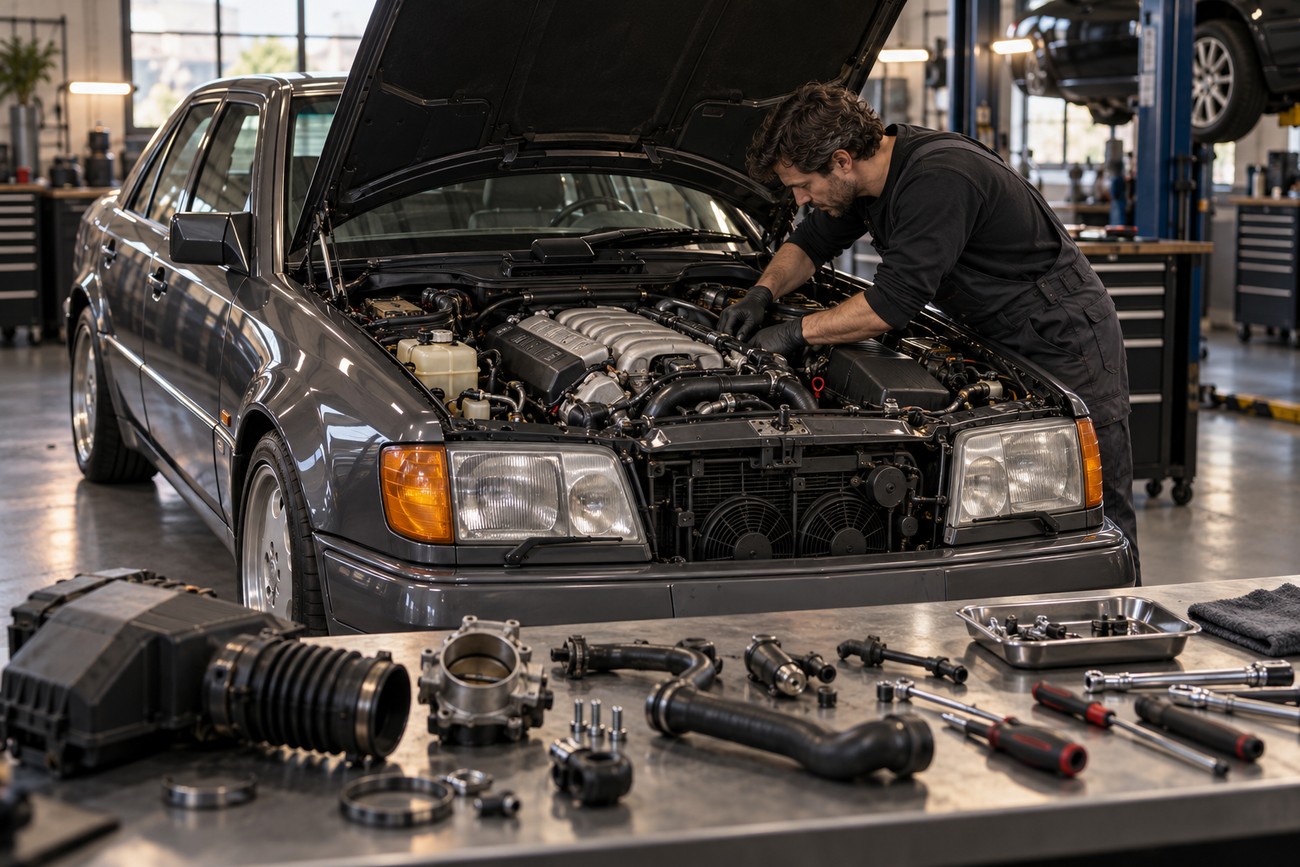
Present-day ownership is governed by age and parts availability more than by the original sales brochure. Original and model-specific components can be expensive or difficult to source, and good used parts are not always easy to identify. A car that appears inexpensive at purchase can require substantial spending before it becomes mechanically trustworthy.
The tightly packaged V8 makes some maintenance operations labor-intensive. Access around the engine and its ancillary systems can be restricted, so routine work may take longer than an owner expects from a large Mercedes sedan. Cooling, intake, ignition, and fuel-system condition all have a direct effect on reliability and drivability.
The automatic transmission is another major consideration. A well-maintained unit can serve the car effectively, but an aging transmission may require an expensive, high-quality rebuild. Delayed engagement, poor shifts, fluid leaks, or a vague service history should be treated as mechanical evidence rather than dismissed as normal behavior for an old car.
Suspension and brake work can also become costly when the correct level of components is required. Corrosion, previous body repairs, deteriorated rubber parts, wiring faults, vacuum-line deterioration, and hardened seals affect both safety and authenticity. These problems often arrive together because the car has reached an age at which several systems may need attention at once.
Many surviving cars have been repaired repeatedly, modified, or cosmetically refreshed without being returned to factory condition. The difficult examples are not always the visibly rough ones; a polished car can conceal non-original parts, poor body repairs, or deferred mechanical work. A specialist assessment is therefore more valuable than a short road drive and a clean engine bay.
Buying a 500E: What the Porsche Badge Story Can Hide
Start with identity and history. Verify the VIN, confirm the body-shell and model specification, and examine service and ownership documentation before treating the Porsche connection as evidence of quality. The file should show how the car was maintained, which major components were replaced, and whether later work changed the factory configuration.
A lift inspection is essential. Examine the structure, jacking points, floor areas, suspension mounting points, and repaired panels for corrosion or accident damage. Cosmetic paintwork can hide previous repairs, while a low odometer reading says little about the condition of seals, wiring, vacuum lines, cooling components, or a car that spent long periods unused.
Factory-correct body structure, a documented cooling-system history, and traceable parts usually deserve more weight than a low-mileage claim. Provenance matters because replacing incorrect or unavailable components can become the largest part of the restoration bill.
The cooling system deserves specific attention before purchase. Inspect its history and operation, then assess the engine’s intake, ignition, and fuel systems for age-related faults. A V8 that runs smoothly during a brief inspection may still have deferred maintenance that becomes apparent under heat, load, or extended driving.
Assess the automatic transmission, suspension, brakes, and steering as a connected group. Noisy or uneven suspension, weak braking, transmission flare, leaks, or poor shift quality can quickly change the financial calculation. Model-specific parts should be identified by provenance and condition rather than assumed to be interchangeable with ordinary W124 components.
Originality should be judged carefully. Restorations, engine swaps, non-original wheels, replacement interiors, altered instruments, and cosmetic repairs can make an apparently perfect car more expensive than a pricier, well-documented example. Bringing a modified car back to authentic condition may cost more than buying the better-preserved car at the start.
500E Myths, Market Differences, and Collector Value
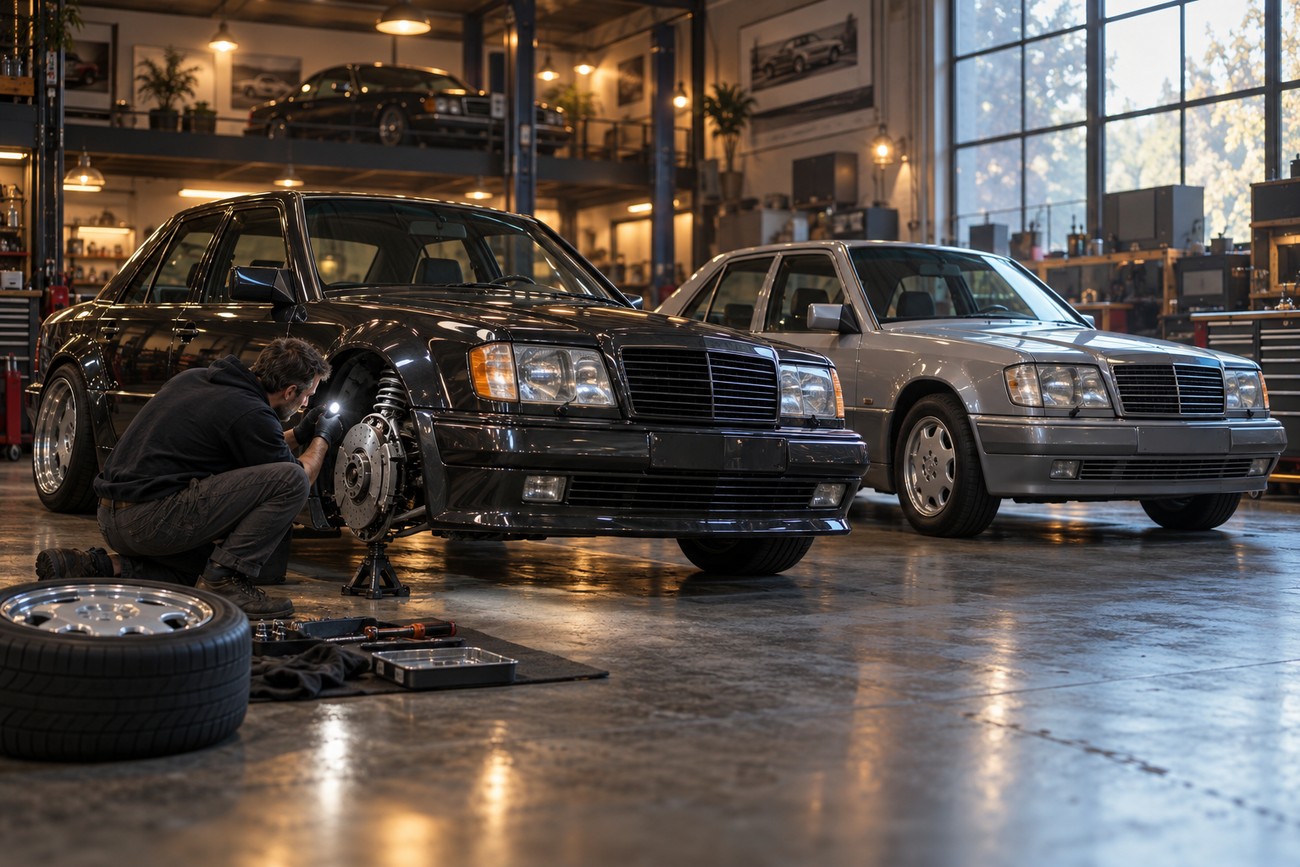
The first myth is that Porsche built the complete car independently. The accurate description is a joint Mercedes-Porsche project involving development, chassis work, body-shell transfers, modifications, and assembly. Porsche’s involvement is substantial, but the 500E remains a Mercedes-Benz model created within a cooperative production program.
The second myth is that the car is simply a W124 with a V8. Its substantially revised chassis, wider track, upgraded brakes, and altered body structure make that description technically inadequate. Conversely, the existence of these changes does not mean every 500E or E 500 has the same specification across all markets and years.
Approximately 10,000–11,000 cars were produced over the full production cycle, although exact totals vary across sources, markets, and years. Early 500E and later E 500 versions differ in designation and may differ in equipment or detail. Collectors should verify the individual car rather than relying on broad assumptions about production year.
Value is strongly influenced by originality and documentation. Correct interior trim, instruments, wheels, body components, and equipment matter because replacement parts can be scarce and because unrecorded modifications reduce confidence. A documented, structurally sound car with a higher odometer reading can be a better collector proposition than a supposedly low-mileage example with an unclear history.
Frequently asked questions
The Porsche connection is real, but its meaning is often reduced to a slogan. These answers separate the documented production arrangement from the informal labels used by enthusiasts.
Was the Mercedes 500E built by Porsche?
Porsche participated in the Mercedes 500E’s development and production, including chassis work, body modifications, and assembly. Body shells moved between Mercedes and Porsche facilities during the build process, which is why the car is closely associated with Porsche.
Porsche did not build the complete car independently. Mercedes-Benz remained the manufacturer behind the model, its M119 V8, overall specification, and vehicle program. “Built by Porsche” is therefore a useful shorthand only if it is understood as a description of cooperation, not exclusive manufacture.
Which Mercedes-Benz model was built by Porsche?
The Mercedes-Benz 500E, later known as the E 500 after the facelift, is the Mercedes model most directly associated with Porsche production involvement. Porsche helped develop, modify, and assemble this low-volume W124 performance sedan through a shared production process.
That statement does not mean Porsche independently built an entire Mercedes model from start to finish. It identifies the 500E as a Mercedes-Porsche project with an unusual division of labor, rather than as a standard Mercedes assembled under Porsche ownership.
Why is the 500E sometimes called the poor man’s Porsche?
“Poor man’s Porsche” is an informal comparison, not an official model designation. The phrase reflects the 500E’s Porsche involvement, strong performance, balanced chassis, and discreet ability to cover ground quickly in a practical sedan body.
The comparison should not be taken as a technical classification or as proof that the 500E drives like a specific Porsche model. Its character comes from the combination of Mercedes comfort and durability targets with a specially developed chassis, a V8, stronger brakes, and Porsche-assisted production.







