
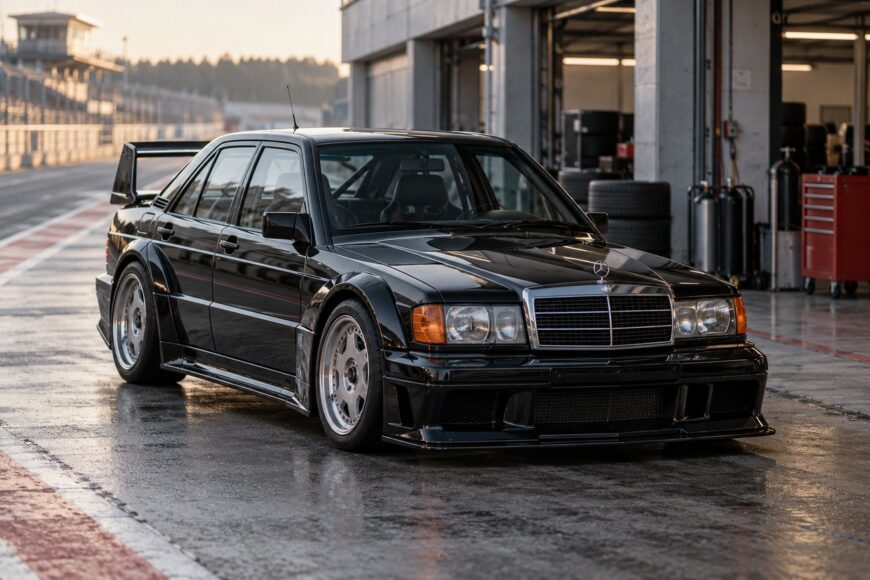
A compact Mercedes-Benz sedan wearing an enormous adjustable rear wing sounds like a styling exercise until you understand what the 190E 2.5-16 Evolution II was built to do. Presented in March 1990, it was a W201 homologation special shaped by the demands of competition, especially the Deutsche Tourenwagen-Meisterschaft, rather than a cosmetic package for an ordinary 190E.
That distinction explains the car’s enduring appeal and its complications. Its collector value rests on rarity, originality, condition, documentation, and DTM lineage. Ownership can be harsh, expensive, and difficult to verify because a genuine Evo II shares its visual language with numerous conversions, replicas, and later reinterpretations.
- The Mercedes 190E Evo II was built for homologation, not fashion
- Mercedes 190E Evo II specifications at a glance
- Why the giant wing changes more than the silhouette
- The biggest buying mistake: confusing an original Evo II with a lookalike
- Ownership reality: rare parts, hard use, and collector-car costs
- Why the Evo II is worth more than its horsepower suggests
- Frequently asked questions
- How much does a Mercedes 190E Evo II cost?
- Why do some sources say 500 cars and others say 502?
- What should a buyer verify before calling a car a genuine Evo II?
The Mercedes 190E Evo II was built for homologation, not fashion
The Evolution II was the final and most extreme development of Mercedes-Benz’s 2.3/2.5-16 concept. Its purpose was to create a road-legal foundation for motorsport development, with the production car carrying the identity required for homologation. That makes the model fundamentally different from a standard 190E 2.5-16 fitted with an aggressive body kit.
Presented in March 1990, the Evo II arrived with visibly widened aerodynamic bodywork and a large adjustable rear wing. These features gave the car its famous silhouette, yet their significance went beyond appearance. The enlarged bodywork supported the wider, more purposeful stance associated with the competition program, while the wing formed part of the car’s aerodynamic specification.
The DTM connection is central to the model’s identity. A road car with this level of visual aggression made sense because it reflected the requirements and image of touring-car racing. The Evo II therefore occupies an unusual position in Mercedes history: it is a compact executive sedan that carries the logic of a racing program into ordinary road use.
That racing purpose also explains why the car should be judged as a complete specification. The engine, suspension, chassis details, bodywork, and aerodynamic components work together as an engineered package. Remove the history and specification from the discussion, and the enormous wing becomes an easy visual joke instead of evidence of one of Mercedes-Benz’s most focused homologation projects.
Mercedes 190E Evo II specifications at a glance
The figures below reflect the commonly documented specification. Production totals vary in presentation, and isolated catalog entries sometimes confuse engine designations or provide fuel and consumption information without clear factory provenance.
| Specification | Mercedes-Benz 190E 2.5-16 Evolution II |
|---|---|
| Model identity | W201 homologation special, chassis identity W201.036 |
| Engine | 2.5-liter naturally aspirated inline-four, 16 valves, commonly described as the M102 2.5-16 with Cosworth co-development |
| Output | 235 hp and 245 Nm |
| Acceleration | 0–100 km/h in 7.1 seconds |
| Top speed | 250 km/h |
| Approximate mass | About 1,340 kg |
| Wheelbase | 2,665 mm |
| Length | 4,543 mm |
| Width | 1,720 mm |
| Height | 1,342 mm |
| Production | 502 examples is the commonly cited figure; 500 is a widespread rounded figure |
Why the giant wing changes more than the silhouette
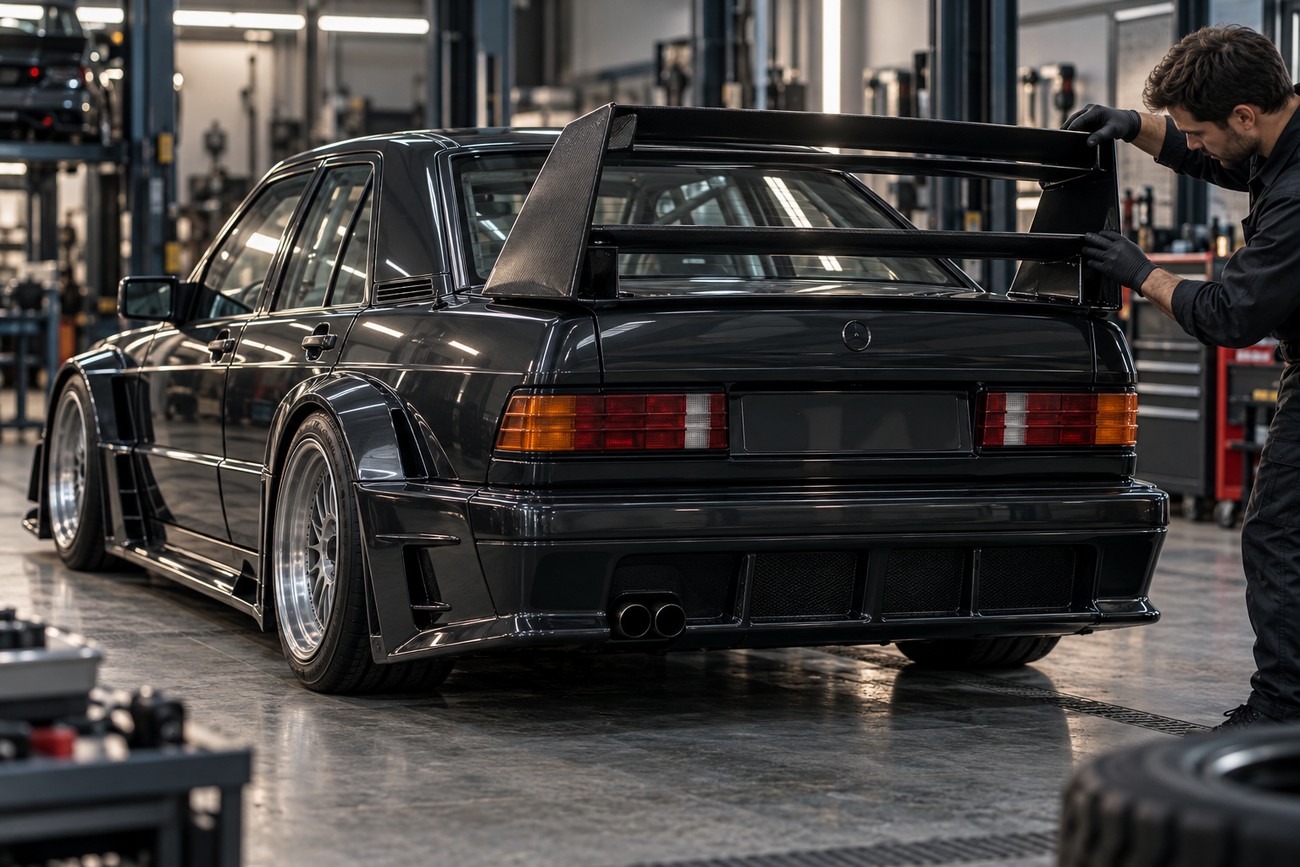
The Evo II’s widened bodywork changes the car’s proportions, stance, and the way its purpose is read from a distance. The large rear wing is adjustable, so it belongs to the functional aerodynamic package rather than serving as a detachable ornament. Together, the flared body and wing communicate that this W201 was developed with stability and competition requirements in mind.
That hardware has consequences on the road. Owner and enthusiast discussions commonly describe the car as stiff, noisy, and closer in character to a track-oriented sports sedan than to a comfortable everyday saloon. The period ergonomics also remain unmistakably old-fashioned, with less refinement and isolation than a modern performance sedan provides.
The rear wing may complicate rearward visibility during parking. It does not make the car impossible to use, but it adds another reminder that the design was shaped around aerodynamic intent rather than effortless urban convenience. A buyer who expects the easy speed of a contemporary AMG-style sedan may find the Evo II demanding at ordinary speeds.
The counterintuitive point is that the wing’s visual drama can distract from the rest of the car. Collectors sometimes focus on whether the spoiler looks correct while overlooking the relationship between body panels, suspension specification, chassis identity, and documentation. A correct-looking wing is useful evidence only when it belongs to a complete, consistently documented Evo II.
The biggest buying mistake: confusing an original Evo II with a lookalike
Appearance is weak evidence in this market. The most recognizable features—the widened arches, deep aerodynamic bodywork, and large rear wing—can be reproduced on an ordinary W201. A standard 190E 2.5-16, a visual conversion, a heavily modified project, and an original Evolution II may therefore appear similar in photographs while carrying entirely different historical and collector significance.
The first inspection step should be identity. Verify the vehicle identification number and the W201.036 chassis identity, then compare the documentation with the car in front of you. Engine specification, body configuration, suspension and chassis details, and the recorded history should form a coherent picture rather than a collection of attractive parts.
Original aerodynamic components deserve close attention because they affect both authenticity and value. Check whether the bodywork is consistent with the Evolution II specification, whether the major parts have credible provenance, and whether repairs or replacements are documented. A freshly painted car can conceal changes that become obvious only when the panels, fittings, and history are examined together.
Separate the categories carefully. An ordinary 190E 2.5-16 is historically important in its own right, yet it is not equivalent to an Evo II. A restomod may be faster or better finished, and an HWA EVO project may reinterpret the Evo II design with modern engineering, but neither is an original Mercedes-Benz 190E Evo II. Calling each one an “Evo II” erases the distinction that collectors are paying to preserve.
Provenance should support the physical inspection rather than replace it. Factory and ownership records, consistent chassis information, period history, and evidence of responsible restoration all matter. If a seller relies on the wing and a compelling story while avoiding identity checks, the risk is already clear.
Ownership reality: rare parts, hard use, and collector-car costs
The expensive part of owning an Evo II often begins after the purchase. Original aerodynamic pieces, body components, interior elements, and specialized chassis or suspension parts can be difficult to source. Their scarcity makes an incorrect replacement more than a cosmetic compromise; it can affect the car’s authenticity, fit, and future value.
Restoration also requires a narrower technical approach than work on a typical W201. Standard Mercedes parts may be easier to locate, yet they cannot automatically substitute for Evo II-specific components. A repair that preserves the shape of the car while changing its specification may produce a usable sports sedan and a weaker collector car.
The driving experience adds another cost in practical terms. With 235 hp, the Evo II remains quick by period standards, but it does not feel like a modern, effortless fast sedan. Noise, stiffness, dated controls, and the need to treat an old performance car carefully can make routine driving more demanding than the specification sheet suggests.
Storage, insurance, inspection, and sympathetic maintenance belong in the ownership budget as well. A rare homologation car needs protection from poor repairs, careless modifications, and unsuitable storage. The sensible financial plan includes preserving the correct parts and records rather than allocating every available resource to the purchase price alone.
Why the Evo II is worth more than its horsepower suggests
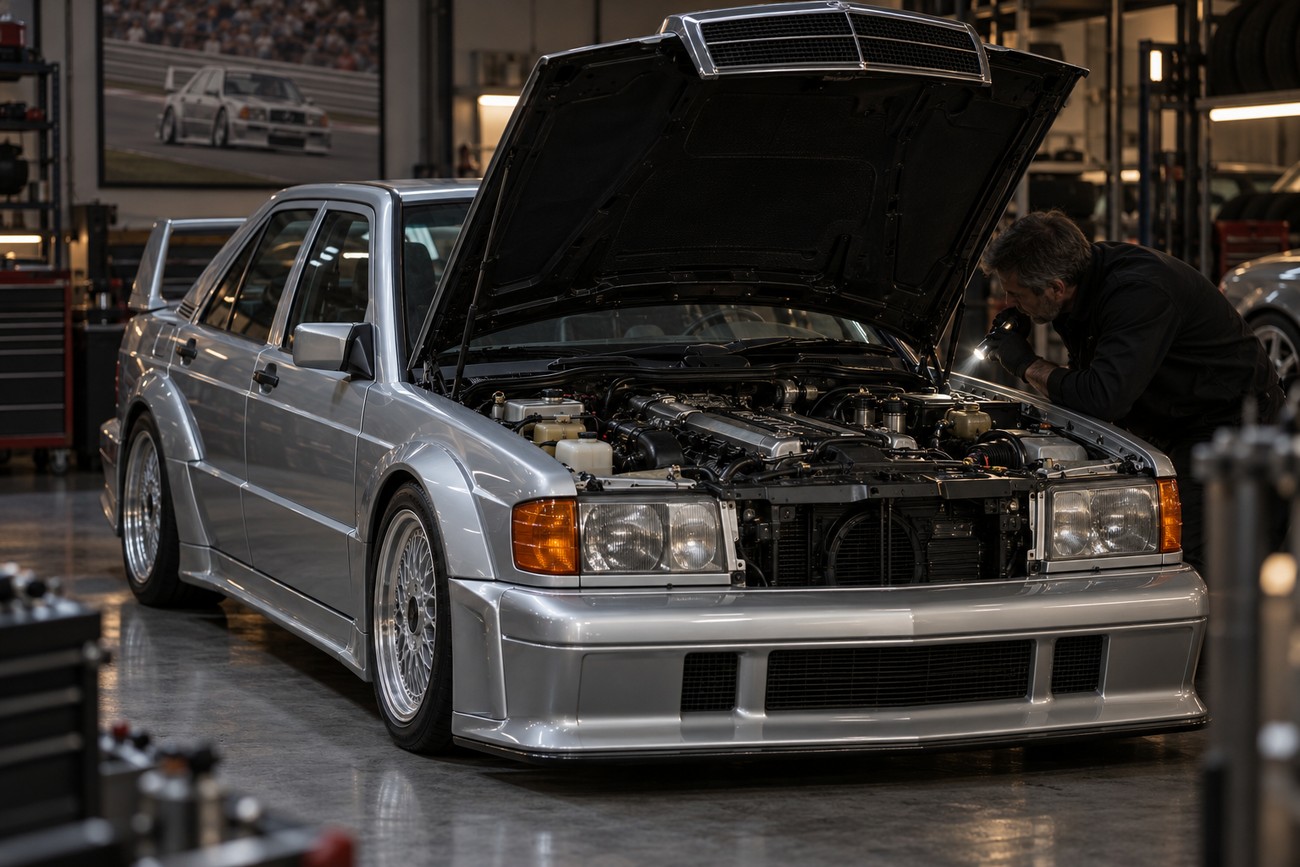
The Evo II’s 235 hp is only one part of its appeal. The commonly cited production figure is 502 examples, while 500 remains a widespread rounded figure. Either way, the production run was small enough for originality and surviving documentation to have a direct effect on desirability.
DTM association gives the car a cultural and engineering context that a powerful road sedan cannot reproduce through acceleration alone. The Evo II represents a specific period when a manufacturer’s competition ambitions could still be expressed through a limited-production road car. That connection is what turns its wide body and giant wing into historical evidence.
Collectors therefore examine condition, originality, provenance, and the integrity of the aerodynamic specification. A car with an intact, well-documented configuration can command greater respect than a more powerful example modified for contemporary performance. The market is judging the survival of a factory concept, not simply the output of an old naturally aspirated engine.
A replica may carry the visual language convincingly and can still be an enjoyable W201 project. Its value follows a different logic, however. Without original identity and credible history, the car does not carry the same collector significance, regardless of how accurately the arches, paint, or rear wing have been reproduced.
Frequently asked questions
The Evo II market rewards precise language because similar-looking cars can differ substantially in identity and historical value. These answers separate the commonly documented facts from claims that depend on condition, records, and market context.
How much does a Mercedes 190E Evo II cost?
No single fixed price represents every Evo II. A reliable assessment must separate the seller’s asking price from an auction result, then account for condition, originality, completeness, and documented provenance.
A car with missing or incorrect aerodynamic parts may require substantial specialist work even if it looks attractive in photographs. A well-preserved, correctly identified example with coherent records belongs to a different market category from a visual conversion, so comparisons based only on exterior appearance can be misleading.
Why do some sources say 500 cars and others say 502?
502 examples is the commonly documented production figure, while 500 is a rounded number repeated by clubs, listings, and popular articles. The difference usually reflects shorthand rather than evidence of two separate production versions.
For a buyer, the exact wording matters less than whether the individual car can be authenticated. The production-count discrepancy should not be used to excuse weak documentation or an uncertain chassis identity.
What should a buyer verify before calling a car a genuine Evo II?
Use this order: identity, documentation, specification, and provenance. Begin with the VIN and W201.036 chassis identity; compare the records with the engine, body, chassis, suspension, and aerodynamic configuration; then examine the ownership and restoration history for consistency.
Only after those checks should paint, trim, and the appearance of the rear wing influence the judgment. Also identify whether the car is a standard 190E 2.5-16, a conversion, a restomod, or a modern HWA EVO project. HWA EVO projects reinterpret the Evo II design, but they are not original Mercedes-Benz 190E Evo II cars.







