
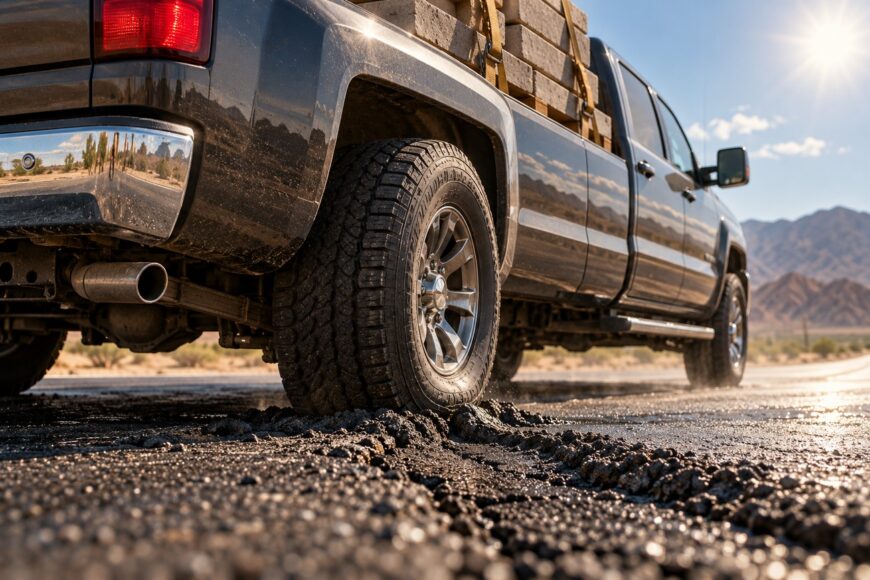
A Silverado does not need to liquefy asphalt to sink into it. Heat softens the binder, while the truck’s weight and concentrated contact pressure deform the pavement beneath the tires, jack stands, or trailer supports.
The risk rises when dark asphalt sits in direct sun, the surface is fresh, the engine idles for a long time, or extra load is carried over the rear axle. A shallow tire imprint may be cosmetic, while a deep rut or sinking support point can make the truck unstable. Diagnosis should start with heat, pavement age, loading, and the size of each contact area.
- Why a Silverado Can Rut Asphalt Without Melting It
- Where the Heat and Load Become Most Dangerous
- Common Parking Mistakes and Safer Choices
- If the Silverado Is Already Sinking or Leaving Ruts
- Frequently asked questions
- At what temperature will asphalt melt?
- What chemical melts asphalt?
- How long does two inches of asphalt last under a Silverado?
Why a Silverado Can Rut Asphalt Without Melting It
Ordinary road asphalt begins to soften at approximately 50–60 °C. Noticeable bitumen flow and severe deformation become more likely around 60–70 °C. Black asphalt in direct summer sun can reach approximately 60–80 °C, with more than 80 °C recorded during extreme heat.
That is softening and deformation, not the dramatic liquid melting many people picture. A loaded Silverado tire can impose approximately 2–3 bar over its contact area, enough to press softened binder aside when the pavement is weak or poorly supported.
A shallow, even imprint usually means the surface yielded under the tire tread. Deep ruts, displaced material, cracking, or movement around a jack point indicate a more serious pavement or base problem. A sound, fully stabilized surface will not be damaged every time a Silverado parks on it, but heat and load can expose weaknesses quickly.
Where the Heat and Load Become Most Dangerous
Exhaust gases can exceed 400–600 °C near the engine, while the rear exhaust system commonly reaches approximately 70–120 °C during normal operation. The tailpipe is therefore not heating the pavement like an open flame, yet heat retained under the cab or bed can worsen a local soft spot during prolonged idling.
Gasoline and diesel Silverados can have different weight distribution and exhaust layouts, so the hottest area is not identical on every truck. A trailer or heavy cargo increases axle loading, and the rear axle may press deeper than the front. The same effect appears under trailer wheels and small stabilizer feet.
Cracks, poor drainage, and a weak or voided base make sinking more likely because softened binder can be displaced into gaps below the surface. Fresh asphalt may remain vulnerable for days or weeks, depending on its composition and stabilization, even when it looks finished from the driveway.
Common Parking Mistakes and Safer Choices
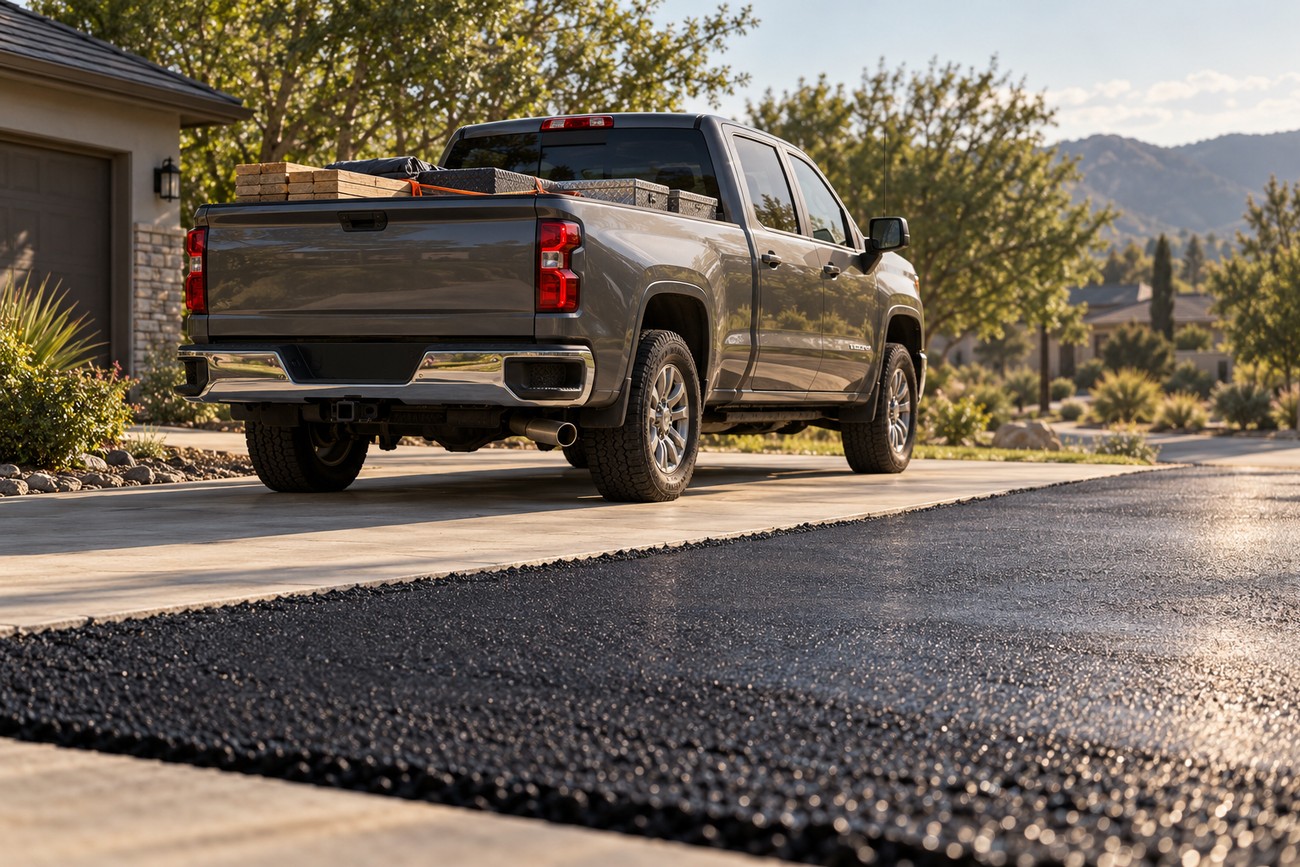
The clearest avoidable mistake is parking on freshly laid or not fully stabilized asphalt. Ask when the surface was installed before leaving a loaded Silverado, trailer, or boat on it. If the answer is uncertain, concrete or compacted gravel is usually a safer choice than dark asphalt in peak heat.
Long idling or stationary warm-up adds localized exhaust and underbody heat. Move the truck to a firm surface before extended warming, maintenance, or repeated engine operation. Shade reduces solar heating, although it cannot correct a weak base or protect asphalt that is still curing.
Thick boards should support both tires and jack stands when hot asphalt is unavoidable. A narrow metal plate may spread load slightly, yet its small footprint can still punch through softened pavement.
Vehicle manufacturers generally do not guarantee that soft asphalt, bitumen, or PVC-like surfaces will remain undamaged during prolonged hot parking. Carrying suitable boards or load-spreading plates is practical insurance, especially for roadside work, summer campsites, and driveways with recent paving.
If the Silverado Is Already Sinking or Leaving Ruts
Stop wheelspin and avoid sudden throttle. Spinning tires deepen ruts, spread bitumen, and can damage the tires. If a jack stand or support point is sinking, treat the truck as unstable and keep people clear of the low side.
Unload removable cargo only if it can be done safely, then use broad boards to distribute load before attempting a slow, controlled extraction. Deep impressions under a loaded truck or trailer may require professional recovery rather than repeated attempts to drive out.
Photograph tire marks, support-point damage, weather conditions, pavement age, and vehicle loading. Those records help clarify disputes with a contractor or parking operator. Surface repair may also require assessment of the base, because filling the visible rut alone can leave the underlying weakness in place.
Frequently asked questions
The questions below address asphalt softening, chemical treatment, and pavement durability. They also explain why surface temperature alone does not determine whether a Silverado will cause damage.
At what temperature will asphalt melt?
Asphalt has no single everyday melting temperature. Softening begins at approximately 50–60 °C, while serious bitumen flow is more likely around 60–70 °C. A truck can deform pavement before it behaves like a liquid, because tire pressure and axle load act on the softened binder.
What chemical melts asphalt?
Using a solvent is not a sensible remedy for Silverado tire marks or jack impressions. Chemical softening can spread contamination and damage nearby materials without restoring the pavement structure. The correct response is mechanical stabilization, careful removal of displaced material, and surface repair suited to the asphalt mix.
How long does two inches of asphalt last under a Silverado?
Thickness alone cannot predict service life. Base strength, drainage, asphalt composition, axle loading, traffic, and repeated hot-weather parking all matter. Two inches over a strong, well-drained base may perform differently from the same thickness over cracked or voided ground, so a paving professional should assess the full section before promising a service life.







