
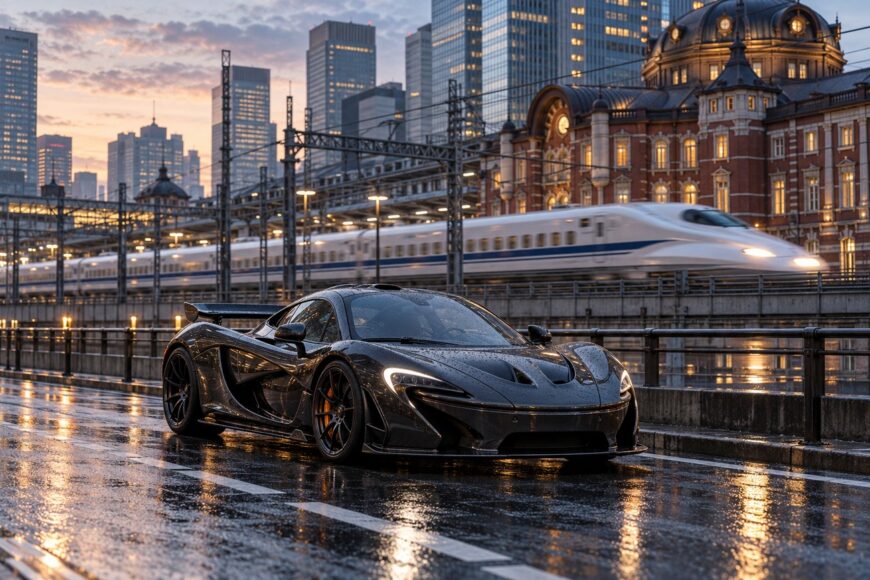
The McLaren P1 carries a stated top speed of approximately 350 km/h. A Tokaido Shinkansen N700S reaches up to 285 km/h in service, yet a fast Nozomi can cover Tokyo to Nagoya in approximately 1 hour 40 minutes. On paper, the hypercar appears to have the decisive advantage; on a timetable, the train starts with the stronger case.
The meaningful comparison is therefore a journey from Tokyo to Nagoya, rather than a contest between two peak-speed figures. This article considers realistic travel conditions, station access, public-road limits, traffic, and the train’s scheduled operation. It is not an invitation to race on open roads, where attempting to reproduce a dramatic video could endanger other people and bring serious legal consequences.
- What Would Count as Winning?
- McLaren P1 vs N700S: Peak Speed Is Not Journey Speed
- Leaving Tokyo: Where the Minutes Go
- Why the P1 Cannot Hold Its Headline Speed
- The Race-Video Trap: Safety, Law, and Missing Context
- Verdict: Who Gets to Nagoya First?
- Frequently asked questions
- What evidence would make a car-versus-train video a fair comparison?
- Which car is better for a trip along the Shinkansen route?
- What is the world’s fastest train?
What Would Count as Winning?
A fair comparison needs the same start and finish points. Tokyo Station to Nagoya Station creates a clear station-to-station test, while a door-to-door journey measures something broader: the time needed to reach the station, board the train, leave the city, and complete the final connection after arrival. Those are useful comparisons, though they answer different questions.
The Tokaido Shinkansen distance between Tokyo and Nagoya is approximately 366 km. That is railway distance, not a road-route measurement, so it cannot be transferred directly to a McLaren journey. The fastest scheduled services also vary by departure, stopping pattern, and timetable.
A typical fast Nozomi takes approximately 1 hour 40 minutes between Tokyo and Nagoya. The clock begins at departure, while a traveler’s real journey may begin earlier with a trip to the station, ticket purchase, platform access, and boarding. A car comparison needs the same discipline: its clock should include the actual starting point, the trip out of the city, the route, stops, and arrival location.
A rolling start beside the tracks would produce a spectacular acceleration comparison, yet it would remove the most difficult parts of a city-to-city trip. It would also place a public-road vehicle beside a railway that uses separate infrastructure and controlled operations. The result could be interesting as a closed-course demonstration, while saying little about who reaches Nagoya first from Tokyo.
McLaren P1 vs N700S: Peak Speed Is Not Journey Speed
The figures below separate published performance from operating speed and scheduled travel time. They show why acceleration and maximum speed provide context, while the timetable is the stronger predictor for the train’s arrival.
| Measure | McLaren P1 | N700S on the Tokaido route | What it predicts |
|---|---|---|---|
| Published or operating speed | Approximately 350 km/h stated top speed | Up to 285 km/h in Tokaido operation | Neither figure gives a complete city-to-city average |
| Design-speed distinction | Claims approaching 370 km/h circulate, without manufacturer confirmation | 300 km/h is a design-speed figure, not the Tokyo–Nagoya operating limit | Marketing or engineering limits should not be treated as normal journey speeds |
| Acceleration | Approximately 2.8–3.0 seconds from 0–100 km/h | Passenger-train acceleration is not the relevant published comparison here | Useful for launch performance, weak for predicting arrival time |
| Power | Approximately 916 PS combined output | Railway traction and operating systems are engineered for scheduled service | Power alone does not account for traffic, braking, or stops |
| Journey baseline | Road-route distance and verified Tokyo–Nagoya time: unknown from these figures | Approximately 1 hour 40 minutes on a typical fast Nozomi over approximately 366 km of railway | The scheduled train time is directly useful for a station-to-station comparison |
Leaving Tokyo: Where the Minutes Go
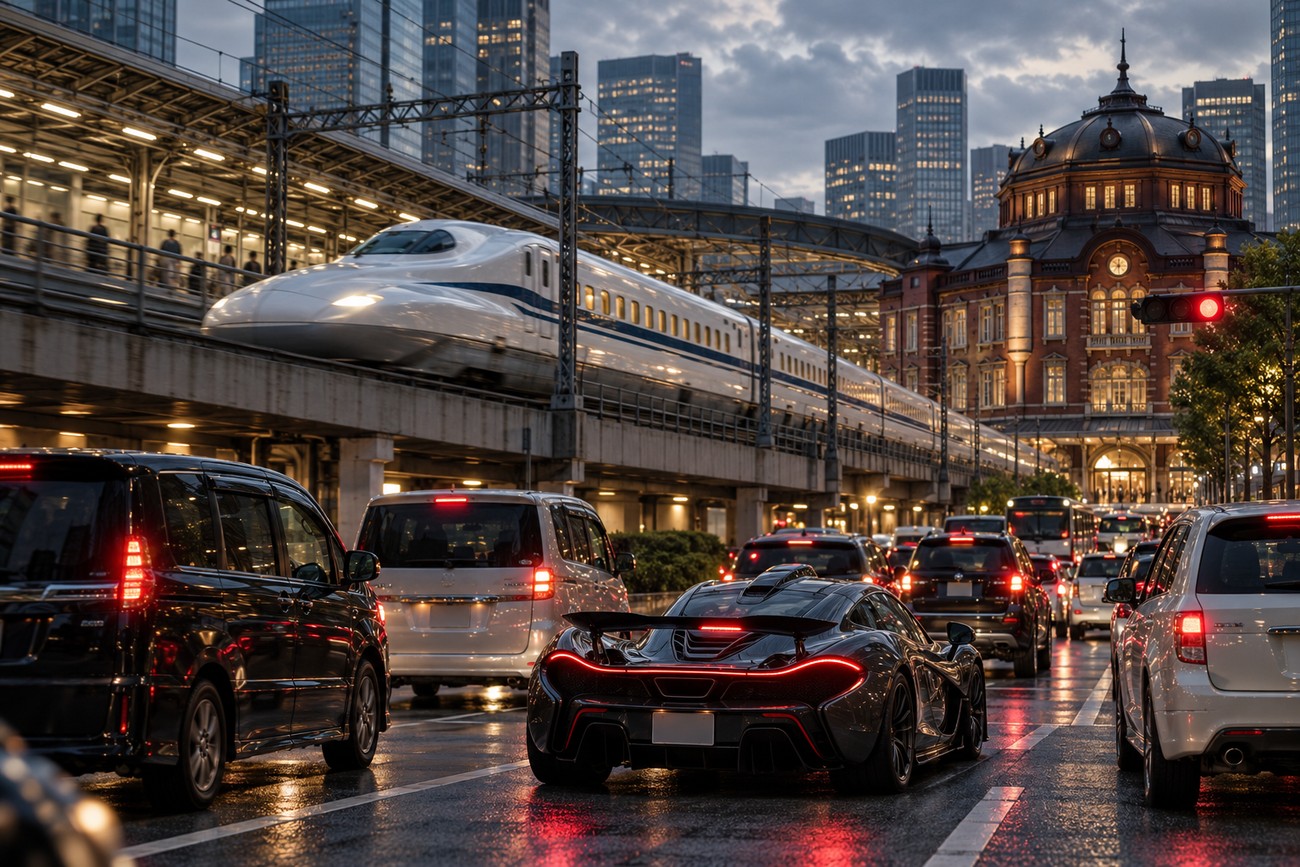
The train’s advantage begins before the N700S reaches its operating speed. A passenger must reach Tokyo Station, find the correct platform, and board before departure, yet the train then follows a defined path with no traffic lights, junction queues, or motorway merges. Its stops are scheduled and visible in advance.
The P1 starts with more variables. City traffic can slow the car before it reaches a motorway, and the route may include junctions, lane changes, toll facilities, and congestion that a railway timetable does not face. The approximately 366 km railway figure cannot establish a road distance, so a car time would require a verified route and endpoints rather than a simple speed calculation.
Fuel use, hybrid-system management, tire checks, and a rest stop can also change the result. The P1’s hybrid system supplies approximately 916 PS combined output, yet that figure describes capability under specified conditions. It does not remove the need to manage heat, fuel, traffic, and the driver’s concentration over a long trip.
The chosen Nozomi departure matters because Tokyo–Nagoya services do not all share the same stopping pattern or timetable. A typical fast Nozomi takes approximately 1 hour 40 minutes, while a different service may take longer. Treating every Shinkansen departure as identical makes the comparison less precise before either vehicle leaves Tokyo.
Why the P1 Cannot Hold Its Headline Speed
A top-speed figure records a narrow performance event under suitable conditions. It does not describe the average speed available across a public-road journey. On Japanese expressways, limits are generally 100–120 km/h, with 120 km/h applying only on sections where it is posted. The P1’s approximately 350 km/h stated top speed is therefore a technical specification, not a lawful public-road target.
Even on a controlled road, sustained speed brings its own constraints. Traffic requires repeated braking and acceleration, while pavement changes, crosswinds, tire condition, cooling, and fuel use affect how long the car can remain at a high pace. The driver must also preserve attention and judgment; a brief straight-line run does not represent a repeatable stint across an entire route.
The P1’s approximately 2.8–3.0-second 0–100 km/h acceleration is equally poor as a journey predictor. It describes the launch phase, while Tokyo–Nagoya performance depends on every later phase, including joining traffic, slowing for hazards, and maintaining a legal pace. Claims approaching 370 km/h circulate among enthusiasts and in some tests, but they are not manufacturer-confirmed and should not carry the same weight as the published figure.
The Race-Video Trap: Safety, Law, and Missing Context
A car and a Shinkansen operate in fundamentally different environments. The train uses separate infrastructure, controlled signaling, automatic safety systems, and railway procedures designed around predictable movement. The P1 shares public roads with other drivers, motorcycles, trucks, pedestrians near junctions, and emergency vehicles.
That difference makes an open-road attempt unsafe as well as unlawful. Japanese expressway limits are generally 100–120 km/h, where the higher limit applies only on posted sections. A vehicle capable of approximately 350 km/h cannot turn that specification into permission to use the speed on a public route.
Online videos can conceal the conditions that create their drama. A production may use permissions, road closures, controlled sections, edited timing, or a simplified route, though the presence of a fast car and a visible train does not prove any particular arrangement. A fair report would disclose the starting points, the train service, the full car route, timing method, stops, and any restricted access.
The emotional effect of these films comes from compressing a complex journey into a few clean images. That edit can make a rolling start look like a city-to-city contest and make a brief burst of speed look sustainable. Viewers should treat the footage as entertainment until the operating conditions are documented.
Verdict: Who Gets to Nagoya First?
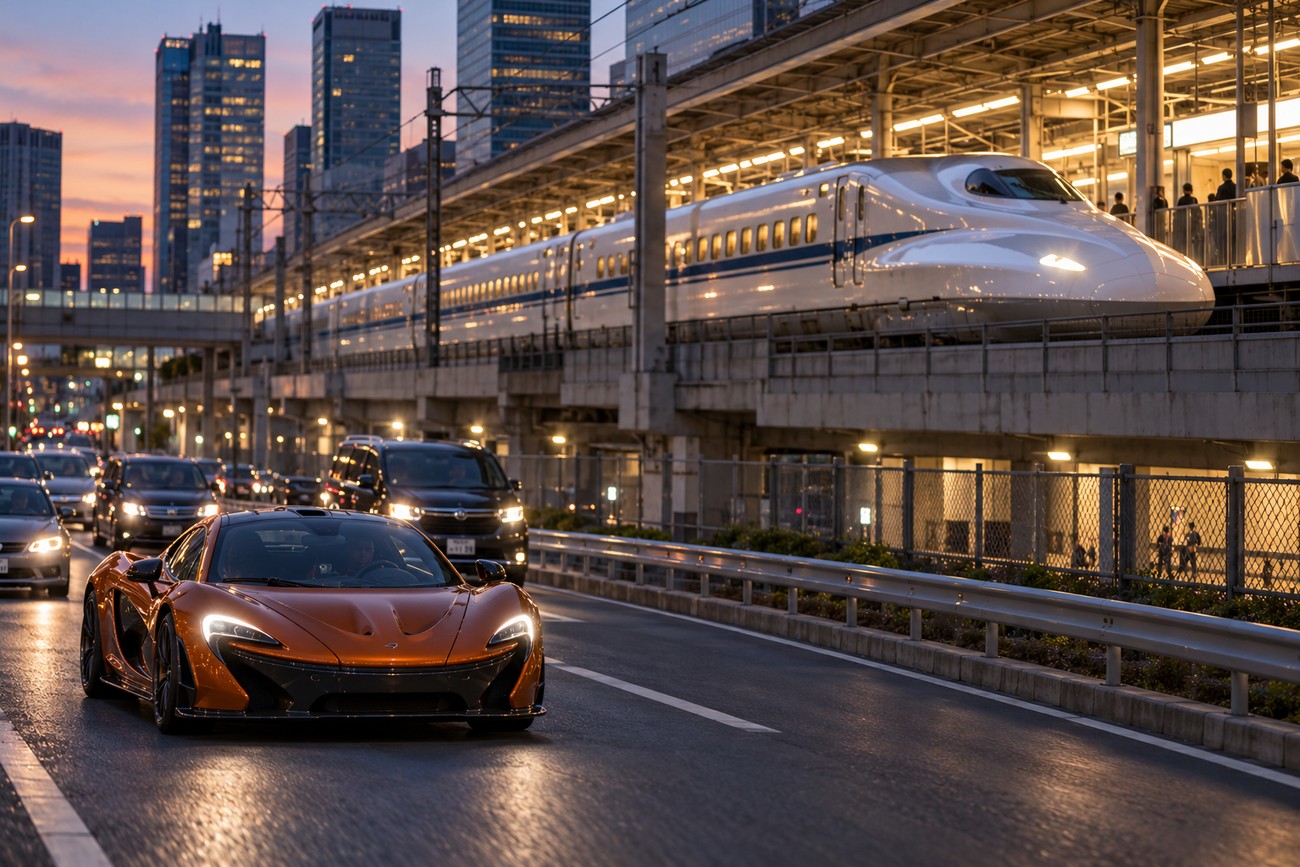
For a normal Tokyo Station–Nagoya Station journey, a fast Nozomi is the credible favorite. Its typical scheduled time is approximately 1 hour 40 minutes, and its route is insulated from the traffic, junctions, and road delays that shape a car trip. That conclusion concerns a defined station-to-station journey, not every possible door-to-door itinerary.
The P1 remains faster on paper at the top end: approximately 350 km/h versus up to 285 km/h for N700S operation on the Tokaido route. Its approximately 2.8–3.0-second 0–100 km/h acceleration also makes it dramatically quicker away from a standstill. Those qualities explain the car’s performance reputation, but they do not establish a verified Tokyo–Nagoya driving time.
A different starting point, destination, departure time, or station-access requirement could change the practical result. A traveler already near a highway may face a different door-to-door calculation from someone crossing Tokyo to reach the station. Without a verified road route and controlled timing, no numerical winning margin can be claimed.
The comparison ends with two kinds of speed. The P1 represents spectacular capability concentrated in a short, controlled performance window. The Shinkansen represents dependable transport built around sustained operation, predictable infrastructure, and a published arrival time. For reaching Nagoya normally, that consistency gives the train the stronger case.
Frequently asked questions
These questions address what a fair comparison would show and why the answer depends on how speed is measured. Video footage needs clear endpoints and timing to support a journey claim. Vehicle choice and train-speed records answer different questions from a scheduled Tokyo–Nagoya trip.
What evidence would make a car-versus-train video a fair comparison?
A credible comparison should use matching start and finish points, continuous timekeeping, and a named train service. It should disclose the car’s full route, every planned stop, station access, and any road closures or restricted sections.
The footage should also explain edits, camera-car movements, and whether either vehicle received a rolling start. Without those details, viewers cannot tell whether the video measures a real journey or a carefully staged performance segment.
Which car is better for a trip along the Shinkansen route?
The best car depends on the purpose. For a genuine trip alongside a Shinkansen route, a reliable road car with comfortable seating, predictable fuel access, and strong visibility is more suitable than a McLaren P1 whose extreme performance is difficult to use legally on Japanese roads.
The P1 is better understood as a high-performance collector car and track-capable machine. It can make a comparison visually compelling, while the Shinkansen remains the more practical choice for a scheduled Tokyo–Nagoya journey.
What is the world’s fastest train?
There is no single answer without defining the category. A train’s operating speed in regular passenger service differs from a test-record speed, a design-speed figure, and a maglev demonstration.
For this comparison, the relevant fact is narrower: the N700S reaches up to 285 km/h in Tokaido operation, while 300 km/h is its design-speed figure. Those operating figures matter more than a separate world-record claim when measuring a scheduled Tokyo–Nagoya journey.







