

The McLaren 720S is built to cover asphalt rapidly; a Welsh forest rally stage can put loose stones, deep ruts, and drainage cuts directly in its path. “How long would it last?” is therefore a question about what stops the car first, rather than one that deserves a stopwatch prediction.
On a smooth, dry stretch, a gentle demonstration pass might be possible. A competitive run over changing gravel is a different test: speed increases the force of impacts and leaves less room to avoid hazards beyond a blind crest. There is no reliable documented full-stage survival time for a 720S, so any numerical answer would disguise the importance of the route, weather, and driver’s pace.
- The honest answer: it depends on the stage, not the horsepower
- Clearance is the first hard limit
- Why 720 PS can make loose gravel harder
- The damage that may not stop the car immediately
- Smooth demonstration run or real Welsh forest stage?
- If a run is planned, decide how it ends before it starts
- Frequently asked questions
- How long does a rally stage last?
- How fast do rally drivers drive on forest stages?
- How long is an average rally stage?
The honest answer: it depends on the stage, not the horsepower
A carefully selected, inspected stretch of dry gravel could allow a short, controlled pass. A rough or wet stage at rally pace could end the attempt at the first consequential strike or loss of traction. Neither outcome can be assigned a credible distance or elapsed time from the available evidence.
“Last” also needs a definition. A car may still drive after scraping its underside or collecting stone chips, yet no longer be undamaged. Completing a competitive stage demands more: it must keep its tires, cooling, brakes, and control intact over the whole timed route.
Welsh forest stages are typically gravel, with possible ruts, stones, mud, blind crests, and changing grip. The hazards depend on the particular stage and weather, so a clear forest road is a poor stand-in for every route. One cautious pass would show that the car crossed that piece of ground; it would not establish rally-stage durability.
Clearance is the first hard limit
The 720S has approximately 107 mm of ground clearance unloaded. That leaves little margin where a wheel drops into a rut while the center of the car passes over raised gravel. Its low nose and long body also make abrupt changes of slope, drainage cuts, and crests places to inspect before driving.
A light scrape might leave the car moving, although it could still damage a panel or fitting. A harder strike to a vulnerable part of the underbody could stop the run. Clearance measured with an unloaded car cannot promise that the underside will clear an irregular surface as the suspension moves.
Double-wishbone suspension with adaptive dampers and Proactive Chassis Control II can adjust damping; that does not add rally-spec wheel travel, clearance, protection, or component strength. Nose lift may help over an individual slope, but a raised nose does not give the whole underbody permanent extra clearance or protect it from stones. Neither feature makes an unseen rock safe to hit.
Why 720 PS can make loose gravel harder

The 4.0-liter twin-turbo V8 produces 720 PS and 770 Nm, driving the rear wheels. On loose gravel, an abrupt throttle input can turn that torque into wheelspin rather than forward motion. If grip changes across a bend, a correction that feels measured on asphalt may become difficult to manage.
Standard tire sizes are 245/35 R19 front and 305/30 R20 rear. Low-profile road tires have limited sidewall margin against a sharp stone or pothole edge, while their tread is no substitute for a gravel rally tire. Simply lowering pressure offers little safe cushioning when so little sidewall separates the wheel from an impact.
The useful pace is set by what the driver can see and stop for, especially before a crest or drainage cut. Gentle throttle and steering inputs reduce the chance of upsetting the car, but they cannot reveal a hidden hazard. Extra power does not compensate for limited grip or the consequences of placing a low wheel and tire assembly against a rock.
The damage that may not stop the car immediately
Owner reports describe stones thrown by the front tires onto the lower doors and surrounding bodywork. That is a credible warning about exposed paint, particularly around the sills, though an owner’s advice to avoid gravel is anecdotal rather than evidence that every car suffers the same damage. Protective film may limit chips; it cannot absorb a substantial impact.
Wheels and tires face direct strikes, while gravel can reach the underbody and cooling openings. The carbon-ceramic brake discs measure approximately 391 mm at the front and 381 mm at the rear. Their size and road performance do not prevent mud or grit from contaminating brake components and ducts; contamination is a risk, not a confirmed failure on a particular run.
After a run, inspection should cover tires, wheels, radiators, ducts, underbody, sills, door panels, and wheel-arch liner fixings. Damage to a fitting or surface may only become apparent after washing away mud and removing accumulated gravel. The ability to drive away is a narrower result than emerging without repairs.
Smooth demonstration run or real Welsh forest stage?
An inspected, dry stretch driven gently lets the driver choose a line around visible stones and stop before a known obstacle. A rutted, wet, or stony stage at competitive pace offers far less time to react. A hidden drain or protruding rock could decide the outcome before the engine’s performance matters.
Blind crests complicate that difference. Grip may change on the far side, and the quickest-looking line may cross a rut that was invisible on approach. These are possible hazards, not a claim that every Welsh stage has the same surface or that every 720S attempt would end at the same point.
A short demonstration pass can establish that one car traversed one selected route under its particular conditions. It cannot establish how the car would withstand repeated impacts over a full timed stage. Without a documented full-stage result and comparable route conditions, a numerical survival estimate would suggest a certainty the evidence does not support.
If a run is planned, decide how it ends before it starts
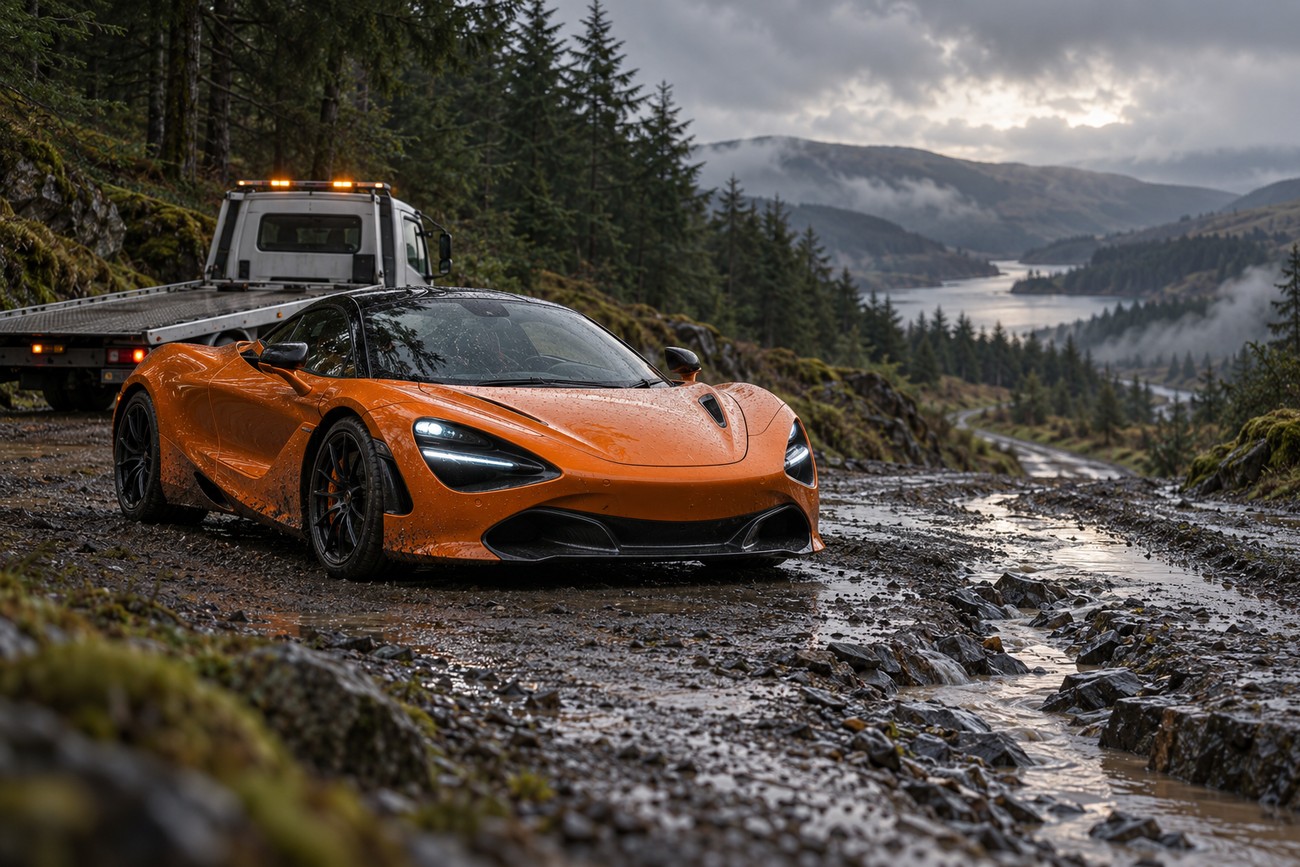
Start with organizer permission and the applicable safety arrangements for a closed rally stage. An open public forest road is not an alternative venue for a stage-style attempt. Before driving, inspect the proposed route for ruts, exposed stones, water cuts, and places where the car could ground.
Set a conservative stopping threshold in advance: an unexpected scrape, tire damage, or a change in braking feel should end the attempt for inspection rather than prompt a faster second try. Arrange recovery before the car enters the route. The 720S has no spare wheel, so a damaged tire can leave it dependent on outside support.
Protection for the lower doors, sills, and front bumper may reduce paint damage from thrown gravel, but film supplies neither ground clearance nor structural impact protection. Afterward, wash and check the tires, wheels, cooling openings, brakes, underside, and bodywork before treating the car as ready for normal use. Planning for that check is part of the run, even if the drive felt uneventful.
Frequently asked questions
A rally stage is one timed section of an event, not the entire rally. Its length, surface, and conditions determine how long competitors spend on it; time spent traveling between stages and at service is separate. Those distinctions matter when comparing a hypothetical 720S run with a rally itinerary.
How long does a rally stage last?
Its elapsed time depends on the route, weather, and driving pace. One timed stage may have different demands from the next, even within the same event. There is no reliable universal duration in the available information, and an entire rally includes more than its timed stages.
How fast do rally drivers drive on forest stages?
Speed changes throughout a forest stage: an open section may permit a higher pace than a bend, blind crest, or rough crossing. An overall average would conceal those slower, hazard-limited sections. It would also say little about a 720S on road tires, whose safe pace would depend on what the driver could see, avoid, and stop for.
How long is an average rally stage?
A stage’s length is the distance of its timed route, while the total distance driven during a rally also includes travel between stages. Routes differ by event, and no universal stage length is established here. Distance alone would not predict whether a 720S could finish: the placement of ruts, stones, and drainage cuts matters more than the figure on a route sheet.







