
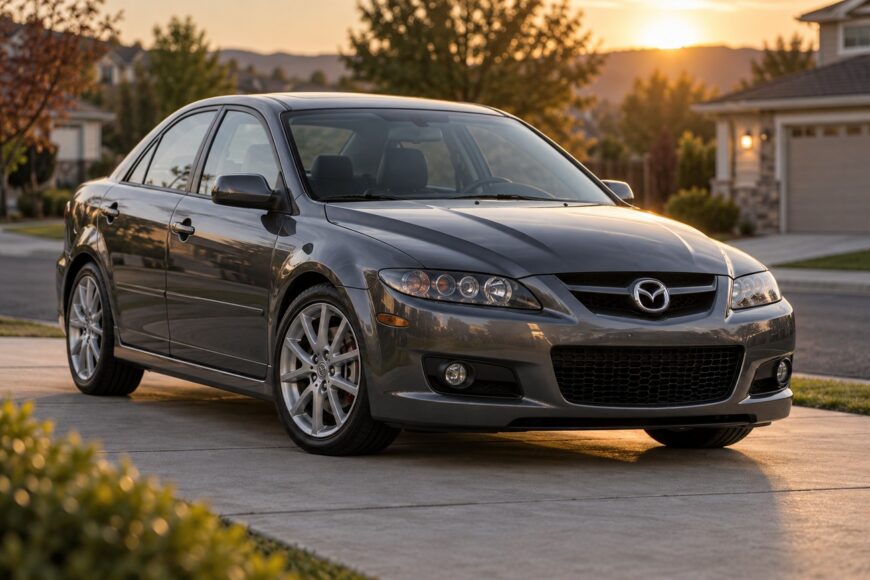
The Mazdaspeed6 looks like an ordinary family sedan, yet it combines a turbocharged direct-injection engine, a six-speed manual, and all-wheel-drive performance. That contradiction is the reason it remains interesting: it can carry five people, use a practical sedan body, and reach 100 km/h in approximately 6.6 seconds.
The real buying decision has little to do with the largest horsepower figure in a brochure. Condition, maintenance history, body integrity, and the quality of previous modifications matter far more. A clean, documented car can be a remarkably capable sleeper; an abused example can turn its age, rust, turbo hardware, fuel-system complexity, and AWD repair costs into a financial trap.
- Why the Mazdaspeed6 still works as a sleeper
- Mazdaspeed6 specifications: what changes by market and year
- How the turbo engine and AWD deliver the performance
- The expensive ownership traps: turbo, DISI, exhaust, and AWD
- Rust, heat, fuel, and other hidden age-related costs
- Tuning mistakes that turn a sleeper into a liability
- A smarter used-buy inspection checklist
- The myths that mislead Mazdaspeed6 buyers
- Who should buy one—and who should walk away
- Frequently asked questions
- Why is the Mazda6 so cheap?
- What is the single most important test before buying a Mazdaspeed6?
Why the Mazdaspeed6 still works as a sleeper
The Mazdaspeed6, also sold as the Mazda6 MPS, was produced approximately from 2005 to 2007. Its five-seat D-segment sedan body sits on the Mazda GG platform and retains the restrained proportions of an ordinary Mazda6. That visual understatement gives the car genuine sleeper value because traffic rarely treats it like a high-performance vehicle.
Its usefulness extends beyond appearance. There is a conventional trunk, seating for five, and a cabin that can remain comfortable on the original suspension. The standard car’s familiar layout also makes the Mazdaspeed6 easier to live with than many two-seat performance cars, provided you accept the cost of premium fuel and specialist maintenance.
Underneath, the differences are substantial. The car has a 2.3-liter turbocharged MZR DISI engine, a six-speed manual transmission, intelligent AWD, stronger chassis hardware, different suspension and brake specifications, and a dedicated fuel system. The result is a sedan that can deliver approximately 6.6-second 0–100 km/h acceleration without advertising its ability through extreme styling.
That restraint can also hide neglect. A tidy exterior may conceal corrosion, an aging turbocharger, or an AWD system that has missed fluid changes. The sleeper appeal works best when the car is judged as an old performance machine wearing family-sedan clothing.
Mazdaspeed6 specifications: what changes by market and year
The core mechanical specification is broadly shared, while published power figures vary by market and model year. The horsepower difference should be read as a market-and-rating issue rather than proof that every example has the same output.
| Specification | Mazdaspeed6 / Mazda6 MPS |
|---|---|
| Production period | Approximately 2005–2007 |
| Engine | 2.3-liter turbocharged MZR DISI inline-four, direct injection, DOHC, 16 valves |
| Power in European and Russian references | Commonly quoted as 260 hp at 5,500 rpm |
| Power in US references | 274 hp for 2006 and 270 hp for 2007 |
| Torque | Approximately 380 Nm, or 280 lb-ft, at around 3,000 rpm |
| Transmission | Six-speed manual only |
| AWD hardware | Intelligent AWD with a center coupling and rear limited-slip differential |
| Torque distribution | Strongly front-biased in normal operation; capable of up to 50/50 between axles |
| 0–100 km/h | Approximately 6.6 seconds |
| Top speed | Approximately 240 km/h in Europe; 151 mph, approximately 243 km/h, with the US limiter |
| Curb weight | Approximately 1,625–1,630 kg, or 3,580–3,590 lb |
| Luggage capacity | Approximately 350 liters, or 12.4 cu ft |
| Fuel requirement | Premium unleaded/high-octane fuel required |
How the turbo engine and AWD deliver the performance
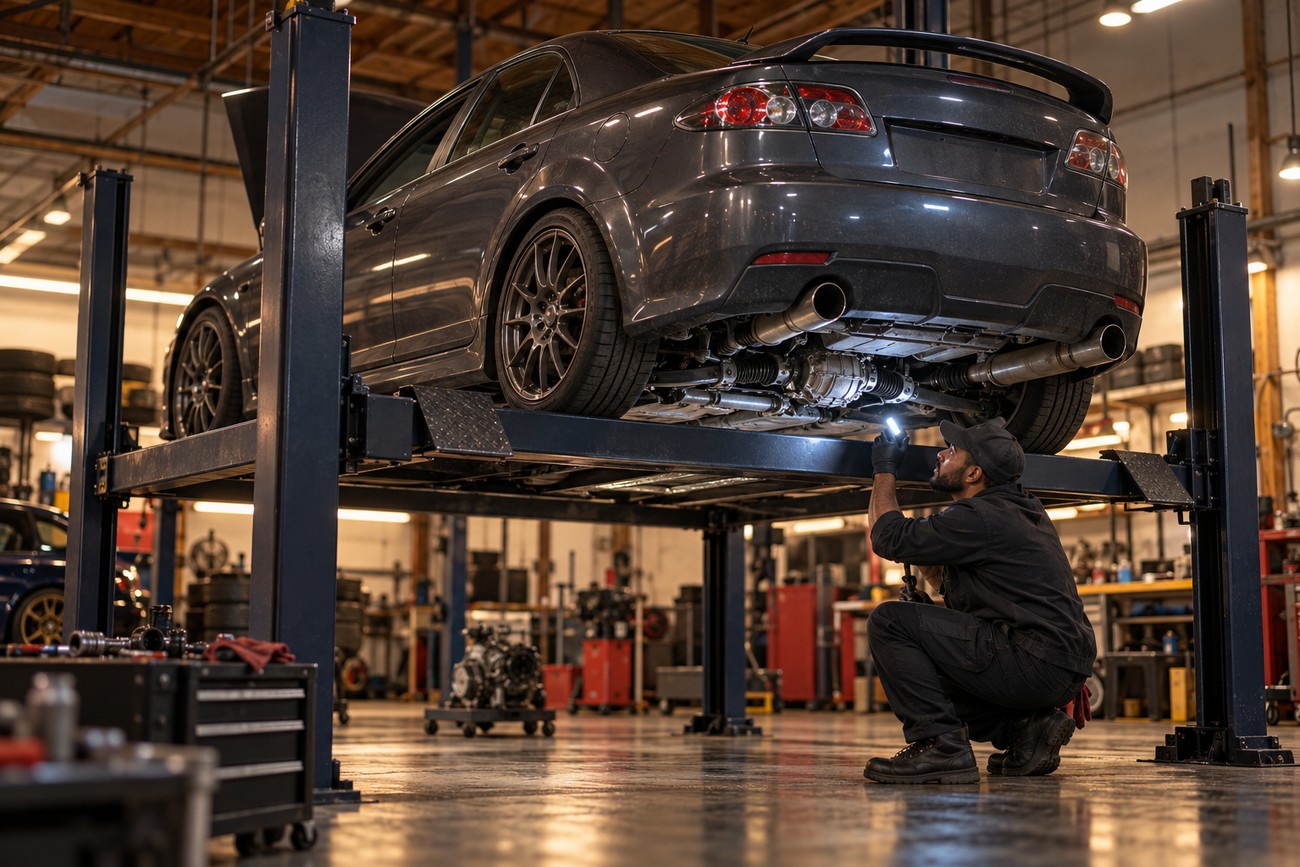
The 2.3-liter MZR DISI uses direct injection and turbocharging to produce strong torque around 3,000 rpm. That broad midrange makes the car quick in ordinary traffic, where response from a rolling start matters more than peak power at the top of the rev range. The six-speed manual lets the driver keep the engine in its useful band, although it also makes clutch and gearbox condition important during inspection.
Intelligent AWD uses a center coupling and a rear limited-slip differential. Normal operation is strongly front-biased, which helps efficiency and keeps the car predictable. Under suitable conditions, the system can distribute torque up to 50/50 between the axles, giving the front tires more support during hard acceleration or low-grip driving.
This layout produces secure traction rather than a naturally rear-driven character. The car can rotate under the right inputs, yet its basic behavior remains front-led. Software changes may alter torque distribution and driver perception, but they cannot turn the hardware into an indestructible rally drivetrain.
Repeated launches, sustained drifting, and heavy track use place substantial loads on the coupling, center hardware, and differentials. A 6.6-second acceleration figure is useful context for the car’s capability; it is not an invitation to treat every old AWD component as competition equipment.
The expensive ownership traps: turbo, DISI, exhaust, and AWD
The turbocharger is one of the first areas to investigate. Aging factory units and boost-control valves can develop smoke, shaft play, and oil leaks. A car that smokes after idling, shows inconsistent boost, or has oil residue around the turbo requires proper diagnosis before any purchase decision.
Exhaust heat creates a related failure chain. Exhaust manifolds and turbo flanges can crack or suffer burn-through, while the tightly packaged engine bay makes access difficult. Repairs may involve substantial labor because several surrounding components must be removed before the damaged hardware can be reached.
Boost errors should be separated into sensor, control, and turbo-wear categories before an expensive turbocharger is approved. A scan result alone cannot identify which part has failed.
The DISI fuel system and its sensors add another layer of risk. MAP, MAF, knock, and fuel-pressure sensor faults can create boost or mixture errors that resemble mechanical failures. Replacing parts at random is an expensive strategy, especially when specialized original components may be scarce, costly, and slow to source.
The AWD system deserves its own inspection rather than a quick road-test check. Coupling, center, and rear differential failures can follow age, overload, hard launches, drifting, or neglected fluid service. A neglected car can expose the buyer to turbo, fuel-system, and differential repairs at the same time.
Rust, heat, fuel, and other hidden age-related costs
Corrosion can decide whether a car is worth saving. Inspect the underbody, wheel arches, and especially the rear longitudinal rails in detail. Surface rust may be manageable, while serious rail corrosion can make structural repairs impractical even when the paint and interior look presentable.
Fuel costs are also part of the ownership calculation. Real-world urban consumption is often 14–16 L/100 km or higher, particularly on modified cars or during short trips. Premium unleaded or high-octane fuel is required, so the running cost is materially different from that of an ordinary naturally aspirated Mazda6.
Heat management becomes more important as driving intensity rises. Factory heat shielding and exhaust cooling can be marginal during hard use, increasing stress around the turbocharger, manifold, and nearby components. Additional cooling and improved shielding may be sensible for a car that sees repeated high-load driving, though they do not repair neglected hardware.
Oil quality and service timing matter because the turbocharged direct-injection engine is less forgiving than an ordinary naturally aspirated Mazda6. Careful owners commonly use quality synthetic oil with 5,000–6,000 km change intervals. Records showing only long, generic service intervals should reduce confidence in the engine’s remaining life.
Tuning mistakes that turn a sleeper into a liability
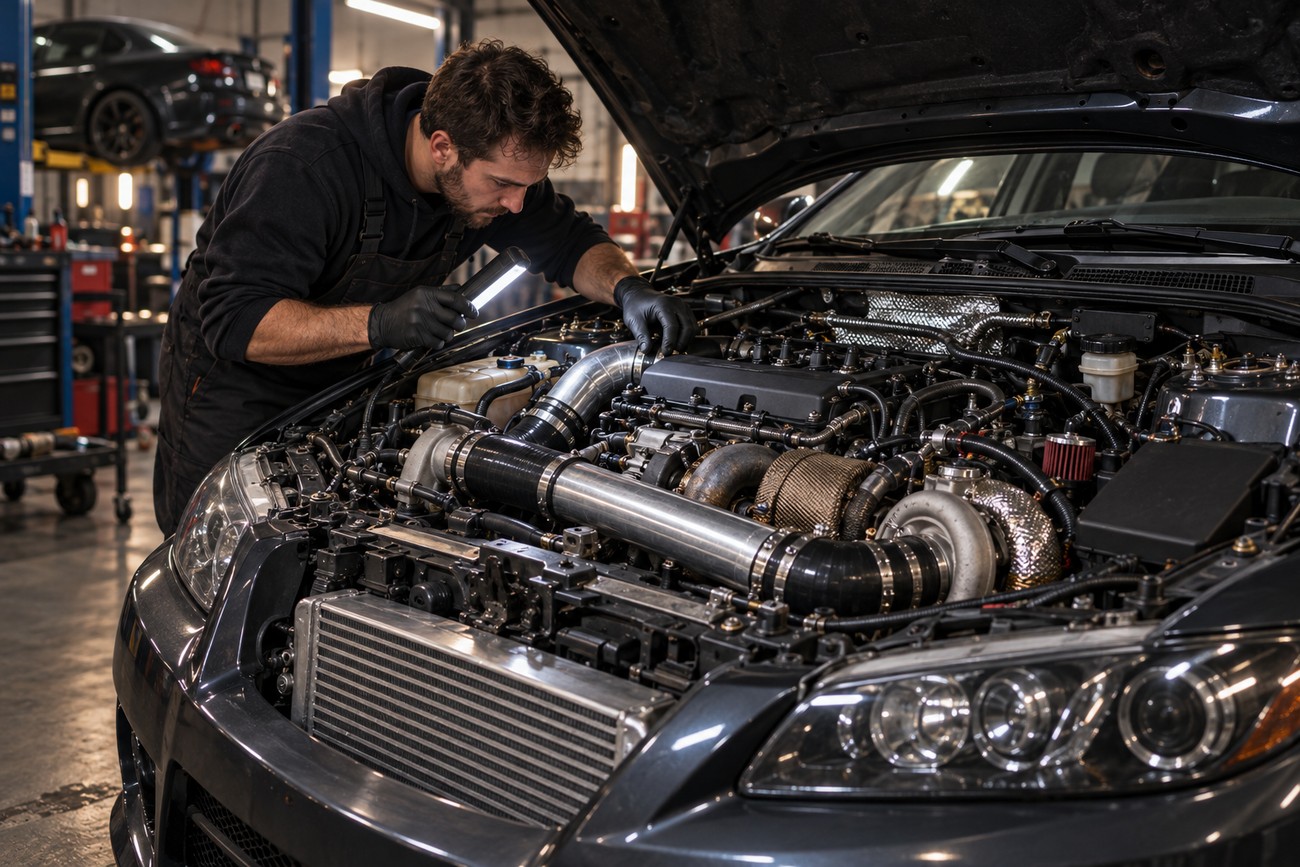
Measured preparation can improve the car; superficial chip tuning can expose its weakest systems. A calibration should be supported by control of air-fuel ratio, exhaust temperature, detonation, fuel-system capacity, and charge-air temperature. More boost without that evidence increases the risk of detonation, cracks, and burn-through around the exhaust side.
Modified examples may consume more than 14–16 L/100 km in urban use, especially when driven aggressively. Added oil cooling, intercooling, and improved heat shielding are common responses to hard-use temperature limits. Their presence is useful information, though it also signals that the car may have been driven beyond standard operating conditions.
AWD hardware has limits. Repeated hard launches and sustained drifting accelerate wear in the coupling and differentials, while mismatched tires can add unwanted stress to the drivetrain. Tire condition and rolling diameter should be checked as carefully as horsepower claims.
Oversized or excessively wide wheels, aggressive alignment settings, and stiff suspension can overload suspension components, the body, and AWD hardware. The original suspension is relatively comfortable and usually offers a better compromise for a road car than an extreme setup installed for appearance.
A smarter used-buy inspection checklist
Start with the body before evaluating performance. Put the car on a lift and inspect the underbody, wheel arches, seams, and rear longitudinal rails. Serious corrosion in those areas can outweigh an attractive price because structural repair, parts sourcing, and paint work quickly exceed the value of the car.
Next, scan the engine and boost systems with appropriate diagnostic equipment. Look for stored and pending faults involving MAP, MAF, knock, fuel pressure, mixture, and boost control. A cold start should be observed from outside the car, with attention to smoke, abnormal noise, unstable idle, and warning lights.
Inspect the turbocharger and exhaust side directly where possible. Check for shaft play, oil leaks, smoke after idle and throttle application, cracked manifolds, and damaged turbo-flange areas. A smooth test drive does not exclude an aging turbo, because early wear may appear only under load or after the engine reaches operating temperature.
The six-speed manual transmission, transfer hardware, center coupling, and both differentials need separate checks. Ask for evidence of regular transmission, transfer, and differential fluid service, then listen for knocks, binding, whining, or vibration during slow turns and acceleration. Tire matching, wheel dimensions, alignment, and suspension condition also affect AWD load.
Make the final decision around evidence and support. A specialist who can diagnose both the MZR DISI engine and this AWD system is more valuable than a general cosmetic inspection. Confirm parts availability and repair options in your area before buying, since specialized DISI and AWD components may involve long lead times and high ordering costs.
The myths that mislead Mazdaspeed6 buyers
Myth: every Mazdaspeed6 makes 260 hp. Reality: European and Russian references commonly quote 260 hp at 5,500 rpm, while US references list 274 hp for 2006 and 270 hp for 2007. The market and model year should appear in any serious comparison, especially when assessing imported cars.
Myth: it is simply a Mazda6 with a turbocharger. Reality: the model has distinctive AWD hardware, suspension, brakes, body reinforcement, and fuel-system components. That engineering explains the performance, while also explaining why ordinary Mazda6 parts and service assumptions do not always apply.
Myth: the AWD is indestructible. Reality: the system is sensitive to launches, drifting, overload, and neglected fluid service. Its ability to send up to 50/50 torque between the axles improves traction, yet it does not remove the age and load limits of the coupling or differentials.
Myth: fuel use matches an ordinary 2.3-liter Mazda6. Reality: urban consumption is often 14–16 L/100 km or higher, and premium or high-octane fuel is required. A buyer who budgets only for the purchase price may underestimate the recurring cost of keeping the car in proper condition.
Who should buy one—and who should walk away

The right buyer accepts that this is an old performance car with a practical body. You should be comfortable paying for premium fuel, preventive maintenance, specialist diagnosis, and occasional parts delays. A car with a documented history, sound body, original-quality suspension, and a healthy AWD system can still provide unusual performance without sacrificing daily usability.
Walk away from serious rust in the rear longitudinal rails, undocumented tuning, persistent smoke, AWD noises, or a seller who refuses a proper inspection. An attractive price does not compensate for several unresolved systems, particularly when original DISI and AWD parts may be scarce.
Consider your local support network before committing. If no nearby workshop can test the engine, turbo control, fuel system, and AWD hardware, even routine faults may become long-distance or mail-order projects. Insurance and tax costs may also be higher in some markets because of the turbocharged power output.
Keep the chassis close to its original balance if the car is intended for road use. The factory suspension can remain comfortable, while hard spring rates, aggressive alignment, and repeated launches may shorten the life of the body and AWD components. The best example is usually the one that has been maintained carefully rather than modified most dramatically.
Frequently asked questions
Why is the Mazda6 so cheap?
The market discount comes from age, discontinued-model economics, a small buyer pool, and the possibility of expensive specialist repairs. Buyers also price in AWD coupling and differential risk, DISI fuel-system complexity, turbocharger wear, corrosion, and scarce replacement parts.
That discount does not indicate weak performance. It reflects the cost uncertainty of an old turbocharged AWD sedan. A cheap example with poor records can cost more than a dearer car with a rust-free body, verified fluids, and a documented engine and AWD inspection.
What is the single most important test before buying a Mazdaspeed6?
The most valuable test is a combined engine, boost, and AWD diagnostic session performed by a workshop familiar with the model. Require a scan for stored and pending faults, a cold start, inspection for smoke and turbo play, checks of fuel-pressure and boost behavior, and a lift inspection of the transmission, transfer hardware, coupling, and differentials.
A superficial road test mainly confirms that the car moves and shifts. It may miss early turbo wear, intermittent sensor faults, corrosion, and AWD problems that appear only during slow turns or sustained load. The inspection should also include service records and a realistic assessment of parts availability.







