
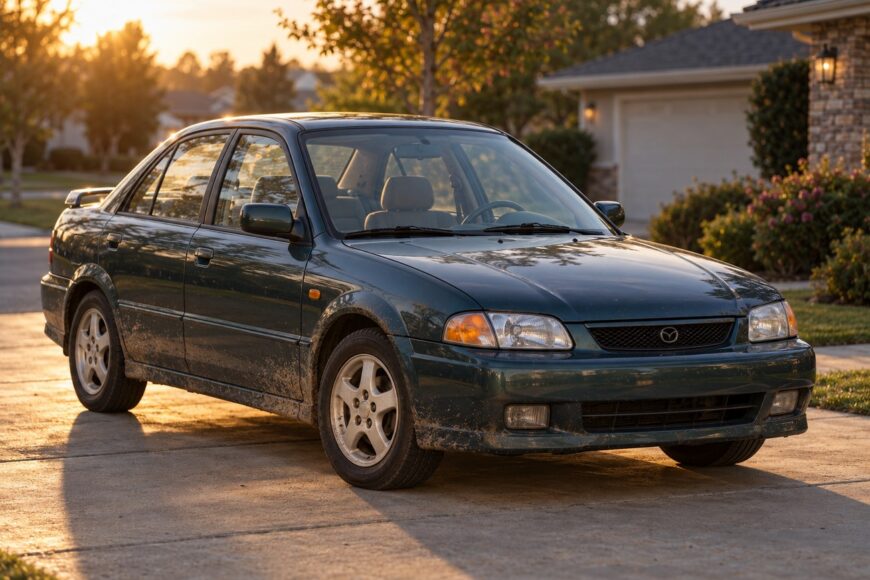
An uncommon turbocharged compact sedan has an appeal that newer performance cars cannot quite replicate. The Mazdaspeed Protegé pairs everyday sedan usefulness with a distinctive engine and a sporting identity. Its modest size also makes it feel like a car you can use regularly, rather than one reserved for occasional drives.
For a buyer, the difficult part lies beneath the badges. The condition and modification history of an individual car matter more than its published specifications: many have had changes to their engines, boost systems, or engine management. Understanding what Mazda supplied is the starting point, but a cold start, a proper drive, and a careful inspection will help determine whether a particular example deserves attention.
- What Makes the Mazdaspeed Protegé Different
- The Driving Experience: Turbo Character and Hesitation
- The Stock Engine’s Limits
- Why Boost and Intercooler Upgrades Need More Than Parts
- Drivetrain and Age-Related Faults Beyond the Turbo
- How to Inspect a Mazdaspeed Protegé Before Buying
- Frequently asked questions
- How many Mazdaspeed Protegés were made?
- How can I check whether a car is a genuine Mazdaspeed Protegé?
- How much horsepower does the Mazdaspeed Protegé have?
What Makes the Mazdaspeed Protegé Different
The Mazdaspeed Protegé was a limited sporting version of the third-generation Protegé sedan. It offered a factory-built route into turbocharged compact-car ownership while retaining the familiar proportions and practicality of the standard four-door. That combination still makes it interesting to buyers who want a usable car with a more specialized character.
Its engine is the 2.0-liter turbocharged FS-DET, rated at 170 SAE hp at 6,000 rpm. Approximate weight is 1,279.5 kg. Those figures describe a relatively light sedan with useful turbo power; they do not, on their own, tell you how well an individual engine has survived two decades of use.
The Mazdaspeed name can lead buyers to assume that every internal engine component was strengthened for performance duty. Factory Mazdaspeed specification does not guarantee reinforced rods or pistons. That distinction matters most when a seller points to increased boost as though the original sporting package makes further power risk-free.
Establish whether the car is original before you judge its character. A standard-looking engine bay may conceal earlier repairs or a replacement engine, while visible modifications may have been installed with care or without a coherent plan. Service records and evidence of the work done are more useful than appearance alone.
The Driving Experience: Turbo Character and Hesitation
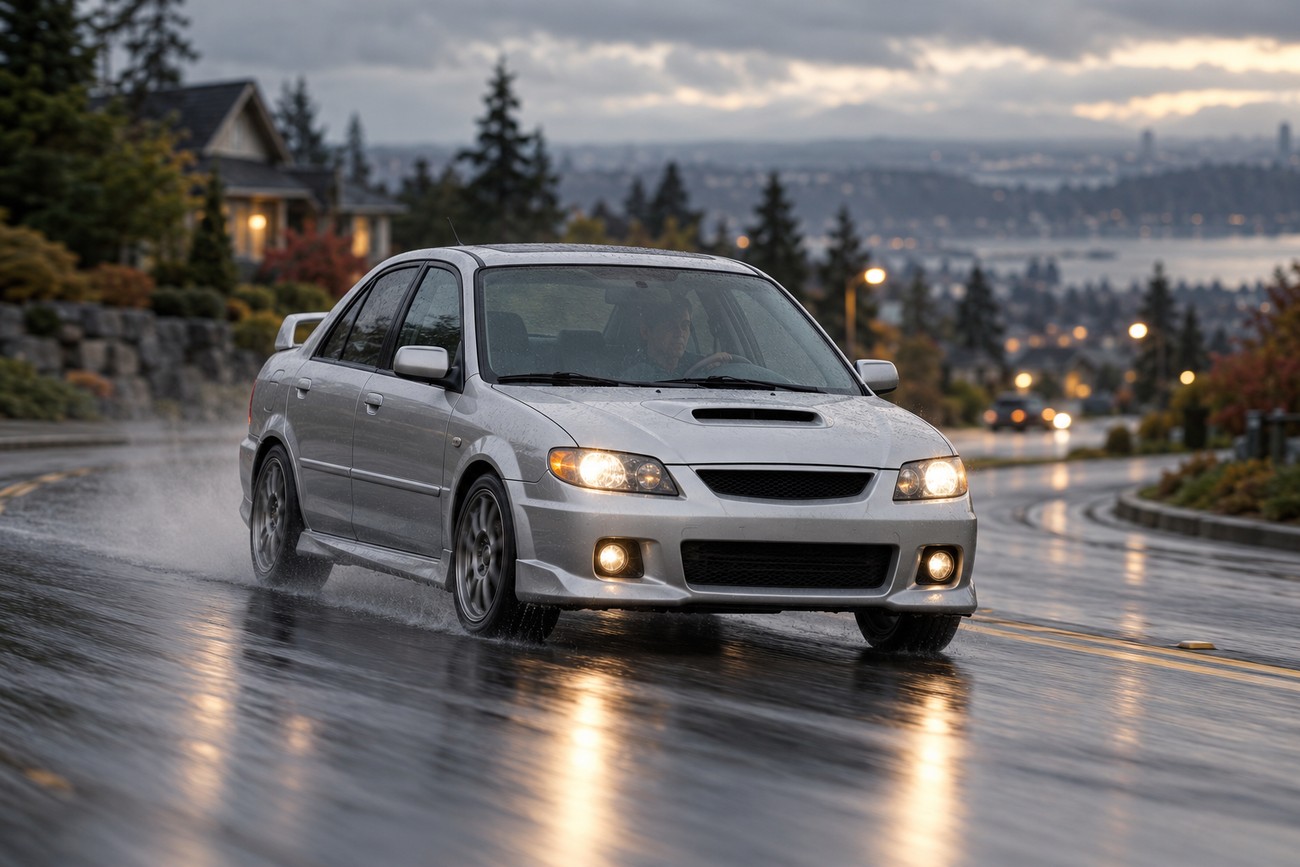
At its best, the Mazdaspeed Protegé delivers the appeal of a compact sedan whose power builds as the turbo comes in. You can enjoy that character without expecting it to behave like a modern, highly polished turbo car. What you should expect is acceleration that is reasonably consistent for the car’s setup and condition.
Owners report hesitation and uneven acceleration, including on otherwise stock cars. Factory engine calibration is one reported source of these complaints, so a stumble does not automatically prove that an aftermarket part has been fitted. Equally, calling every stumble “normal” risks overlooking a fault that needs diagnosis.
Cold operation can make drivability problems easier to notice. Altered intake or intercooler arrangements may also change how the engine responds, particularly if the rest of the setup has not been assessed with them. A brief drive after the seller has warmed the car can miss behavior that appears during the first miles.
Notice whether hesitation occurs at a repeatable point, under a particular load, or only as the engine warms. Those observations give a specialist something more useful to investigate than a general complaint that the car feels slow. They also help distinguish an established characteristic of one setup from a developing problem.
The Stock Engine’s Limits
Factory turbocharging and a 170 SAE hp rating do not establish that the FS-DET has a heavily reinforced bottom end. The badge does not settle how much extra boost its rods or pistons can tolerate. For a buyer, that makes the history of boost changes and engine work more important than the performance badge on the trunk.
Owner discussions raise concerns about rods and the oil pump. Accounts of rod failures around 110,000–140,000 miles exist, sometimes describing severe block damage, but that range is not a universal service-life estimate. A well-kept engine should not be condemned by its odometer alone, and a lower-mileage one should not receive an automatic pass.
Oil-pressure evidence deserves particular attention because it helps assess the engine as a working assembly rather than as a list of replaced parts. Ask for maintenance records and details of any previous overheating, excessive boost, or engine replacement. An undocumented rebuild or swap needs the same scrutiny as an original engine with an uncertain past.
Compression and oil-pressure checks, performed appropriately by a qualified shop, can clarify risks that a tidy engine bay cannot. Results still need interpretation alongside starting behavior, noises, leaks, and records. The useful question is whether the evidence tells a consistent story about the engine now in the car.
Why Boost and Intercooler Upgrades Need More Than Parts
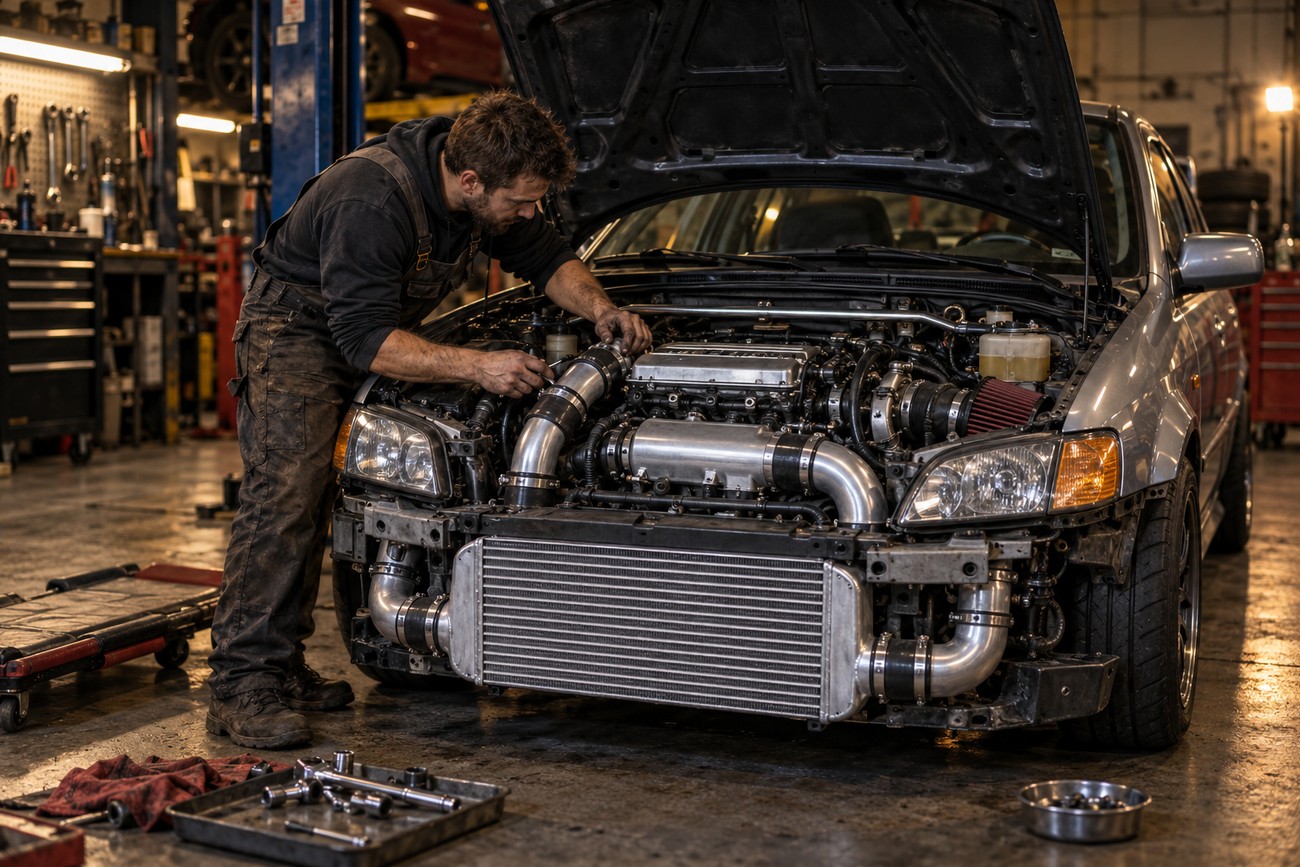
Increasing boost is an understandable temptation in a light turbo sedan, but the stock bottom end leaves limited room for assumptions. Fueling, detonation, oil pressure, and temperatures all need attention when output rises. A boost figure or parts list by itself cannot show whether the engine has operated safely.
A larger front-mount intercooler may look like an uncomplicated improvement. Owners have reported added turbo lag after some installations, particularly where the hardware change was not considered as part of the complete setup. Pipe routing and engine calibration deserve assessment alongside the intercooler rather than after a disappointing test drive.
Piggyback or aftermarket engine management is sometimes used to address drivability complaints or support other changes. Its presence is neither an automatic defect nor proof that the original hesitation has been cured. The quality of the configuration, the associated hardware, and any available tuning records matter more than the controller’s mere presence.
Look at modifications as a system. Nonstandard injectors, altered boost control, intake changes, and engine management should make sense together and should have a traceable installation history. If the seller cannot explain what was changed or why, allow for diagnostic work rather than assuming a specialist can simply adjust one setting.
Drivetrain and Age-Related Faults Beyond the Turbo
More engine power also reaches a stock transmission with limited strength headroom. During a drive, pay attention to gear selection, unusual noises, and how the car behaves as load changes. A smooth engine cannot compensate for an expensive gearbox or differential problem.
A limited-slip differential, or LSD, is advertised as a feature, yet owners report cracked or failed differentials. Verify which unit is installed and assess its condition rather than treating “LSD” in a listing as a confirmed advantage. Repairs or replacements over the car’s life can make the specification on paper a poor guide to the hardware present.
A knock from the rear over rough pavement deserves investigation, though it does not necessarily mean the whole suspension is worn out. Stabilizer bushings or related hardware may be responsible. Locating the noise before negotiating a purchase is better than budgeting for the wrong repair.
Age brings less glamorous work, too. Owners report wear in axles, wheel bearings, and engine mounts, while high-mileage turbochargers may pass oil. Plastic parts in hot turbo plumbing can become brittle; inspect them for damage or improvised repairs, especially on a car whose intake layout has been changed.
Finish the mechanical inspection with the body. Check for rust and look inside the trunk, including the spare-wheel well, for dampness or signs of past water entry. Body repairs, aging rubber, and electrical deterioration can consume time and money even when the turbocharger itself is healthy.
How to Inspect a Mazdaspeed Protegé Before Buying
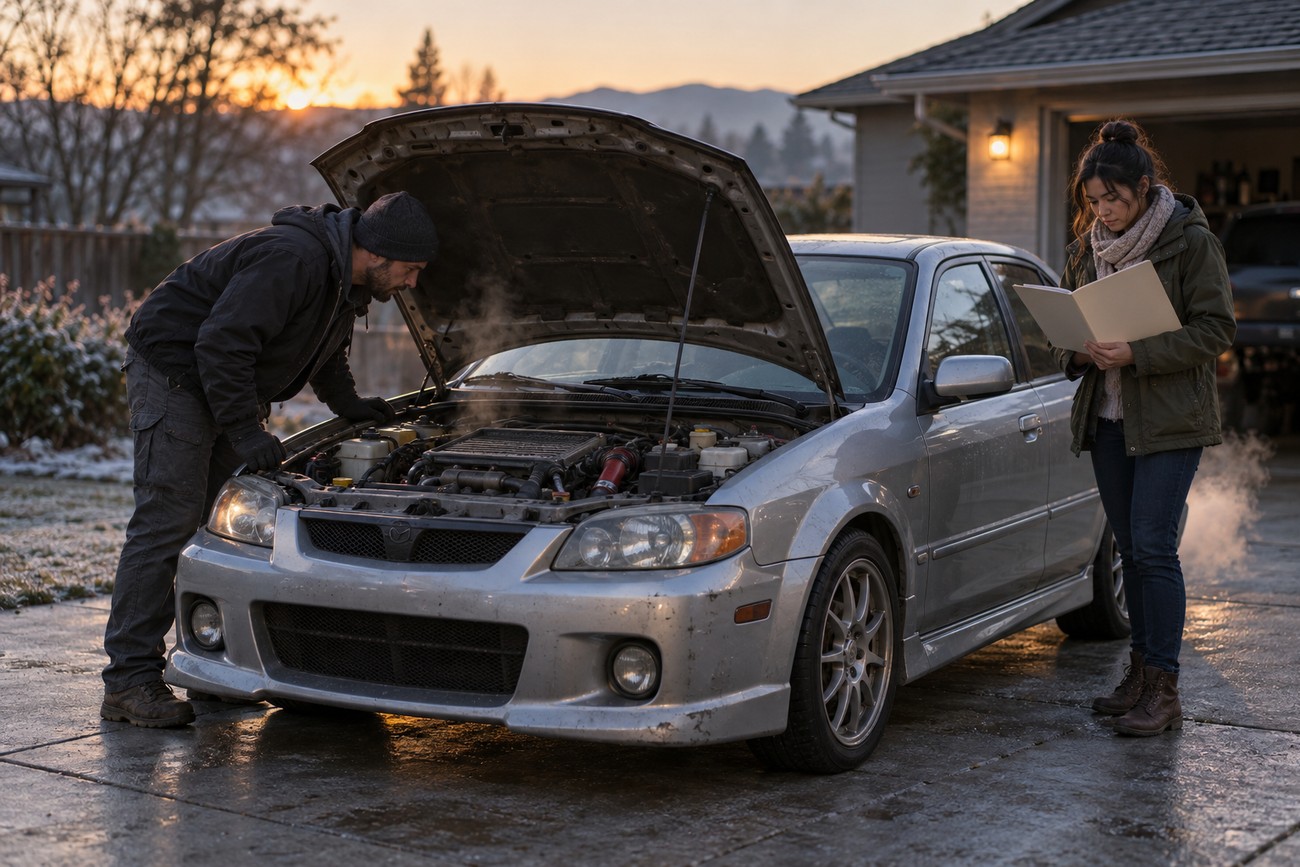
Start with documents and a modification inventory. Compare service and repair records with the engine, intake, intercooler, injectors, and boost-control hardware actually fitted. Ask about any engine replacement or major repair, and look for enough detail to understand what parts were used and what prompted the work.
Arrange to see the car before its first start of the day, then drive it long enough to assess behavior under load once it is ready to do so. Listen, watch for smoke, and note hesitation without repeatedly stressing a suspect engine. A clean warm idle is reassuring only within that limited test condition.
Follow the drive with a qualified inspection where needed. Compression, oil pressure, turbo condition, gearbox operation, differential condition, and body corrosion all merit attention. If a test produces an uncertain result, ask for an explanation before treating it as either a clean bill of health or a reason to walk away.
Signs of aftermarket engine management, nonstandard injectors, or altered boost control call for evaluation of the complete setup. A wideband display or a neat-looking controller does not establish that fueling and calibration are appropriate. Request records that connect the hardware to the work performed, and budget for further assessment if those records are absent.
Finally, weigh likely repairs and access to Mazdaspeed-specific parts against the asking price. A cheaper car with unresolved drivability, differential noise, and trunk moisture may be a more demanding purchase than a better-documented example. Condition and modification history should decide the comparison, ahead of the headline power figure.
Frequently asked questions
A few basic facts are worth confirming separately from the inspection. Production claims, authenticity, and advertised power can shape an asking price, yet each calls for a different kind of evidence. Use documentation for the car you are considering rather than relying on a listing’s shorthand.
How many Mazdaspeed Protegés were made?
The supplied research does not establish a verified production total. If rarity is central to a seller’s price, ask for documented production records that support the figure being quoted. Avoid treating a repeated number in advertisements as confirmation.
How can I check whether a car is a genuine Mazdaspeed Protegé?
Cross-check the VIN and original vehicle documentation against the car, and investigate any inconsistency before purchase. Badges, exterior parts, and a seller’s description cannot establish authenticity on their own, especially when cars can be repaired or modified over time.
How much horsepower does the Mazdaspeed Protegé have?
The factory rating is 170 SAE hp at 6,000 rpm from its 2.0-liter turbocharged FS-DET. That is a published engine specification, not a measurement of a particular used car. Modifications, mechanical condition, and how output is measured can all affect a figure quoted for an individual example.







