
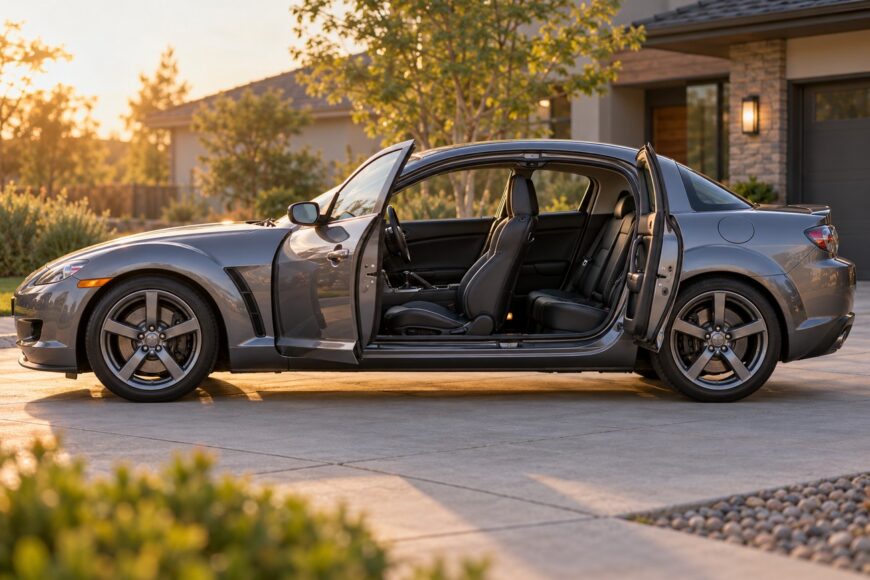
The Mazda RX-8 looks unusually welcoming for a sports coupe: four seats, four doors, and an opening to the rear cabin without a conventional central pillar. That promise has limits. The rear doors depend on the front doors being open, the back seats remain a coupe compromise, and the rotary engine asks more of an owner than its compact size might suggest.
Those trade-offs are also part of the RX-8’s appeal. Its unusual doors make occasional rear passengers possible, while its naturally aspirated rotary and rear-wheel-drive layout give it a character that a conventional four-door car cannot replicate. For a used-car buyer, the deciding factor is the particular RX-8 in front of you: its version, maintenance history, and the condition of its engine and doors.
- How the RX-8’s freestyle doors actually work
- Why the Renesis and chassis make this more than a door gimmick
- Power, performance, and fuel figures depend on the version
- The ownership costs hidden behind an appealing RX-8
- What to check before buying a used RX-8
- Frequently asked questions
- What year of Mazda RX-8 should I avoid?
- How should I arrange an RX-8 rotary compression check?
- Why is the RX-8 so cheap?
- What killed the rotary engine?
How the RX-8’s freestyle doors actually work
The RX-8 is a rear-wheel-drive, four-seat sports coupe. Its small rear doors are hinged at the back and open only after the corresponding front doors. With both doors open, there is no conventional central pillar dividing the opening, so passengers get a clearer route to the rear seats than the coupe shape suggests.
That arrangement works best when everyone can get in or out together. A rear passenger cannot simply open their own door while the front one stays shut, as they could in a conventional four-door car. In a tight parking space, the sequence of opening two doors also deserves a trial run before you assume it suits your routine.
The rear seats are real, but access remains a coupe compromise. If a front seat is set far back, the route into the rear cabin becomes more awkward. Four doors therefore make the RX-8 more flexible than many sports coupes without giving it the everyday ease of a four-door family car.
The pillarless opening also makes the fit and operation of the doors worth checking on a used example. Open and close each pair in the proper sequence, and look for awkward movement or uneven alignment. It is a practical check of the feature you will use, rather than a judgment based on how striking the doors look when open.
Why the Renesis and chassis make this more than a door gimmick
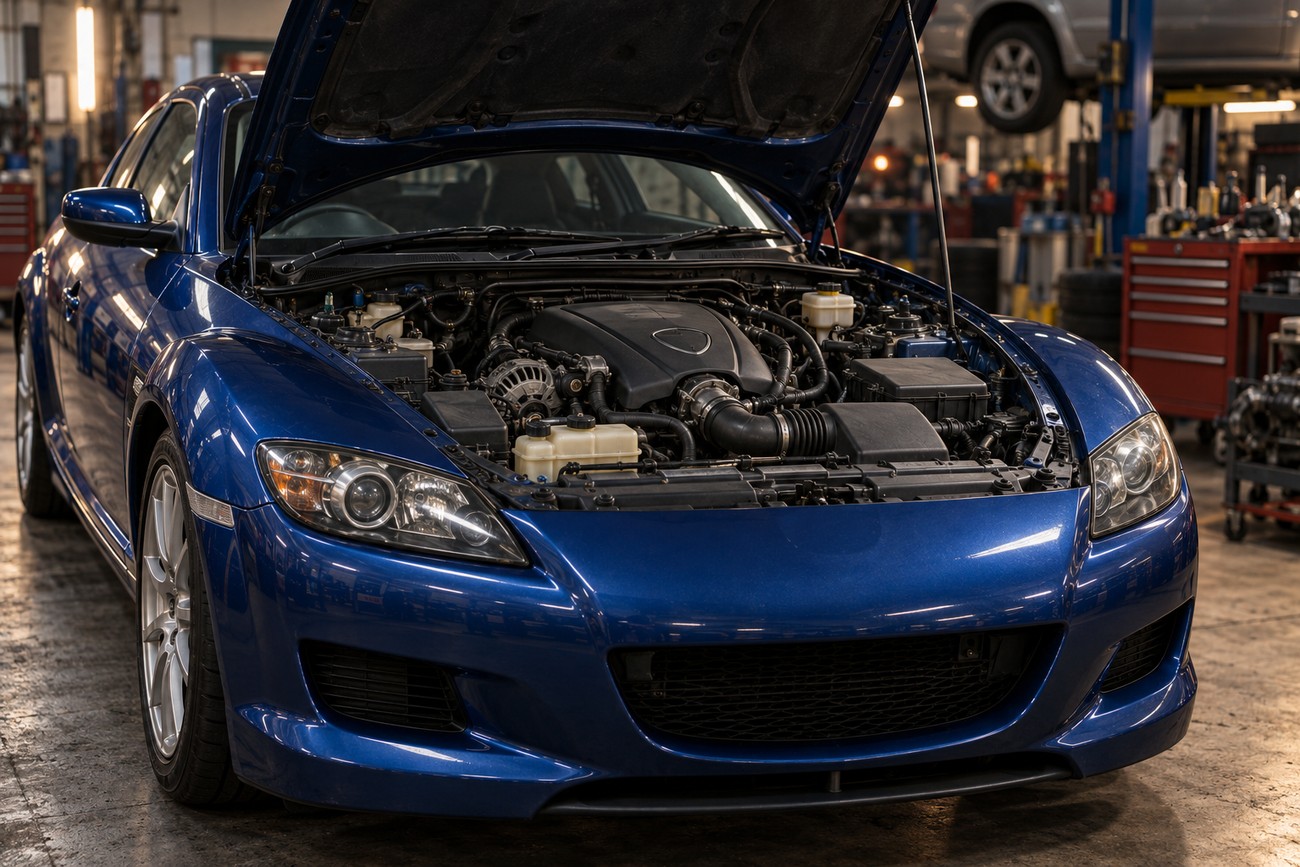
Behind the unusual body layout is a naturally aspirated 13B-MSP Renesis rotary with a displacement of 1,308 cc (1.3 liters). It is mounted longitudinally at the front and drives the rear wheels. A standard RX-8 is not turbocharged, despite the rotary engine’s association with other boosted sports cars.
The rotary’s compact packaging is central to the RX-8’s character. It helps Mazda combine a front-engine, rear-drive sports-car layout with room for four seats in a low coupe body. That is why the car interests drivers for reasons beyond its door mechanism: the engine and chassis layout are part of the same design idea.
RX-8 descriptions often cite 50:50 weight distribution as a design claim. It is a useful explanation of the balance Mazda sought, though it should not be treated as a measured figure for every car in every configuration. On a test drive, the more useful evidence is how the specific car steers, responds, and feels over the roads you actually use.
The engine’s appeal brings a buying obligation. Compactness and distinctive response do not tell you whether a used Renesis is healthy. Mechanical condition deserves at least as much attention as the chassis and bodywork.
Power, performance, and fuel figures depend on the version
RX-8 listings can describe different cars under the same model name. Standard Power and High Power versions are commonly distinguished, with reported main outputs of 192 hp and 231/240 hp; the exact figure depends on version, market, and source. Confirm the specification of the car being sold before using an advertised output to compare it with another.
Reported 0–100 km/h times span 6.4–7.5 seconds, depending on version. That range gives a sense of the RX-8’s performance, but it is not a single promise for every example. A car’s condition matters too, particularly when you are evaluating an older vehicle rather than a catalog specification.
Catalog-style consumption figures include 8.5 L/100 km on the highway and more than 12 L/100 km in town. They are reference points, not guarantees of real-world economy. Frequent urban driving can make the cost of fuel feel more prominent than the RX-8’s modest 1.3-liter displacement suggests.
For a prospective buyer, the useful comparison is between the exact versions on the shortlist, with fuel spending considered alongside purchase condition. A lower advertised price or a higher quoted power figure says little about the better buy until the cars’ histories and mechanical health are known.
The ownership costs hidden behind an appealing RX-8
The RX-8 can be a rewarding daily car for someone prepared for its demands, but it is a poor choice if low running costs are the main goal. Budget for the driving you will do, especially if much of it is urban.
Rotary ownership also calls for attentive maintenance. Oil and spark plugs deserve scrutiny in the service record, while starting behavior can reveal a reason for further investigation. Ask what work has been done and whether problems were diagnosed, rather than accepting a vague assurance that the engine has been “looked after.”
Reports of difficult starts or accelerated engine wear are risks to investigate, not a fate shared by every RX-8. Poor maintenance or overheating can worsen engine condition, so a documented history carries more weight than a tidy engine bay. A prospective owner should leave room in the budget for specialist assessment and for issues that an inspection uncovers.
This is where the car’s appealing specification can distort a buying decision. Four seats may make an RX-8 easier to justify, yet they do not reduce its fuel use or remove the need to monitor a specialist engine. Buy it for the experience it offers, with a realistic plan for keeping it in good condition.
What to check before buying a used RX-8

Start by establishing exactly which RX-8 is for sale. Check its market specification and whether it is a Standard Power or High Power version; reported main outputs of 192 hp and 231/240 hp cannot be applied indiscriminately. This keeps comparisons between listings grounded in the cars rather than their advertisements.
Next, review maintenance records and ask directly about overheating, starting problems, oil care, and work on the ignition system. Mileage and exterior appearance cannot establish rotary engine health. Gaps in the history are a reason to seek stronger mechanical evidence, particularly if the seller’s account of past problems is unclear.
Arrange to observe the engine starting both cold and warm, and note any hesitation or difficulty for a specialist to assess. Then seek a compression test appropriate to a rotary engine, with results interpreted by someone familiar with the Renesis. Avoid relying on a generic pass-or-fail claim without an explanation of what was tested.
Finish with the parts of the car its design makes distinctive. Open the front doors, then the rear-hinged rear doors, and check that each pair moves and closes properly. Sit in the back with the front seats positioned for the people who will drive and ride in the car. That simple test tells you more about the four-seat claim than a photograph of the doors standing open.
Frequently asked questions
For used RX-8s, questions about a model year or an asking price are best answered with evidence about the individual car. The following checks help turn broad concerns into a purchase decision.
What year of Mazda RX-8 should I avoid?
The available evidence does not establish a universally bad RX-8 model year. Do not reject or favor a car solely because it falls on one side of an unsupported cutoff. Compare its exact version, documented maintenance, starting behavior, and rotary-appropriate compression assessment instead.
How should I arrange an RX-8 rotary compression check?
Before committing to a purchase, ask a rotary-experienced specialist to perform a compression assessment appropriate to the Renesis. Arrange for the results to be explained in the context of that engine and the car’s starting behavior; a number without an informed interpretation is less useful to a buyer.
Why is the RX-8 so cheap?
A low asking price does not, by itself, explain an RX-8’s condition. Fuel costs and the prospect of specialist rotary maintenance may affect what buyers are willing to pay, while an individual car may also need work. Treat the price as a reason to inspect carefully, not as proof of either a bargain or a failing engine.
What killed the rotary engine?
There is no single cause that explains the condition of every used RX-8 rotary. Poor maintenance or overheating can worsen an engine’s condition, and starting trouble warrants investigation rather than an instant diagnosis. Service records, observations of cold and warm starts, and a rotary-appropriate compression assessment offer a sounder basis for judging a particular car.







