
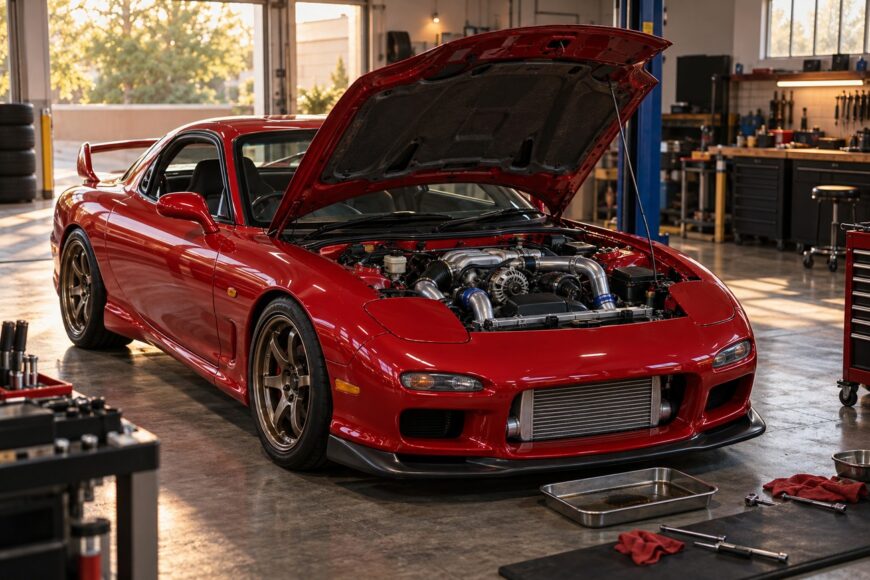
The Mazda RX-7 FD has a reputation for fragile engines, while experienced owners often say a properly maintained car can be dependable. Both views contain part of the truth. The FD’s twin-rotor, turbocharged 13B-REW demands stricter control of heat, lubrication, ignition, and tuning than many conventional engines, so neglect can turn a usable car into an expensive rebuild project.
A clean body and a strong test drive cannot reliably establish compression, seal condition, cooling performance, or the quality of previous modifications. A car with an unknown history may look excellent while carrying damage from overheating, poor calibration, or incorrect servicing. Reliability should therefore be judged through evidence and operating condition, rather than through either a blanket warning about rotary engines or a seller’s assurance that the car is “reliable if maintained.”
- Is the RX-7 FD rotary actually unreliable?
- Heat, oil, and boost: what puts the engine at risk
- Why a strong pull is not proof of a healthy rotary
- The hidden costs behind a clean-looking FD
- Before you buy: evidence that matters more than a seller’s claims
- FD warning signs: what to check before blaming the seals
- Frequently asked questions
- What is the typical lifespan of an FD rotary engine?
- How reliable is an FD RX-7?
- What is the typical lifespan of a Mazda rotary engine?
Is the RX-7 FD rotary actually unreliable?
The FD uses the twin-rotor, turbocharged 13B-REW. Its rotary design has different lubrication, sealing, and heat-management demands from a piston engine, so reliability depends heavily on how those demands are handled. A well-maintained FD can be predictable, but that does not make it tolerant of neglected cooling systems, poor tuning, or careless use.
Some characteristics that alarm first-time owners are normal for a rotary. The factory oil-metering system supplies oil for lubrication, and some oil consumption is expected. Rotary compression also requires its own testing method, so a number copied from a conventional compression test may create false confidence or unnecessary concern.
The serious risk comes from accumulated heat, inadequate lubrication, detonation, a lean mixture, or long-term seal wear. Overheating can damage an engine that previously ran well, while extra boost can expose weaknesses in fueling, ignition, and calibration. Unknown history, overheating, and poor tuning increase the risk of a costly rebuild.
There is no universal mileage point at which every FD rotary fails. Condition, maintenance, modifications, and previous thermal stress matter more than a countdown. Treat reliability as a record-and-inspection issue, especially when the car has changed hands repeatedly or carries undocumented engine work.
Heat, oil, and boost: what puts the engine at risk
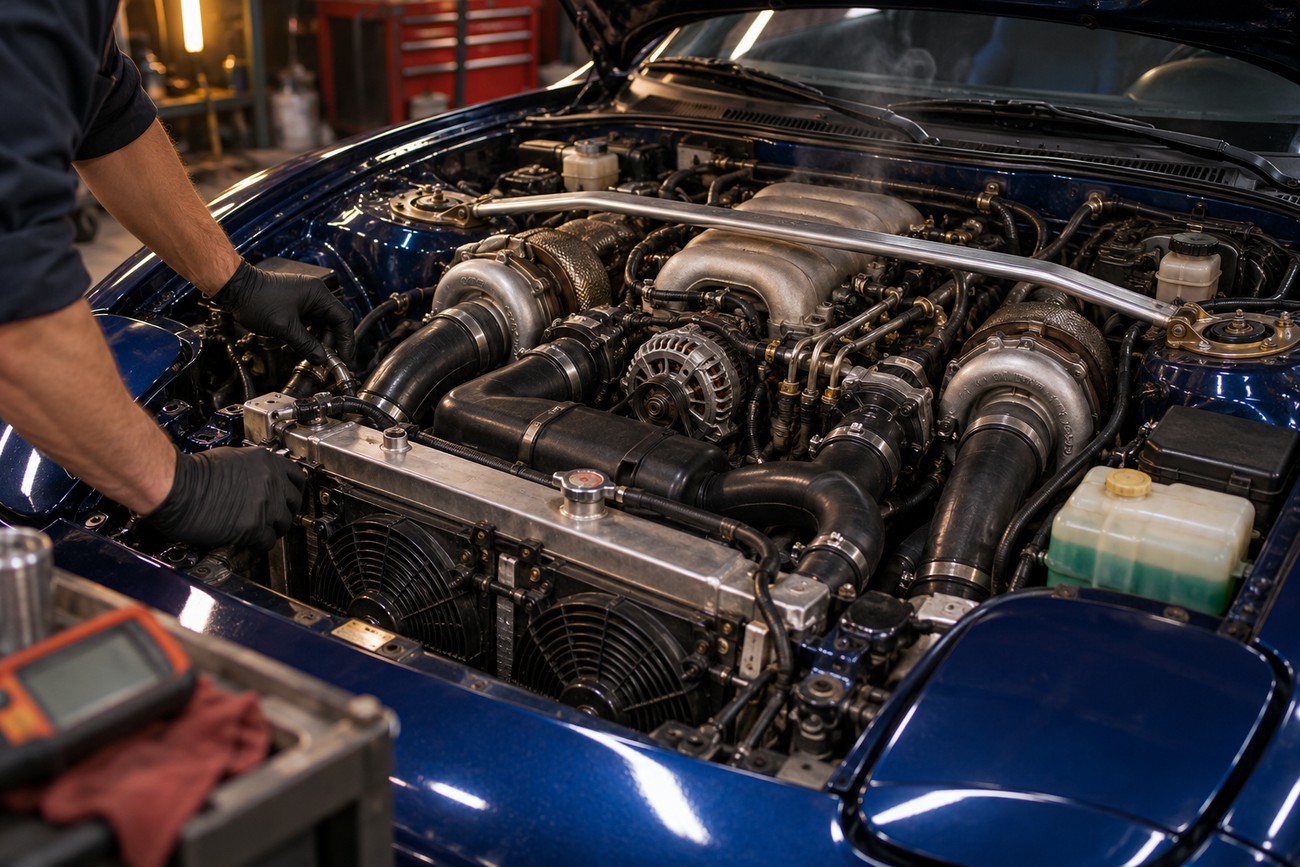
Temperature control is central to FD ownership. If the temperature rises in traffic, the cooling system, radiator condition, fans, airflow, and coolant circuit deserve attention before the problem is dismissed as a normal rotary trait. Repeated overheating increases thermal stress on the housings, seals, and related components.
The 13B-REW depends on metered oil for lubrication, so the factory oil-metering system is an operating system rather than decorative equipment. Some oil consumption is expected, and routine checks help you identify a change from the car’s usual pattern. A sudden increase, especially alongside smoke or other running changes, warrants investigation.
Cold engine parts and seals should not be subjected immediately to hard acceleration or high load. A gentle drive after startup allows the car to come up to operating condition under controlled demand. After hard use, a sensible cool-down period reduces the heat soak associated with switching off a very hot turbocharged engine immediately.
Higher boost requires appropriate fueling, ignition, temperature control, and calibration. Better oil alone cannot prevent overheating, detonation, or a lean mixture. An apparently successful boost increase may still leave little margin if the fuel system, sensors, ignition components, or engine management have not been matched to it.
Many dependable FD owners achieve consistency through discipline rather than exotic parts: checking oil, watching temperature, maintaining ignition components, verifying vacuum plumbing, and investigating small changes early. This approach cannot guarantee a particular engine lifespan, but it can prevent minor faults from becoming major thermal or lubrication failures.
Why a strong pull is not proof of a healthy rotary
An FD can feel fast even when its seal condition is declining. Turbocharged power may mask a developing loss of compression, and a short drive may not reproduce a difficult hot start, an intermittent misfire, or a problem that appears only after heat builds in the engine bay.
Assess both cold and hot starts. A long cold crank or a hot restart problem can reflect compression loss, but ignition faults, worn plugs, weak coils, or flooding can produce similar symptoms. Starting behavior is useful evidence, not a standalone diagnosis.
Rotary compression should be recorded chamber by chamber for both rotors under a consistent test method. The useful result is the pattern and stability across the readings, rather than one headline number presented as proof that the engine is healthy.
Arrange a rotary-specific compression test and compare the readings across the chambers of both rotors. Uneven or unstable results deserve closer investigation, while a single apparently good figure cannot establish future reliability. There is no universal pass-or-fail number that can replace the correct equipment, method, and interpretation.
The hidden costs behind a clean-looking FD
Age-related faults can make an FD difficult to diagnose even when its core engine is intact. Vacuum lines can leak, electrical connections can deteriorate, and ignition components can cause rough running or hard starting. These faults may imitate seal or compression problems and can also undermine a modified engine’s calibration.
Cooling problems deserve equal attention. Restricted airflow, tired fans, neglected radiators, or an unclear cooling-system history can allow temperature to rise during traffic or repeated hard driving. A clean engine bay does not prove that the system performs correctly under load.
A sound rotary rebuild requires rotary-specific expertise, equipment, and parts knowledge. It is not interchangeable with routine piston-engine work, and a “fresh rebuild” claim should be supported by invoices, parts details, photographs where available, and test records. Even good paperwork supports a current inspection; it does not replace one.
Smoke after the car has been sitting can indicate oil accumulation or seal-related problems, but it is not automatic proof of failed apex seals. Likewise, some oil use is expected from this engine. A change from the car’s usual consumption, persistent smoke, or a new running fault should prompt systematic testing rather than an immediate diagnosis.
Before you buy: evidence that matters more than a seller’s claims
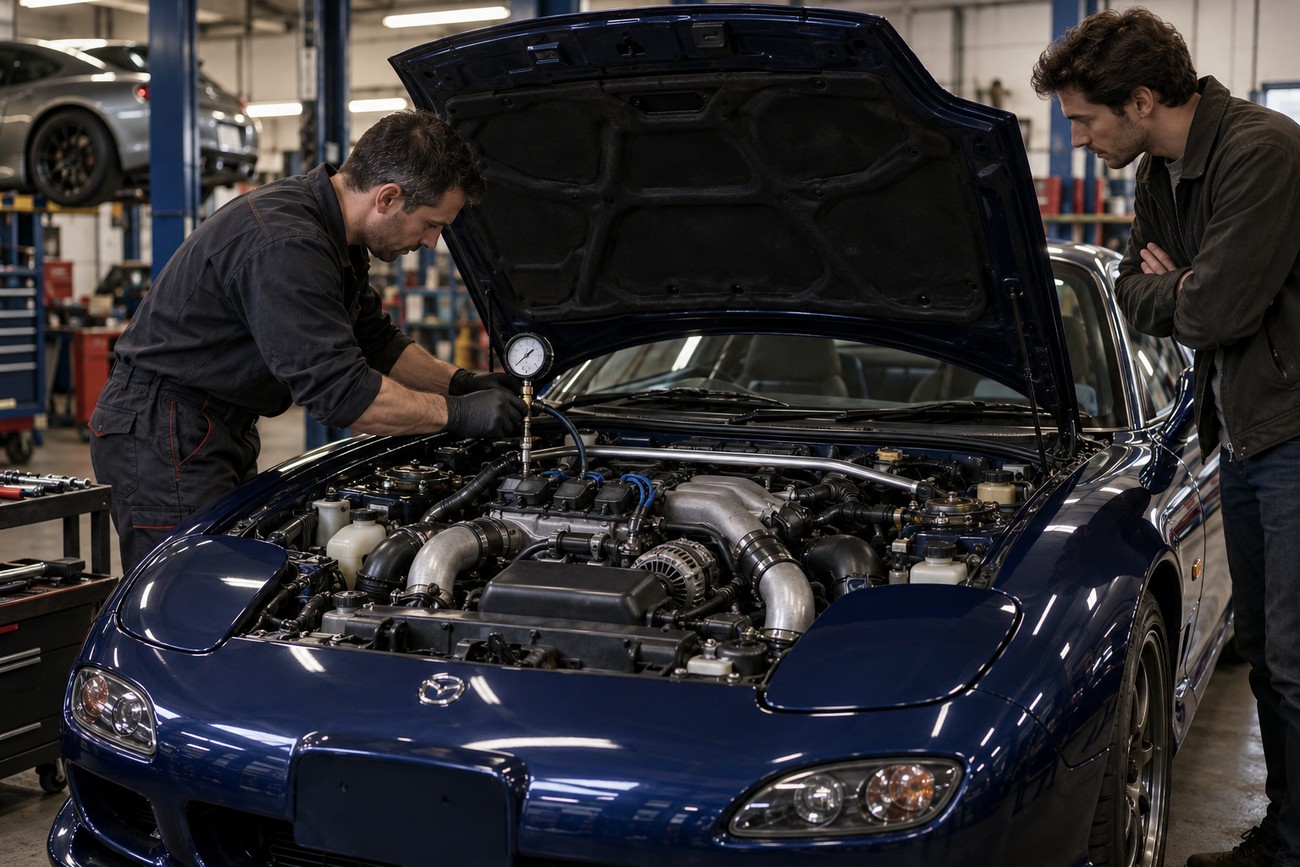
Start with an unassisted cold inspection. The car should be observed from a genuinely cold state, with the starting behavior, idle quality, smoke, warning lights, and initial noises recorded. Then assess a fully warm restart, because a car that starts acceptably cold may reveal a weakness once heat has accumulated.
Arrange a documented rotary-specific compression test performed under a consistent method. The report should identify readings across the chambers of both rotors, rather than offering only a vague statement that “compression is good.” Compare those results with the starting behavior and the engine’s service history.
Inspect the cooling system, ignition components, vacuum plumbing, oil-metering system, and evidence of tuning changes. Ask how boost was altered, how fueling and ignition were calibrated, and whether the car has suffered overheating or detonation. A swapped or modified FD may also have an unclear parts specification, which can complicate future servicing.
Request rebuild invoices, parts details, photographs, and previous test records. A claimed fresh rebuild needs supporting records and a current condition check. If the seller will not permit sensible inspection, if the history is contradictory, or if the car shows overheating and poor tuning together, budget for specialist work or walk away rather than treating the purchase price as the full cost.
FD warning signs: what to check before blaming the seals
These symptoms can have several causes. Use them to choose the next inspection or test, rather than treating any single sign as a conclusive diagnosis.
| Symptom | Plausible causes | Sensible first checks |
|---|---|---|
| Hard cold or hot starting | Compression loss, weak plugs or coils, flooding, fuel delivery faults, or ignition timing problems | Observe both cold and hot starts; inspect plugs and coils, check for flooding, and arrange a rotary-specific compression test |
| Smoke after sitting or after startup | Oil accumulation, seal wear, lubrication-system issues, or another oil-control fault | Record when the smoke appears, check oil level and consumption history, and inspect the engine before assuming failed apex seals |
| Temperature rising in traffic | Cooling-system restriction, weak fans, poor airflow, low coolant, or previous overheating damage | Check coolant condition and level, radiator and fan operation, airflow, and temperature behavior under controlled conditions |
| Oil use increasing from the car’s normal pattern | Expected metered oil use combined with a developing leak, seal issue, or lubrication-system fault | Track the change, inspect for leaks and smoke, verify the oil-metering system, and seek specialist diagnosis |
| Misfires or rough idle after tuning | Vacuum leaks, inadequate fueling, weak ignition, poor calibration, detonation damage, or a lean mixture | Inspect vacuum plumbing, plugs, coils, fuel delivery, engine-management data, and the modification history before increasing boost further |
Frequently asked questions
The questions below focus on lifespan and day-to-day reliability. In each case, the individual car’s condition and history matter more than a general reputation.
What is the typical lifespan of an FD rotary engine?
There is no defensible universal mileage figure for an FD rotary. Lifespan is a condition-and-history question shaped by cooling performance, lubrication, tuning, starting behavior, previous overheating, and the quality of any rebuild.
Assess the current engine with a rotary-specific compression test, cold and hot starts, and service evidence. A lower-mileage car with unknown history may deserve more caution than a well-documented, carefully maintained example with more use.
How reliable is an FD RX-7?
A well-maintained FD can be predictable, but it requires closer attention to temperature, oil metering, ignition, vacuum integrity, and calibration than many conventional sports cars. Reliability becomes substantially less certain when the car has undocumented modifications, overheating history, or poor tuning.
For a buyer, the practical measure is evidence: current test results, consistent starting behavior, cooling-system condition, and records that explain the engine and modifications. No single inspection guarantees future reliability.
What is the typical lifespan of a Mazda rotary engine?
Mazda rotary engines do not share one reliable lifespan figure because design, use, maintenance, calibration, and repair quality vary widely. A modified turbocharged FD engine also faces different thermal and fueling demands from a lightly used, standard car.
Judge the individual engine rather than the badge. Verify lubrication, temperature control, compression balance, ignition condition, and the specification of any swapped or rebuilt parts before making a purchase or repair decision.







