
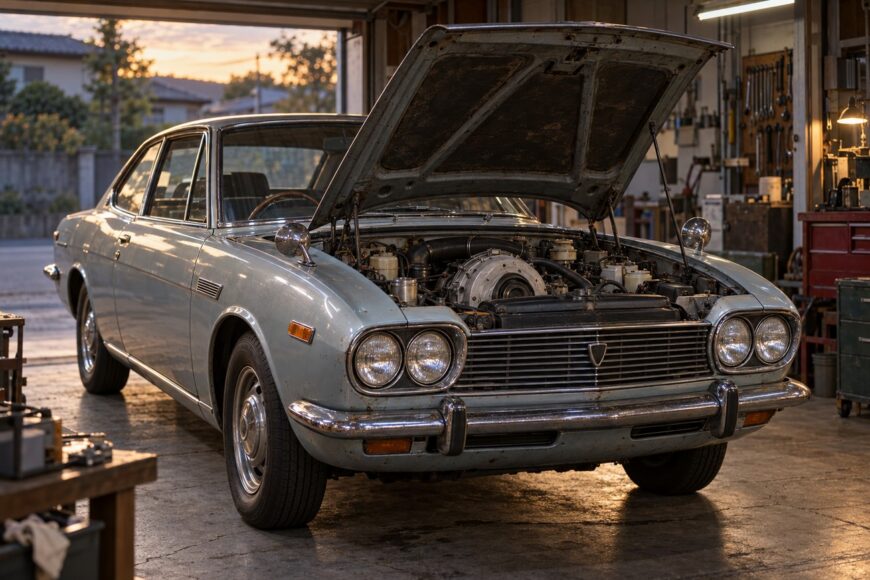
The Mazda R130 Luce Rotary Coupe combined two firsts that still make it unusual: Mazda’s first front-wheel-drive layout and a 13A Wankel engine built specifically for the car. Production ran from 1969 to 1972 and totaled 976 cars. That small run secures its historical importance while making ordinary ownership—finding a carburetor part, repairing a driveshaft, or replacing damaged trim—unusually difficult.
The R130 was more than a Luce sedan fitted with a rotary engine. Its front-drive architecture demanded a different mechanical layout from the rear-wheel-drive Luce, and its two-door body was a distinct design. Factory figures describe an ambitious grand touring coupe; a surviving car must also be judged by the condition and completeness of components for which there may be no straightforward replacement.
- Why the R130 Matters in Mazda History
- The 13A Rotary and the Front-Drive Engineering Gamble
- R130 Factory Specifications: The Numbers with Caveats
- Why Owning a Rare R130 Is Harder Than Buying One
- How to Inspect a R130 Before Buying or Restarting It
- Rarity, Originality, and the Myths Around the R130
- Frequently asked questions
- How many spark plugs does the Mazda 13A rotary use?
- How reliable is the R130’s quoted 0–60 mph time?
- What are the rarest Mazda cars?
- What is the most famous rotary car from Mazda?
- What is the most expensive Mazda ever made?
Why the R130 Matters in Mazda History
Mazda built the R130 during its early effort to establish the rotary engine beyond a single specialist model. Other early rotary Mazdas sent power to the rear wheels. The R130 instead paired its rotary with front-wheel drive, an independent engineering decision that also made it Mazda’s first front-wheel-drive model.
It remained the only production Mazda with a rotary engine and front-wheel drive before the MX-30 R-EV. That distinction describes a specific layout, rather than a direct technical lineage: the later vehicle serves a different purpose. For the R130, the point is that Mazda tried a configuration it did not make standard across its better-known rotary cars.
The coupe’s design is associated with Giorgetto Giugiaro during his Bertone period. Its separate two-door body and front-drive mechanical package make comparisons with an ordinary rear-wheel-drive Luce sedan misleading, even where the family resemblance is apparent. A buyer using sedan assumptions to assess the shell or mechanical parts may overlook precisely what is hardest to replace.
The confirmed total of 976 cars makes the R130 rare without proving that it is Mazda’s rarest car. Production totals alone do not establish how many complete examples survive. They do, however, explain why a seemingly minor missing fitting can become a prolonged search rather than a routine order.
The 13A Rotary and the Front-Drive Engineering Gamble
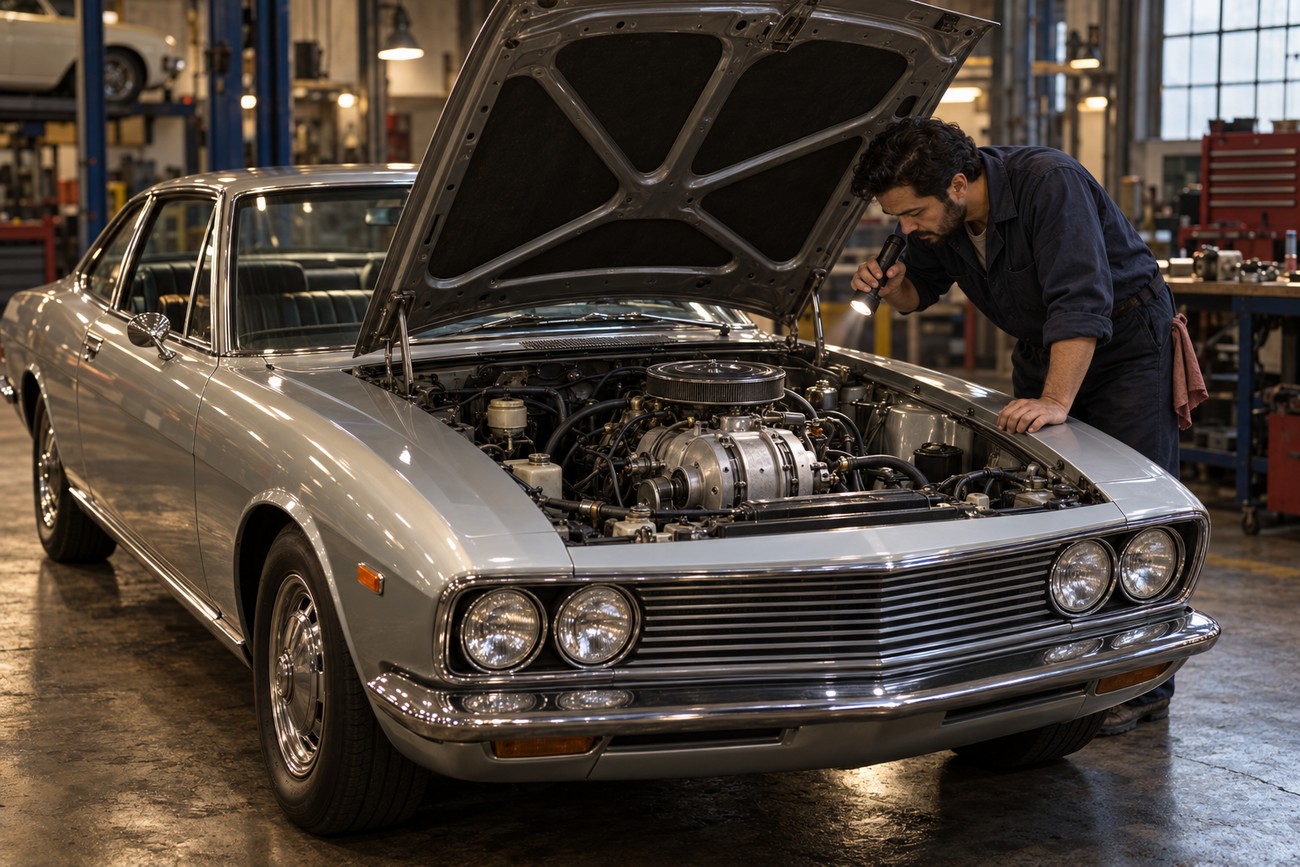
The R130 used the 13A, a two-rotor Wankel engine with a classified displacement of 1310 cm³. Mazda developed the 13A specifically for this coupe and did not use it again in series production. Its designation matters when identifying a car or ordering parts: “Mazda rotary” is too broad a description for this engine.
A rotary’s classified displacement is not directly equivalent to the same stated displacement in a piston engine. The geometry and working cycle differ, so a simple litre-for-litre comparison says little about how either engine delivers its performance. Period comparisons with larger piston engines should be read as claims made for context, rather than as a universal conversion rule.
Front-wheel drive brought the engine, four-speed manual gearbox, and driveshafts into a tight front module. That packaging helped distinguish the coupe from Mazda’s rear-drive rotary models, but it also concentrates several difficult jobs in one area. Access, mountings, and the relationship between the gearbox and driveline matter as much as the engine’s internal condition.
The 13A should not be treated as interchangeable with a 10A, 12A, or 13B merely because all are Mazda rotaries. Mounts, associated equipment, and transmission connections need individual verification before a proposed substitute part is bought or a conversion is planned. An incomplete car can therefore be harder to rescue than an apparently more worn example that retains its correct mechanical assemblies.
This is the R130’s central engineering trade-off in present-day terms. Its unusual layout makes it significant to a historian, while its model-specific engine and compact driveline narrow the pool of useful donor parts. A repair plan should start with what is actually fitted to the car, supported by its numbers and documentation, rather than with assumptions drawn from a more common RX model.
R130 Factory Specifications: The Numbers with Caveats
These published specifications describe the R130, although two commonly cited figures require care when comparing sources or individual cars.
| Item | Published specification |
|---|---|
| Engine | 13A, two-rotor Wankel engine; 1310 cm³ classified displacement |
| Output | 126 PS / 93 kW |
| Torque | 172 N·m at 3500 rpm |
| Transmission | Four-speed manual |
| Suspension | Independent double wishbones at the front; rear beam axle with trailing arms |
| Brakes | Front discs, rear drums, and vacuum assistance |
| Steering | Power-assisted rack-and-pinion steering |
| Published mass | Approximately 1185 kg in Mazda material; 1285 kg in a professional test reference |
| Published top speed | 190 km/h in Mazda material; approximately 119 mph / 191 km/h in a professional reference |
The approximately 1185 kg and 1285 kg mass figures should be kept separate rather than averaged into a new specification. Different methods of stating curb weight are a plausible explanation, but the published figures alone do not establish exactly which equipment or fluids each source counted. That uncertainty matters if weight is used to judge a claimed power-to-weight ratio.
The speed figures present a much smaller disagreement. Mazda’s 190 km/h and the professional reference’s approximately 119 mph / 191 km/h are effectively the same rounded claim, though the test method may also affect a recorded result. Neither figure guarantees that a surviving car, with decades of wear or altered tuning, will reproduce it.
Output of 126 PS / 93 kW and torque of 172 N·m at 3500 rpm give a clearer account of the published engine specification. They remain period figures, not a health report for the example in front of you. Its cooling, ignition, and rotary-specific test results are more useful when deciding whether it is ready to drive.
Why Owning a Rare R130 Is Harder Than Buying One
Parts availability is the first practical divide between admiring an R130 and maintaining one. Components for its 13A, carburetor, ignition system, and front-drive assembly are harder to source than parts for mass-produced RX or Familia models. Trim and model-specific fittings add another problem: a mechanically serviceable car may remain incomplete for want of pieces that no general rotary supplier stocks.
Corrosion deserves at least as much attention as the engine. Rust in the sills, arches, floors, or pillars can require structural work on a body with a narrow donor base. Fresh paint may conceal repairs or missing metal, so the cost of making a shell sound can outweigh the apparent benefit of buying the most presentable car.
Finding someone who understands both an early rotary and this front-drive arrangement can be harder than identifying the failed component. A specialist familiar with a later rear-drive RX may still need to establish how the R130’s mounts, ancillaries, and driveline fit together. Allow time for diagnosis and parts research; replacing items by resemblance is a poor substitute for checking fit and specification.
Documentation can be uneven as well. Incomplete histories, market-specific catalogs, and differing part numbers mean that a description in one source may not settle what belongs on an individual car. The small surviving population also prevents confident reliability statistics based on ordinary owner reports: a handful of successful journeys or costly rebuilds cannot describe the whole model.
How to Inspect a R130 Before Buying or Restarting It
Begin with the shell and the car’s completeness, rather than its paint or a brief demonstration run. Check body geometry, structural corrosion, and evidence of previous repairs before assigning value to cosmetic finish. A sound-looking coupe with compromised sills or pillars can be a larger project than a faded but structurally intact one.
Record what remains original or at least correct for the car. The carburetor, gearbox, instruments, trim, and front-suspension components materially support collector value, while missing pieces may be difficult to identify and harder to source. Compare fitted parts with the car’s records where possible, allowing for differences between market catalogs rather than treating one printed number as conclusive.
A stored rotary that starts on a fresh battery and idles briefly has demonstrated little about its roadworthiness. Verify the cooling, ignition, carburetion, seals, and rotary-specific compression readings before treating that start as evidence of engine health.
A conventional piston-engine compression test is insufficient for diagnosing the 13A. Use a procedure designed to capture the appropriate rotary chamber readings, with engine speed and temperature recorded so the results can be interpreted meaningfully. An unexplained set of numbers, even from a seller acting in good faith, is a weak basis for a purchase decision.
Long storage calls for inspection before sustained running: seals, carburetor passages, spark plugs, wiring, and the cooling system may all need attention. Once repairs are complete, continue to watch operating temperature, oil quality, ignition, and cooling rather than focusing solely on whether the engine reaches its advertised output. Those fundamentals determine whether an old Wankel can be used responsibly.
Rarity, Originality, and the Myths Around the R130
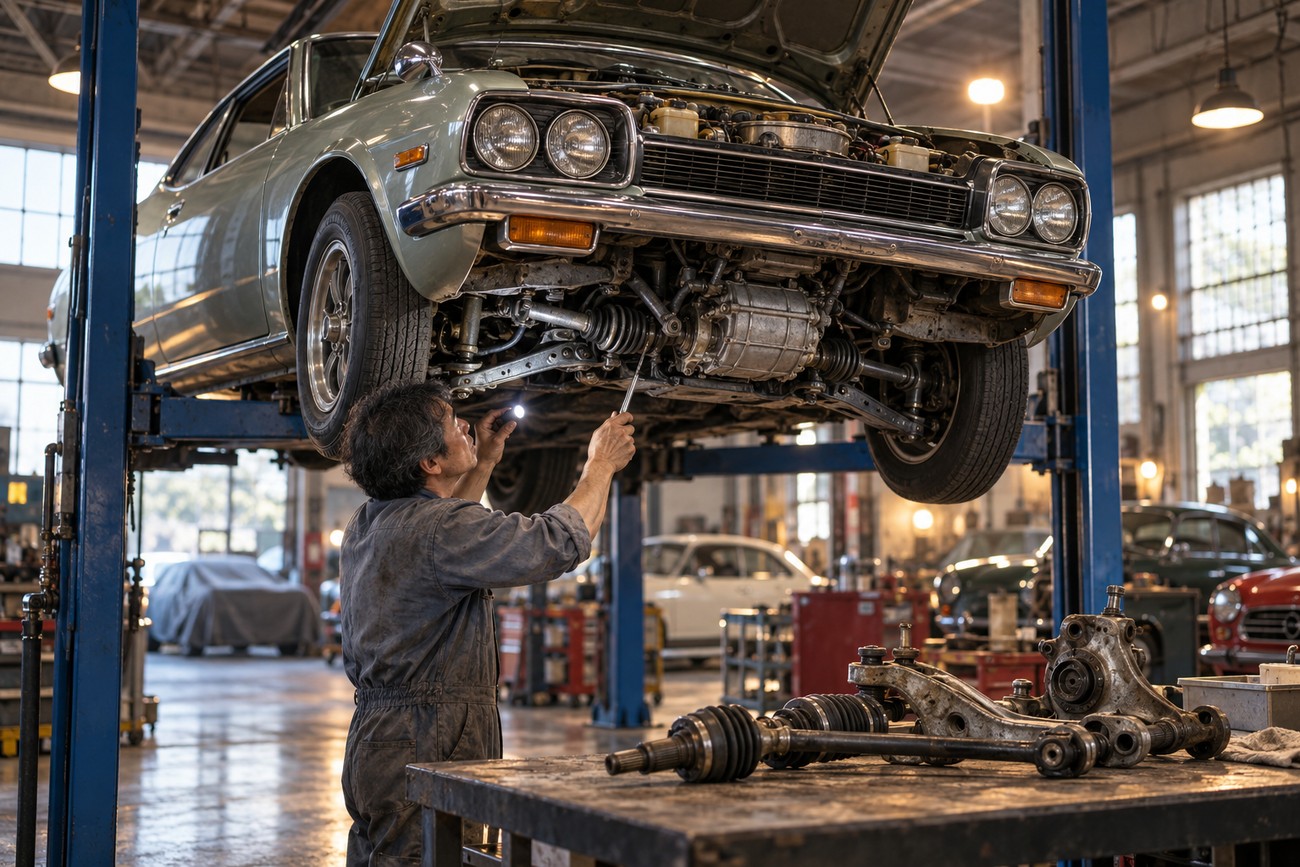
Calling the R130 a Luce with a rotary engine misses the extent of its mechanical departure. Ordinary Luce models used rear-wheel drive; the coupe’s front-wheel-drive layout changed the powertrain arrangement and the parts needed to maintain it. That difference explains both its place in Mazda history and the risks of assuming a conventional Luce will supply every missing component.
Another oversimplification gives every R130 an identical mass and expected performance. Published weight figures differ by about 100 kg, likely because of measurement methods, while the quoted top speeds differ only slightly. The commonly quoted 0–60 mph time of 8.3 seconds is a period performance claim, not a result independently established across today’s surviving cars.
A production total of 976 cars signals a narrow donor base, not ready access to spares. In particular, the 13A’s lack of another series-production application limits the value of assuming that plentiful rotary parts will fit. Rarity can increase interest in a car while simultaneously making an apparently modest repair difficult to finish.
For a collector, a running car assembled from mismatched or substitute components may be less compelling than a complete original example awaiting careful mechanical work. Correct carburetor, gearbox, instruments, trim, and front-suspension parts preserve evidence of what Mazda built. Their presence does not remove restoration risk, but it gives a buyer a firmer starting point than cosmetic presentation alone.
Frequently asked questions
How many spark plugs does the Mazda 13A rotary use?
The 13A uses two spark plugs per working chamber. Replacing the plugs alone may therefore leave an ignition fault unresolved if the related leads, connections, or other ignition components are deteriorated. Diagnosis should consider the complete system before poor running is attributed to internal rotor wear.
How reliable is the R130’s quoted 0–60 mph time?
The commonly quoted 0–60 mph time is 8.3 seconds, but it should be treated as a period reference rather than a dependable prediction for a surviving R130. There is no broad, independent test sample of present-day cars to show how consistently they achieve it; condition, tune, and measurement method all matter.
What are the rarest Mazda cars?
The R130 belongs in a discussion of rare series-production Mazdas because its documented run was 976 cars. An absolute ranking is harder to defend: limited-production road cars, competition vehicles, and prototypes are different categories, and a build total is not the same as a verified survivor count. The early Cosmo Sport is another historically significant, low-volume Mazda, but those distinctions should be stated before calling any one model the rarest.
What is the most famous rotary car from Mazda?
The RX-7 is Mazda’s best-known rotary road-car nameplate, with recognition extending well beyond specialist collectors. The 787B is especially famous in motor racing. The R130 has a narrower audience, though its front-wheel-drive layout gives it a distinctive place in the company’s rotary history.
What is the most expensive Mazda ever made?
There is no single dependable answer without defining whether “most expensive” means original development cost, original sale price, or a verified resale price. A purpose-built racer such as the 787B cannot be compared directly with a production road car on a showroom-price basis, while collectible-car sale records change. The R130’s rarity alone is not evidence that it holds a Mazda price record.







