
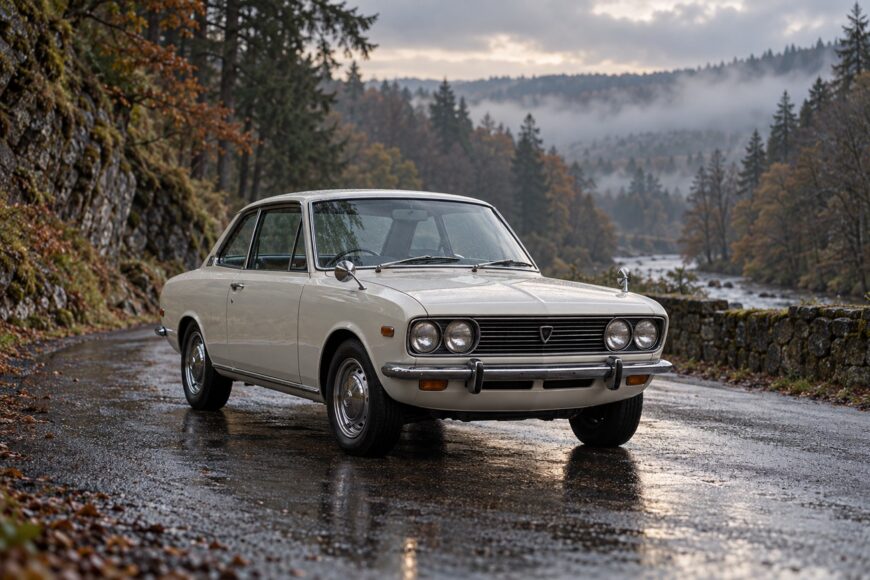
A modest road-going rotary coupe produced one of Mazda’s striking early endurance results: two R100s finished fifth and sixth in the 1969 Spa 24 Hours. The achievement deserves its place in racing history, although figures quoted for the Spa cars can give a misleading impression of the coupe a buyer might find today.
The production R100 had its own appeal: a light body, an unusual engine, and a direct link to Mazda’s first years of rotary competition. Living with one also means taking fuel use, engine condition, and scarce parts seriously. Appreciating the car requires keeping the showroom coupe and the race-prepared entries distinct.
- From Familia Rotary Coupe to Mazda R100
- What the road-going R100 actually delivered
- Spa 1969: three entries and two remarkable finishes
- What Spa proved—and what it did not
- The ownership costs hidden by the racing legend
- How to judge an R100 before buying
- Frequently asked questions
- What is Mazda’s best-known rotary car?
- How can I verify a car advertised as an R100?
- What would substantiate a claimed link to a Spa race car?
From Familia Rotary Coupe to Mazda R100
The Mazda R100 was an export name for the Familia Rotary Coupe, introduced in 1968. Its significance lies partly in the car Mazda chose for the engine. Where the Cosmo presented rotary power in a more exotic package, the Familia put it into a smaller, simpler coupe with broader everyday appeal.
Under the hood was a 982 cm³ twin-rotor Wankel. Its rotors and combustion chambers worked differently from the pistons and cylinders of a conventional engine, so the displacement figure is not directly comparable with that of a one-liter piston engine. Treating “982 cm³” as a complete description of its performance or fuel needs misses much of the R100’s character.
The coupe made Mazda’s rotary program visible beyond a specialist sports car. Its familiar small-car layout gave drivers a way to experience an engine that was still unusual on public roads, while giving Mazda a production model with which to build its reputation.
Production estimates of around 95,800 cars across 1968–1973 appear in model histories, although that figure should not be treated as a confirmed factory total without supporting records. For someone assessing a surviving car, its identity, condition, and documented history are more useful than an uncertain aggregate number.
What the road-going R100 actually delivered
The standard road engine was rated at 100 bhp at 7,000 rpm and 98 lb·ft at 3,500 rpm. That output gave the small coupe respectable period performance, especially when the driver used the upper part of the rev range. It did not make a showroom R100 equivalent to Mazda’s Spa entries.
Reported figures put weight at approximately 803 kg, 0–60 mph at 10.9 seconds, and top speed at approximately 108 mph. Those numbers describe a lively late-1960s small coupe rather than effortless acceleration at any speed. A driver expecting strong low-rev pull from a similarly sized piston car may find the rotary’s delivery unfamiliar.
The mechanical layout remained straightforward: a four-speed manual and rear-wheel drive, front disc and rear drum brakes, front MacPherson struts, and a leaf-sprung rear axle. The light body and eager engine help explain the R100’s appeal, while its suspension and brakes place it firmly in its era. Smooth running at high rpm should not be mistaken for modern refinement throughout the car.
Displacement is also a poor guide to fuel consumption. Owners commonly report using more fuel than they expected from a 982 cm³ badge, particularly when driving in the rev range where the engine feels most responsive. Anyone budgeting for an R100 should judge it as an early rotary coupe, not as an economy car with a nominally small engine.
Spa 1969: three entries and two remarkable finishes
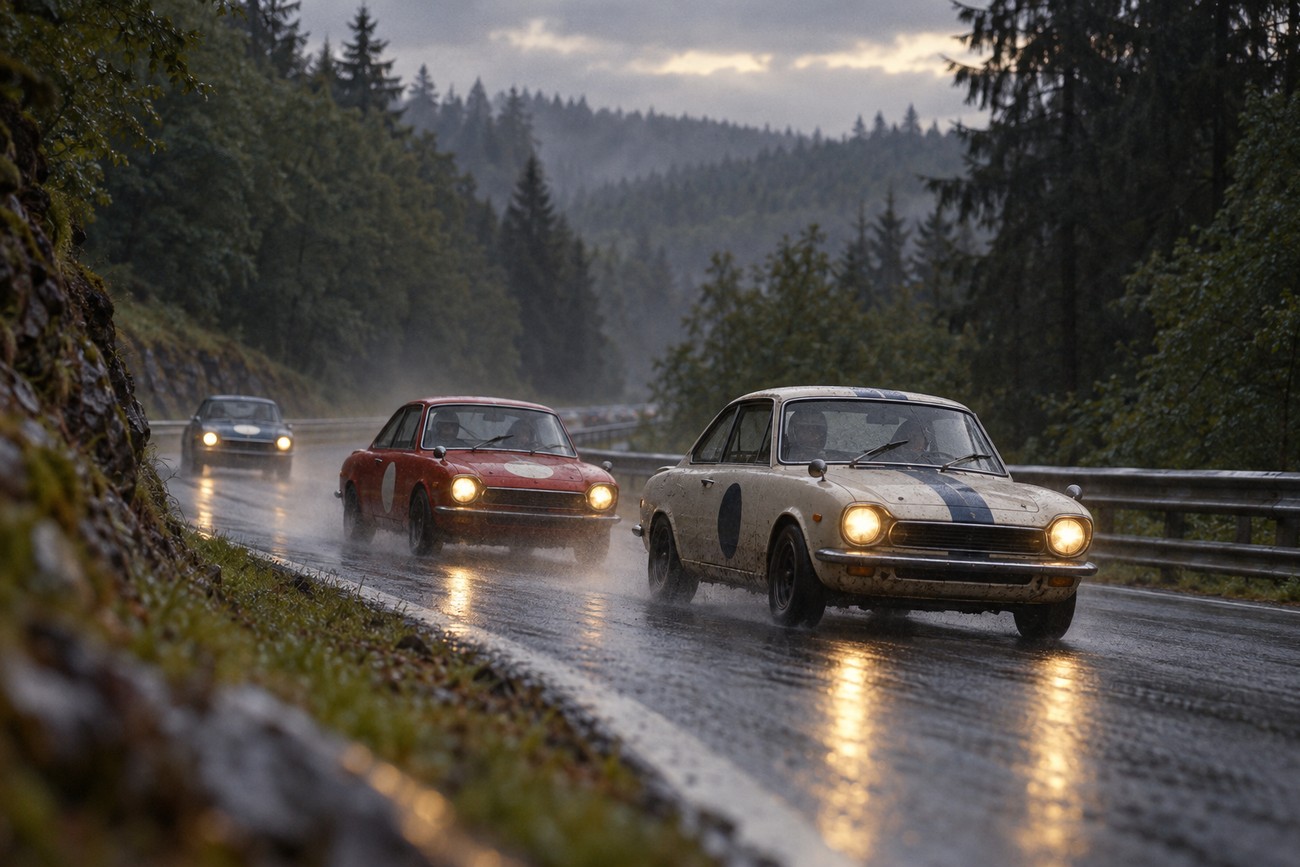
Mazda entered three R100s in the 1969 Spa 24 Hours. The race-prepared cars were reported to produce 200 bhp at 9,000 rpm, a substantial change from the road car’s 100 bhp at 7,000 rpm. That distinction matters whenever the Spa result is used to describe how a standard R100 drives.
Two of the three cars finished fifth and sixth. Against a field that included Porsche, BMW, Lancia, NSU, Mini, and Alfa Romeo machinery, getting both cars to the end of a 24-hour race and placing them so high was a meaningful result. Mazda did not win the event, and the finishing positions need no embellishment.
The third R100 retired after an accident in which driver Léon Dernier died. His death is part of the account of that race and should not be reduced to a footnote in a story about engine durability. It also means the outcome cannot be described simply as three successful entries.
Spa gave Mazda an opportunity to test its developing rotary technology over sustained competition distance. The fifth- and sixth-place finishes showed what carefully prepared R100s could achieve under those conditions. They say far less about the specification, maintenance demands, or provenance of any road coupe that survives today.
What Spa proved—and what it did not
Two of Mazda’s three R100 entries finishing the 1969 Spa 24 Hours in fifth and sixth provided evidence that its early rotary engine could withstand an endurance contest in competitive form. This went beyond demonstrating a burst of speed. Running long enough to earn those places was central to the achievement.
The result also carried weight because the R100 belonged to a smaller, simpler production coupe than the Cosmo. Mazda was developing the rotary for a car with a wider potential audience, then taking that model into demanding competition. The connection made the engineering effort relevant to more than a single exotic flagship.
Spa did not turn the production R100 into a 200 bhp car. That reported output at 9,000 rpm belonged to the race-prepared entries; the road specification was 100 bhp at 7,000 rpm. A surviving street car shares their model lineage, but only documentary evidence could establish that an individual chassis raced there.
Period accounts also drew attention to the rotaries’ conspicuous noise. It is a useful detail of how those cars were experienced at the circuit, though sound alone proves nothing about power or reliability. The lasting measure of the effort remains the recorded finishes, considered alongside the loss of Dernier.
The ownership costs hidden by the racing legend
The R100’s small displacement can make ordinary running costs easy to underestimate. Owners commonly report fuel consumption higher than the 982 cm³ figure suggests, and the engine invites revs when the road opens up. A buyer comparing it with a conventional small-capacity coupe should allow for that difference before judging whether regular use is realistic.
Rotor sealing and compression deserve particular attention as these cars age. Wear can have substantial consequences for how an engine starts and runs, while competent rotary repair may be harder to arrange than work on a familiar piston engine. A car that still moves under its own power has not thereby demonstrated that its engine is healthy.
Running faults need careful diagnosis, however. Carburetor condition and ignition settings also affect an early rotary’s response and consistency, so rough running alone does not identify a failed rotor seal. Maintenance records and a specialist assessment give more context than a brief drive or a seller’s assurance that the engine has always sounded the same.
Original parts present another constraint. Body panels, trim, and some brake components may require patient searching, while past modifications can complicate identification and repairs. The race story makes an R100 desirable; the practical ownership experience depends heavily on the completeness and condition of the particular car.
How to judge an R100 before buying
Start with identity and history. Compare the car’s chassis identification with its paperwork, establish whether its Familia or R100 designation fits its market, and ask what has been changed. A modified car can still be worthwhile, but undocumented engine, brake, or body alterations make its condition and originality harder to assess.
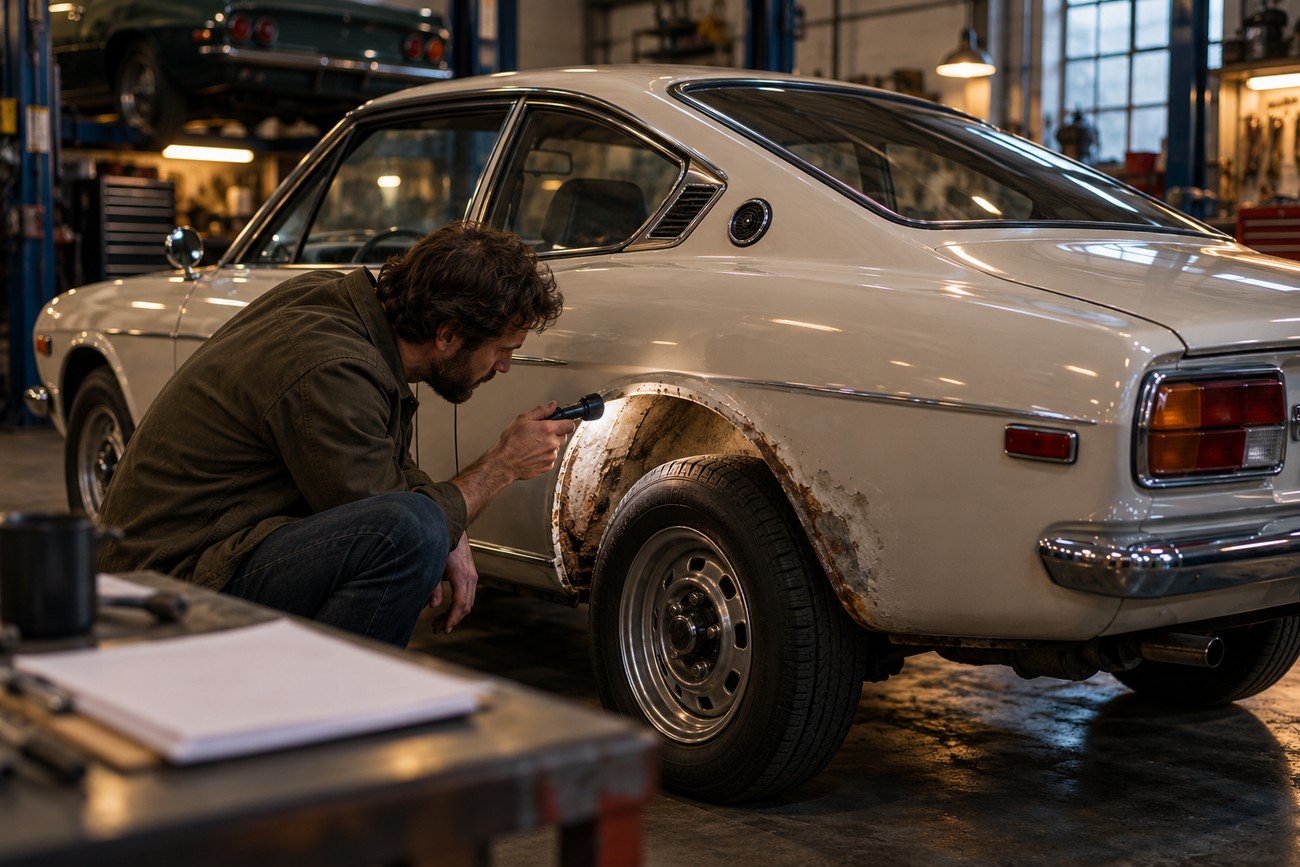
Inspect the body before becoming absorbed in a power claim. Corrosion and old repairs need close examination, especially where missing original panels or trim would be difficult to replace. An apparently inexpensive project can demand extensive work before its mechanical condition even becomes the main concern.
Warm, smooth running on a short drive cannot replace a rotary-specific compression check. Pair that check with a close inspection of corrosion and undocumented changes; each can conceal a different, substantial problem.
Then arrange running and compression checks with someone familiar with rotary engines, and read the findings alongside maintenance records. No single reading establishes the whole engine’s condition, and a test is most useful when its method and results are documented. Check cold and warm behavior, as well as the condition of the carburetor and ignition system.
Finally, keep claims of Spa specification separate from claims of Spa provenance. A standard R100 was a 100 bhp road car; a period-inspired build or an advertised 200 bhp figure does not make it one of the 1969 race cars. Its genuine historical connection is to the model Mazda raced, unless records establish more.
Frequently asked questions
The R100’s place in Mazda history is clearer when recognition, identity, and race provenance are treated as separate matters. A familiar model name does not authenticate an individual car. The checks below address those distinctions directly.
What is Mazda’s best-known rotary car?
The RX-7 is generally Mazda’s more widely recognized rotary model. The R100 has a different claim to importance: introduced in 1968 as the export-market name for the Familia Rotary Coupe, it helped bring Mazda’s rotary engine into a smaller production car before the RX-7 era. Popularity and historical priority measure different things.
How can I verify a car advertised as an R100?
Reconcile the chassis identification and registration paperwork with the car itself, then check whether its Familia or R100 badging suits its original market. “R100” was an export name, so a different badge is not automatically evidence against the car. Conversely, badges and a seller’s description cannot establish identity if the records or chassis details disagree.
What would substantiate a claimed link to a Spa race car?
A claim that a particular chassis raced at Spa needs credible competition-history records and identification evidence connecting that car to the 1969 entries. Period photographs, race documentation, and subsequent ownership evidence may help establish that chain when they can be matched reliably. Similar appearance, rotary power, or a claimed 200 bhp output can suggest a Spa-style build, not establish race-car provenance.







