
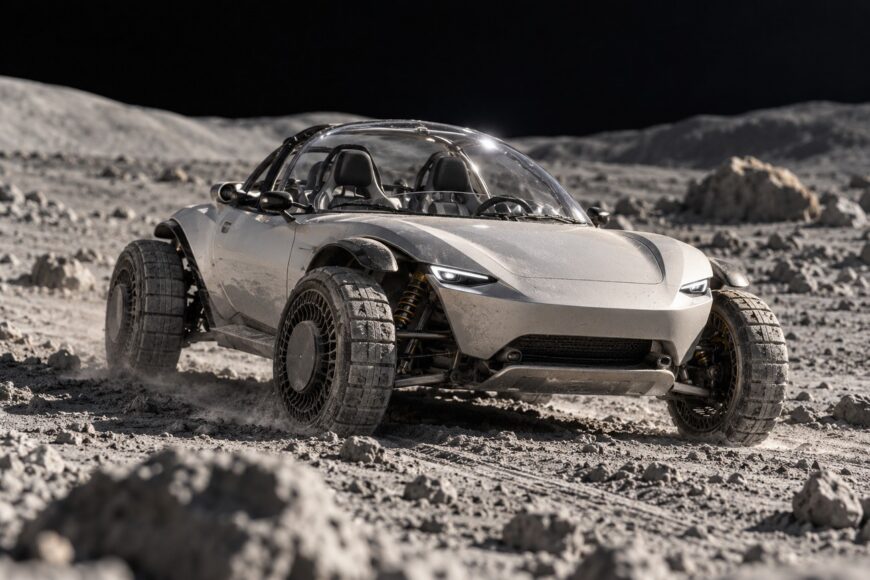
A lightweight Mazda MX-5 Miata on a lunar starting grid has an immediate visual logic: a compact rear-drive roadster, a manual gearbox, and very little mass to carry across the surface. The Lunar Grand Prix, however, is a hypothetical thought experiment. Mazda has not announced a lunar MX-5 or a race program, and no official lunar performance or conversion specifications exist.
Lower gravity would reduce the car’s weight, yet it would leave its mass and inertia unchanged. The tires would carry less normal load, aerodynamic downforce would disappear in the vacuum, and the gasoline engine would face problems that a sealed cabin cannot solve. A lap could become slower, less predictable, or impossible before outright speed became the main issue.
The useful question is therefore one of engineering suitability. The road-going Miata provides a clear reference point for examining mass, traction, propulsion, thermal management, dust protection, and packaging. It does not provide evidence that those systems would work on lunar regolith.
- The road-going Miata behind the lunar thought experiment
- Low gravity makes it lighter, not easier to corner
- Earth-road MX-5 versus lunar race demands
- Why a stock MX-5 cannot race in a vacuum
- What a lunar Miata build would have to give up
- The packaging problem hidden inside a lightweight roadster
- Frequently asked questions
- What year to avoid Mazda MX-5?
- Which Miata is the lightest?
The road-going Miata behind the lunar thought experiment
The 2026 MX-5 Miata uses a naturally aspirated 2.0-liter four-cylinder rated at 181 hp and 151 lb-ft (205 N·m), with a 7,500-rpm redline. That power arrives without turbocharging, so the engine’s character depends on revs and gearing, while the car’s low curb weight shapes how responsive it feels. On Earth, this combination helps explain why the Miata can feel responsive without producing sports-car power figures.
A six-speed manual is standard, while an available six-speed automatic adds a manual mode. The manual car weighs 2,366 lb (approximately 1,073 kg), and the automatic weighs 2,405 lb (approximately 1,091 kg). Those figures make the manual the lighter starting point within the current lineup, although they describe a road car with road-car systems and equipment.
The engine sits in a front-midship layout and drives the rear wheels. That arrangement keeps the powertrain’s mass relatively close to the center of the chassis and gives the rear tires the job of converting engine torque into forward motion. It is an appealing basis for a thought experiment because the layout is simple to describe and its compromises are visible from the driver’s seat.
Claims that the Miata has an exact 50:50 weight split overstate the specification. Mazda specifies a 53:47 distribution. That balance is a property of the production vehicle in its intended configuration; lunar hardware, protective structures, support equipment, or ballast would change it.
Low gravity makes it lighter, not easier to corner
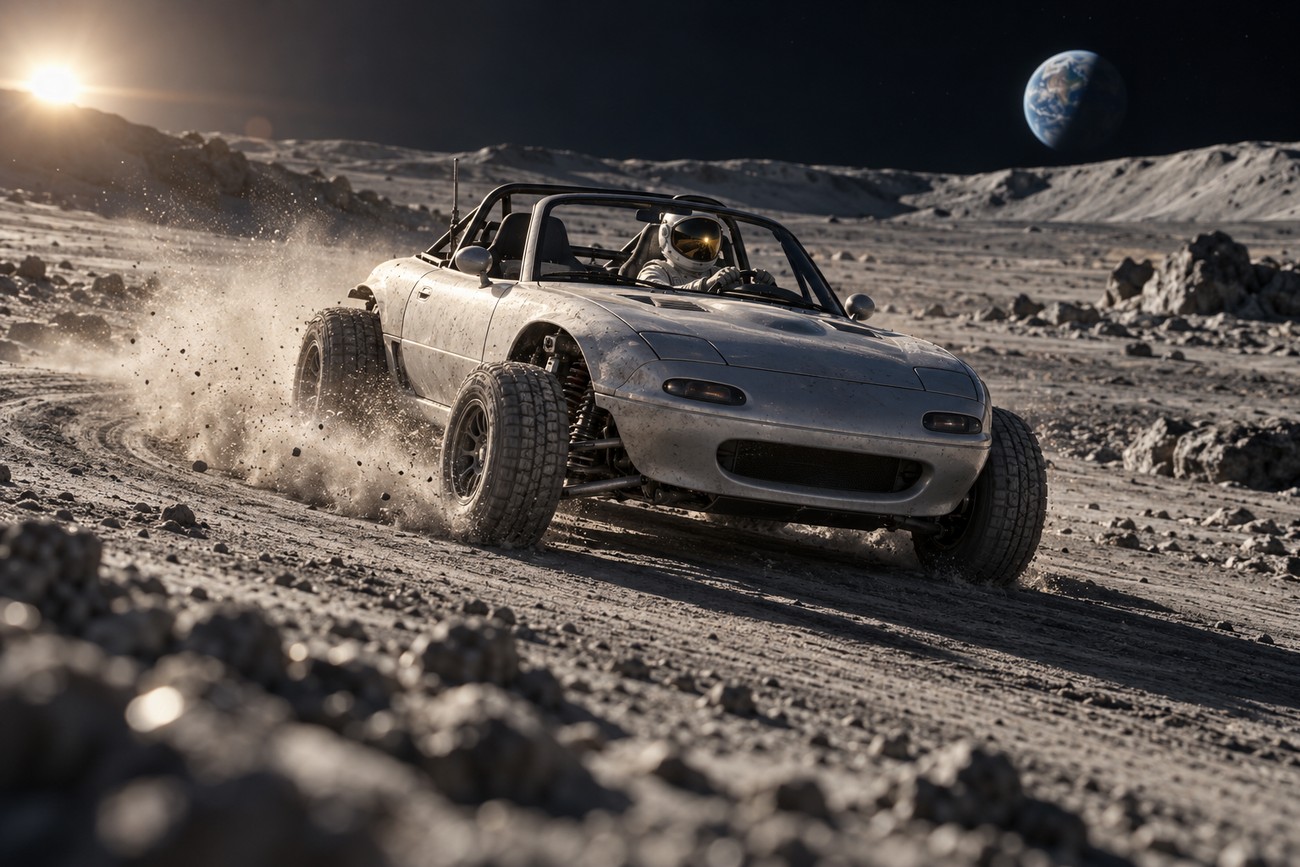
Lunar gravity is approximately 1.62 m/s², roughly one-sixth of Earth’s. The Miata’s mass would remain the same, so its inertia would also remain unchanged. Its weight would fall accordingly, which changes how strongly the tires are pressed into the surface and how much force the suspension must support.
That distinction matters during every maneuver. A car with unchanged mass still resists acceleration, braking, and a change in direction, while the reduced normal load limits the force available at the tire contact patches. The result is not a simple sixfold improvement in acceleration or cornering.
Braking would expose the same problem in reverse. The vehicle would have less gravitational load helping the tires develop friction against the surface, while its inertia would continue to carry it forward. Regolith could add another variable through its loose, abrasive, and mechanically unfamiliar surface behavior. MX-5 tire behavior on lunar regolith has not been validated.
Cornering would become a balance between low vertical loading and unchanged inertial demand. Earth tire friction data cannot be assumed to describe a road tire working on lunar soil, and suspension settings developed for paved roads would provide no guaranteed answer. A low-gravity track could therefore reward careful speed management more than the car’s light road-car feel suggests.
Aerodynamic downforce would be effectively absent in the lunar vacuum. Spoilers and wings that rely on moving air could not replace the lost mechanical loading, so adding road-racing aerodynamic parts would not automatically restore grip. No lap time can be predicted without tested tires, surface data, suspension behavior, and a complete vehicle configuration.
Earth-road MX-5 versus lunar race demands
The production car offers known road specifications, while the lunar side remains an engineering question. The table separates those established characteristics from outcomes that have not been tested.
| System or characteristic | Earth-road MX-5 | Lunar condition | Unresolved engineering requirement |
|---|---|---|---|
| Mass and weight | Mass remains tied to the production configuration and its stated curb weight. | Lunar gravity is approximately 1.62 m/s², roughly one-sixth of Earth’s; weight falls while mass and inertia remain unchanged. | Design the suspension, restraints, and load paths for reduced weight with unchanged inertial loads. |
| Tire grip | Road tires are developed for paved surfaces and Earth loading. | Reduced normal load limits available tire force, and lunar regolith changes the contact surface. | Test tire construction, pressure, tread, suspension, and surface interaction on representative regolith. |
| Propulsion | Naturally aspirated 2.0-liter gasoline engine with 181 hp and 151 lb-ft (205 N·m). | A vacuum provides no atmospheric oxygen for normal engine operation. | Supply an oxidizer and redesign the propulsion system; engine performance remains unknown. |
| Heat rejection | Road-car systems are designed for terrestrial operating conditions. | Conventional atmospheric convection cannot perform its usual role in a vacuum. | Provide a purpose-designed heat-rejection system with tested capacity and durability. |
| Dust protection | Standard seals, filters, joints, and exposed mechanisms serve road use. | Abrasive lunar dust can enter or wear components in ways unverified for the MX-5. | Validate sealing, filtration, lubrication, service access, and component life. |
| Aerodynamic downforce | Road-car aerodynamic devices operate in an atmosphere. | Aerodynamic downforce is effectively absent without an atmosphere. | Develop and test a means of maintaining adequate traction without aerodynamic downforce. |
No official lunar MX-5 figures are available for traction, cooling, sealing, ground clearance, range, reliability, or engine performance. Those gaps are central design unknowns rather than minor specification omissions.
The table also shows why a road-car comparison can become misleading. A familiar engine-output or curb-weight number says little about operation when the surface, atmosphere, cooling path, and wheel loading all change together.
Why a stock MX-5 cannot race in a vacuum
Enclosing the driver would address only one part of the environment. The stock gasoline engine cannot operate normally in a vacuum without an oxidizer supply and a viable heat-rejection system. A sealed cockpit does not provide combustion oxygen, and it does not create a path for rejecting the engine’s waste heat.
Conventional cooling depends heavily on moving air through a radiator and around hot components. In a vacuum, atmospheric convection cannot provide that service, so heat would need to move through a purpose-designed system and ultimately be rejected through suitable radiators or other hardware. The required architecture would affect mass, packaging, power demand, and serviceability.
Sealing a drivetrain against abrasive dust can complicate heat removal and maintenance at the same time. Dust exclusion, lubrication, inspection access, and thermal design must therefore be developed as one system.
Lunar dust creates a second group of risks. Its abrasive character raises questions about standard MX-5 seals, filters, hinges, bearings, exposed joints, and other mechanisms. A new filter or a sealed cabin could protect one area while leaving suspension components, brakes, driveshaft joints, or service interfaces exposed.
Road-oriented ground clearance and suspension settings also cannot be assumed suitable for rocky regolith. The MX-5’s low body and road tires are designed around paved surfaces, while lunar terrain would introduce obstacles, loose material, and unusual wheel loading. No official lunar specifications confirm that the car’s clearance, suspension travel, or underbody protection would survive such use.
What a lunar Miata build would have to give up
A lunar Miata would be a new vehicle architecture built around the MX-5’s compact concept. Propulsion might require an oxidizer-fed engine system, an electric drive system, or another approach, but each possibility would need testing for power delivery, energy storage, thermal behavior, and control on regolith. The road car’s 181-hp specification would not predict the result.
Thermal hardware could become as important as propulsion hardware. Radiators, insulation, heat exchangers, pumps, and protective structures would add mass and occupy space that the roadster has little of. The design would also need to keep sensitive systems serviceable after exposure to dust, vibration, and low-gravity wheel loads.
Low mass remains attractive for transport and deployment, yet low wheel loading can reduce available tire force. A lunar vehicle might need ballast, specialized tires, or another means of achieving adequate traction. Each solution could increase mass or complexity and reduce the transport advantage that made the Miata appealing in the first place.
Mazda’s stated 53:47 weight distribution applies to the road car. Batteries, oxidizer tanks, radiators, protective structures, life-support equipment, or ballast would move the center of mass and alter axle loads. No finished vehicle’s speed, range, or reliability can be inferred until those changes are modeled and tested together.
The packaging problem hidden inside a lightweight roadster
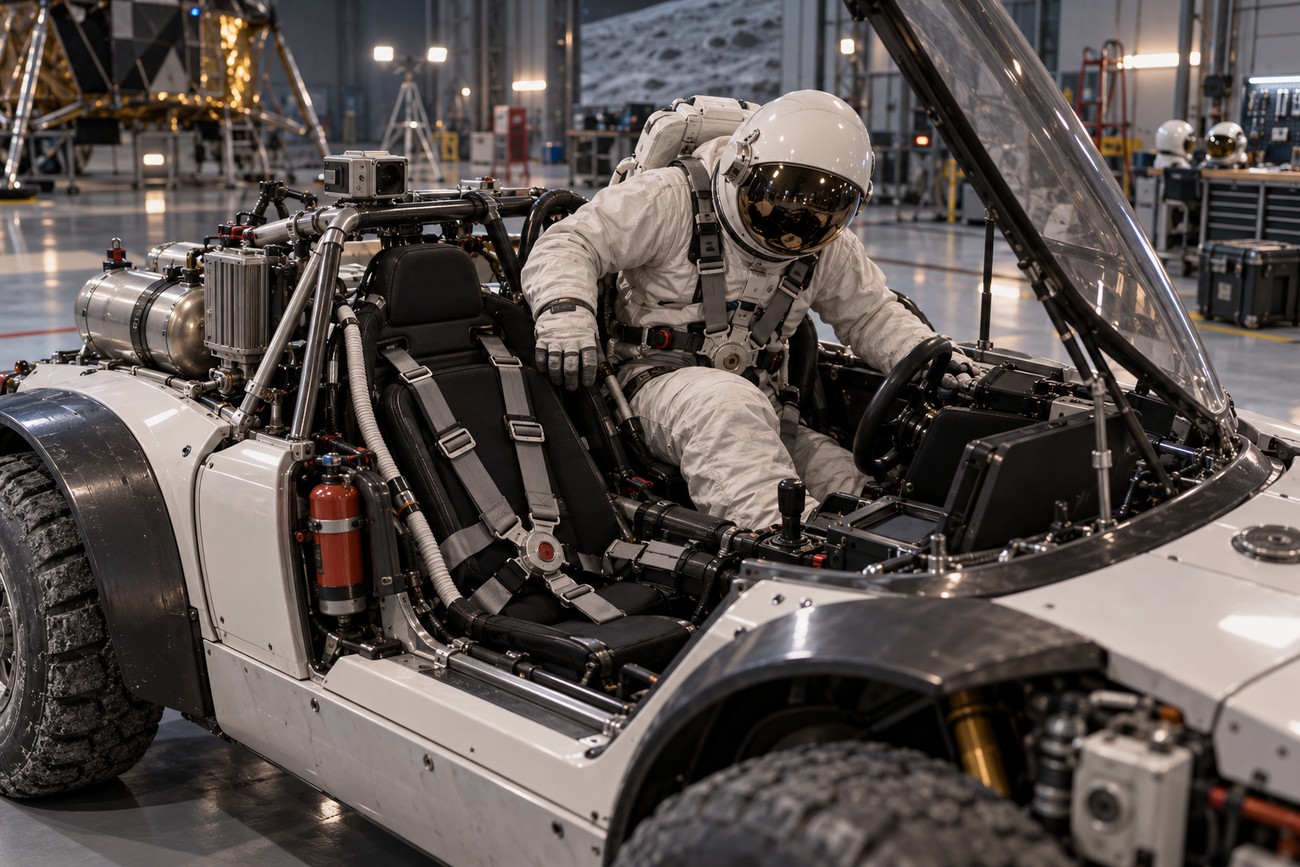
The MX-5’s compact cabin is part of its appeal on Earth, yet it leaves little spare volume for lunar equipment. Some ND MX-5 owners report a high seating position and limited adjustment, particularly for taller drivers. Those reports are useful prompts for a fit check, though they do not establish whether a redesigned lunar cockpit would be comfortable or safe.
Occupant protection would also demand more than fitting a driver into the existing seat. A lunar vehicle could require restraints, helmets, communications equipment, environmental controls, displays, emergency hardware, and structural protection. No official lunar MX-5 packaging or occupant-protection specifications are available.
Storage is already a constrained part of the roadster layout. The cabin has limited in-cabin storage and no conventional glovebox, while even ordinary items such as a large water bottle can be awkward to place. Lunar support equipment would make those familiar compromises much more consequential.
The design exercise therefore asks whether the Miata’s compact package can survive a safety-focused redesign without losing its original advantages. Adding equipment may solve one operational problem while creating another through mass, balance, access, or heat. The answer would require a new vehicle evaluation rather than a simple conversion checklist.
Frequently asked questions
What year to avoid Mazda MX-5?
There is no single avoidable model year established by the information available here. A purchase decision should weigh the specific car’s condition, maintenance history, seating fit, storage expectations, transmission choice, and intended use rather than relying on a blanket year rule.
For the lunar thought experiment, model year is secondary to system suitability. No production MX-5 year has official specifications for lunar traction, cooling, sealing, engine performance, or occupant protection.
Which Miata is the lightest?
Among the stated 2026 MX-5 configurations, the six-speed manual is lighter at 2,366 lb (approximately 1,073 kg). The available six-speed automatic weighs 2,405 lb (approximately 1,091 kg).
That comparison covers the current specifications provided here, not every Miata ever produced. A lunar conversion would add equipment and could require ballast, so the lightest road version would not necessarily become the most capable lunar vehicle.







