
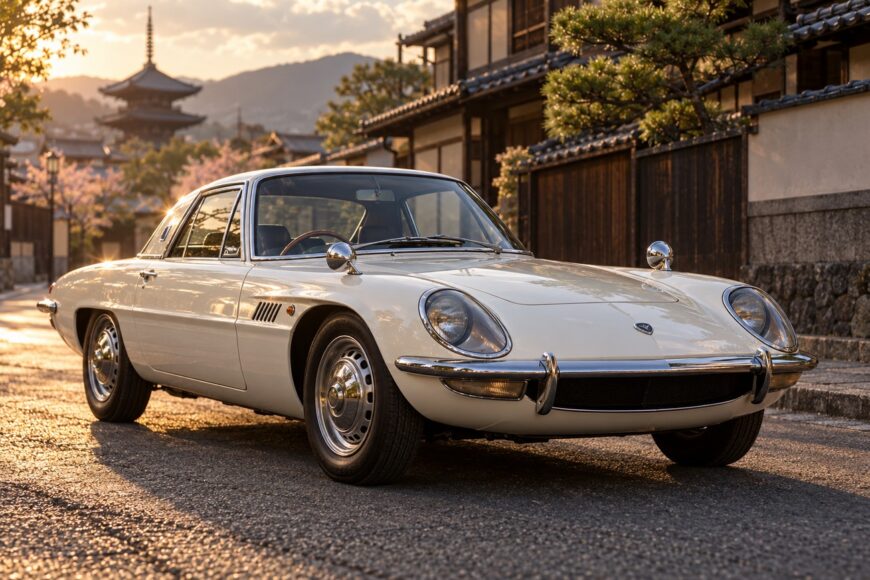
The Mazda Cosmo Sport embodies a central contradiction of early rotary engineering: it was a light, futuristic sports car with exceptionally smooth power delivery, yet its compact engine created maintenance demands unfamiliar to owners of conventional piston cars. Its appeal begins with the sensation behind the wheel and continues with the technical care required to keep one healthy.
Launched in 1967, the Cosmo Sport was Mazda’s first production car with a rotary engine. Mazda calls it the world’s first volume-production sports car powered by a two-rotor rotary engine, a more precise claim than the familiar description of it as the first rotary car ever built. Its headline figures remain impressive, although preserving an original example today depends on understanding oil control, cooling, ignition, specialist parts, and the condition of its apex seals.
- How Mazda Turned the Rotary into a Production Sports Car
- The Type 10A: Small Displacement, Unusual Demands
- L10A and L10B: The Cosmo Sport’s Two Personalities
- What Ownership Really Demands from a Cosmo Sport
- Buying, Restoring, and Preserving the Original Car
- Why the Cosmo Sport Still Matters to Mazda’s Rotary Story
- Frequently asked questions
- What was the first rotary car made by Mazda?
- How much is a Mazda Cosmo Sport worth?
- What killed the rotary engine?
- How is the Cosmo Sport different from the Mazda RX-7?
How Mazda Turned the Rotary into a Production Sports Car
Mazda entered rotary development during a period when the Wankel engine promised compact dimensions, low vibration, and high specific output. The Cosmo Sport became the company’s answer to the difficult question of whether those qualities could survive ordinary production standards. Its long, low body and two-seat layout gave the unusual engine a natural home: a sporting coupe where smoothness and revving character mattered as much as practicality.
The car reached production in 1967 after extensive development work, making Mazda the first Japanese manufacturer to commit a two-rotor engine to a production sports car. Production continued in small volume through 1972. That limited run helped preserve the Cosmo’s exclusivity while also making today’s supply of correct mechanical and trim components unusually thin.
The historical distinction matters. Other rotary-powered vehicles and prototypes existed, so calling the Cosmo Sport simply the first rotary car ever made oversimplifies a disputed history. Mazda’s official wording identifies the meaningful achievement: the first volume-production sports car powered by a two-rotor rotary engine.
Commercially, the Cosmo served as a technology demonstrator that customers could actually buy. Technically, it forced Mazda to solve combustion, sealing, cooling, lubrication, and manufacturing problems at the same time. The lessons learned would shape the company’s later rotary cars, including the RX-3 and RX-7.
The Type 10A: Small Displacement, Unusual Demands
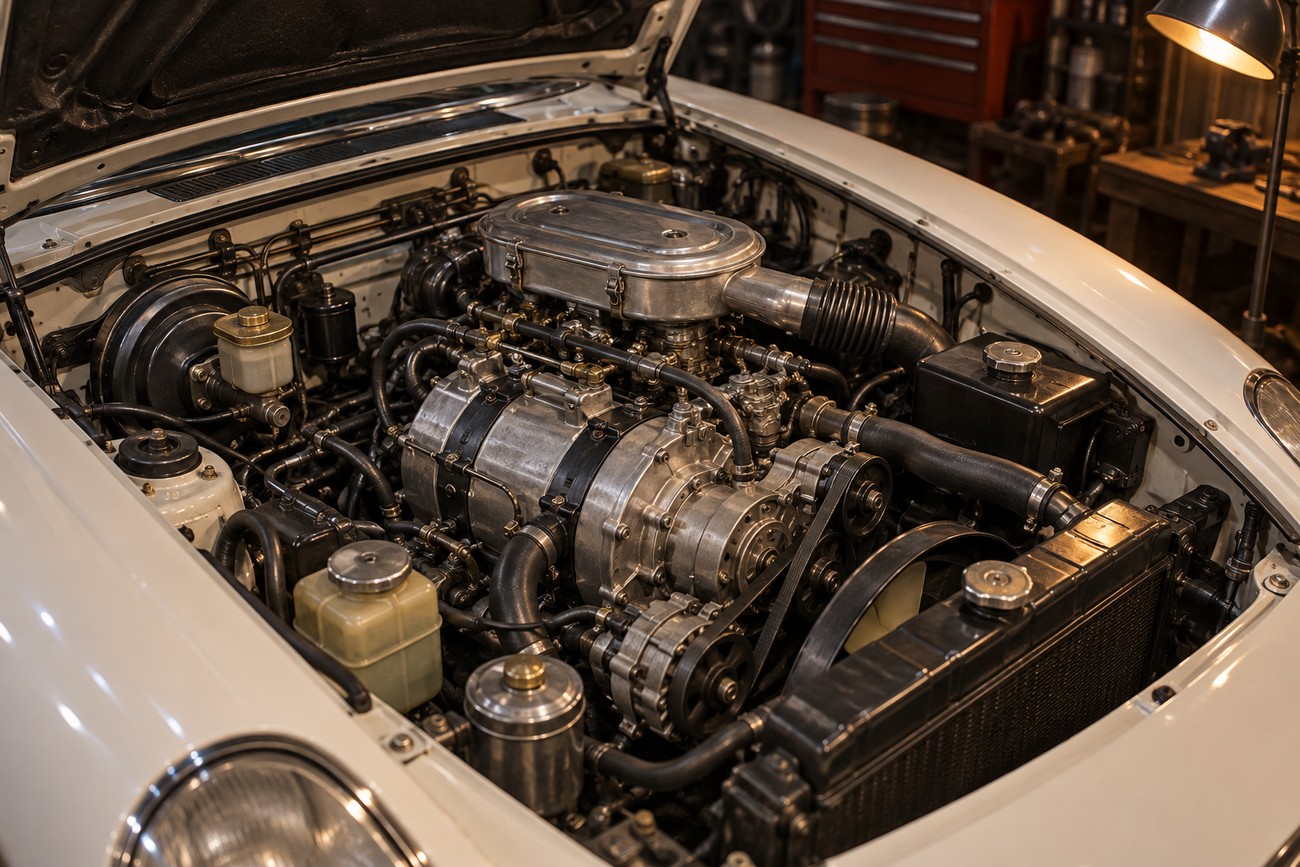
The Cosmo Sport used the Type 10A, a two-rotor Wankel rotary with 982 cm³ total displacement, described as 491 cm³ × 2. It used a four-stroke cycle and liquid cooling. The compact engine sat longitudinally at the front and drove the rear wheels, allowing Mazda to build a conventional sporting layout around an unconventional power unit.
Early L10A cars produced approximately 109–110 PS at 7,000 rpm, with about 130 N·m at roughly 3,500 rpm. Sources differ between 109 and 110 PS, so a single supposedly exact figure can be misleading. The important driving characteristic was the way the engine gained revs with little of the vibration associated with reciprocating pistons.
That smoothness changes the driver’s reference points. The Cosmo does not deliver its personality through a large torque surge; its appeal lies in clean, eager acceleration and a distinctive high-rpm sound. A nominally one-liter rotary can therefore feel technically special while consuming fuel and oil at a rate that surprises anyone judging it by displacement alone.
Rotary tuning also requires its own logic. Twin spark plugs, separate ignition components, carburetor calibration, lubrication, and cooling all influence combustion and sealing. Apex seals sit at the center of the design: neglect, overheating, unsuitable oil, or poor tuning can accelerate wear, reduce compression, and turn a compact engine into a difficult and expensive rebuild.
L10A and L10B: The Cosmo Sport’s Two Personalities
The early L10A and later L10B versions share the same basic concept, although their performance and road manners differ in meaningful ways.
| Specification | Early L10A | Later L10B |
|---|---|---|
| Power | Approximately 109–110 PS at 7,000 rpm | Approximately 128 PS at 7,000 rpm |
| Torque | About 130 N·m at roughly 3,500 rpm | 139 N·m at 5,000 rpm |
| Transmission | Four-speed manual | Five-speed manual |
| Wheelbase | Approximately 2,200 mm | Approximately 2,350 mm |
| Claimed top speed | Approximately 185 km/h | Up to approximately 200 km/h |
The L10B’s additional ratio helps keep the engine in a more useful part of its rev range and makes sustained high-speed driving less busy. The longer wheelbase also gives the later car a calmer, more stable character. Early cars feel more compact and immediate, while later cars offer greater composure when speed rises.
These changes affect collectability as well as driving. A buyer comparing two apparently similar Cosmo Sports should verify the version, gearbox, wheelbase, engine specification, and period details before treating performance claims as interchangeable. Published specifications often blur the distinction between the two series.
Both versions remain light, at about 940 kg, with approximately 4,140 mm of length, 1,595 mm of width, and 1,165 mm of height. Front disc brakes and rear drum brakes serve a chassis with independent front spring suspension and semi-independent rear leaf-spring suspension. The result is historically significant and entertaining, although its sporting setup can feel firm and noisy on a long modern highway.
What Ownership Really Demands from a Cosmo Sport
A healthy Cosmo Sport needs disciplined routine rather than occasional attention. Oil quality and level, cooling-system condition, fuel quality, ignition, carburetor setup, and apex-seal condition are interconnected. The rotary also consumes oil by design because oil reaches the combustion process, so checking the level is part of normal ownership rather than evidence of an immediate fault.
Cold starting and warm-up deserve patience. An unstable idle, difficult starting, or poor throttle response may result from carburetor adjustment, ignition timing, weak ignition components, or compression loss. Fuel quality matters as well; questionable or low-octane fuel can increase the risk of detonation and damage, particularly in an engine whose condition and calibration are already uncertain.
A rotary compression test, cold-start behavior, oil control, and cooling-system inspection must be assessed together. A single symptom rarely identifies the real cause because sealing, temperature, ignition, and lubrication influence one another.
Overheating is especially serious because seal damage and compression loss can follow. Neglected apex seals may require specialist rebuilding, and original Type 10A parts are harder to source than ordinary components for a conventional compact engine. A mechanic who applies piston-engine assumptions to rotary ignition, carburetion, or lubrication can create repeat failures even after replacing damaged parts.
Fuel economy is another ownership adjustment. Real-world consumption is substantially higher than many buyers expect from a nominally 982 cm³ engine, especially during active driving. Oil use, specialist servicing, and the need for careful warm-up add to running costs, so the Cosmo should be approached as a historic sports car with a small engine rather than as an economical one-liter commuter.
Buying, Restoring, and Preserving the Original Car
Condition and originality determine far more than appearance. A correct rotary engine, Hitachi-Stromberg carburetor, original badges, steering wheel, instrument cluster, and body trim can matter greatly to collectors. These details are difficult to replace when missing, and a polished restoration with incorrect components may be less desirable than a less perfect car retaining its authentic parts.
Mechanical inspection should extend beyond a compression reading. The buyer needs evidence of cold-start behavior, stable running, oil control, cooling performance, ignition condition, and the history of any engine rebuild. Apex seals, rotary-specific gaskets, carburetor components, and suspension parts may require specialist sourcing, which can turn a seemingly minor defect into a long restoration delay.
Factory-correct restoration is expensive because the work depends on scarce knowledge as well as scarce parts. Body and interior pieces can be difficult to locate, while suspension and engine work may require fabrication, careful repair, or access to a narrow network of suppliers. Documentation therefore has practical value: it helps distinguish preserved originality from recent work that merely looks convincing.
Undocumented piston-engine conversions and improvised tuning sharply reduce collector appeal. They may make a car easier to operate in a particular market, yet they erase much of the reason the Cosmo Sport matters. Before buying, confirm the identity of the engine, carburetor, instruments, trim, and major restoration work rather than relying on photographs alone.
Why the Cosmo Sport Still Matters to Mazda’s Rotary Story
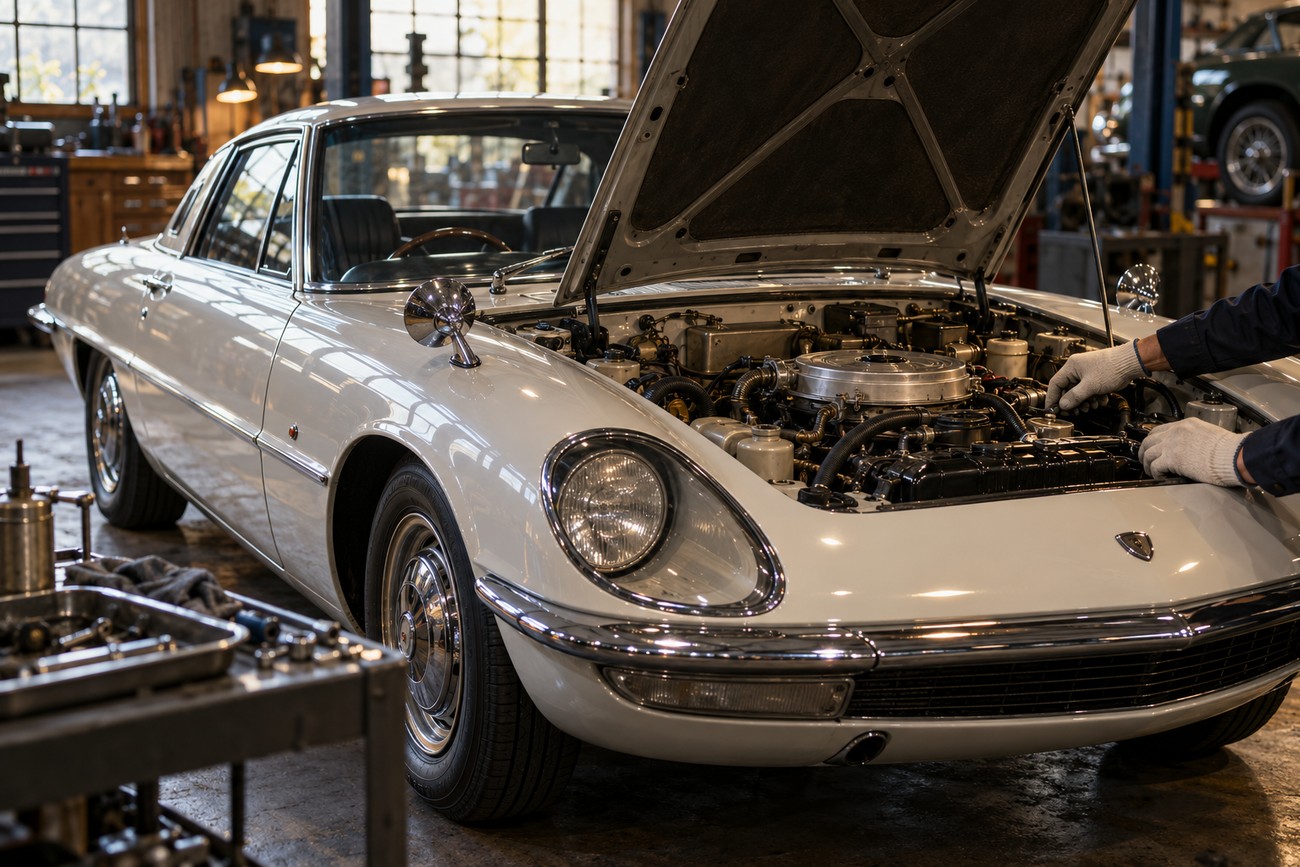
The Cosmo Sport established the rotary identity Mazda would carry into the RX-3 and RX-7: compact packaging, smooth running, low conventional vibration, and an eagerness that made engine speed part of the experience. Its operating lessons also carried forward. Warm-up, oil control, careful break-in, cooling inspection, and regular monitoring remained central to later rotary ownership.
The car’s success did not prove that the rotary was an effortless replacement for the piston engine. Fuel consumption, seal durability, emissions requirements, maintenance complexity, and parts availability remained fundamental concerns. Development costs also stayed high because Mazda had to refine combustion, sealing, lubrication, and emissions performance as regulations became more demanding.
That combined burden explains the rotary’s eventual decline more accurately than any single failure. The engine offered a memorable driving character, yet manufacturers had to justify its fuel use, durability expectations, service requirements, and continuing engineering investment against increasingly efficient piston alternatives.
For historians and collectors, the Cosmo’s value rests in that tension. It made a two-rotor sports car a production reality and gave Mazda a distinctive technical identity. It also showed, from the beginning, that rotary smoothness came with obligations that every owner must understand.
Frequently asked questions
What was the first rotary car made by Mazda?
The Mazda Cosmo Sport was Mazda’s first production car with a rotary engine. Mazda describes it more specifically as the world’s first volume-production sports car powered by a two-rotor rotary engine.
That wording avoids the broader and disputed claim that it was the first rotary-powered car ever built. Experimental and other rotary vehicles complicate that statement, while the Cosmo’s documented importance lies in bringing a two-rotor sports car into small-volume customer production from 1967 to 1972.
How much is a Mazda Cosmo Sport worth?
There is no single universal value for a Mazda Cosmo Sport. Condition, originality, documentation, version, restoration quality, and the presence of correct rotary-specific parts all influence the market far more than the model name alone.
A serious evaluation should confirm the L10A or L10B specification, engine condition, compression, cold-start behavior, cooling system, carburetor, badges, instruments, steering wheel, and body trim. A cosmetically attractive car with an incorrect engine or undocumented conversion may be less valuable than a sound, properly documented example requiring careful cosmetic work.
What killed the rotary engine?
No single problem killed the rotary engine. Higher fuel consumption, increasingly difficult emissions compliance, concerns about seal durability, demanding maintenance, and the cost of continued development combined to weaken its commercial case.
The Cosmo Sport illustrates both sides of the equation. Its smoothness and compact design were genuine advantages, while fuel use, oil consumption, cooling requirements, specialist servicing, and parts support limited its appeal as regulations and customer expectations changed.
How is the Cosmo Sport different from the Mazda RX-7?
The Cosmo Sport was Mazda’s pioneering luxury-sporting rotary coupe and the company’s first production rotary car. The RX-7 arrived later with a more focused, mass-market sports-car role, using rotary technology in a package designed for broader sales and a different period of competition.
The Cosmo is therefore valued primarily as a landmark and collector car, with rarity and originality carrying substantial weight. The RX-7 became the more familiar expression of Mazda’s rotary sports-car formula, while the Cosmo remains the production breakthrough that began that story.







