
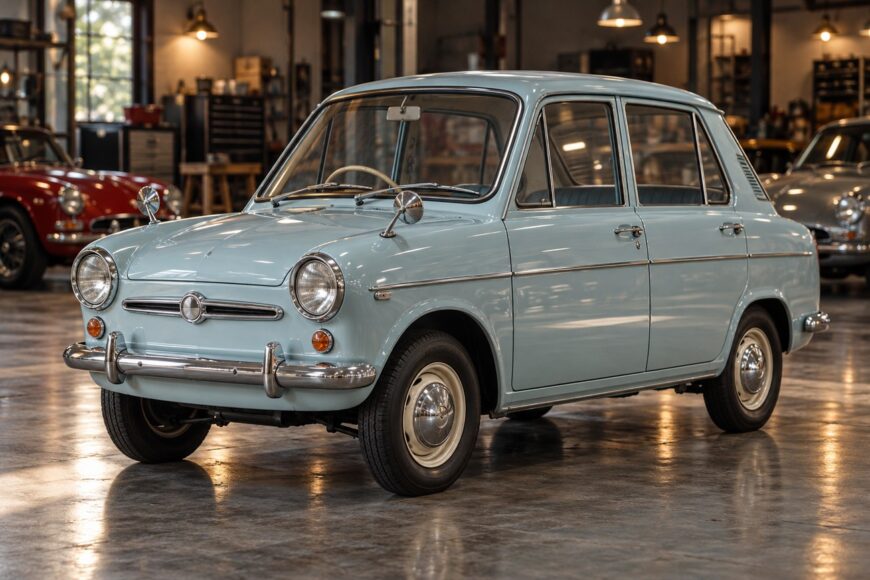
The Mazda Carol debuted in 1962, but the four-door version did not arrive until 1963. That distinction matters when identifying an early car: “1962 Carol” describes the model’s debut, while “four-door Carol” describes a body style added later.
For a car in Japan’s tiny kei category, the extra doors made an appealing promise. Rear passengers could get in without folding a front seat forward, giving the Carol a more family-oriented character. The small cabin, rear-mounted engine, and modest power remained, however, so the four-door’s usefulness is best understood alongside the chronology that produced it.
- A 1962 Carol, but a 1963 four-door
- What four doors changed—and what they could not
- How the small four-cylinder shaped the drive
- Carol 360 and Carol 600: dates, engines, and kei status
- The ownership compromises period styling can hide
- Buying a four-door Carol without buying its problems
- Common Carol myths worth checking
- Frequently asked questions
- How can I check the date of a Carol advertised as a 1962 four-door?
- How can I verify a Carol’s original color and interior trim?
- What should an overseas buyer confirm before importing a Carol?
A 1962 Carol, but a 1963 four-door
The Mazda P360 Carol debuted in February 1962. Its 358 cc engine placed the Carol 360 in the period kei category, whose size and engine limits shaped the car’s compact design. The original launch date is well established, but it should not be applied to every later version.
Mazda added the four-door Carol 360 in 1963. A listing that calls a car a “1962 four-door” therefore deserves a closer look at its identification and paperwork. The seller may be using the model’s launch year rather than the date of that particular vehicle.
The Mazda R360 can cause a second mix-up. It was a separate model, rather than an earlier car named the R360 Carol. Keeping the names apart makes Mazda’s early small-car range easier to understand and helps buyers search for the right period literature and parts.
Body style, model name, and build date each answer a different question. The P360 name establishes which Carol is being discussed; the number of doors identifies the variant; and the individual car’s records establish its history. None should stand in for the others.
What four doors changed—and what they could not
The 1963 four-door retained the Carol 360’s kei-car format and rear-engine layout. Its clearest practical gain was access: a rear passenger no longer had to enter past a front seat. For short local trips, that change could make the car easier to use even though its exterior remained compact.
Additional openings did not make the rear bench spacious. Adult passengers still had to work within a tight cabin, and the rear doors should be judged by how easily they let someone enter and leave, rather than taken as evidence of generous legroom. Exact space claims need period measurements that are not consistently available.
The small package also housed an unusual engine for an early kei car: Mazda’s 358 cc DA four-cylinder. Its configuration is part of the Carol’s historical interest, though it did not turn the car into a strong performer. A buyer drawn to the engineering should still try the seating position and rear-seat access in person.
The four-door’s significance is chiefly one of packaging. Mazda offered a tiny car with a more conventional family-car entry arrangement while accepting the space limits of the category. That is a more useful way to read its design than assuming four doors made it a full-sized family sedan in miniature.
How the small four-cylinder shaped the drive
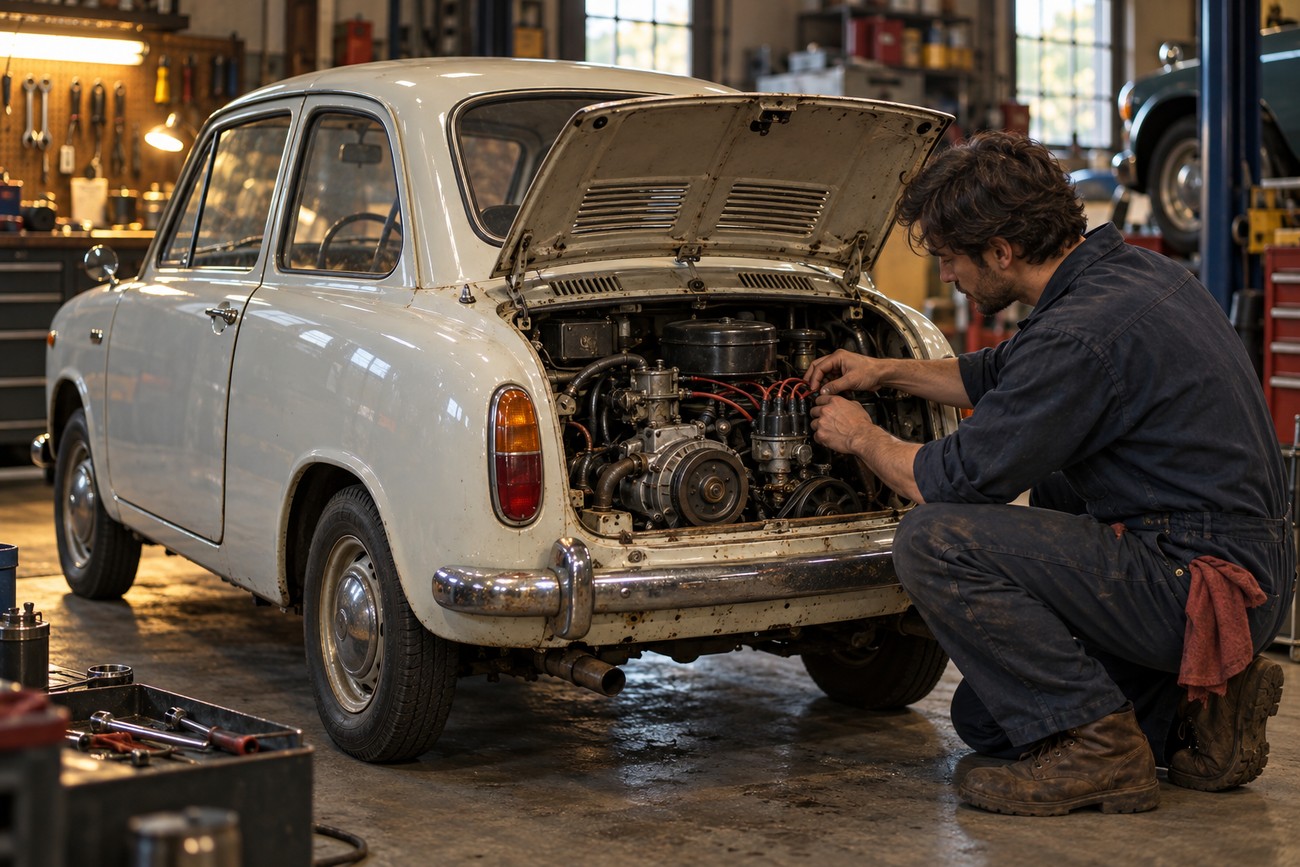
The Carol 360 used a rear-mounted 358 cc DA four-cylinder engine and a four-speed manual gearbox. Factory output was 18 hp initially, rising to 20 hp from September 1963. Those figures set sensible expectations before a test drive: progress depends on choosing gears and allowing time to build speed.
Passengers and hills make that modest output more apparent. A car that feels willing on a level road with one occupant can require more planning when loaded. This is a practical consequence of limited power, rather than evidence that every surviving engine is in poor condition.
Some owners report that engine noise and vibration become intrusive at higher road speeds. Those accounts are useful context, though they are impressions, not measurements that apply equally to every car. Condition, maintenance, and past repairs can change how an individual Carol sounds and feels.
The rear-engine arrangement also matters beyond sound. It places the engine’s weight behind the occupants and calls for attention to the car’s condition and responses on wet roads. Anyone used to a modern front-engine car should learn its handling gradually, while treating any unusual heat or running problems as reasons for inspection.
Carol 360 and Carol 600: dates, engines, and kei status
These versions share the Carol name, but their launch dates and engines differ. The distinction is especially important when checking whether a car belongs to the period 360 cc kei category.
| Version | Introduction | Body style | Engine | Stated output | 360 cc kei status |
|---|---|---|---|---|---|
| Launch Carol 360 (P360) | February 1962 | Original body style | 358 cc DA four-cylinder | 18 hp initially; 20 hp from September 1963 | Yes |
| Four-door Carol 360 | 1963 | Four-door | 358 cc DA four-cylinder | 18 hp initially; 20 hp from September 1963 | Yes |
| Carol 600 | Autumn 1962 | Carol 600 range; body style should be checked for the individual car | 586 cc RA | Not stated here | No |
The ownership compromises period styling can hide
The four-door’s friendly proportions can make it look easier to live with than its dimensions allow. Rear access improved, but rear-seat space remained tight. If regular adult passengers are part of the plan, sitting in the actual car will reveal more than photographs of its doors and upholstery.
Loaded performance needs the same realistic assessment. The Carol 360’s stated output was 18 hp initially and 20 hp from September 1963, so carrying passengers changes how readily it tackles inclines and traffic. A relaxed local outing suits its abilities better than a schedule that demands sustained modern-road pace.
Period braking equipment and occupant protection also deserve careful evaluation. Early small-car brakes should not be assumed to deliver modern stopping performance, and safety-belt fitment may differ among surviving examples or reflect later work. Leave more space in traffic and inspect the equipment on the individual car rather than relying on a general description.
A rear-mounted engine brings its own maintenance checks. Access, cooling condition, and evidence of previous work matter when assessing reliability; an engine that runs briefly at an inspection has not demonstrated how it behaves on a longer drive. Reports of noise or heat problems are reasons to investigate a particular vehicle, not proof that every Carol has them.
Driving conditions matter as much as mechanical condition. The car’s small size, limited power, and period safety standards make regular high-speed use a different proposition from occasional classic-car outings. That distinction should guide where it will be driven and what work must be completed before use.
Buying a four-door Carol without buying its problems
Start with the structure beneath the finish. Inspect the floors, sills, wheel arches, and lower door edges, and ask how any corrosion repairs were carried out. Fresh paint may make a car presentable while leaving the strength and quality of earlier repairs unresolved.
Confirm that the engine and body details match the car being offered. The 358 cc DA engine calls for model-specific parts checks, while some four-door body and trim pieces may be harder to replace than items shared with other Carol versions. Do not assume a part will fit merely because it comes from another small Mazda or another kei car.
Ask for maintenance records and examine the cooling system’s condition, particularly if the car has received engine or exhaust changes. A careful inspection should establish whether the car starts, runs, and controls its temperature consistently; it should not begin with speculative tuning. Where records are thin, allow for a more thorough mechanical assessment before committing to purchase.
Documentation helps with originality as well as repairs. Compare the fitted engine, interior pieces, and finish with whatever period material and ownership records survive, while recognizing that an old car may have been altered more than once. A convincing restoration is one whose underlying work and specification can be explained, not merely one that photographs well.
Common Carol myths worth checking
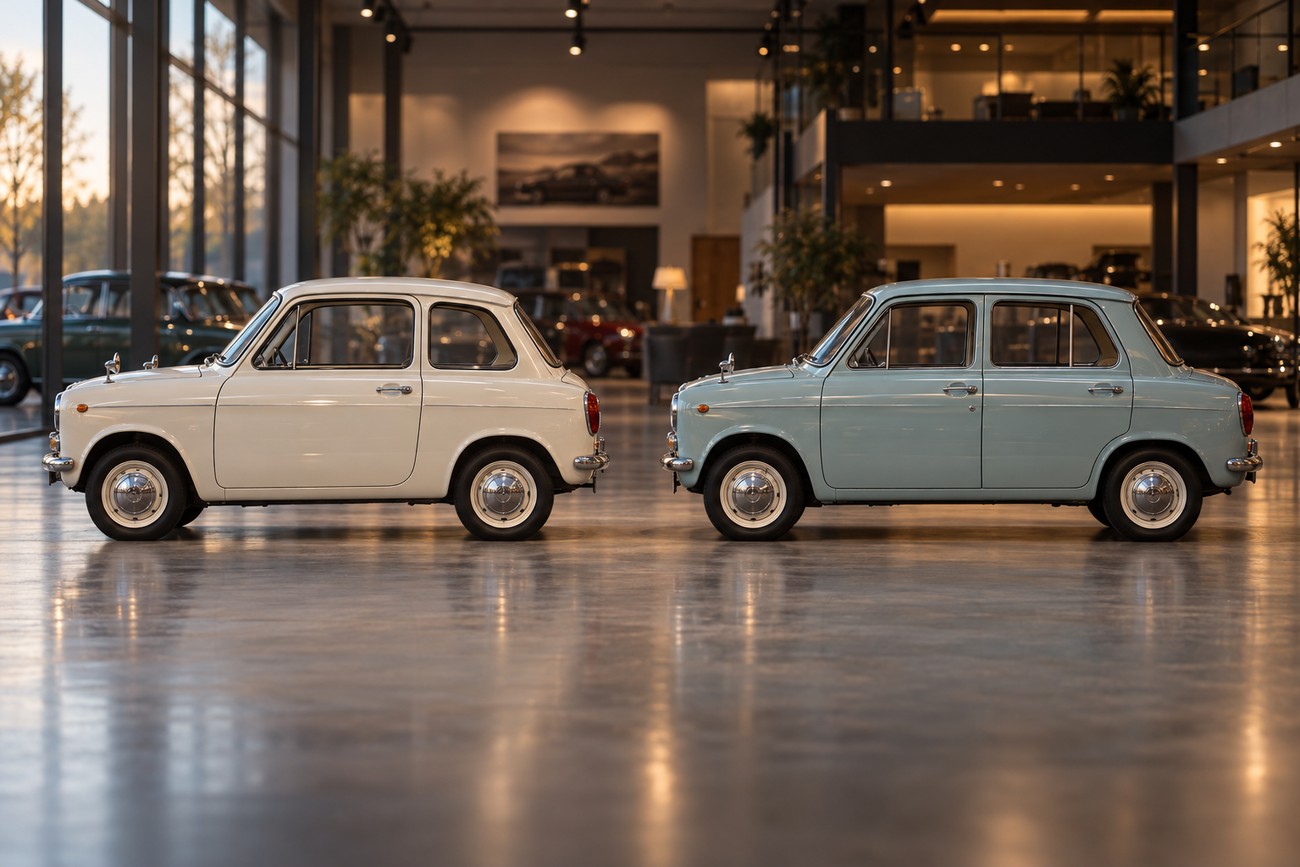
“All early Carols had two doors” overlooks the four-door Carol 360 added in 1963. The P360 Carol itself debuted in February 1962, which explains why accounts of the model can start a year before accounts of its four-door body. The two dates refer to different events.
Calling the R360 an “R360 Carol” combines separate Mazda models. That mistake can lead to confusion when reading histories or looking for components. Use the model designation shown by the car and its documentation instead of relying on a loosely worded advertisement.
The Carol 600 was more than a 360 with the same engine in a larger body. Introduced in autumn 1962, it used a different 586 cc RA engine and did not qualify as a 360 cc kei car. Its engine specification should not be transferred to a Carol 360.
Inflated horsepower claims need similar care. The Carol 360’s stated factory output was 18 hp initially and 20 hp from September 1963; a 50 hp figure should not be applied to the production 360. Identifying launch year, body style, and engine separately is the simplest way to keep these histories—and prospective purchases—straight.
Frequently asked questions
For an individual Carol, original documents and physical identification carry more weight than a seller’s shorthand description. The following checks help resolve details that model histories alone cannot establish.
How can I check the date of a Carol advertised as a 1962 four-door?
Compare the car’s chassis identification with its registration history and period model literature, then ask the seller to explain any mismatch. The four-door was introduced in 1963, so “1962” may refer to the Carol name’s debut rather than that vehicle. A registration date can also differ from a build date; preserve copies of the documents and establish which date each one actually records.
How can I verify a Carol’s original color and interior trim?
Compare period brochures and any surviving paperwork with paint found in protected areas, such as beneath trim or inside less-exposed panels. Those traces can support an originality assessment, but later repairs may have covered or replaced them. Treat the current exterior finish and upholstery as evidence to investigate, rather than proof of the factory specification.
What should an overseas buyer confirm before importing a Carol?
Confirm that the seller can provide valid title and export paperwork, and check the destination country’s import, registration, and road-use rules before arranging shipment. Requirements vary by jurisdiction and may depend on the car’s documented age and specification. Make a plan for receiving, storing, and servicing the car as well; delivery is only the start of owning a rare rear-engine classic.







