
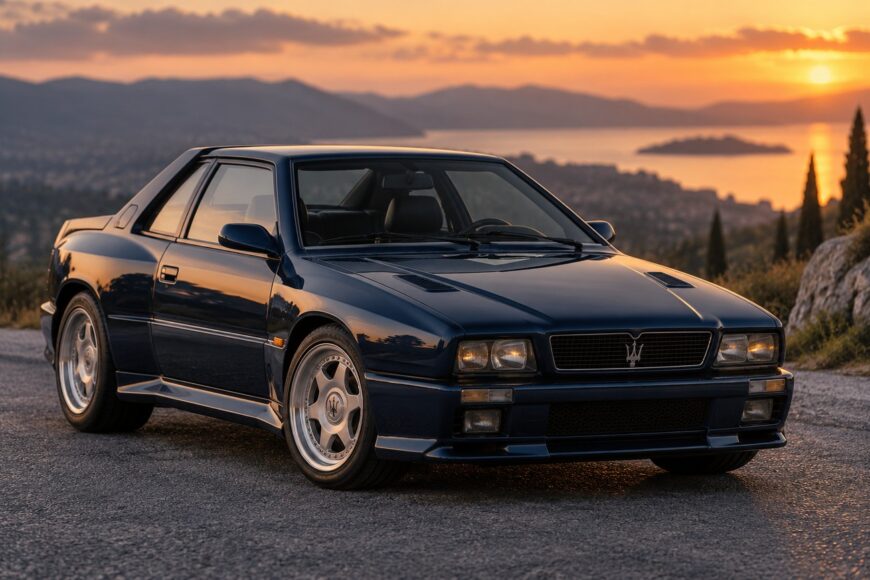
A compact Maserati coupe with a twin-turbo V8, a six-speed manual gearbox, and rear-wheel drive has an appeal that needs little embellishment. The Shamal combines the familiar outline of the Biturbo family with an engine that gave the small car a higher level of performance. Its short wheelbase and broad stance make the promise visible before the engine starts.
Finding a sound Shamal is harder than appreciating the idea. Few appear for sale, and a polished advert cannot establish the quality of old repairs, the health of the turbocharged engine, or the availability of a part the car may need next. Produced from 1990 to 1996, the Shamal rewards close attention to what distinguishes it mechanically—and equal attention to the history of the individual car.
- More Than a Biturbo With a Different Body
- The V8 Biturbo: Hardware Behind the Muscle
- Maserati Shamal Specifications: Figures and Caveats
- What the Shamal Feels Like on the Road
- Buying One: Inspection Matters More Than the Advert
- Rarity, Collectability, and the Cost of Getting It Wrong
- Frequently Asked Questions
- How much does a Maserati Shamal cost?
- Was the Maserati Shamal sold in the US?
- Why are some used Maseratis cheap while the Shamal is not?
- How should a Shamal be cared for between infrequent drives?
More Than a Biturbo With a Different Body
The Shamal belongs to Maserati’s Biturbo family, yet calling it a restyled Biturbo misses the central change. Maserati describes a Biturbo-derived coupe in which a new twin-turbo V8 replaced the V6. That distinction matters to anyone comparing the cars: a shared lineage does not make their powertrains interchangeable or their ownership demands identical.
Its dimensions help explain the visual impression. The Shamal is 4,100 mm long and 1,850 mm wide, on a 2,400 mm wheelbase. Those figures describe a short, relatively broad car rather than a long grand tourer. The proportions give its muscular styling a mechanical context: substantial engine output was packaged within a compact footprint.
The 1990–1996 production period also places the Shamal within a specific chapter of Maserati’s history. It developed an existing model family while giving it a distinct engine and identity. That is a more useful way to understand it than treating every Biturbo-derived coupe as a variation on the same specification.
For a buyer, the family connection offers a starting point for research, not a shortcut around it. Confirm which components and service procedures apply to the Shamal itself before assuming that knowledge of a V6 Biturbo will cover the V8. The difference is particularly important when an advert says only that the car has been “fully serviced,” without identifying the work done.
The V8 Biturbo: Hardware Behind the Muscle
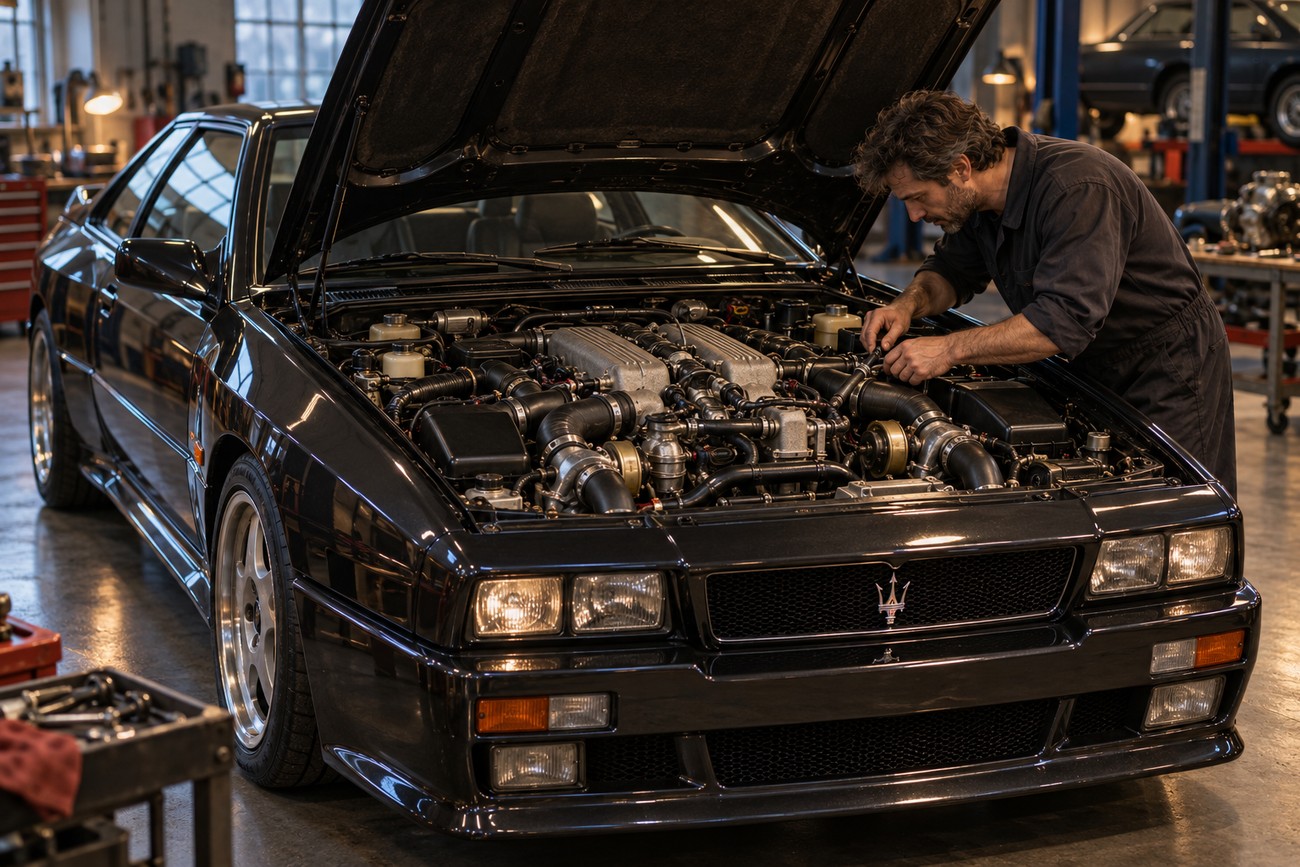
At the heart of the Shamal is a 3,217 cm³ twin-turbo DOHC V8 with four valves per cylinder. Marelli IAW manages electronic fuel injection and ignition. The engine’s specification explains why the car deserves to be considered on its own terms within the Biturbo family; it also identifies systems that deserve careful inspection decades later.
Power reaches the rear wheels through a six-speed Getrag manual gearbox. The arrangement gives the driver direct control over gear selection, while the turbocharged engine supplies a broad measure of thrust. Specialist specifications quote 436 Nm at 2,800 rpm. That torque figure, and the relatively low engine speed at which it is quoted, say more about the Shamal’s likely midrange character than a peak-power number alone.
Published horsepower claims require more care. An English-language account gives 318 bhp, while other published specifications list 322 hp or 326 hp. Those figures retain different source-unit labels and should not be merged into a single supposedly definitive factory rating. A buyer comparing documents should note what each source measures and how it labels the result.
The mechanical appeal comes with practical consequences. A complex twin-turbo engine, electronic controls, and an uncommon manual drivetrain make the standard of previous work especially relevant. Evidence of careful maintenance is more persuasive than an engine bay cleaned for photographs; neither appearance nor a brief idle demonstrates how the systems behave under load.
Maserati Shamal Specifications: Figures and Caveats
These published figures identify the car; catalogue performance claims should not be read as test results for a surviving example.
| Item | Published specification or qualification |
|---|---|
| Engine | 3,217 cm³ twin-turbo DOHC V8; four valves per cylinder |
| Engine management | Marelli IAW electronic fuel injection and ignition |
| Published power claim | 318 bhp in an English-language account |
| Other published power claims | 322 hp and 326 hp in published specifications; neither is treated here as universally definitive |
| Torque | 436 Nm at 2,800 rpm in specialist specifications |
| Transmission and drive | Six-speed Getrag manual; rear-wheel drive |
| 0–100 km/h | 5.3 seconds, commonly quoted catalogue figure |
| Top speed | 270 km/h, commonly quoted catalogue figure |
| Dimensions | 2,400 mm wheelbase; 4,100 mm long; 1,850 mm wide; 1,300 mm high |
| Kerb weight | Approximately 1,417 kg |
What the Shamal Feels Like on the Road
The specification points toward a car that needs considered inputs. A rear-drive layout, a 2,400 mm wheelbase, and the quoted 436 Nm at 2,800 rpm put meaningful torque into a compact package. That is a mechanical inference, not a claim that every Shamal delivers power in precisely the same way. Tyres, setup, and the condition of the boost system will affect what a driver experiences.
The six-speed manual makes gear choice part of managing that response. Reports of abrupt boost delivery exist, but they should prompt an inspection rather than become a diagnosis for every car. During a proper drive, a prospective buyer should pay attention to whether power builds consistently and whether any hesitation, surging, or warning signs call for further investigation.
Catalogue figures commonly give 5.3 seconds for 0–100 km/h and 270 km/h for top speed. They convey the Shamal’s intended performance, though they do not establish what a particular car can achieve now. Maintenance, mechanical condition, and testing conditions all stand between a published number and a responsible assessment of a vehicle offered for sale.
Likewise, the short wheelbase suggests that surface quality and driver inputs may matter more than they would in a larger touring car. Some ownership accounts mention limited comfort on rough roads, but that is an experience-based caution rather than a universal verdict. A measured road test over the roads you expect to use will reveal more than a description of the car as either tame or intimidating.
Buying One: Inspection Matters More Than the Advert
Start by establishing the car’s identity and tracing its history. Compare its identifying details with the registration and service records available for that example, then look for dates, work descriptions, and supporting invoices. Scarcity makes gaps harder to resolve: there may be few comparable cars nearby, and a seller’s account can be difficult to corroborate after ownership has changed several times.
Inspect the body before becoming absorbed in the engine specification. Look for corrosion, evidence of repairs, inconsistent panel fit, and signs that previous work has concealed rather than corrected damage. A specialist body assessment can help distinguish an acceptable historic repair from work that will be costly to revisit. On an uncommon coupe, the difficulty of sourcing a correct replacement part deserves consideration alongside the visible defect.
Verify boost and injection behavior with a marque specialist during the pre-purchase inspection. A clean idle and fresh cosmetic work cannot show how those systems perform once the engine is working.
Next, arrange a mechanical inspection that covers the V8, both turbos, fuel injection, ignition, electrics, and six-speed gearbox. Ask the inspector to explain which checks were completed and which could not be completed on the day. Reports of electrical faults or uneven boost are reasons to investigate symptoms and records, not grounds to assume that every Shamal has them.
Finally, judge mileage in the context of originality and documented work. A low reading says little about the quality of repairs, the condition of components, or how long the car has stood unused. Check whether changes from original specification are understood and recorded, and discuss any prospective parts needs with a specialist before agreeing on a price. Parts delays and the need for marque knowledge are reported ownership concerns; their effect depends on the car and the work required.
Rarity, Collectability, and the Cost of Getting It Wrong
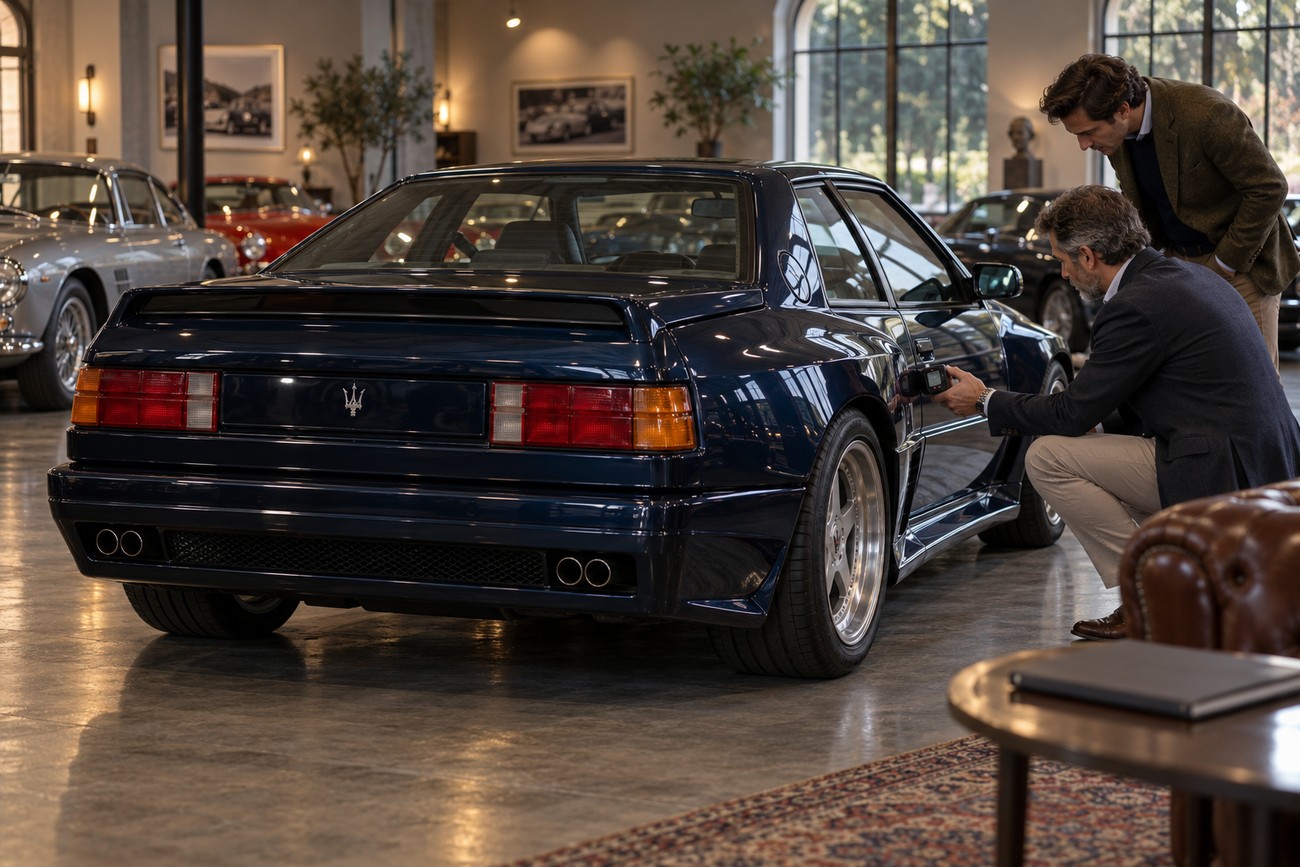
Only a small number of Shamals appear in the European listings considered here. That scarcity makes a promising advert tempting, but it also weakens simple price comparisons. An asking price records what a seller hopes to receive; without a confirmed sale and a clear account of the car’s condition, it cannot establish market value on its own.
A narrow market works in both directions. Finding an original, well-documented car may take patience, and selling one may take patience, too. Rarity alone does not guarantee a quick resale or future appreciation, particularly if the next buyer must budget for specialist work that has been deferred.
Condition should therefore lead the valuation discussion. Examine the standard of body and mechanical work, the completeness of the records, and how much of the car remains correct to its specification. Two examples with similar odometer readings can present different ownership prospects if one has clear evidence of careful work and the other relies on reassuring language in its advert.
The costliest mistake may be treating a cheaper-looking Shamal as a bargain before establishing what it needs. A purchase budget should allow room for an independent inspection and the work it identifies, while leaving uncertainty where a system could not be tested. That approach cannot remove the risks of owning a rare classic, but it makes them visible before they become yours.
Frequently Asked Questions
The Shamal’s small market leaves several common buying and ownership questions without a simple universal answer. These distinctions help keep an individual advert, a historical claim, and a sensible care plan in their proper context.
How much does a Maserati Shamal cost?
Observed European listings have asked approximately €99,000–€165,000 for a Shamal. Those are asking prices, not confirmed sale prices or a stable valuation range. Condition, originality, documentation, and the work a car needs can change the comparison substantially; a single advert is a poor basis for valuing another example.
Was the Maserati Shamal sold in the US?
The available evidence does not establish whether the Shamal was officially sold in the US. A definitive answer would require period distributor records or other authoritative market documentation. The presence or absence of a car in current US listings would not, by itself, establish its original sales status.
Why are some used Maseratis cheap while the Shamal is not?
Broad claims about inexpensive used Maseratis are a poor pricing guide for the Shamal’s thin collector market. An unrelated model offered cheaply may have a different supply, demand, and ownership profile. Equally, one ambitious Shamal asking price does not prove what buyers will pay; completed transactions and closely comparable condition would offer better evidence.
How should a Shamal be cared for between infrequent drives?
Dry storage is a sensible starting point, followed by a car-specific plan agreed with a marque specialist. Ask that specialist how to manage the battery, fluids, fuel, and periodic checks during the intended period off the road. The right arrangements depend on the individual car’s condition and how long it will be stored; infrequent use should not be mistaken for freedom from maintenance.







