
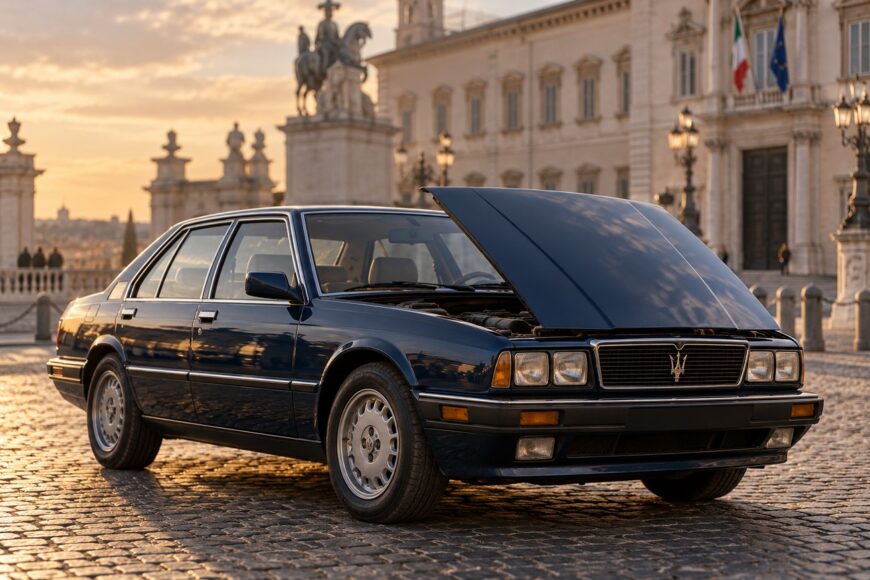
The Maserati Quattroporte III carries the image of an Italian state car: formal proportions, Giugiaro lines, and a large V8 beneath a restrained four-door body. That image is attractive, especially when attached to the documented presidential connection, but it can conceal the realities of owning a low-volume car now more than four decades old.
This is a carbureted, rear-wheel-drive luxury sedan with specialist mechanical and electrical needs. Its provenance, exact specification, and structural condition matter more than the badge, the V8 soundtrack, or a seller’s horsepower claim. A handsome Quattroporte can still require difficult parts sourcing, careful carburetor work, and costly corrosion repairs.
- From Giugiaro Design to the Quirinal Palace
- A Representative Sedan with a Carbureted V8
- The Royale, Presidential Myth, and Collector Value
- Buying One: The Checks That Matter More Than the Badge
- Frequently asked questions
- Why is the Maserati Quattroporte III so cheap compared with newer Maseratis?
- How can you tell whether a Quattroporte III is a genuine Royale?
- Why is the Maserati Quattroporte so cheap?
From Giugiaro Design to the Quirinal Palace
Giorgetto Giugiaro designed the Quattroporte III with a clean, formal shape suited to executive transport. The model was first shown in 1976, while the launch of the third generation belongs to 1979. That distinction explains why contemporary references sometimes attach different dates to the same car.
Its industrial story was Italian but distributed across more than one site. Steel body shells were produced at Innocenti near Milan, and assembly took place in Modena. The car is also closely related in construction and origin to the De Tomaso Deauville, a useful point for buyers searching for technical context and possible component relationships.
On December 14, 1979, Maserati presented the Quattroporte III to Italian President Sandro Pertini in both manual and automatic forms. A special Dark Aquamarine car with a beige velour interior was delivered to the presidential administration in 1983 for official journeys.
That history belongs to specific supplied cars and special orders. It does not make every Quattroporte III government-owned, presidential, or armored. A seller’s description should therefore be supported by factory records, invoices, chassis information, and continuous documentation rather than by the model’s political symbolism alone.
A Representative Sedan with a Carbureted V8
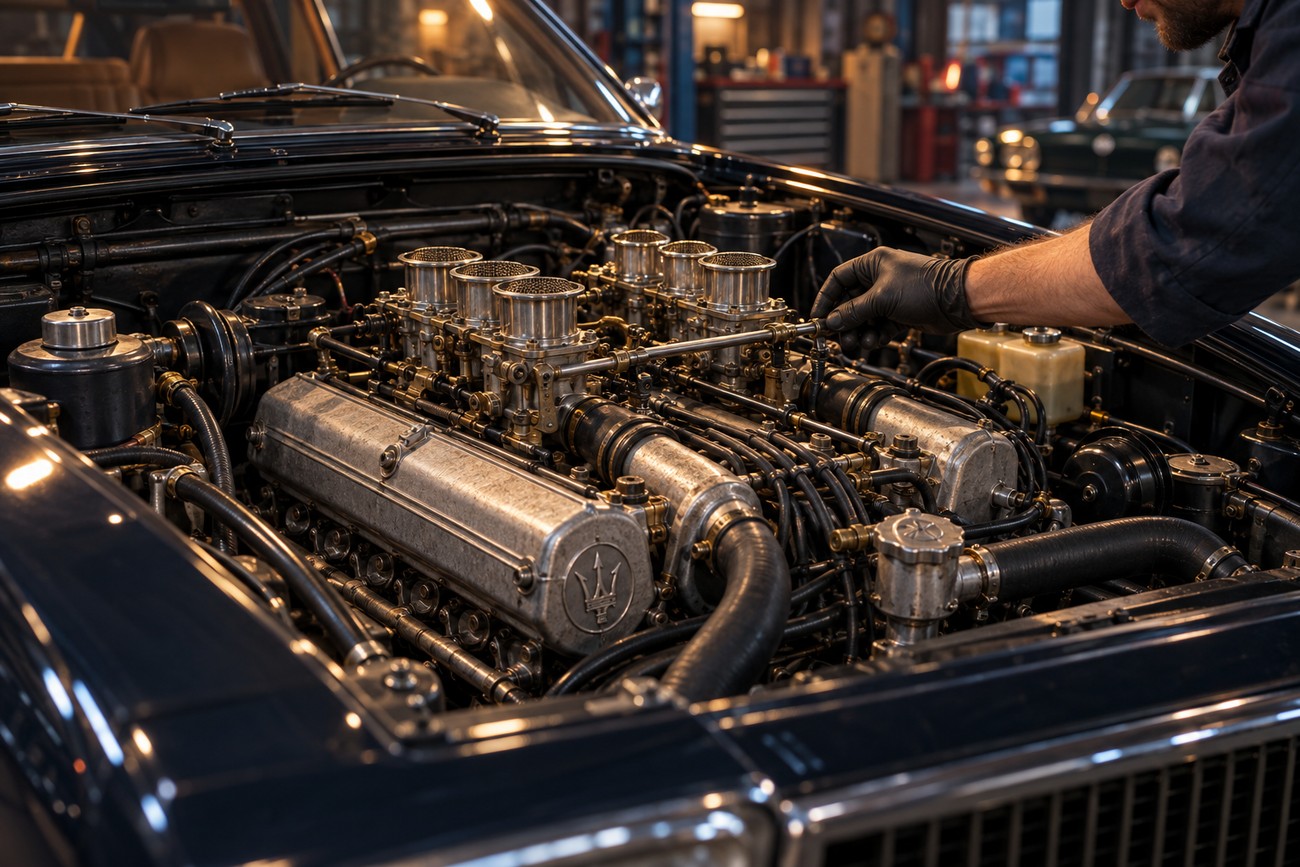
The base engine was a 4.2-liter, 90-degree V8 with two overhead camshafts, officially rated at 255 hp. Later 4.9-liter cars offered more performance; Maserati lists the 4.9-liter at 280 hp and 220 km/h. Some reference sources give 270–282 hp and 220–230 km/h, reflecting differences in year, market, specification, and measurement method.
Those figures should be treated as identification clues, not as a contest between advertisements. A genuine car may have a specification that explains a number outside the seller’s preferred range. Confirming the engine, transmission, market version, and factory documentation is more useful than accepting a claim that every Quattroporte III produced 300 hp.
The carbureted V8 gives the sedan much of its character, yet it also changes the ownership experience. Cold starting, idle quality, and throttle response depend on correct synchronization and careful adjustment of the individual carburetors. After prolonged storage, stale fuel, disturbed settings, or neglected ignition components can turn a dramatic V8 into a difficult engine to start and keep running smoothly.
In concept, the car is closer to a Deauville-based executive machine than to a later fuel-injected Maserati sports sedan. That helps explain its long body, substantial cabin, and relaxed grand-touring character. It also means that modern assumptions about electronic engine management or easy parts availability do not apply.
The Royale, Presidential Myth, and Collector Value
The Quattroporte Royale appeared in 1987 with an updated interior and a more powerful 4.9-liter engine. Its late production position gives it particular interest, but a Royale claim still requires proof. A badge, refurbished cabin, or seller’s wording cannot establish the identity of a factory-built special version.
Verification should begin with the year and engine specification, then continue through factory records, interior details, chassis information, and provenance. Original trim, correct equipment, and a coherent history often reveal more than a recent cosmetic restoration. This is especially important because rare Italian cars can acquire replacement parts and descriptions that gradually become accepted as fact.
The presidential connection has similar limits. The documented 1983 delivery was Dark Aquamarine with beige velour upholstery, a combination that may add historical interest when supported by records. A claim that a 1982 presidential car was armored comes from a single Hagerty source and is not confirmed by the cited official Maserati material, so it should not be generalized.
Collector value therefore rests on a combination of provenance, originality, color, interior, and condition. A larger engine may make a car more desirable, but displacement alone cannot compensate for undocumented history, altered equipment, structural corrosion, or an incomplete restoration.
Buying One: The Checks That Matter More Than the Badge
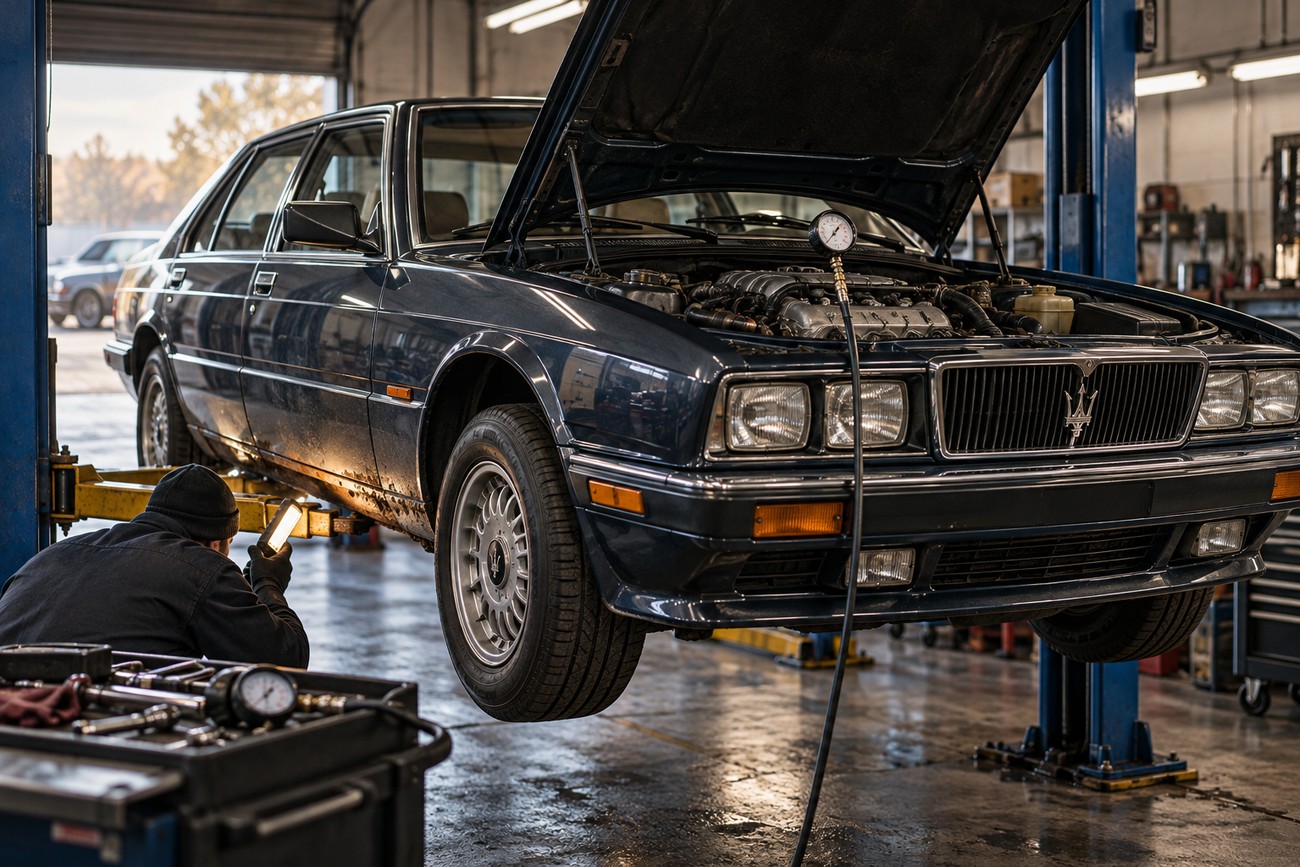
Start with a genuinely cold engine. Check how the car starts without preparation, whether the idle settles, and whether each carburetor responds correctly. A proper inspection should include compression and oil pressure, because a clean engine bay and a polished exhaust note reveal little about internal wear.
Inspect the underside, sills, pillars, floor, and previous repair areas with the same attention given to the paint. Thick paint or fresh underseal can hide corrosion and poorly executed structural work. The most expensive car is often the apparently attractive one that needs its body shell corrected before mechanical rebuilding can begin.
A warm, freshly detailed engine can conceal poor cold-start behavior and an incorrectly balanced carburetor system. Testing the car from cold and checking each carburetor separately gives a far more reliable picture of its condition.
Age-related electrics deserve their own diagnosis. Instruments, relays, window mechanisms, and central equipment may work intermittently, and replacing components without the wiring diagrams can make the fault harder to trace. Automatic cars also need transmission-specific testing; a fluid change will not repair worn mechanical components or faulty control equipment.
Parts supply is another ownership risk. Many components are specific to this low-volume model and may not be available from ordinary inventory. Budget for specialist labor, fabrication, and research before buying. Published fuel estimates of approximately 18.5–19.5 l/100 km are already substantial, and urban use may be higher.
Frequently asked questions
The questions below address the Quattroporte III’s purchase price, special-version claims, and ownership risks. In each case, documentation and condition matter more than appearance or a seller’s description. A careful assessment should account for restoration work as well as the initial purchase price.
Why is the Maserati Quattroporte III so cheap compared with newer Maseratis?
A low purchase price reflects a smaller buyer pool and the limited market for specialist parts, not necessarily low ownership cost. The car is old, mechanically distinctive, and expensive to restore correctly, so many buyers discount it heavily to account for unknown electrical, structural, and carburetion work.
Compare the asking price with the cost of making the car dependable. A cheap example with incomplete records may require more expenditure than a better-documented car bought at a higher price. Restoration exposure, rather than the badge, is the central financial risk.
How can you tell whether a Quattroporte III is a genuine Royale?
Verify the claim through factory documentation, the car’s year, its 4.9-liter specification, interior details, and a consistent ownership history. The Royale appeared in 1987 with an updated interior and a more powerful 4.9-liter engine, so those elements should agree with the chassis and records.
A Royale badge can be added, and interior components can be replaced. Treat the seller’s description as a lead, then confirm it through factory information and period documentation before assigning a collector premium.
Why is the Maserati Quattroporte so cheap?
Its market value is restrained by age, specialist maintenance, fuel use, corrosion risk, and difficult parts sourcing. The Quattroporte III also lacks the broad support network available for more common classic cars, which narrows the number of buyers willing to undertake a restoration.
Usability can improve substantially after proper mechanical and electrical work, but that investment is rarely recovered in full. Buy the best-documented, structurally sound example you can find rather than the cheapest car carrying the most impressive story.







