
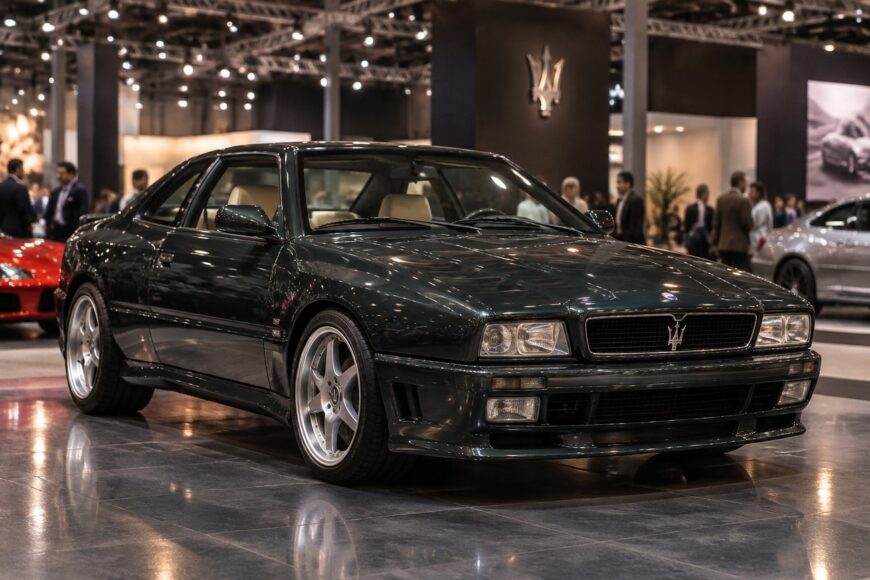
A compact 1990s sedan with a 330-hp twin-turbo V6 sounds like an engineering contradiction. The Maserati Ghibli Cup resolved it with a small-displacement engine, rear-wheel drive, a six-speed manual gearbox, and a level of specific output that belonged closer to a specialist sports car than an executive four-door.
That performance came with heat, mechanical complexity, sharp power delivery, nervous road manners, and difficult parts supply. The Cup rewards a sympathetic owner who understands preventive maintenance; it can punish anyone treating it as an ordinary used sedan. The figures below separate Maserati’s factory specification from enthusiast folklore and inconsistent catalog data, without reducing the car to a generic specification sheet.
- What the Maserati Ghibli Cup Actually Is
- The 2.0-Liter Twin-Turbo V6 That Made It a Hot Rod
- Performance on Paper, and the Feel Behind the Numbers
- 1990s Maserati Ghibli Cup: Spec Sheet Without the Noise
- The Ownership Reality: Heat, Turbos, and Scarce Parts
- How to Buy a Ghibli Cup Without Buying a Problem
- 330 or 355 HP? Sorting the Ghibli Cup Myths
- Frequently asked questions
- Which Maserati Ghibli has a Ferrari engine?
- What does IHI mean on a Ghibli Cup specification sheet?
- Why do some listings show 243 kW instead of 330 hp?
- Was the Ghibli Cup a racing homologation special?
What the Maserati Ghibli Cup Actually Is
The Maserati Ghibli Cup was presented at the Bologna Motor Show in December 1995. It was a late and limited version of the second-generation Ghibli II, arriving near the end of a model line that had carried Maserati’s compact, turbocharged performance identity through the 1990s.
Its ancestry reaches back to the Biturbo family and its many derivatives. That lineage favored compact dimensions, forced induction, and high output over the polished refinement associated with larger luxury sedans. The Cup pushed that formula toward its most concentrated road-car expression, with a more serious performance brief than an ordinary Ghibli II.
The 2.0-liter capacity also reflected the Italian market in which the car was developed and sold. Taxation and registration economics made smaller engines particularly relevant in Italy, so displacement alone does not describe the Cup’s ambition. Maserati extracted exceptional output from a compact V6 instead of relying on a larger engine.
That makes the Cup historically interesting beyond its acceleration figures. It belongs to the final, highly developed phase of Maserati’s 1990s Biturbo-derived approach, when a relatively small sedan could deliver super-sedan pace through turbocharging, gearing, and aggressive calibration. Production totals should not be invented or assumed from the model’s rarity; individual cars and documentation matter more than a neat number.
The 2.0-Liter Twin-Turbo V6 That Made It a Hot Rod
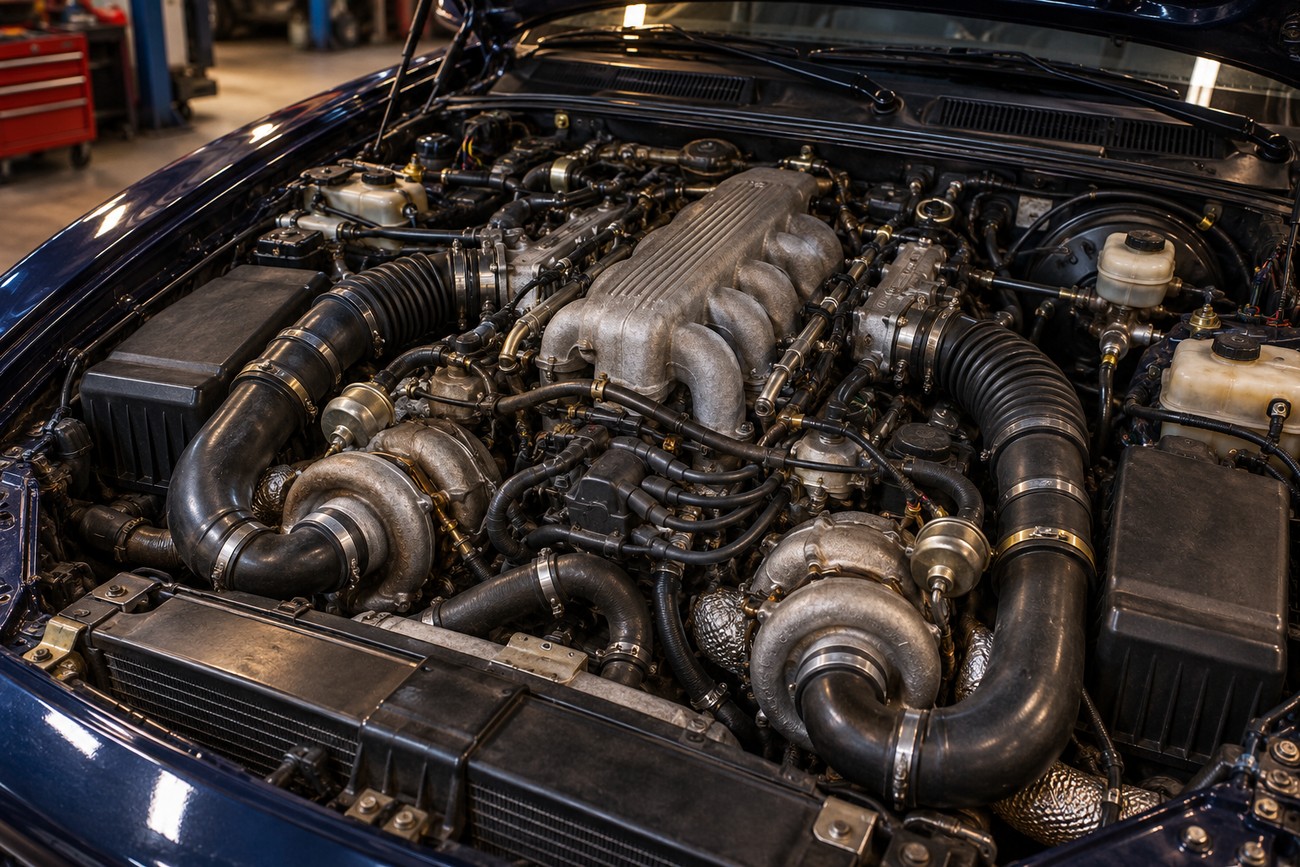
The engine is a 2.0-liter V6 with two IHI turbochargers, Weber-Marelli fuel injection, and 24 valves. In practical terms, that means a compact engine working through two separate pressure-generating units, a detailed intake and fuel system, and a calibration designed to produce substantial power from limited displacement.
Maserati’s official description gives 330 hp at 6,500 rpm. Period descriptions also cited approximately 165 bhp per liter, a remarkable specific-output figure that explains both the Cup’s speed and its sensitivity to maintenance. Every component involved in producing and controlling boost operates under meaningful thermal and mechanical demand.
Power reaches the rear wheels through a six-speed Getrag manual transmission. That combination gives the driver direct control over the engine’s operating decisions: gear choice, boost response, and throttle position all matter. It also means clutch condition and gearbox behavior deserve the same attention as the engine itself.
Some enthusiast and third-party sources claim 355 hp, but this is not the official Maserati figure. Other listings use 330 bhp, 325 hp, or 243 kW, partly reflecting different catalog conventions and rounding. The defensible factory reference remains 330 hp at 6,500 rpm.
The appeal of the layout is its density. A small rear-wheel-drive sedan with a manual gearbox and twin turbos offers a level of involvement that many modern performance cars filter through electronics and greater mass. The cost is a system with more hoses, connections, heat sources, and calibration dependencies than its modest displacement might suggest.
Performance on Paper, and the Feel Behind the Numbers
Independent testing reports approximately 5.6 seconds from 0 to 100 km/h, with a top speed of approximately 270 km/h. In the mid-1990s, those figures placed the Cup firmly in super-sedan territory. They remain serious numbers for a compact car, particularly one whose driver manages the transmission without an automatic launch system.
Reported torque is 280 lb-ft, equivalent to 371 Nm, at 4,000 rpm. The figures explain the car’s force once the engine is operating in its effective range, while the twin-turbo arrangement explains why the delivery can feel sudden. Throttle inputs that seem minor in a modern, heavily managed car may produce a much more immediate change in the Cup’s attitude.
Owners often describe the power delivery as sharp and difficult to meter smoothly in city traffic. Low-speed driving can therefore demand concentration, especially when the road is crowded or the engine and turbo system are not behaving at their best. The compact body helps the car feel alert, yet it also leaves little distance between the driver’s inputs and the chassis response.
Stiffness, mechanical noise, and a generally nervous character complete the impression. The Cup prioritizes speed and intensity over everyday comfort, so a short fast drive can be memorable while a long urban commute exposes its compromises. Its personality is closer to a road-going hot rod than to a quiet luxury sedan.
1990s Maserati Ghibli Cup: Spec Sheet Without the Noise
The figures below put factory information beside the variations found in specialist specifications and listings. They should be read as a guide to the individual car, since period and third-party data are not perfectly consistent.
| Item | Factory or canonical reference | Reported variation or context |
|---|---|---|
| Engine | 2.0-liter V6, twin IHI turbochargers, Weber-Marelli injection, 24 valves | Specification is consistent with the Cup’s Biturbo-derived layout |
| Power | 330 hp at 6,500 rpm according to Maserati’s official description | Listings may show 330 bhp, 325 hp, or 243 kW; some unofficial sources claim 355 hp |
| Torque | 280 lb-ft, equivalent to 371 Nm, at 4,000 rpm | Different units can make the same output appear inconsistent |
| Transmission | Six-speed Getrag manual | Rear-wheel drive |
| Kerb weight | No single universally consistent figure | Published figures range from 1,365 kg to 1,424 kg |
| Acceleration | No single factory figure used here | Independent testing reports approximately 5.6 seconds from 0 to 100 km/h |
| Top speed | No single factory figure used here | Approximately 270 km/h is commonly reported |
The Ownership Reality: Heat, Turbos, and Scarce Parts
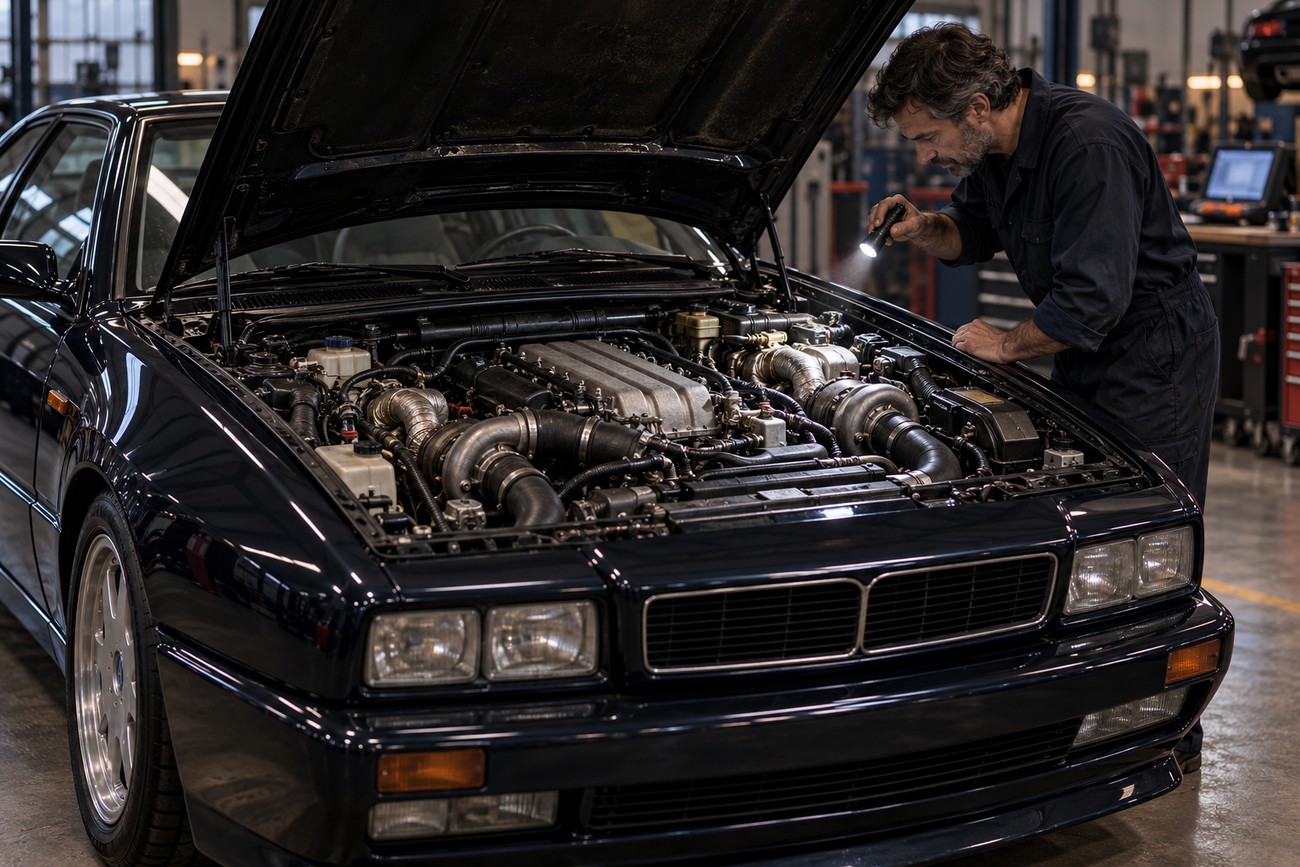
The Cup’s approximately 165 bhp per liter in period descriptions is an impressive technical achievement, though it raises the workload for the engine and its supporting systems. Heat management becomes central to reliability, especially in an older car whose hoses, seals, wiring, and cooling components may have aged together. A clean engine bay does not prove that those parts remain healthy.
The twin-turbo system creates several potential leak points. Turbochargers, intake and boost plumbing, hoses, fuel delivery, cooling, and calibration all influence the final result, so a power complaint cannot automatically be assigned to one failed turbo. A car may lose performance because a peripheral component has deteriorated while the turbocharger itself remains serviceable.
The complete boost, cooling, and hose system should be diagnosed together because replacing a turbocharger based on a power-loss symptom alone can leave the original fault untouched.
Preventive maintenance is therefore more appropriate than waiting for a dramatic failure. Previous owners who serviced the car by symptoms may have left small leaks or heat-related weaknesses to develop into larger faults. The quality of the maintenance history often tells you more than a recent cosmetic refurbishment.
Parts supply adds a separate risk. Original components and Cup-specific body parts can be rare and expensive, and a correct repair may involve a long search rather than a next-day order. That delay affects the ownership experience even when the eventual mechanical repair is straightforward.
The result is a car that can be rewarding when maintained as a complete system and costly when treated as a sequence of isolated repairs. Scarcity also makes improvisation tempting, yet unsuitable substitutions can create new problems in a highly stressed turbocharged installation.
How to Buy a Ghibli Cup Without Buying a Problem
Begin by verifying that the car is genuinely a Cup and by documenting its specification. Check the identification details, period records, and the history of modifications. A rare performance derivative may have been altered, repaired, or assembled from parts during its life, so the badge and advertised horsepower are only starting points.
A serious inspection should include a cold start and a full assessment of turbochargers, hoses, intake and boost plumbing, fueling, and cooling. Look for evidence that the system has been maintained as a whole. The engine’s behavior under load matters, yet the surrounding hardware often determines whether that behavior remains repeatable.
The six-speed manual gearbox and clutch are critical inspection points. Check engagement, selection, noise, and the clutch’s response under load, then relate those findings to the documented service history. A transmission that feels acceptable during a brief drive can still require expensive work if its condition is marginal.
Documentation should show preventive servicing rather than a string of emergency repairs. Records of cooling-system attention, hose replacement, turbo-related work, fuel-system maintenance, and clutch or gearbox service carry practical value. An undocumented car may be usable, but its price should reflect the uncertainty.
Daily-use buyers also need a realistic allowance for frequent servicing and possible parts delays. A lower asking price is not a bargain if a rare component leaves the car stationary for an extended period. Condition, authenticity, and documentation should decide the purchase more heavily than the advertised horsepower figure.
330 or 355 HP? Sorting the Ghibli Cup Myths
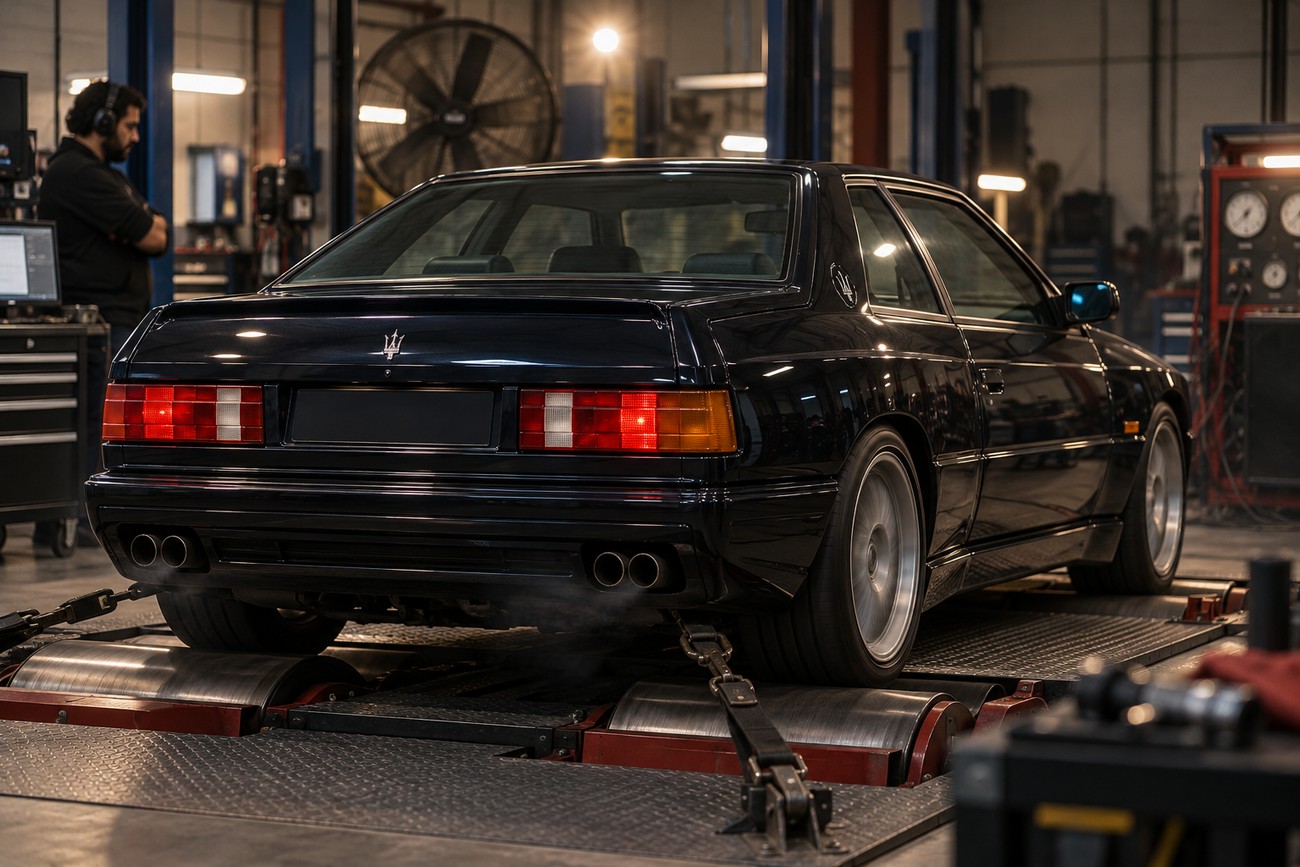
Maserati’s official description gives the Ghibli Cup 330 hp at 6,500 rpm. That is the correct starting point for identifying the factory specification. The 355-hp figure appears in unofficial sources and should be labeled disputed rather than repeated as settled fact.
Third-party data varies in other ways as well. Specialist specifications and listings may use 330 bhp, 325 hp, or 243 kW, while published kerb-weight figures range from 1,365 kg to 1,424 kg. These differences may reflect unit conventions, rounding, equipment, source methodology, or individual-market records.
Performance figures should receive the same cautious reading. Approximately 5.6 seconds to 100 km/h and approximately 270 km/h describe the car’s established period capability, while the exact result depends on test conditions and vehicle condition. A worn clutch, tired turbo system, or poor calibration can make a healthy specification irrelevant to the car in front of you.
The Cup is also more than a mildly upgraded standard Ghibli. It is a distinct limited performance version within the late Ghibli II range, shaped by Maserati’s Biturbo-derived engineering and an unusually aggressive output target. Its value lies in that complete character, not in winning an argument over one disputed number.
Frequently asked questions
Which Maserati Ghibli has a Ferrari engine?
The 1990s Maserati Ghibli Cup does not have a Ferrari-built engine. It uses Maserati’s 2.0-liter twin-turbo V6, while Ferrari-built V6 engines are associated with later Maserati Ghibli generations. Buyers should therefore identify the car by its generation and engine specification before using modern Ghibli search results as references.
What does IHI mean on a Ghibli Cup specification sheet?
IHI identifies the manufacturer of the Cup’s two turbochargers. It is a turbocharger-supplier reference, not the name of a separate engine family and not a trim level. This distinction helps decode advertisements that list the engine and turbo hardware in the same line.
Why do some listings show 243 kW instead of 330 hp?
243 kW is a metric power label, while 330 hp and 330 bhp use horsepower conventions that can differ slightly in definition and rounding. Catalogs may also convert and round the same underlying specification differently. The apparent conflict does not by itself prove that a car has a different engine; the official Maserati reference remains 330 hp at 6,500 rpm.
Was the Ghibli Cup a racing homologation special?
The Cup is best described as a limited-production road-car performance derivative, not automatically as a formal racing homologation model. Its rarity, aggressive specification, and Biturbo lineage give it strong competition-car associations, but those qualities do not by themselves establish a homologation purpose.







