
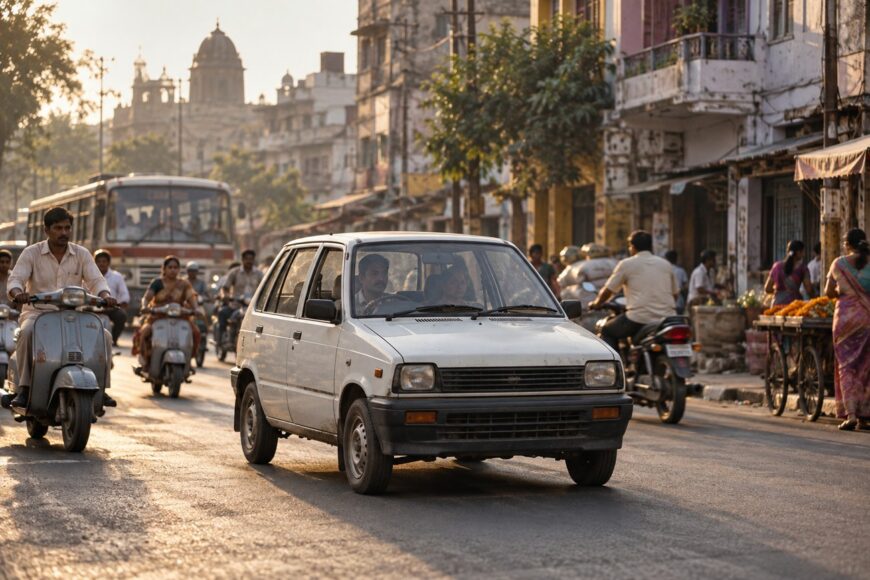
The Maruti 800 occupies an unusual place in automotive history. It helped turn private car ownership from a distant aspiration into a practical possibility for millions of Indian households, yet the same car feels remarkably basic today. Its compact body, small engine, limited safety equipment, and aging mechanical systems demand a more careful assessment than its reputation as a “people’s car” may suggest.
A buyer may be considering one for nostalgia, inexpensive urban transport, restoration, or use as a family car. Those are very different jobs. The condition of the individual vehicle, its version, parts support, and the roads it will use matter more than the Maruti 800 badge or a low asking price.
- How the Maruti 800 Changed Indian Motoring
- Maruti 800 Specifications: Small Numbers, Clear Trade-Offs
- What It Is Like to Live With One Today
- The Maruti 800 Myths That Mislead Buyers
- Buying a Used Maruti 800: Condition Beats Year
- Safety, Practical Limits and the Maruti 800 Legacy
- Frequently asked questions
- What is the oldest Maruti 800 model?
- What was the price of a 1986 Maruti Suzuki 800?
- Which Maruti 800 model is best?
How the Maruti 800 Changed Indian Motoring
The Maruti 800 entered production in 1983 and became a defining step in India’s move toward mass car ownership. Its small footprint, modest running costs, and relatively simple construction made private transport more attainable for households that had previously relied on two-wheelers, public transportation, or older larger cars. The model remained in production until 2014, giving it one of the longest runs of any Indian mass-market car.
Its success came partly from matching the realities of Indian cities. A narrow body was easier to place on crowded streets, a small petrol engine reduced the mechanical and financial burden of ownership, and uncomplicated controls were familiar to drivers moving up from motorcycles. The Maruti 800 was never a luxury product. Its importance came from making an ordinary car usable and attainable at a time when the market offered far fewer choices.
The car is sometimes described as an entirely indigenous Indian design. That is inaccurate. The Maruti 800 was based on the Suzuki Alto 1979 model year and represented a locally produced and adapted branch of Japanese small-car engineering. This origin does not diminish its Indian cultural impact. Local production, distribution, servicing, and adaptation to Indian conditions made the model a distinctly Indian motoring experience.
Its production record also explains why examples remain familiar across generations. Only the Hindustan Ambassador lasted longer on an Indian production line. A surviving 800 may therefore be an early, lightly modified car, a later version with different equipment, or an extensively repaired vehicle that shares little of its original condition. The history is national in scale, while the buying decision is intensely specific to the individual car.
Maruti 800 Specifications: Small Numbers, Clear Trade-Offs
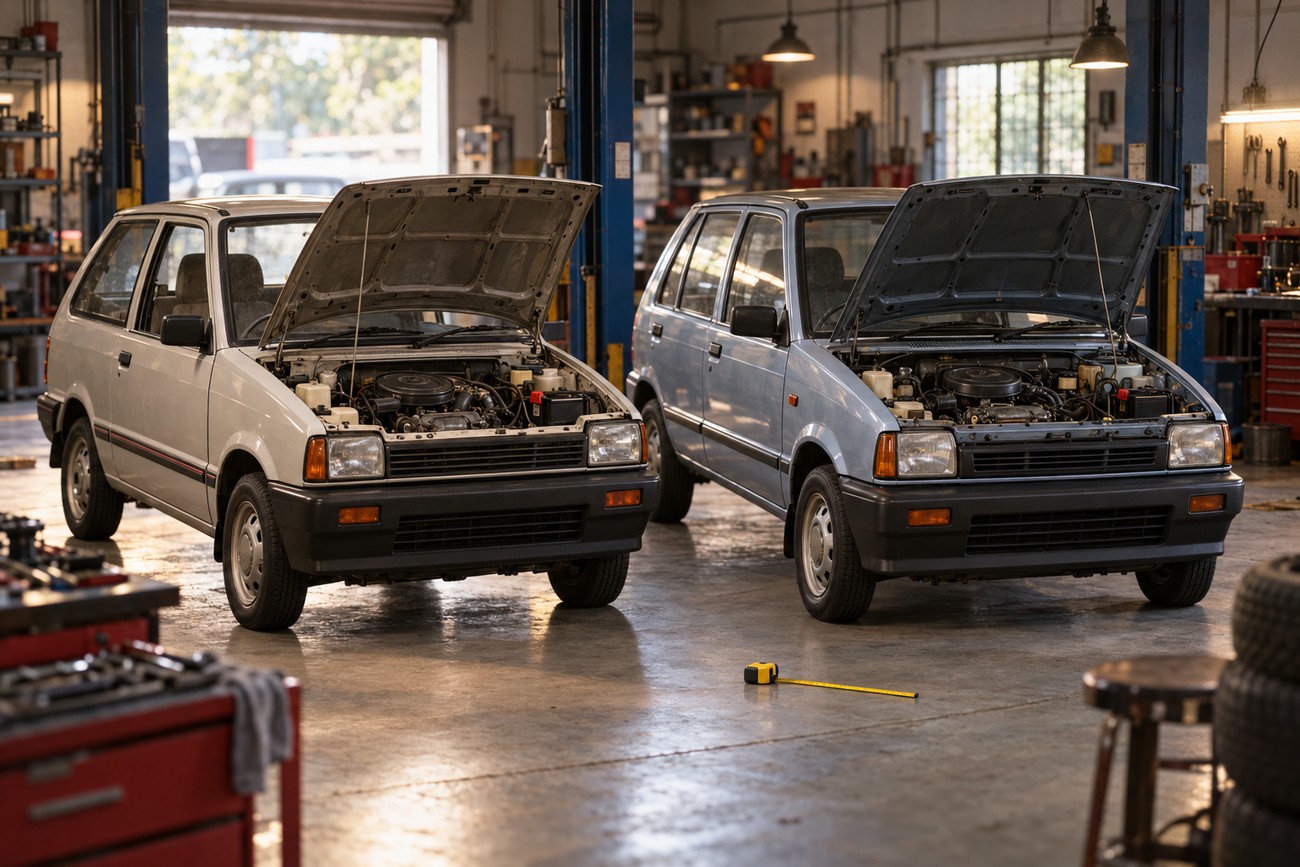
The Maruti 800 used a 0.8-litre petrol engine, but its specifications should not be treated as one fixed set. Sources document both 35 hp and 45 hp for different versions, markets, or modifications. Late versions are commonly listed with front-wheel drive, a 5-speed manual gearbox, and a 5-door hatchback body. Earlier cars may differ in engine specification, transmission, equipment, and emissions hardware.
Typical catalogue dimensions are 3335 mm in length, 1440 mm in width, 1405 mm in height, and a 2175 mm wheelbase. These figures explain the car’s urban manners: it occupies little road space, can fit into tight parking areas, and remains easy to place in slow traffic. Some listings cite a turning radius of about 4.4 m, although that figure should be rechecked against the specific modification before it is used as a buying assumption.
Catalogue performance figures include a top speed of approximately 137 km/h and 0–100 km/h times of roughly 18.5–21 seconds, depending on the version and source. Those numbers already describe restrained performance when the car was new. On an old example, worn compression, a tired clutch, incorrect tuning, underinflated tires, or extra passengers can make the response slower still.
In daily traffic, the small engine is adequate for low-speed urban work when the car is healthy and lightly loaded. Full occupancy, air-conditioning use, steep roads, and highway overtaking expose its limited reserve quickly. A driver planning regular long-distance travel should treat the published figures as historical reference points, not as a promise of modern traffic performance.
What It Is Like to Live With One Today
The Maruti 800 still makes sense in a narrow but real role. Its small exterior dimensions simplify parking and maneuvering, while its controls and mechanical layout are easy for a basic workshop to understand. For short urban errands, a sound example can be less intimidating than a larger modern vehicle, especially on crowded streets where width and visibility matter more than acceleration.
Cabin space is the first major compromise. Owners commonly describe the interior as cramped, and rear-seat comfort becomes limited when adults occupy the front seats. The boot is also small, so a family’s luggage, shopping, or child-related equipment can quickly consume the available space. It is better understood as an ultra-budget urban hatchback than as a fully equipped family car.
The driving experience has other predictable limits. Low sound insulation allows engine, road, and wind noise into the cabin, while the basic suspension can feel busy and unsettled over poor surfaces. Vibration may be acceptable at low speeds in a well-maintained car, but worn mounts, suspension components, or tires can turn the same design into an exhausting daily commute.
Air conditioning and a full load place a noticeable demand on the engine. Acceleration becomes more deliberate, and joining faster traffic requires planning rather than a quick burst of power. That makes the Maruti 800 most convincing as a city runabout or second car, with occasional highway use on familiar roads, rather than as the only vehicle for a family that regularly travels long distances.
The Maruti 800 Myths That Mislead Buyers
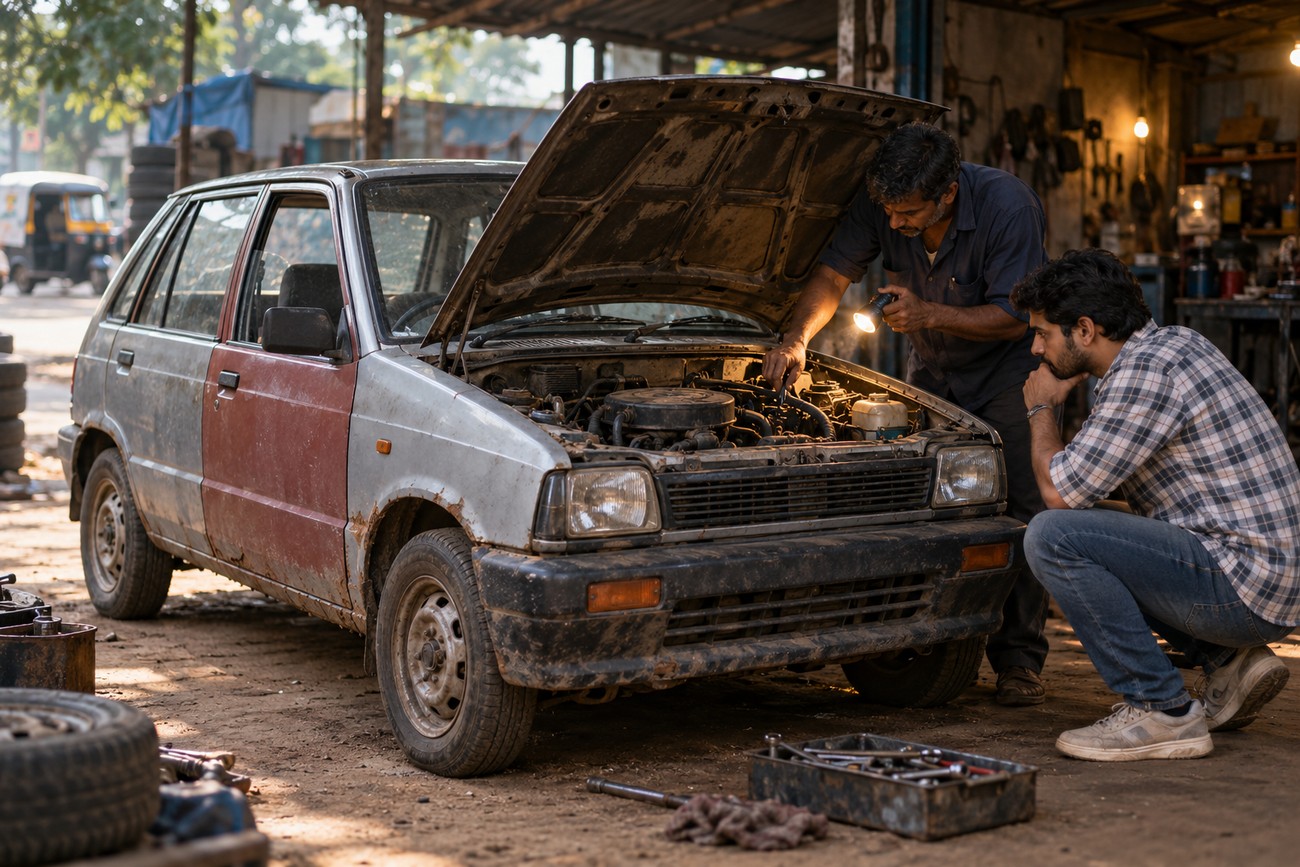
The first common myth is that every Maruti 800 has the same engine output. The documented 35 hp and 45 hp figures belong to different versions, markets, or modifications. Before comparing two cars, identify the production period, engine, transmission, and equipment. A seller’s reference to “the 800’s power” is too vague to predict how one particular car will drive.
Fuel economy is also frequently reduced to a single attractive number. Claims around 6 L/100 km may reflect selected catalogue figures and favorable conditions, rather than congested traffic in an old, heavily used car. Real consumption changes with maintenance, tire condition, load, air-conditioning use, traffic, fuel quality, and driving style. A buyer should inspect the car’s actual fuel records where possible instead of budgeting from an ideal figure.
Published fuel requirements vary as well. Catalogues for different years or markets reference both AI-92 and AI-95, so the correct requirement should be checked for the exact engine and market specification. Fuel-tank capacity is similarly modification-dependent: 30 liters is typical, while some listings state 28 liters. These differences are small in isolation, but they demonstrate why generic specification pages can mislead an owner ordering parts or estimating range.
The final myth is that a Maruti 800 is automatically a complete family car because it has five doors and four seats. Its dimensions, boot capacity, limited loaded performance, and period-level equipment point to a more modest role. The model’s appeal lies in inexpensive, uncomplicated city transport; expecting the space, refinement, and highway confidence of a modern compact car leads to disappointment.
Buying a Used Maruti 800: Condition Beats Year
Start with the body shell before evaluating trim, paint, or the seller’s description of the engine. Inspect door bottoms, wheel arches, floor areas, suspension mounting points, and the underside for corrosion. Uneven panel gaps, mismatched paint, bubbling seams, and fresh underseal can indicate repairs that deserve closer examination. A clean-looking exterior may conceal extensive patchwork beneath the surface.
Next, check the chassis and suspension. Look for evidence of structural repairs, poor welding, sagging, uneven tire wear, and knocks over rough pavement. The steering should not feel excessively loose, and braking should be consistent. On a car of this age, a road test is more informative than a brief stationary start because it reveals clutch engagement, gearbox behavior, vibration, overheating tendencies, and suspension noise.
Corrosion, chassis repairs, and electrical quality matter more than shiny paint or an early advertised model year because they determine whether an old 800 is a usable car or a continuing repair project.
Electrical condition deserves its own inspection. Test the starter, alternator, lights, indicators, wipers, horn, instrument panel, heater, and air-conditioning equipment if fitted. Worn wiring and improvised connections can create intermittent faults that are difficult to trace. Also inspect the engine for oil leaks, blue exhaust smoke, difficult cold starting, overheating, and signs that several unrelated repairs have been combined over time.
Service records are valuable, but they do not replace physical inspection. Confirm the identity of the engine and major components, then verify that replacement parts are compatible with the vehicle’s generation. Different years and equipment levels have meaningful differences, and a part that fits one Maruti 800 may not be correct for another. Availability should be checked before purchase, especially for trim, electrical components, and less common body items.
Production year alone is a weak guide to value. A later car with neglected corrosion can be a poorer purchase than an older example with a sound shell, coherent maintenance history, and accessible parts. Nostalgia can make a rough car seem more desirable than it is, while a low price may simply transfer the cost into bodywork and electrical repairs. Buy the condition and intended use, not the legend.
Safety, Practical Limits and the Maruti 800 Legacy
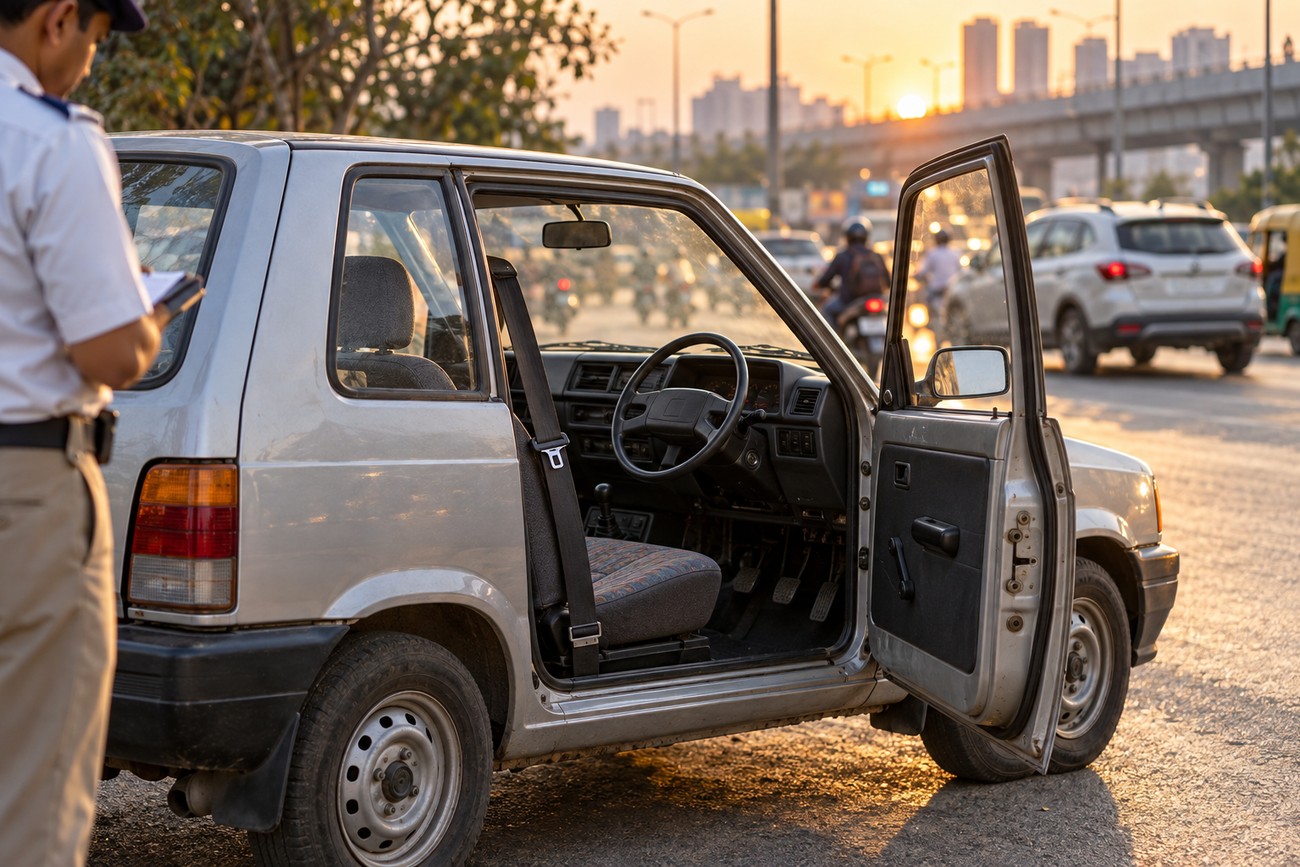
The Maruti 800 should be judged in its historical setting while still being assessed honestly by today’s standards. Its passive-safety level is basic by current expectations, and it lacks modern driver-assistance systems. That means the car provides little of the electronic support, crash protection, and occupant restraint development found in newer vehicles. Careful speed selection and defensive driving matter more, not less, in an older design.
The model did evolve during its long production life. A version meeting Euro 3 standards appeared on the Indian market in 2005, showing that the car was adapted over time rather than frozen in its earliest form. Emissions compliance, engines, equipment, and drivetrains can therefore differ across the production run. A late car may be more suitable for a particular owner, but its condition still determines whether that advantage survives in practice.
Its strongest modern case remains low-speed urban transport. Compact dimensions, simple operation, and an established place in Indian automotive culture can make a good example useful for short trips or as a second vehicle. The same qualities do not erase its restricted cabin, small boot, modest refinement, or limited ability to keep pace when fully loaded on demanding highways.
Production ended in 2014 after 31 years. The legacy is deserved: the Maruti 800 helped normalize car ownership and gave India a durable small-car foundation. That achievement should coexist with practical caution. A well-preserved car can be an inexpensive piece of motoring history; a neglected one can be an unsafe and uneconomical project disguised by a famous name.
Frequently asked questions
The answers below separate historical facts from claims that require a specific car, market, or period source. That distinction is especially important with an old model whose published specifications changed across generations.
What is the oldest Maruti 800 model?
The oldest Maruti 800 models are from the 1983 production start. An early surviving example should be verified through its vehicle identification details, registration records, period components, and production documentation where available. The presence of early-style badges, panels, or interior parts alone does not prove that the entire car is an original early-production vehicle.
Restored cars can contain later replacement parts, while heavily repaired cars may retain an early identity but little original material. For collectors, matching documents and components matter more than an early appearance. For ordinary transport, structural condition and parts support remain more important than claiming the earliest possible year.
What was the price of a 1986 Maruti Suzuki 800?
There is no reliable universal price for a 1986 Maruti Suzuki 800 without a verified period advertisement and market context. The figure would depend on location, trim, taxes, dealer charges, delivery conditions, and whether the source recorded an official price or an asking price.
Historical claims should therefore be checked against a dated advertisement, an archived price list, or contemporary registration information. That original figure should not be confused with today’s used-car asking prices, which reflect rarity, restoration quality, local demand, and the condition of the individual vehicle.
Which Maruti 800 model is best?
The best version depends on the job. For urban errands, prioritize a sound body, reliable electrical system, easy parts access, and a healthy engine rather than choosing solely by the 35 hp or 45 hp label. For restoration, an unusually complete early car may be more valuable, while occasional transport favors the most usable, well-supported example available in the local market.
Check the generation before buying parts, and judge the car after a proper inspection. A later version is not automatically superior, and an earlier version is not automatically more desirable. Condition, compatibility, and intended use provide a more dependable recommendation than a single badge or catalogue specification.







