
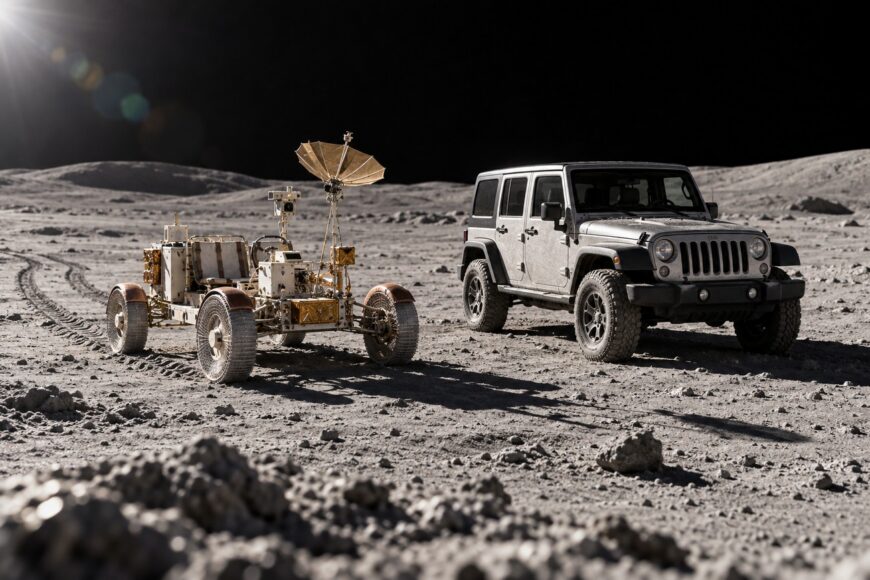
A Jeep Wrangler crossing a lunar plain makes a compelling image: high ground clearance, exposed wheels, and a landscape that looks like the world’s most remote off-road trail. Yet Earth off-roading assumes an atmosphere, familiar temperatures, and gravity that keeps tires pressed into the ground. The Moon offers a vacuum, severe thermal swings, abrasive dust, and approximately one-sixth of Earth’s gravity.
The meaningful comparison is therefore about more than whether the wheels could turn. A lunar vehicle must start, shed heat, retain control, complete a useful route, and remain recoverable if conditions deteriorate. On those terms, the purpose-built Apollo lunar rover has a clear advantage over a stock Wrangler, though its modest speed and narrow mission role would disappoint anyone expecting a conventional SUV.
- What Does It Mean for a Vehicle to Work on the Moon?
- The Moon Changes Every Assumption Behind a Jeep
- Lunar Rover vs. Jeep Wrangler: Systems Compared
- Why a Stock Jeep Wrangler Would Fail Before It Became an Off-Roader
- Why the Lunar Rover Is the Better Vehicle—and a Limited One
- Low Gravity Does Not Turn Lunar Driving into Easy Off-Roading
- The Hidden Engineering Problems: Dust, Heat, Energy, and Testing
- The Verdict: Which Vehicle Would Work on the Moon?
- Frequently asked questions
- How many lunar rovers are left on the Moon?
- What powered the lunar rover on the Moon?
- How many lunar rovers have operated on the Moon?
What Does It Mean for a Vehicle to Work on the Moon?
“Work” should mean operating through a planned surface mission, rather than moving a few feet after extensive improvisation. The vehicle needs a dependable source of propulsion, components that tolerate vacuum and dust, and enough stored energy for driving and thermal control. It must also carry its intended load without losing steering or braking authority on uneven ground.
Reliability matters more on the Moon because a breakdown changes the mission, not merely the travel plan. A crew cannot summon a tow truck, and a robotic vehicle may have no practical means of repair. Route length, terrain, available energy, and the ability to return must therefore shape the vehicle before the first wheel is built.
Lunar gravity is approximately one-sixth of Earth’s, which reduces a vehicle’s weight while leaving its mass and inertia unchanged. That affects traction, stopping, and stability in ways familiar ground-clearance measurements cannot capture. A machine that climbs rocks on Earth has demonstrated an ability under Earth’s gravity, with Earth-compatible tires and systems; it has not demonstrated lunar mobility.
There is also a crucial distinction between modifying an Earth vehicle and designing a lunar one. A near-total rebuild could produce a vehicle with a Wrangler-like outline, but its propulsion, cooling, wheels, materials, and protection would be different. The comparison here is between an actual stock Wrangler and a rover engineered around lunar conditions.
The Moon Changes Every Assumption Behind a Jeep
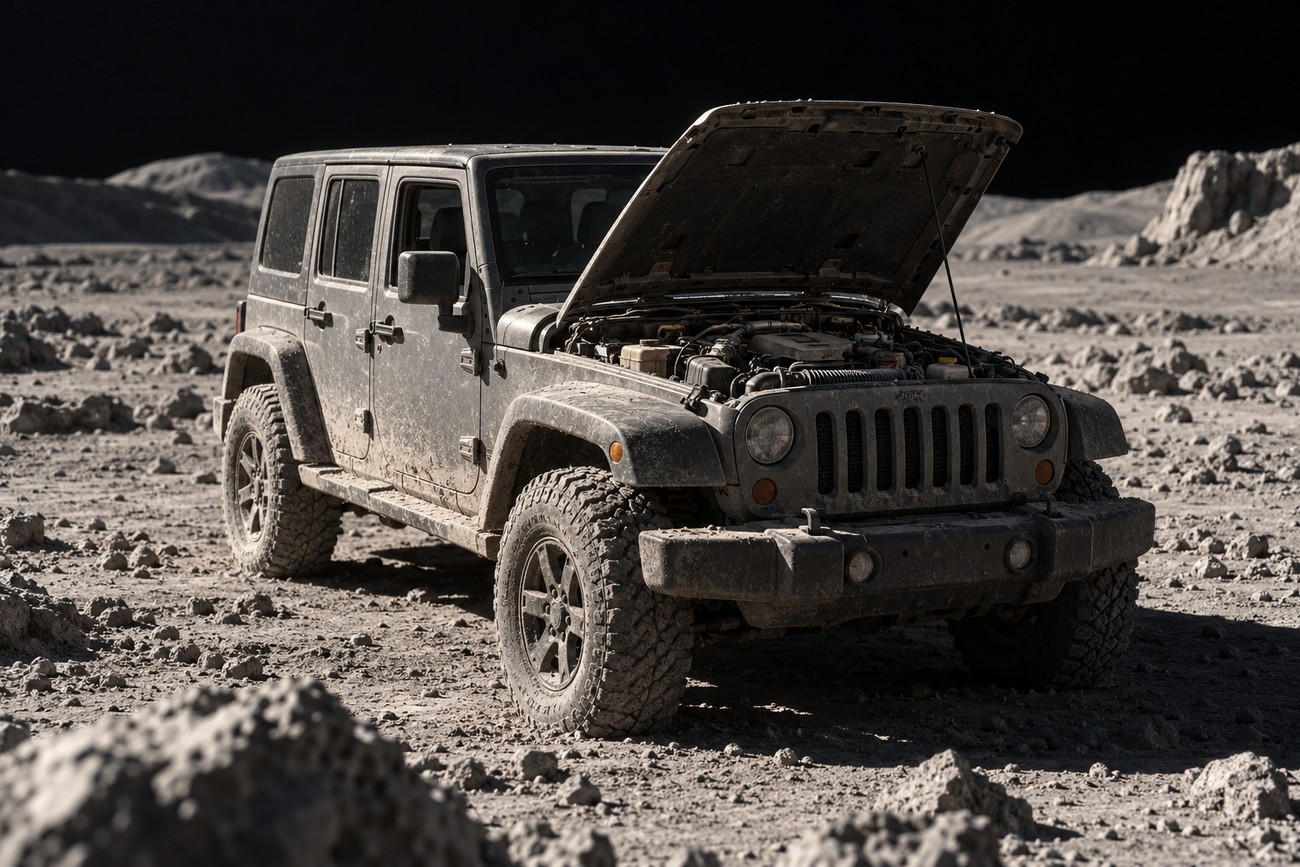
The Moon has a vacuum and no usable atmospheric oxygen. An internal-combustion engine depends on oxygen reaching its cylinders, while many vehicle systems assume they can exchange heat or gases with surrounding air. Vacuum also changes how materials and fluids behave, so a component that works well on a terrestrial trail may be unsuitable before terrain becomes an issue.
Heat presents two opposite hazards. Lunar surface temperatures can reach approximately +120 °C on an illuminated surface and fall to approximately −170 °C during lunar night. Exposure depends on location, sunlight, and mission timing, but either extreme lies far outside the conditions an ordinary road vehicle is designed to survive. Repeated heating and cooling can alter seals, plastics, cable insulation, and lubricants.
The absence of air removes ordinary convective cooling. A radiator can circulate coolant inside a vehicle, but its familiar method of transferring heat to passing air is unavailable. Motors, electronics, and batteries still generate heat; keeping them within operating limits calls for a different thermal-management design. Shade can help one component while leaving another too cold to function.
Regolith adds a mechanical problem that does not resemble ordinary mud. It is abrasive and electrostatically clingy, so it can remain on surfaces and contaminate joints, bearings, connectors, and sensors. A wheel may continue to rotate while dust quietly degrades the latch, electrical connection, or steering mechanism needed for the trip home.
Ordinary rubber tires, polymers, sealants, and greases cannot be assumed to retain their properties through vacuum and extreme thermal cycling. Some materials may become brittle or change shape; unsuitable lubricants may evaporate, thicken, or degrade. Every exposed part needs evaluation as part of a system, rather than an assumption that an off-road specification covers space.
Lunar Rover vs. Jeep Wrangler: Systems Compared
The largest differences sit beneath the bodywork: each vehicle starts with a different set of environmental assumptions.
| System or priority | Apollo lunar rover | Stock Jeep Wrangler |
|---|---|---|
| Propulsion | Battery-powered electric drive designed for lunar surface travel. | Internal-combustion engine designed to run in Earth’s atmosphere. |
| Oxygen requirement | Electric motors need no oxygen for combustion. | The engine cannot operate normally without an external oxidizer in lunar vacuum. |
| Energy | Stored battery energy budgeted for a short mission. | Fuel system depends on a working combustion engine and Earth-oriented supporting systems. |
| Cooling | Thermal design accounts for operation without convective cooling from air. | Liquid cooling is built around rejecting heat under terrestrial conditions. |
| Wheels | Specialized mesh-like wheels rather than ordinary pneumatic rubber tires. | Pneumatic rubber tires intended for Earth’s roads and trails. |
| Structure and materials | Lightweight, folding vehicle using materials selected for its mission environment. | Road-vehicle body and components selected for terrestrial durability and use. |
| Dust and environmental protection | Designed with lunar contamination and vacuum in mind. | No stock protection against sustained lunar vacuum and regolith exposure. |
| Speed | Approximately 10–13 km/h maximum. | Built for far higher speeds on Earth; that capability cannot be transferred to the Moon. |
| Traction assumptions | Designed for low gravity and loose lunar terrain, within mission limits. | Tire loading and handling depend on Earth’s gravity and terrestrial surfaces. |
| Payload and purpose | Limited payload for short surface movements during a specific mission. | Passengers, cargo, comfort, and general-purpose driving on Earth. |
The propulsion mismatch is decisive. The rover’s electric drive can draw energy from its batteries without atmospheric oxygen. The Wrangler’s fuel, intake, exhaust, and engine form a linked combustion system; changing one part does not make the rest compatible with vacuum.
The wheel comparison is similarly easy to oversimplify. The rover’s mesh-like wheels addressed material survival and contact with lunar soil, while Wrangler tires are designed to deform and grip under terrestrial conditions. Replacing the tires alone would leave the engine, cooling, seals, and electronics exposed to the same fundamental problems.
Finally, speed and payload measure different design goals. The Jeep offers substantially more familiar transport capability on Earth. The rover gives up that versatility to move a limited load over short lunar routes while preserving the systems needed to finish the mission.
Why a Stock Jeep Wrangler Would Fail Before It Became an Off-Roader
A stock Wrangler’s first obstacle is starting and sustaining its engine. Combustion needs both fuel and an oxidizer; the Moon supplies no usable atmospheric oxygen. Without a separate oxidizer system and major changes to the engine and fuel delivery, pressing the accelerator would not produce normal propulsion. The air intake and exhaust are designed for an atmosphere that is absent.
Supplying an oxidizer would only expose the next problem. A Wrangler’s liquid-cooling architecture moves heat away from the engine and ultimately rejects it under Earth conditions, commonly through a radiator exchanging heat with air. In vacuum, that ordinary external cooling path disappears. An engine adapted to burn fuel on the Moon would need a substantially different way to manage its heat.
The tires and surrounding hardware also face conditions beyond a typical off-road test. Ordinary pneumatic rubber tires are poor candidates for vacuum and the lunar temperature range, while common seals, polymers, and lubricants need separate qualification. Dust can reach wheel bearings, steering joints, and electrical connectors. A vehicle might fail through a stuck mechanism or an unreliable connection even after its propulsion had been redesigned.
Electronics raise another qualification problem. Sensors, cables, and connectors must tolerate thermal cycling, contamination, and the lunar radiation environment. A dashboard that works through winter weather and desert heat has not thereby been tested for sustained operation in vacuum. Protecting one control unit would accomplish little if its wiring or connectors remained vulnerable.
A lift kit, aggressive tread, or larger tires addresses a narrow slice of terrestrial trail performance. None supplies oxygen or solves heat rejection. Making a Wrangler-shaped vehicle operational on the Moon would require redesigning propulsion, cooling, materials, lubrication, electronics, wheels, and environmental protection. By then, its resemblance to a Jeep would say more about styling than engineering.
Why the Lunar Rover Is the Better Vehicle—and a Limited One
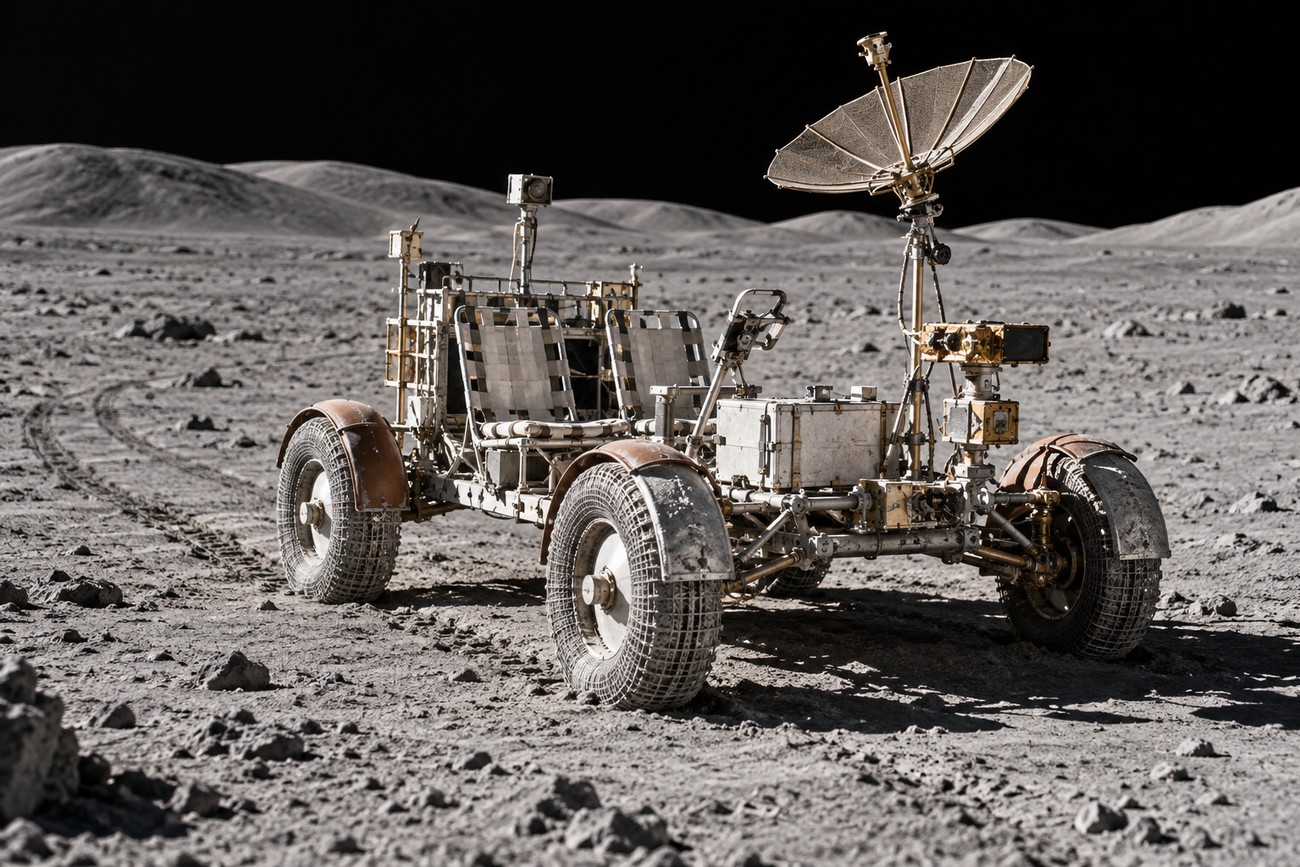
The Apollo lunar rover was a specialized mobility system built for vacuum and low gravity. Battery-powered electric drive avoided the need to carry an oxidizer for engine combustion and made propulsion easier to integrate with a vehicle designed for the lunar environment. Its advantage was compatibility with the mission, rather than an excess of power.
Lightweight, folding construction served a practical purpose: the vehicle had to travel to the Moon before it could travel across it. Specialized mesh-like wheels replaced ordinary pneumatic rubber tires. Each choice traded some familiar automotive qualities for equipment that could be carried, deployed, and used on a short surface excursion.
Its maximum speed was approximately 10–13 km/h. That sounds slow beside a road vehicle, yet a faster machine offers limited value when the route must account for loose soil, obstacles, energy reserves, and a safe return. The rover was intended for short mission movements with a limited payload, not everyday driving or unrestricted exploration.
Purpose-built does not mean invulnerable. Dust, temperature, terrain, and finite battery energy still constrained what the rover could do. It could not substitute for the Jeep’s Earth-side comfort, general cargo capacity, or broad range of uses. On the Moon, however, a narrower machine designed to complete its assigned route is more useful than a versatile one whose basic systems cannot operate.
Low Gravity Does Not Turn Lunar Driving into Easy Off-Roading
Approximately one-sixth of Earth’s gravity means a vehicle presses on the ground with much less force for the same mass. Its inertia remains: a moving vehicle still resists changes in speed and direction. The tires therefore have less normal force available for grip, while steering and braking must still control the vehicle’s mass.
That distinction defeats the idea that a heavy Jeep becomes an effortless climber simply because it weighs less on the Moon. Reduced weight can lessen the force on the ground, but it also reduces the frictional traction available at the wheels. Loose regolith adds uncertainty: a driven wheel may slip or dig in instead of carrying the vehicle forward.
Steering demands restraint for the same reason. A sharp input can ask the wheels to change direction faster than their contact with the soil allows, especially over uneven terrain. Braking is also limited by grip; having no air resistance to slow the vehicle does not help it stop. Lower gravity offers no automatic guarantee of stability on a slope or across a rut.
Vacuum does remove aerodynamic drag, an advantage that matters greatly to some fast-moving machines. For a slow lunar rover, it is a minor benefit beside traction, thermal limits, and stored energy. There is little value in saving energy against air resistance if a wheel loses purchase or a component overheats.
The Apollo rover’s approximately 10–13 km/h maximum speed is best read as a mission boundary, not an engineering embarrassment. Controlled travel protects the vehicle and helps its occupants judge unfamiliar ground. A successful lunar drive ends with the vehicle and crew where the mission requires them, rather than with the highest speed reached along the way.
The Hidden Engineering Problems: Dust, Heat, Energy, and Testing
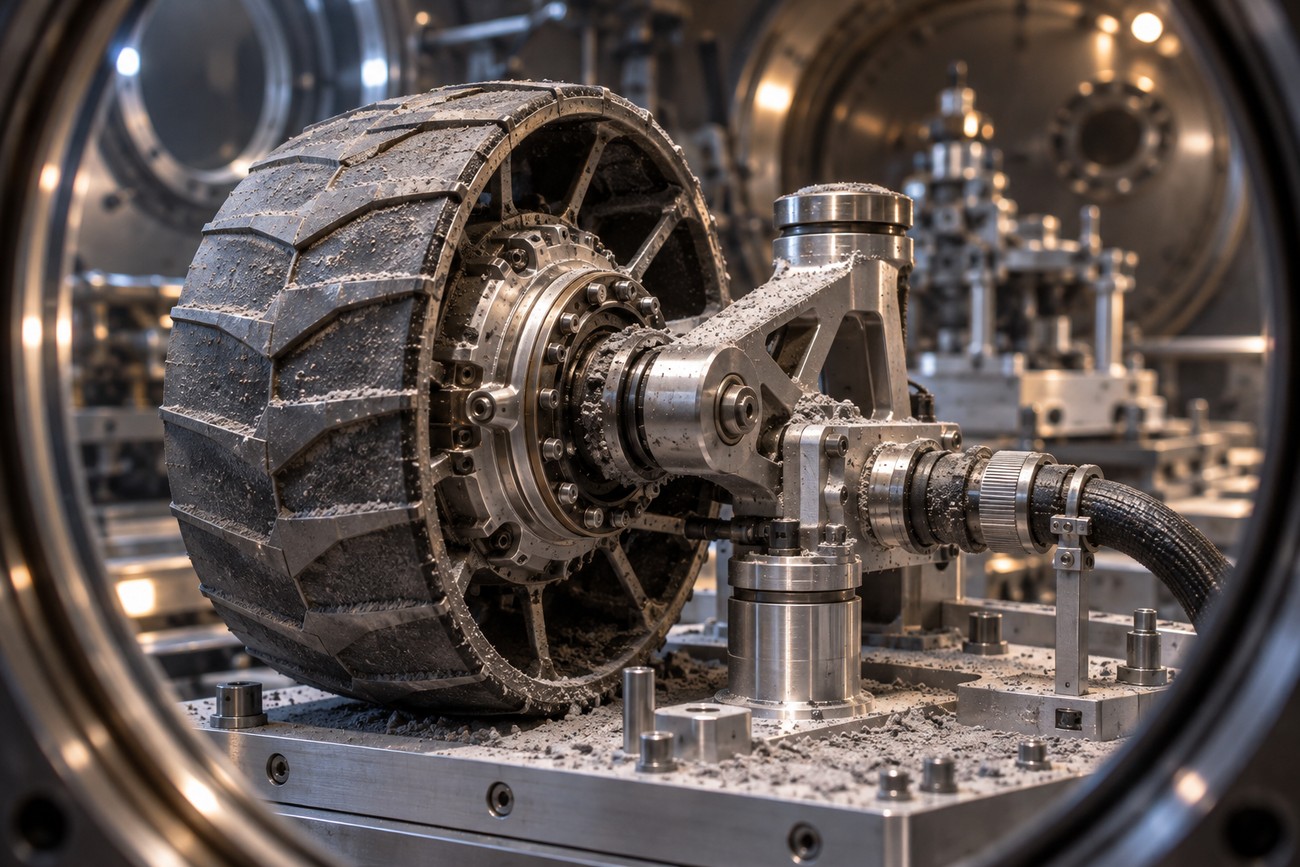
Dust protection has to reach beyond the obvious exposed wheel. Abrasive, electrostatically clingy regolith can enter joints, latches, bearings, connectors, and sensors, then interfere with movement or signals. A latch that becomes difficult to close or a connector that gives an intermittent reading may matter as much as a failed drive motor.
Temperature changes make contamination harder to assess. Materials expand and contract, seals change how they contact mating surfaces, and lubricants may behave differently at thermal extremes. A clean mechanism surviving a temperature test does not establish that the same mechanism will work after dust has settled into it.
Dust and thermal-vacuum behavior need to be tested together: a connector, bearing, or latch may pass separate exposure tests yet fail after repeated contamination and temperature cycling.
Heat management remains active work even without an engine. Batteries, electric drive components, and electronics generate heat while operating, and the lack of air prevents ordinary convective cooling. When sunlight disappears or equipment sits in shadow, heaters may be needed to keep critical components within usable temperatures. Both driving and temperature control draw from the available energy.
Solar panels can support future lunar vehicles where sunlight is available, but they cannot provide continuous power through lunar night or in permanently shadowed areas without energy storage. A route that looks short on a map may demand reserves for heaters, delays, difficult ground, and the return journey. Energy planning is therefore part of route planning, not a separate estimate made after the vehicle is built.
Qualification must reflect these combined stresses. Thermal-vacuum, dust, and radiation-resistance testing can reveal failures that ordinary road testing misses; repeated cycles matter where seals, lubricants, cables, and connectors age together. A credible lunar conversion would need that validation across the whole vehicle. A brief demonstration of turning wheels would show only that the wheels turned.
The Verdict: Which Vehicle Would Work on the Moon?
The purpose-built Apollo lunar rover would work for the lunar surface missions it was designed to perform. A stock Jeep Wrangler would not operate normally there. Its combustion engine lacks atmospheric oxygen, its cooling system cannot rely on air, and its ordinary tires and other components have not been designed for lunar vacuum, dust, and temperature extremes.
A Wrangler-shaped lunar vehicle is theoretically possible, but the shape would be the least demanding part of the project. Propulsion, cooling, materials, lubrication, electronics, wheels, and environmental protection would require a near-total redesign, followed by relevant testing. Calling the result a modified stock Jeep would obscure what made it lunar-capable.
The rover wins on environmental compatibility and the ability to complete its limited mission. It gives up the Wrangler’s familiar speed, payload expectations, comfort, range expectations, and general-purpose versatility. Those are sensible trade-offs when the alternative cannot begin an ordinary drive.
The lunar rover is not a battery-powered Jeep, and the Moon is not simply an easier trail. The deciding capability is surviving and controlling the entire journey in an environment built for neither roads nor roadside assistance.
Frequently asked questions
Counts of lunar rovers depend on whether the subject is crewed vehicles, robotic vehicles, completed missions, or hardware still on the surface. The distinctions below keep those figures from being mistaken for one another.
How many lunar rovers are left on the Moon?
Three Apollo Lunar Roving Vehicles were left on the Moon, one each from Apollo 15, Apollo 16, and Apollo 17. They are parked mission hardware, not operational vehicles available for another drive.
A broader count also includes robotic rovers left by other lunar missions, so “lunar rovers left on the Moon” needs a definition before it has a single total. A rover mission and an individual vehicle are different units of counting, and the presence of hardware on the surface does not mean it remains functional.
What powered the lunar rover on the Moon?
The Apollo lunar rover used stored energy from onboard batteries to power its electric drive during short surface excursions. It did not need atmospheric oxygen for propulsion, and its route had to fit within the available energy.
Solar power can support other lunar vehicle designs, but solar-only operation becomes difficult during lunar night and in permanently shadowed terrain. Those conditions require stored energy or another power source for driving, communications, and temperature control.
How many lunar rovers have operated on the Moon?
Three crewed Apollo lunar rovers operated on the Moon during Apollo 15, Apollo 16, and Apollo 17. That is a count of the Apollo vehicles, rather than a total for every lunar rover.
Robotic rover missions add other vehicles, and totals vary with the definition used. A count might include only vehicles that drove successfully, all mobile robotic spacecraft that operated on the surface, or the missions that delivered them. Keeping mission count, vehicle count, and rover type separate is more accurate than treating every lunar mobility system as an Apollo-style rover.







