

A lowered Honda S2000 reaches the crest of a humped crossing and stops moving. A front lip scraping the rising surface is one possibility; the car resting on its underside as its wheels pass over the crest is another. The distinction matters because adding throttle to a grounded car can turn minor contact into damage.
On an ordinary road, the immediate choice is whether the car can safely retrace its approach at a crawl or whether it needs professional recovery. Make that decision only after checking traffic and the contact point from a safe position. If the car is immobilized on railway tracks, treat it as a separate emergency: get everyone to safety and call the railway’s posted emergency number or local emergency services without delaying for vehicle-recovery attempts.
- First, make the crossing safe
- Why the lowered S2000 gets stranded on a hump
- Find the contact point before moving again
- Getting free without making the damage worse
- Why the catalogue figure was not enough
- Avoiding the next humped crossing
- Frequently asked questions
- What should I tell the recovery operator before they arrive?
First, make the crossing safe
Stop as soon as the car meets firm resistance. Repeated attempts to drive forward can press a bumper, exhaust, or underbody component harder against the hump. Do not use a burst of speed to carry the car over it.
Assess approaching traffic before anyone gets out or tries to guide the driver. If it is safe to leave the car, move to a place clear of traffic and warn others as local rules and conditions allow. Nobody should stand directly ahead of or behind the vehicle, or reach beneath it while a driver is at the controls.
A raised road crossing and a railway crossing demand different priorities. If the S2000 is immobilized on railway tracks, move everyone to a safe place and urgently contact the railway using its posted emergency number, or call local emergency services. Give the crossing’s identifying details if they are posted and you can obtain them safely.
Do not spend time diagnosing the underside or organizing a tow while people remain near a car stranded on tracks. At an ordinary road hump, there may be time to assess a cautious exit. On railway tracks, evacuation and the urgent call come first.
Why the lowered S2000 gets stranded on a hump
The front lip can meet the rising face of a crossing before the front wheels reach it. That is an approach-geometry problem: the bumper’s height and distance ahead of the wheels both affect whether it clears the slope. A light scrape there does not, by itself, mean the car is supported by the hump.
Farther across, the wheels may be on opposite sides of the crest while the underside touches its high point. This is a breakover problem. If the car’s weight settles onto the center section, the tires may have too little traction to move it without worsening the contact.
Sources commonly give 107–130 mm for stock S2000 ground clearance across versions and markets; one specification for a 1999–2003 version gives 130 mm. Neither figure establishes this lowered car’s actual clearance. The published measurement also cannot tell you whether its front overhang will enter a slope or its underside will pass over a particular crest.
Lowering the suspension can reduce the margin available over a hump, and passengers or luggage can reduce it further. The exact change depends on the car’s setup and load, so a crossing cleared while driving alone may become marginal on another trip. Exhaust routing, bumper add-ons, and suspension components can also determine which part touches first.
Find the contact point before moving again

At a safe ordinary-road location, look from beside the car for where it meets the crossing. A caught front lip or bumper may be visible without approaching the vehicle’s path. Stay clear of traffic and do not crawl underneath to confirm a suspected contact point.
Look for signs that the center of the car is resting on the crest, rather than merely brushing it. Check what you can see of the exhaust and suspension area, along with any parts hanging lower than usual. Firm resistance, an unusual noise, or wheels struggling for traction are reasons to stop testing the throttle.
The recovery operator needs to know whether the car appears supported at its center or caught at the front lip: that distinction affects how it can be moved and loaded without pressing the same point harder against the crossing.
A superficial bumper scrape and a vehicle carrying weight on an underside component are different recovery problems. If you see leaking fluid, a displaced exhaust, or a trapped part, leave the car stationary and seek professional help. Do the same if you cannot identify the contact safely; guessing from the driver’s seat is a poor basis for another attempt.
Getting free without making the damage worse
On an ordinary road, consider moving the car only when traffic conditions permit and you have a clear route back. If it is not firmly grounded and nothing appears trapped or damaged, cautiously retracing the approach at very low speed may release a lightly caught lip. Stop immediately if resistance returns.
A spotter can help only from a position clear of traffic and the vehicle’s path, where the driver can see or communicate with them. Agree on a stop signal before the car moves. The spotter should never try to lift a bumper, pull a component free, or stand where the car could roll toward them.
Do not substitute momentum, wheelspin, or repeated throttle attempts for a clear view of the contact. If the S2000 remains supported by the hump, or you cannot judge the route safely, call a recovery operator. Explain that the car is lowered and describe the suspected contact point so the operator can plan suitable loading.
This cautious-reversing advice applies only to a safe ordinary-road location. For a car immobilized on railway tracks, move everyone to safety and urgently call the railway’s posted emergency number or local emergency services. Do not delay evacuation to try another driving technique.
Why the catalogue figure was not enough
A published ground-clearance figure describes a measurement, not a promise that every ramp or crest is passable. The lowest point beneath a car does not describe the reach of its front bumper. Nor does that single figure show how much room the underside has while the wheels straddle a sharp change in slope.
Stock S2000 figures commonly span 107–130 mm across versions and sources, with one 1999–2003 specification listing 130 mm. Those numbers are useful background when comparing published specifications. They are not a measurement of a particular modified car, its tires, its load, or the crossing beneath it.
Approach angle, overhang, and breakover geometry explain why two cars with similar stated clearance can behave differently at the same hump. On a lowered S2000, the first contact might be a bumper edge on the way up, while a later contact could be under the cabin or near the exhaust. Knowing which happened is more useful for the next move than arguing over the catalogue number.
Avoiding the next humped crossing
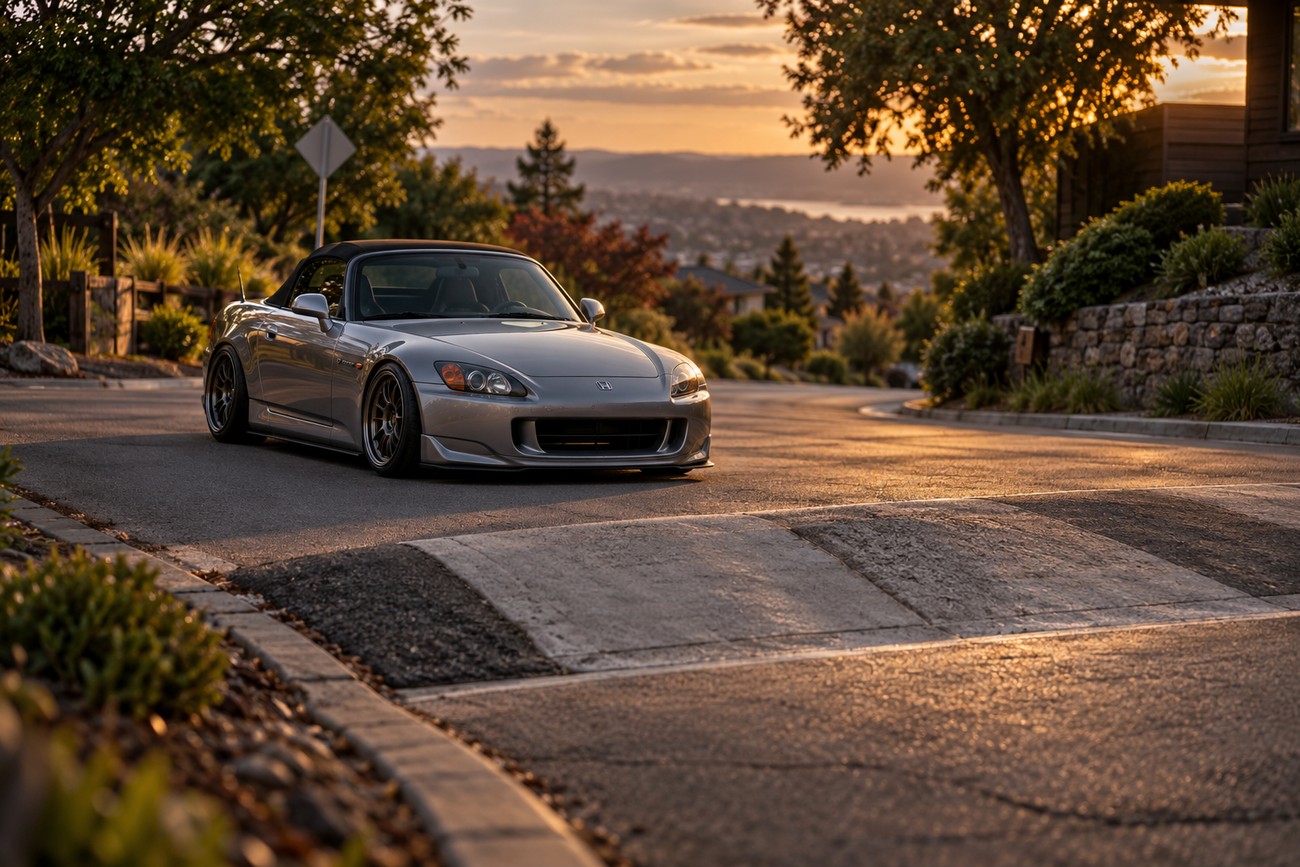
Assess an unfamiliar crest before committing to it, especially where a steep approach leads straight into a sharp summit. If the profile looks marginal, choose another route while you still have room to do so safely. Do not rely on an angled approach where traffic, pedestrians, or the road layout make that maneuver unsafe.
Allow for changes in load. A passenger or luggage can reduce the available margin even if the car cleared the same entrance when empty. Approach speed also matters: a slow, controlled entry gives you a chance to stop at the first scrape instead of driving farther onto the hump.
After suspension changes, check the car’s actual vulnerable points on level ground, including the front lip and low-mounted underside parts. A stock specification cannot establish their height on a modified S2000. If ordinary driveways and crossings have become unreliable, reassessing ride height and the fitted components is more dependable than hoping each crest has a forgiving shape.
Frequently asked questions
A clear recovery call helps the operator understand both the location and the vehicle’s condition before dispatch. Gather what you can observe safely; there is no need to inspect underneath the car. Railway tracks change the priority of the call.
What should I tell the recovery operator before they arrive?
Give your exact location, say whether railway tracks are involved, and explain that the S2000 has lowered suspension. Describe the suspected contact point—front lip, center underside, exhaust, or an uncertain location—and report any visible leaks or damaged parts. Mention any traffic hazard that may affect access to the car.
If the vehicle is immobilized on railway tracks, first move everyone to safety and urgently call the railway’s posted emergency number or local emergency services. A recovery call must not delay that emergency response.







