
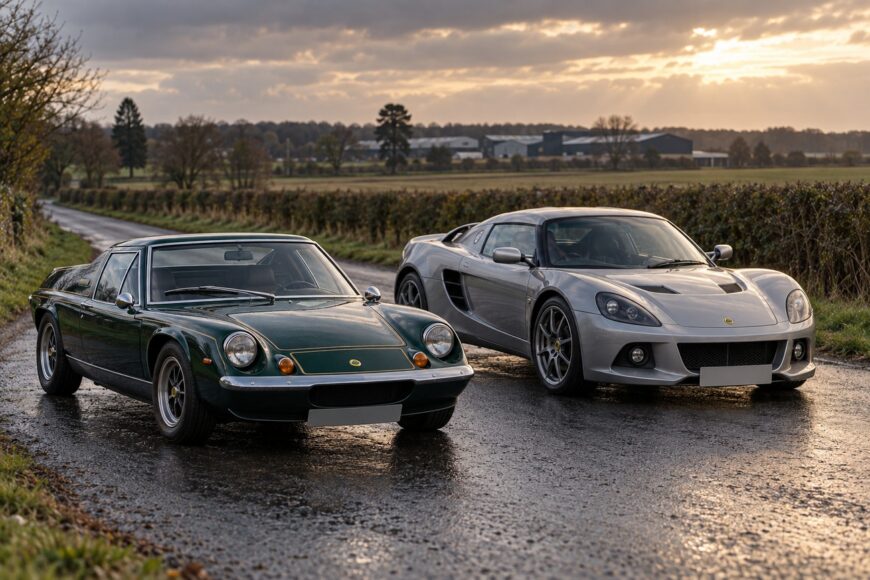
Lotus Europa is two very different mid-engined, rear-wheel-drive coupes sharing one name. The classic Europa was a lightweight 1966–1975 sports car built around minimal mass and compact dimensions; the Europa S arrived in 2006–2010 with a turbocharged engine, a more modern structure, and a different set of compromises.
That distinction matters more than the badge. A classic car weighing approximately 610–710 kg delivers its character through delicacy, gearing, and chassis response, while the Europa S uses 190 hp and 272 Nm to move approximately 995 kg. Catalogue figures also need context: performance, dimensions, and equipment can vary by version, market, and year.
- Lotus Europa Explained: One Name, Two Very Different Cars
- Classic Europa vs. Europa S: Two Cars, One Name
- Why the Europa Feels Faster Than Its Numbers
- Living With a Europa: Space, Noise, and Access
- Buying a Used Europa: Where the Real Risk Lies
- Europa Myths, Versions, and Market Logic
- Frequently asked questions
- How many Lotus Europas are left?
- Why are Lotus cars so cheap?
- How much does a Lotus Europa cost?
Lotus Europa Explained: One Name, Two Very Different Cars
The original Lotus Europa was introduced in 1966 as a compact two-seat, mid-engined, rear-wheel-drive coupe. Its proportions were exceptionally low, and its purpose was clear: place the mass close to the center of the car, keep the structure light, and let modest engine output produce serious pace. Its 2337 mm wheelbase and 4064 mm length created a small footprint, while the 1080 mm height contributed to its distinctive driving position.
Early cars used an engine closely related to the Renault 16 unit. Later versions received Lotus/Ford Twin-Cam power, changing the character and performance of the car without abandoning the original formula. Depending on the version, engines occupied the approximately 1.47–1.56-litre range and worked with four- or five-speed manual gearboxes.
The Europa S, produced from 2006 to 2010, revived the name after a long gap. It remained a two-seat, mid-engined, rear-wheel-drive coupe, yet its engineering and market position were different. Its extruded-and-bonded aluminum chassis, composite panels, turbocharged GM engine, and six-speed transmission made it a contemporary lightweight sports car rather than a direct continuation of the original Europa.
That separation prevents a common buying mistake. A buyer seeking the tactile, almost fragile simplicity of the early car should not automatically choose a Europa S because it is newer or quicker. Conversely, someone wanting stronger acceleration and more modern mechanical hardware should assess the S on its own terms, including its greater weight, tighter cabin, and more demanding service requirements.
Classic Europa vs. Europa S: Two Cars, One Name
The table shows the broad engineering difference between the generations. Figures marked as approximate or published should be checked against the specific car, because Europa S catalogues differ by market, year, and specification.
| Item | Classic Europa, 1966–1975 | Europa S, 2006–2010 |
|---|---|---|
| Layout | Two-seat, mid-engined, rear-wheel-drive coupe | Two-seat, mid-engined, rear-wheel-drive coupe |
| Mass | Approximately 610–710 kg | Approximately 995 kg, subject to version and market documentation |
| Dimensions | 2337 mm wheelbase, 4064 mm length, 1080 mm height | Public catalogues disagree on width and height; figures vary by market, year, and specification |
| Engine family | Renault and later Lotus/Ford engines of approximately 1.47–1.56 liters | 2.0-litre turbocharged GM Z20LER Ecotec |
| Published output | Version-dependent; modest output paired with very low mass | 190 hp and 272 Nm; SE references include 222 hp and 300 Nm |
| Transmission | Four- or five-speed manual gearbox | Six-speed Getrag M32 manual gearbox |
| Chassis concept | Very light period Lotus construction; condition varies greatly with age and restoration | Extruded-and-bonded aluminum chassis with composite panels |
| Published performance | Highly dependent on engine, gearbox, and specification | Approximately 5.5–5.6 seconds from 0–97 km/h and approximately 230 km/h; SE references include 4.9 seconds to 100 km/h and 235 km/h |
Why the Europa Feels Faster Than Its Numbers
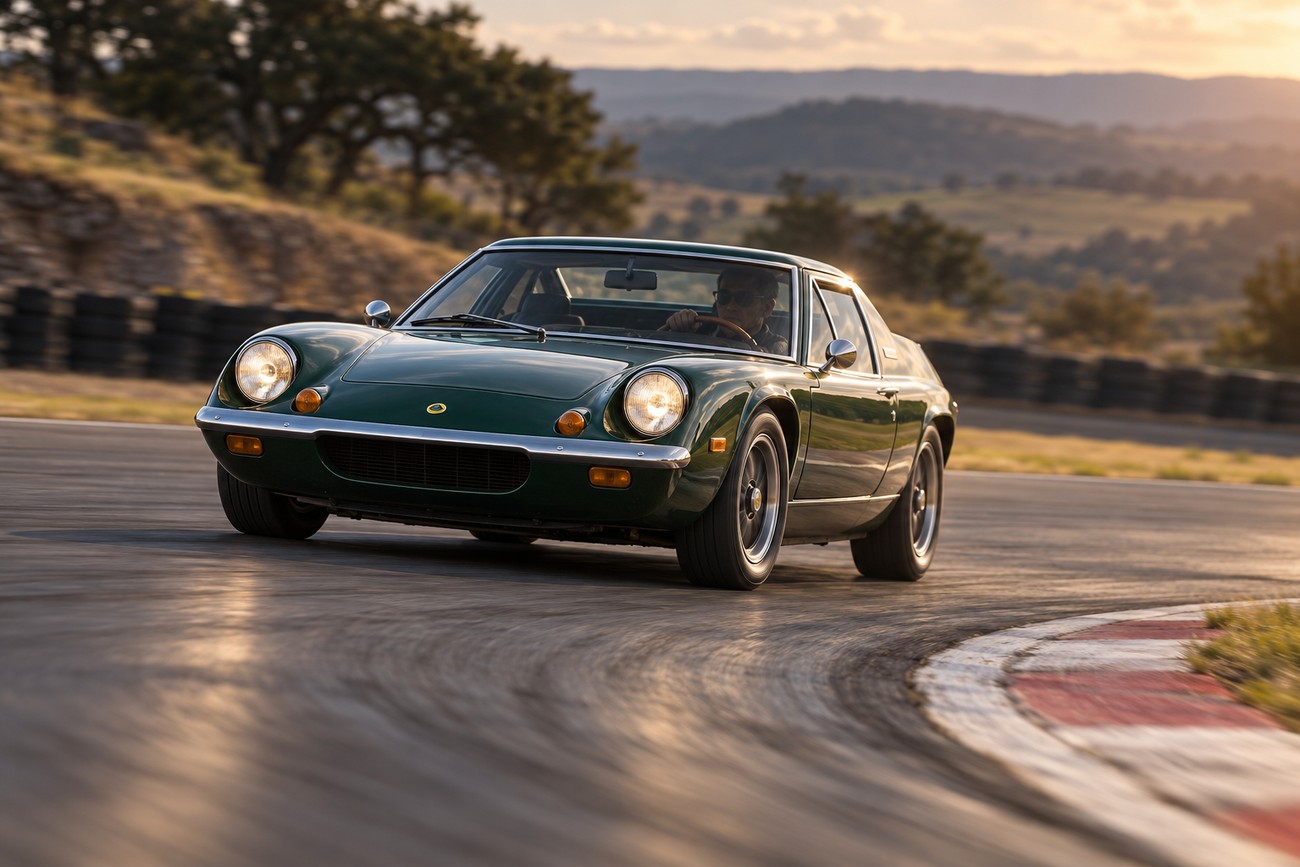
The classic Europa’s approximate 610–710 kg mass is the central performance fact. It reduces the work required from the engine, braking system, tires, and suspension, so relatively modest power can feel immediate. The low body and mid-engine layout also make changes of direction feel more consequential than the specification sheet suggests.
Engine choice alone does not define an early Europa. Renault power gives the car one period character, while later Lotus/Ford Twin-Cam versions bring a different response and sound. The four- versus five-speed gearbox matters just as much: ratios determine how often the engine stays in its useful range and whether the car feels relaxed or busy on a particular road.
The Europa S approaches speed through a different balance. Its 2.0-litre turbocharged GM Z20LER Ecotec produces 190 hp and 272 Nm, enough for published acceleration of approximately 5.5–5.6 seconds from 0–97 km/h. The car is still light by general sports-car standards, yet approximately 995 kg is substantially more than an early Europa, so its steering and transitions should not be expected to feel as delicate.
This is where horsepower comparisons become misleading. The early car rewards momentum, precision, and an understanding of its gearing; the S supplies a stronger shove and broader flexibility. Neither approach is automatically superior. They suit different roads, different drivers, and different tolerances for noise, age-related faults, and mechanical involvement.
Living With a Europa: Space, Noise, and Access
Both generations demand a physical compromise before the engine starts. The low roof, substantial sills, and low seating position make entry and exit awkward, particularly in tight parking spaces. Taller occupants may also find the cabin restrictive around headroom, legroom, and shoulder room.
Once inside, the Europa feels focused rather than spacious. Visibility, storage, and loading access deserve a personal test because a published luggage figure says little about whether an object can actually pass through the opening. The Europa S presents a more modern interior and may appear easier to use, yet its compact cabin remains that of a small sports car.
The most revealing practicality test is physical: sit in the car wearing the shoes and clothing you would use on a long drive, then repeat the exercise after the car has been parked beside another vehicle. Entry technique and door clearance can matter more than a brochure’s luggage figure.
Ride quality and noise also shape ownership. The Europa is an attentive, emotional sports car, with road texture and mechanical activity forming part of the experience. That can make a short drive memorable, while a long commute over poor surfaces may expose the firm ride and limited insulation.
Claims that the Europa S is simply a better daily car than an Elise should be treated as broad marketing language. It may offer a different compromise, yet access, cabin space, parts supply, and specialist support still determine whether it works for your routine. A weekend car used occasionally can tolerate limitations that become tiring when repeated every day.
Buying a Used Europa: Where the Real Risk Lies
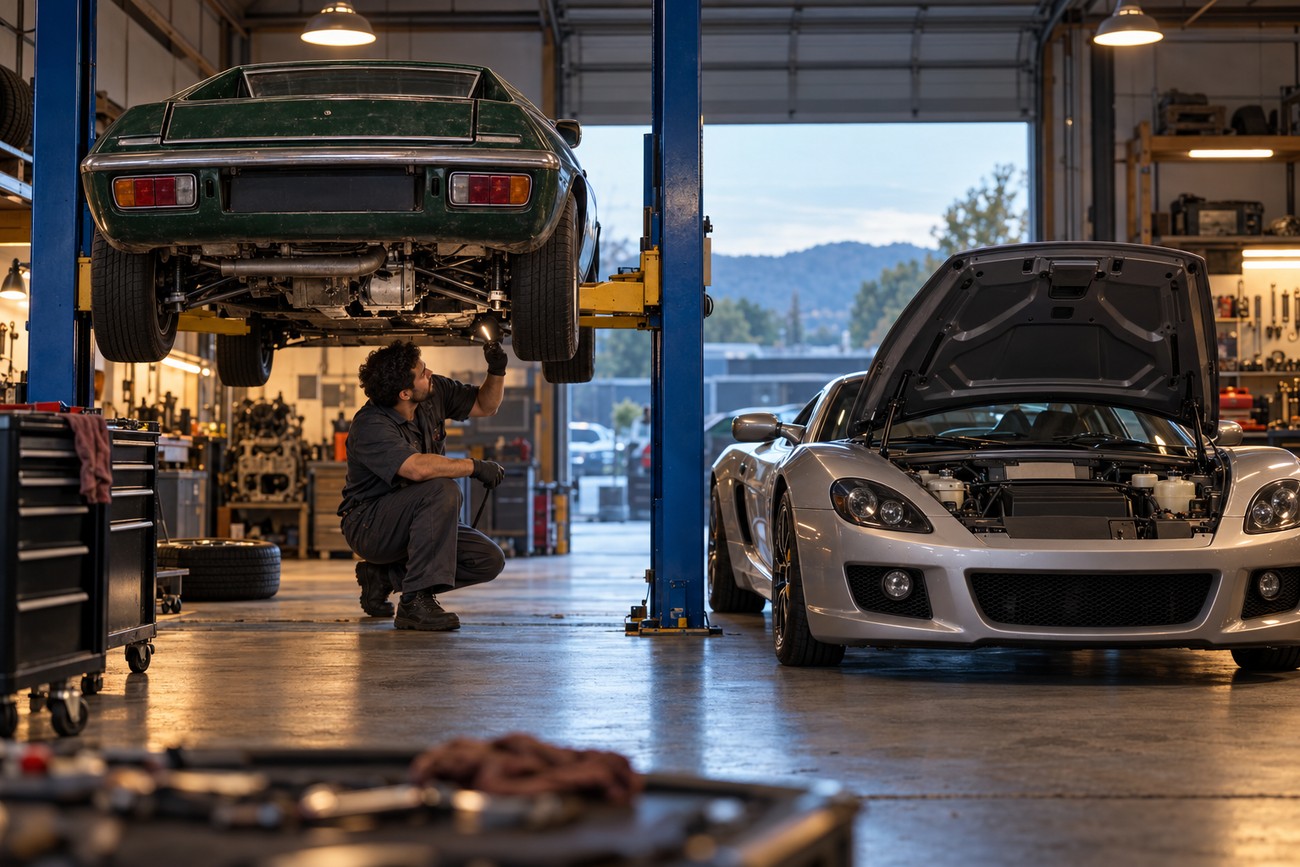
Condition should lead the inspection. On a classic Europa, age makes the body, chassis, and structural areas more important than a fresh paint finish or an attractive interior. A restored appearance can conceal incomplete work, while an honest car with visible age may have stronger documentation and more dependable underlying repairs.
The Europa S brings newer components, though it still needs a careful mechanical assessment. Cooling, clutch operation, suspension condition, and electrical systems deserve specific attention, because neglect in any of these areas can turn an apparently usable car into a specialist project. Service records should show what was done and when, rather than merely confirming that the car was “maintained.”
A cold inspection can reveal more than mileage or cosmetic presentation. On the Europa S, gearbox behavior, cooling history, and suspension work deserve particular scrutiny, with the Getrag M32’s condition assessed through its operation and documented service rather than assumed from the six-speed label.
Parts availability adds another layer of risk. Some Lotus-specific components can be difficult to source, requiring used parts, specialist fabrication, or special orders. That affects downtime as well as cost: a simple-looking fault may become inconvenient if the correct component is unavailable or requires an experienced supplier.
The sensible purchase process therefore starts with records, a cold examination, and an inspection by someone familiar with the model’s construction. On a classic car, investigate the structural condition and quality of previous work. On a Europa S, verify cooling, clutch, suspension, electronics, and Getrag M32 behavior. Mileage remains useful context, though it cannot replace evidence of careful maintenance.
A polished advert is a weak basis for comparison. A well-documented, carefully maintained example can be a better prospect than a cosmetically perfect car with unclear history. Set aside funds for specialist attention before committing, since the lower purchase price of an imperfect Europa may only move the expense into the first months of ownership.
Europa Myths, Versions, and Market Logic
The first myth is that every Europa is essentially the same car. The classic 1966–1975 model and the 2006–2010 Europa S share a layout and a name, yet they differ in chassis concept, mass, engines, transmissions, and market logic. Treating them as one continuous model produces poor comparisons and unrealistic expectations.
The second myth concerns weight. The Europa S is generally listed at approximately 995 kg, which is light compared with many modern sports cars, though it is nowhere near the mass of an early Europa. That additional weight supports more equipment and a different level of performance, while also changing the way the car responds to steering, braking, and road surface.
Performance figures require similar caution. Standard Europa S references commonly cite 190 hp and 272 Nm, while SE references include 222 hp, 300 Nm, 4.9 seconds to 100 km/h, and 235 km/h. Public catalogues also disagree on Europa S width and height, so model year, market, and specification should be confirmed before treating any single number as universal.
Finally, an engine sourced from Renault or GM does not make the whole car mechanically simple. The difficult parts of ownership often lie in Lotus-specific packaging, chassis access, suspension, cooling, electronics, and parts supply. The Europa is a compact lightweight sports car, not a business-class coupe; its value lies in the relationship between mass, balance, and response.
Identify the generation first, then the exact version, market, and condition. That sequence is more useful than comparing advertisements by horsepower or asking price. With a Europa, the individual car matters unusually strongly.
Frequently asked questions
The Europa name covers two generations with different production histories and ownership realities. These answers address the questions that cannot be settled by a single catalogue specification.
How many Lotus Europas are left?
There is no dependable worldwide census of surviving Lotus Europas. Registration databases, club records, and national archives are fragmented by country, and they rarely distinguish every classic version from the later Europa S with consistent accuracy.
Current advertisements are also a poor substitute for a survivor count. They show cars offered for sale at a particular moment, not cars stored, restored, exported, dismantled, or simply absent from public listings. Production totals and surviving examples should therefore be treated as separate questions.
Why are Lotus cars so cheap?
An attractive purchase price can reflect narrow buyer demand, difficult access, and deferred maintenance rather than low ownership cost. Specialist parts may require searching or ordering, and repairs can take longer when a suitable technician or component is unavailable.
Europa ownership is especially sensitive to condition. A car that needs cooling work, clutch attention, suspension repairs, electrical diagnosis, or structural restoration can consume the apparent saving quickly. Compare the complete ownership plan, including inspection and servicing, instead of judging value from the advert price alone.
How much does a Lotus Europa cost?
There is no responsible single price for a Lotus Europa. First identify the classic Europa or the Europa S, then assess the market, originality, documented maintenance, structural condition, and quality of any restoration or modifications.
Two cars with similar cosmetic presentation can have very different value if one has clear records and sound structure while the other has uncertain repairs. Market location also affects availability and support. A specialist inspection is therefore part of valuation, not an optional expense after the purchase decision.







