
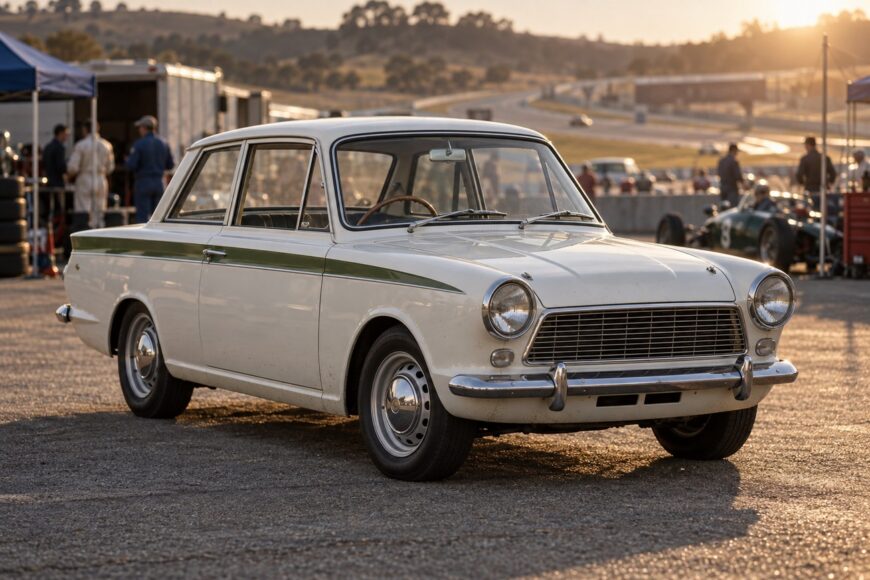
From a distance, the Lotus Cortina has the shape of a practical family saloon. Its Twin Cam engine, competition-minded chassis, and racing record tell a more demanding story. It offered room for passengers and luggage while giving drivers the response and balance they wanted on a circuit or rally stage. That combination remains appealing, provided the everyday compromises are taken as seriously as the sporting reputation.
The distinction between generations matters as much as the badge. An early Mk1 carries the more unusual body and rear-suspension engineering; the Mk2 kept the Twin Cam character in a simpler package. For anyone considering a purchase, the next distinction is between a factory-built car and a standard Cortina converted later. Both can be enjoyable, but their histories, specifications, and claims to originality need different scrutiny.
- How a family Cortina became a Lotus
- The Twin Cam and the chassis behind the reputation
- Lotus Cortina Mk1 and Mk2: the differences that matter
- Why racing made the saloon a legend
- The family-racer promise meets the real road
- Buying one: authenticity, rust, and expensive surprises
- Frequently asked questions
- How much is a Lotus Cortina worth today?
- How many Lotus Cortinas are left?
- Why does a Lotus Cortina sometimes lift a front wheel in racing photographs?
- What did FIA Group 2 homologation mean for the Lotus Cortina?
How a family Cortina became a Lotus
The Mk1 debuted for the 1963 model year as a Ford–Lotus project based on the Ford Consul Cortina. Ford supplied an accessible saloon starting point, while Lotus helped turn it into a car built for competition. The result retained the usefulness of a saloon body, making its racing purpose all the more striking.
That ordinary-car foundation was central to its appeal. A driver could recognize the controls and proportions of a Cortina, then find an engine and chassis that encouraged a much more committed pace. The family-racer description captures this dual identity, though it says little about the noise, firm ride, and maintenance that came with it.
The name also needs care. The Mk1 is conventionally called the Lotus Cortina, whereas the Mk2 is commonly called the Ford Cortina Twin Cam, although period naming varies. A badge or Twin Cam engine alone cannot settle what a particular car was when built.
Standard Cortinas have been converted to Twin Cam specification, sometimes with considerable skill. Such a car may be rewarding to drive, but the conversion does not automatically make it a factory Lotus Cortina. For a buyer, the difference affects how the car should be described and which evidence should support its history.
The Twin Cam and the chassis behind the reputation
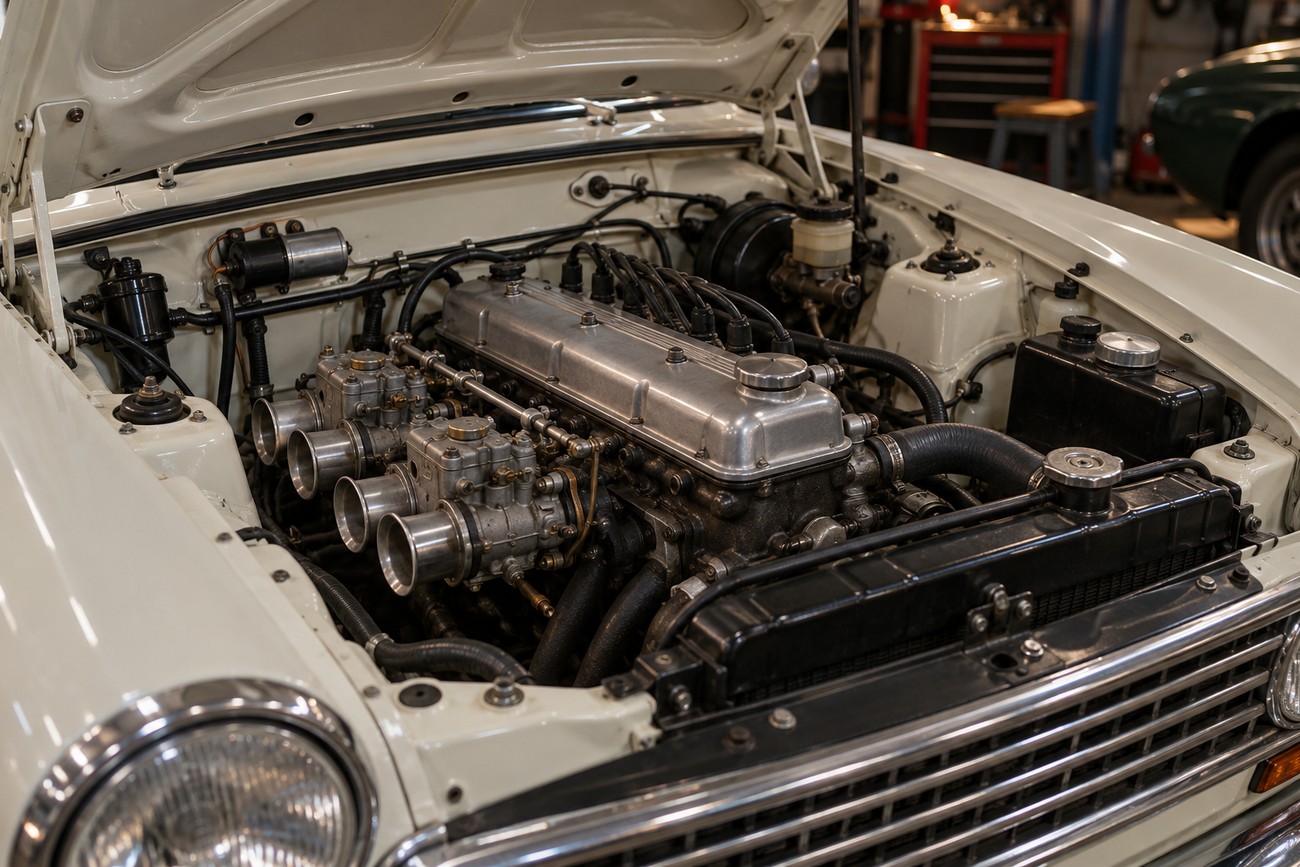
The 1.6-liter Lotus-Ford Twin Cam combined a cast-iron Kent block with an aluminum double-overhead-camshaft head. In road-going Mk1 form, output was approximately 105–115 bhp. Its attraction lay in the way the engine responded and gathered speed, giving a modest-sized saloon a sense of urgency without requiring a racing engine in every road car.
Period promotional material quoted top speeds around 170–180 km/h. Some magazine tests and owner accounts instead suggest roughly 160–165 km/h as a more realistic limit. Neither range describes every car: condition, gearing, tune, and test circumstances matter. The engine’s willingness through a series of bends explains more of the Cortina’s enduring appeal than a single maximum-speed figure.
The Mk1 chassis had to cope with that pace. Its shell was strengthened, and an A-frame helped locate the live rear axle, giving the car a distinctive arrangement that demands attention during restoration. Early Mk1 cars also used aluminum body panels, but that detail should not be applied to every Mk1 or to later cars.
These changes make the Mk1 mechanically interesting and potentially complicated to own. Rear-axle mounts, welds, and past repairs affect both handling and structural confidence; the engine’s character depends heavily on its state of tune. A car with the right specification on paper can feel far less convincing if those foundations have deteriorated.
Lotus Cortina Mk1 and Mk2: the differences that matter
The two generations share a Twin Cam theme, but their construction and identities differ. Specifications and surviving cars may vary, so the table is a starting point for checking an individual example.
| Feature | Mk1 | Mk2 |
|---|---|---|
| Period | Debuted for the 1963 model year | 1967–1970 |
| Common name | Lotus Cortina | Ford Cortina Twin Cam; period naming varies |
| Body panels | Aluminum panels on early cars | Steel panels |
| Rear axle | Distinctive A-frame location | Simpler leaf-sprung live axle |
| Road-going output | Approximately 105–115 bhp | Approximately 109–115 bhp |
| Estimated production | Around 3,000–3,300 | Around 4,000–4,300 |
Production estimates differ between records. They describe cars built, not cars surviving today, and cannot establish whether a particular example retains its original components.
Why racing made the saloon a legend
The Lotus Cortina was homologated for FIA Group 2, connecting a recognizable production saloon to period competition rules. Its record includes a 1964 British saloon-car championship achievement, as well as rally and endurance successes. Results gave substance to the car’s sporting image: this was a saloon developed to compete, rather than one merely advertised with racing imagery.
Touring-car photographs helped fix that image. A Cortina leaning into a corner, sometimes with a front wheel clear of the ground, looks dramatic precisely because the body beneath it remains familiar. The contrast between a family-car outline and committed race-car behavior did much to make the model memorable.
Prepared competition cars, however, should not be mistaken for standard road examples. Their setup, use, and subsequent repair histories may differ substantially from those of a privately driven car. A racing result establishes what the model could achieve in its period; it does not tell a buyer how a surviving road car will behave on a commute.
Competition history can add interest to an individual car when it is well documented. It can also mean accumulated stress, replacement components, and difficult decisions about restoration. The same past that makes a Cortina compelling deserves close examination beneath the paint.
The family-racer promise meets the real road
A healthy Twin Cam and responsive chassis make the Cortina feel alert in a way its sensible shape does not advertise. You can carry passengers, yet the ride is firm, the cabin is noisy, and keeping the car at its best takes regular attention. Its practicality is real, with clear limits for anyone expecting an effortless family daily driver.
Oil leaks are a familiar complaint, including seepage around seals, cam covers, and the timing-cover area. Twin-carburetor setup can also become frustrating when idle quality or response is poor. These symptoms call for diagnosis and appropriate adjustment rather than an assumption that every Twin Cam is inherently unreliable.
Cooling deserves equal attention. Owners report overheating in traffic and during hard use, so radiator condition and the effectiveness of the cooling system matter as much as the temperature seen on a brief test drive. A car that behaves on an open road may reveal a weakness while waiting in slow traffic.
The engine is sensitive to poor oil choices, incorrect clearances, and overheating. Service work should follow the relevant specifications, especially around valve gear and cylinder-head assembly. Sensible, regular use can also be kinder than a pattern of infrequent cold starts and very short trips, provided the car is warmed properly and faults are addressed.
Speed claims need similar restraint. Neither period promotional figures nor road-test results are a universal promise for an older example. Its stronger argument remains the character of the engine and chassis at speeds where a driver can use them.
Buying one: authenticity, rust, and expensive surprises
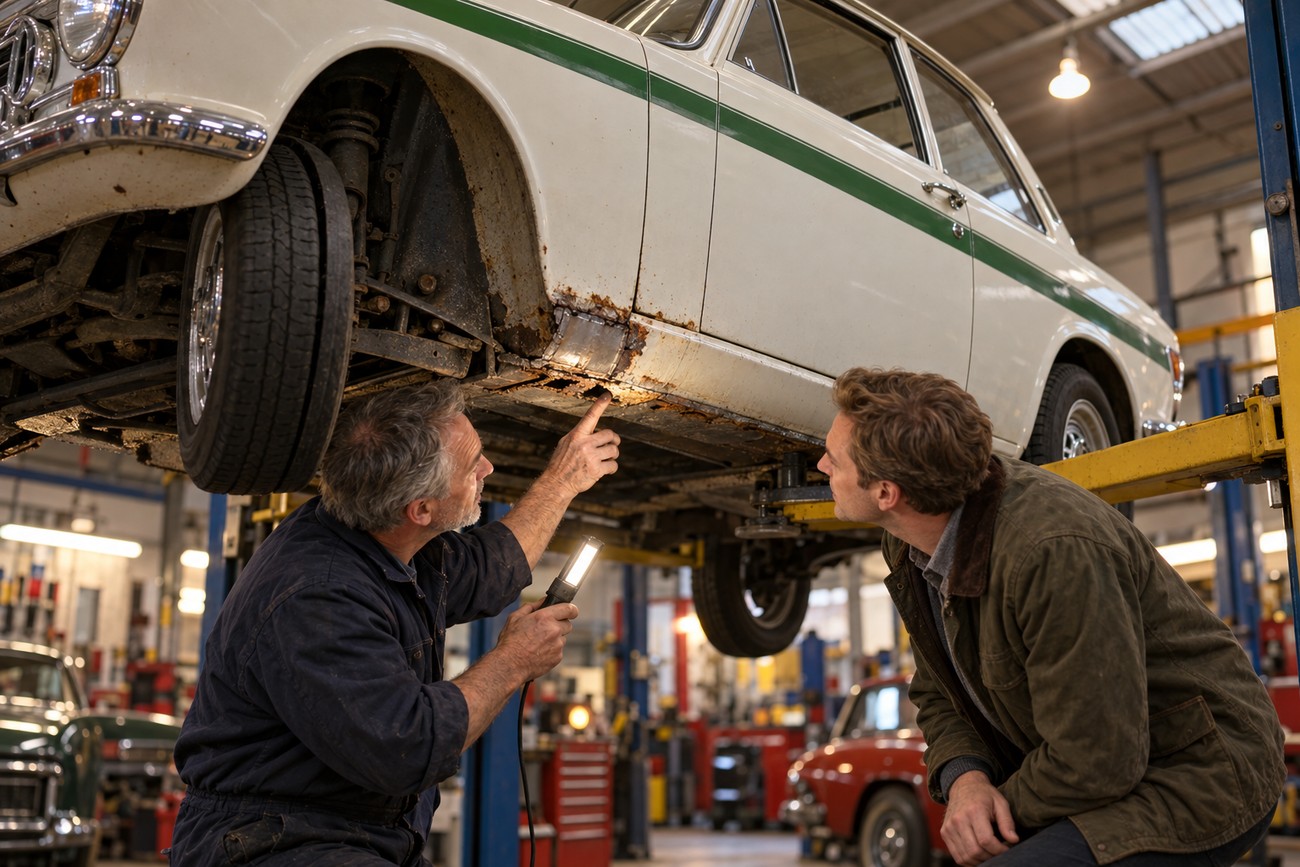
Begin with identity before judging the engine bay. Compare period paperwork with the car’s identifying details, then seek marque-club expertise where records or physical features need interpretation. A standard Cortina converted to Twin Cam specification can be an enjoyable, honestly described car; it should not be priced or presented on an unsupported claim of factory identity.
Next, inspect the shell thoroughly. Sills, lower doors, and structural members are vulnerable to rust, while old competition use and subsequent repairs can obscure damage or fatigue. Paint and trim are easier to assess than the quality of metal and welding hidden below them, so a sound-looking car still warrants a careful structural inspection.
On a claimed factory Mk1, period paperwork, shell details, and evidence around the A-frame mountings should tell a consistent story before an attractive Twin Cam installation is treated as proof of identity.
For a Mk1, examine the A-frame mounting points and nearby welds closely. Owners have reported cracking, worn mounts, and difficult repairs in this area. Check the condition and type of rear-axle components, and ask what has been replaced; ordinary Ford parts can appear on cars that have been repaired or modified over decades.
Only then turn to the engine and its supporting systems. Assess starting, running, leaks, carburetor behavior, and cooling, and look for evidence that Twin Cam work was performed to the correct specifications. Generic servicing may miss important clearances, assembly procedures, or the significance of an unsuitable setup. Specialist inspection is particularly valuable when a seller describes a recently rebuilt engine without detailed records.
A cheap project can become the costly way to buy one. Structural metalwork, a proper engine rebuild, and model-specific Lotus, suspension, or early-Mk1 body parts can each demand substantial effort, with some components difficult to source. A documented, little-modified car may therefore be more attractive than a more powerful conversion with unanswered questions. Set a restoration budget around the work the car needs, rather than the appeal of its starting condition.
Frequently asked questions
Some of the most useful distinctions are difficult to capture in a specification table. Value, rarity, racing images, and homologation each describe a different part of the Lotus Cortina story. None should stand in for evidence about an individual car.
How much is a Lotus Cortina worth today?
There is no defensible single price for a Lotus Cortina from the information available here. To interpret current comparable sales, separate Mk1 from Mk2, then compare documented factory identity, condition, originality, and the quality of any restoration. An asking price is less informative than a completed sale for a genuinely comparable car.
Modifications need context rather than an automatic premium or discount. A carefully described conversion may suit a driver, while a documented, relatively original Mk1 may appeal to a different buyer. Present-day market evidence is essential before assigning either a figure.
How many Lotus Cortinas are left?
A dependable worldwide survivor total is not established. Estimated original production is around 3,000–3,300 Mk1 cars and 4,000–4,300 Mk2 cars, with differences between records; those are build estimates, not counts of cars still in existence.
Registration data cannot close the gap reliably. Stored projects may be off the road, cars move between countries, and records may classify vehicles under different names. Any precise survivor claim needs a clearly defined scope and method.
Why does a Lotus Cortina sometimes lift a front wheel in racing photographs?
Cornering transfers load across the car, and period competition suspension behavior could leave an inside front wheel visibly light or airborne. The photograph captures a car under racing loads, often with a competition setup, rather than a normal feature of driving to the shops.
The image helps explain the Cortina’s reputation for spirited handling, but it cannot establish how an individual road car rides or grips. Tire choice, suspension condition, and setup all influence that experience.
What did FIA Group 2 homologation mean for the Lotus Cortina?
FIA Group 2 homologation connected an eligible production model to the rules under which period competition cars could be entered and prepared. It helps explain why the Cortina’s production specification and racing program belonged to the same story.
Homologation does not certify the specification of every surviving car. A road example, a period-prepared racer, and a later replica may all reflect that history differently; each needs to be understood through its own documentation and components.







