
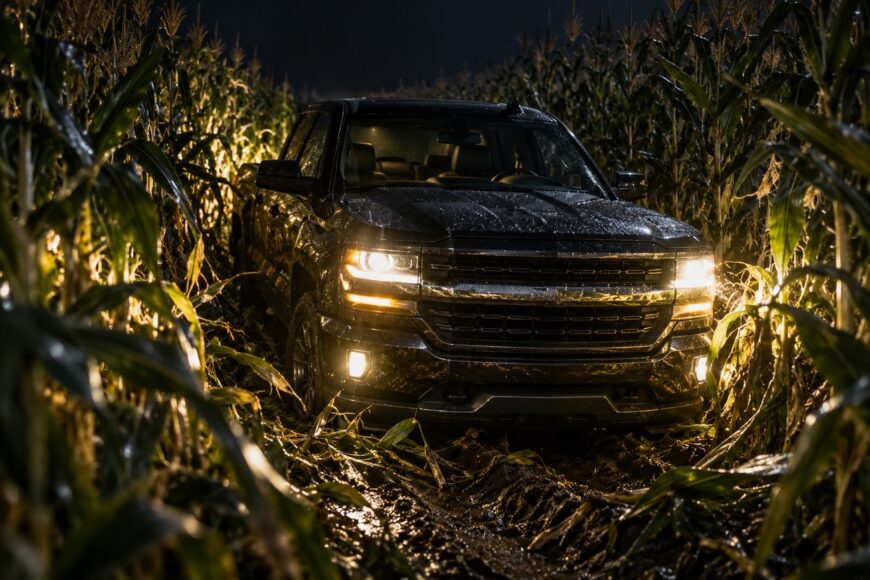
Surrounded by corn approximately 2–2.5 m tall, even a full-size Chevrolet Silverado can feel trapped. Stalks block the windshield and side windows, while the truck’s size makes nearby rows, ditches, and field edges difficult to judge.
The Silverado may look ready for off-road travel, yet continued driving can turn a navigation error into a stuck vehicle, damaged crops, and a harder search. The safest response is to preserve your position, share the best location information available, and call for help before panic leads you deeper into the field.
- Why a Silverado Can Get Lost in Corn
- What to Do When You Realize You Are Lost
- Why Driving Out Can Make the Situation Worse
- How Search and Recovery Actually Work
- Frequently asked questions
- What happens if you get lost in a corn maze?
- What should you tell 911 when you cannot describe where the truck is?
- What does “cornfield” mean in slang?
- Why shouldn’t you tell secrets in a cornfield?
Why a Silverado Can Get Lost in Corn
Mature corn removes the visual references that normally keep a driver oriented. In a full-size pickup, the hood and cab already limit the view close to the vehicle; dense stalks then create a wall on every side. At night, headlights reflect from the leaves and stems, making the direction of travel even harder to judge.
Navigation data can add to the problem. GPS may show a position, but rural cellular service can be unstable, and mapping data may show obsolete or nonexistent field roads. A route line does not prove that a passable road remains there or that it is open to the public.
OnStar may assist with location and communication, but it cannot guarantee a precise, directly accessible point in rural fields. A dispatcher may know the truck is somewhere between fields while responders still need a usable entrance, track, or landmark.
The Silverado’s rear camera and parking sensors offer little useful orientation inside dense corn. They can help with nearby obstacles in a driveway or parking area, but they do not map a crop field, identify a safe exit, or reliably interpret tightly packed stalks as a hazard.
What to Do When You Realize You Are Lost
Stop as soon as you recognize that the route is unclear. Keep the truck stationary unless there is an immediate threat such as fire, dangerous weather, flooding, or another hazard. Turn off unnecessary electrical loads, conserve fuel and phone battery, and avoid repeated attempts to “find the road” by guessing.
Use the phone or vehicle system to record and share your location. Send a map pin if possible, but explain that the pin may be approximate and that the truck may be inaccessible from the displayed point. Call 911, roadside assistance, or a local responder, and keep the phone available for follow-up calls.
Give rescuers the last paved road, gate, driveway, or named turn you remember. Note your direction of travel, nearby buildings, utility lines, field edges, and any visible farm entrance. If the vehicle is safe and occupied, staying inside usually makes you easier to locate and protects you from ditches, fences, heat, and disorientation.
Identify the last known access point before choosing any movement. Existing tire tracks and row direction can help a local operator understand where the truck entered, while a blind turn may create a second route that rescuers must search.
Daylight can reveal row direction, a headland, a farm entrance, or power lines that are invisible at night. A local farmer may also know equipment lanes better than a standard navigation app. If a responder gives clear instructions and the route is visibly safe, follow them; do not leave the vehicle simply because waiting feels embarrassing.
Why Driving Out Can Make the Situation Worse
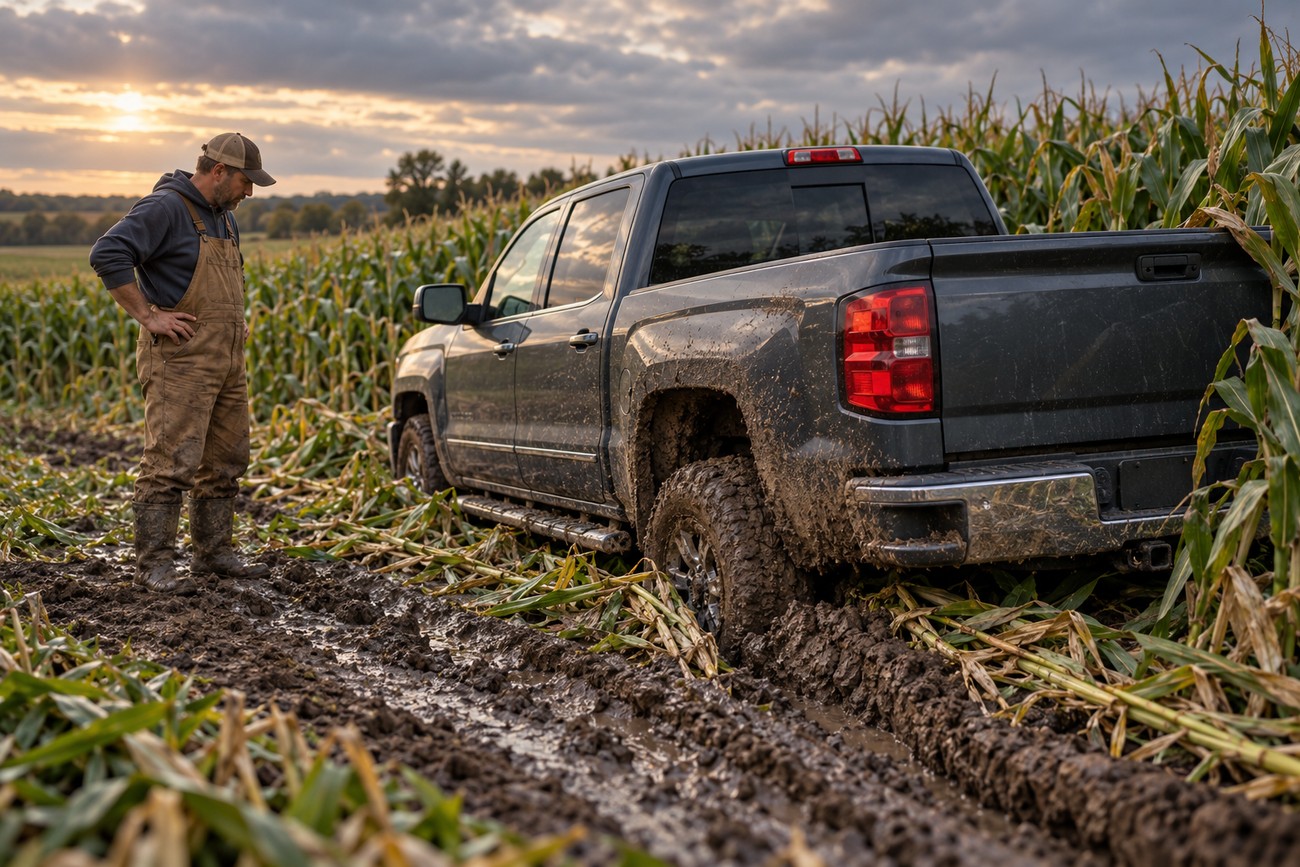
Clearance and large tires can help a Silverado cross some soft ground, but they do not prevent bogging, deep ruts, bumper damage, or harm to the underbody and suspension. Wet soil may support the truck briefly and then collapse under the driven wheels. Spinning tires usually reduce traction while digging the vehicle deeper.
Cutting a straight path through the crop also increases the damage. Several crushed rows can be assessed by a farmer at hundreds of dollars, and the field is private property even if a map route led you there. A mistake that began as a wrong turn can therefore involve crop-loss claims, conflict with the owner, and a costly extraction.
If movement is unavoidable, reversing along short, visible tire tracks is generally less damaging than creating a new route. Moving along the rows is preferable to cutting across them when the ground and exit are clearly safe. Stop immediately if the route disappears, the truck begins to sink, or you lose sight of the way back.
Recovery may require a tractor or specialized tow service. Fuel can be wasted during repeated attempts, and further wheel spin can make the recovery point harder to reach. Calling early is usually safer for the occupants, the vehicle, and the crop.
How Search and Recovery Actually Work
Searchers may not be able to drive directly to the Silverado’s reported position. Dense corn can obstruct views from drones and helicopters, so teams may combine phone or cellular location data with tire tracks, field access points, and local knowledge. The result may identify a broad area rather than a usable entrance.
Responders often work outward from the last known road or gate. They may inspect fresh tracks, ask nearby residents about equipment lanes, and approach from a farm access point rather than follow the navigation pin across planted rows. This is why a calm description of the route matters even when you cannot name your exact location.
Personal safety and vehicle recovery are separate decisions. Once occupants are safe, a tractor or specialized tow service may be needed to remove the truck, with charges for extraction and possible crop damage. Hiding the mistake or leaving on foot can delay both parts of the response.
Prevention starts before the pavement ends. Verify unfamiliar routes, note the last paved road, keep the phone charged, and treat an unexplained map line as a warning rather than permission to enter. Off-road marketing does not make a planted field a suitable or legally authorized route.
Frequently asked questions
What happens if you get lost in a corn maze?
A commercial corn maze normally has an operator, defined boundaries, and an exit procedure. Staff may monitor the site or provide instructions. A working cornfield is different: it may have no nearby staff, marked pedestrian route, or safe exit, and may contain ditches, fences, machinery, and private-property risks.
What should you tell 911 when you cannot describe where the truck is?
Give the last named road or turn, direction of travel, approximate time, number of occupants, fuel level, phone battery status, and the truck’s color and configuration. Add nearby buildings, utility lines, gates, water, fire, severe weather, or other hazards. Explain that the Silverado is in or near a cornfield and that the location pin may be approximate.
What does “cornfield” mean in slang?
“Cornfield” can be used informally to describe a rural, isolated, or out-of-the-way place. The meaning depends on the speaker and context; it is not a universal slang term with one fixed definition.
Why shouldn’t you tell secrets in a cornfield?
That idea is usually a joke about privacy and the belief that tall corn hides people from view. A real cornfield is poor protection: sound can carry, workers or landowners may enter, and the crop can conceal hazards. It should not be treated as a private or secure place.







