
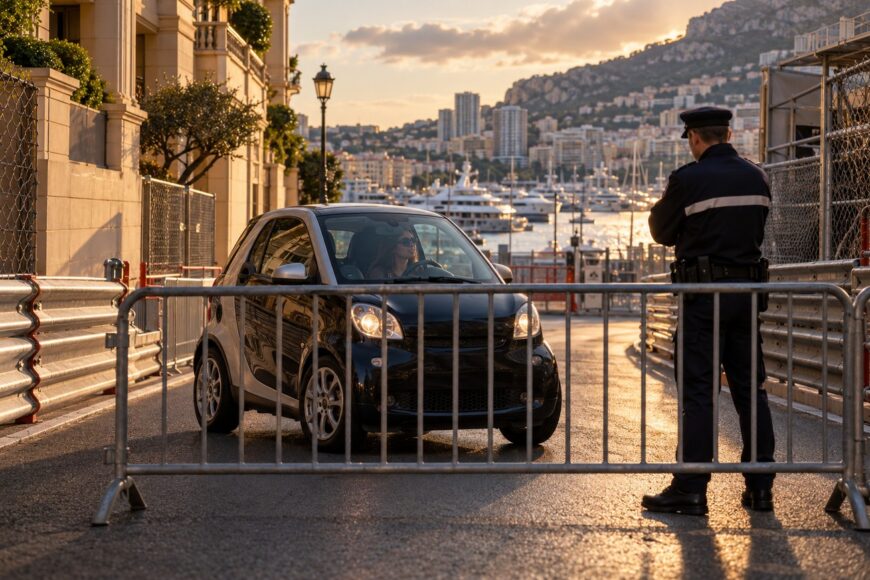
A Smart Fortwo fits Monaco’s tight parking spaces, yet it cannot bypass closed streets, controlled checkpoints, or a missing legal parking space. Its small footprint helps only after an approved route and a permitted destination have been established.
Resident disruption can begin weeks before race sessions. Infrastructure installation may alter traffic from late February, while dismantling can keep restrictions in place until mid-July, with exact dates varying by event. Living near the circuit therefore requires access planning around the building, corridor, and checkpoint rather than enthusiasm for a particular car.
- How the Monaco GP Changes Daily Access Before Race Weekend
- What a Smart Fortwo Solves—and What It Cannot
- A Resident Access Plan That Works in Practice
- The Mistakes and Hidden Disadvantages Smart Owners Miss
- How to Use the Smart During Race Week
- Frequently asked questions
- Where do most F1 drivers live in Monaco?
- Where does Lance Stroll live?
- Where does Lando Norris live in Monaco?
How the Monaco GP Changes Daily Access Before Race Weekend
The circuit uses streets that normally carry residents, deliveries, taxis, and local traffic. Restrictions can affect Boulevard Albert Ier, Avenue d’Ostende, Avenue de Monte-Carlo, Boulevard Louis II, Port Hercules, and some tunnels. A familiar route may become one-way, controlled, or unavailable as barriers and event infrastructure are installed.
Traffic changes may begin in late February, although the exact timetable varies by event. Race sessions add their own closures and traffic-control periods, while dismantling may continue until mid-July. The practical effect is a long disruption window rather than a problem limited to the main race day.
Parking bans are introduced in phases around Port Hercules, La Condamine, Monte-Carlo, and Fontvieille. A space that is legal during ordinary weeks can therefore become unavailable before the first session. Residents should check installation and removal notices separately from the sporting calendar.
What a Smart Fortwo Solves—and What It Cannot
The Fortwo is useful in dense urban driving because its compact dimensions make tight legal parking spaces easier to enter and leave. It can also reduce the stress of maneuvering near older buildings, narrow ramps, and crowded garage approaches. Those benefits matter in Monaco when a permitted space is already available.
Small dimensions do not override street closures, access controls, no-stopping rules, or a police checkpoint. A Fortwo cannot use a closed tunnel simply because it occupies less road space, and it cannot stop outside a building where temporary restrictions prohibit stopping. A short wheelbase solves maneuvering problems after the route has been approved.
The car itself also requires a model-specific assessment. Noise, heat management, and reliability depend on the Smart’s generation, engine, and condition. During a period of slow traffic and repeated queuing, the condition of the individual vehicle may matter more than its size.
A Resident Access Plan That Works in Practice
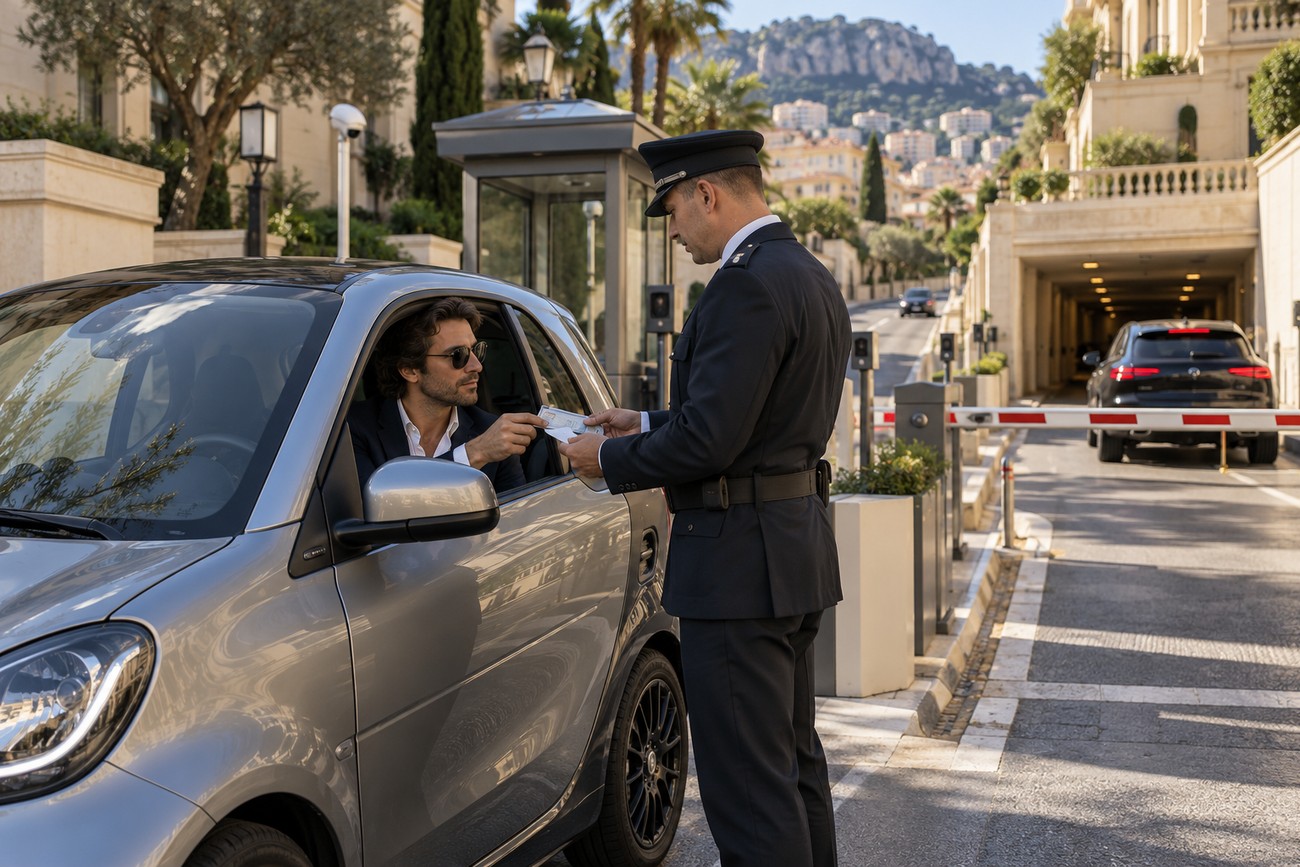
Start with the exact building address and its usual access corridor. A district label such as Monte-Carlo or La Condamine is too broad for race-week planning because two nearby buildings can fall under different barriers, traffic directions, or checkpoint arrangements. Record the approach, the nearest alternative route, and the garage entrance separately.
Carry identification, proof of residence, or an approved pass whenever you may cross a controlled resident access point. Residents generally retain access when they can show the relevant documentation, yet this does not guarantee passage through every street or tunnel. Actual passage depends on the exact street, the time of the session, the current traffic plan, and the police checkpoint in operation.
The useful planning unit is the building’s access corridor at a specific time, rather than the district name or the car’s dimensions.
Confirm with the building manager or garage operator that the entrance will remain usable during the relevant phase of construction. Ask whether a temporary barrier, one-way change, or reserved area affects entry and exit. A garage space may remain assigned to you while the approach to it is temporarily closed.
Official guidance favors public transport and parking at the principality’s entrance to avoid the congested center. Parking des Salines has capacity for approximately 1,790 cars. A €10 daily tariff was announced for entry from 06:00 to 18:00 during the cited Historic GP arrangement, but that was event-specific and should not be treated as a universal Monaco GP tariff.
The Mistakes and Hidden Disadvantages Smart Owners Miss
The usual navigation route is an unreliable reference during the event period. Standard navigation apps may lag behind temporary closures, police checkpoints, altered one-way systems, and phased access rules. A route that appears short on the screen can end at a barrier or force a long detour.
Race day is only one part of the disruption. Installation may begin in late February, and restrictions may remain during dismantling until mid-July, with dates changing by event. Leaving the Smart outside during an early installation phase can create a problem before any racing takes place if a new parking ban is introduced.
Nearby garages also require verification. Spaces may be limited, reserved for residents, or unavailable during particular event phases, and a compact car does not create a legal parking space where none exists. Confirm the status of the specific facility and the access route rather than assuming that the closest garage will remain usable.
A resident address provides a basis for requesting access; it does not provide unrestricted movement. A street, tunnel, or approach may be fully closed even when residents of the surrounding building normally receive controlled access. The more useful question is whether your building’s corridor is open at the intended time.
How to Use the Smart During Race Week
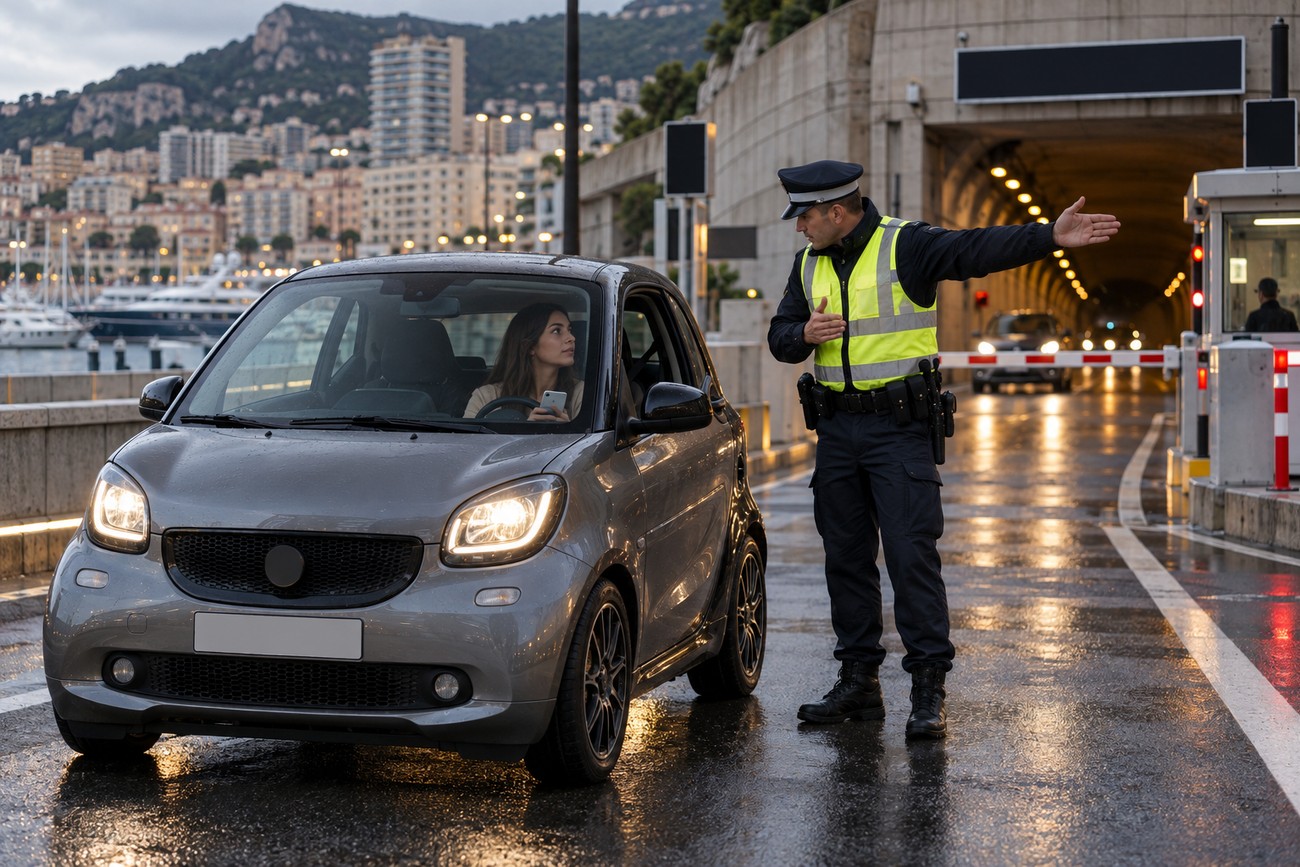
For each essential trip, check the day’s official notices before leaving. Confirm the open approach immediately before departure, especially if the journey crosses Port Hercules, a circuit street, or a tunnel. Tunnel and approach availability can change by time and event phase.
Keep identification, proof of residence, or the relevant work or access pass in the car whenever you may meet a controlled resident checkpoint. Documents support a request for access, while the final decision still depends on the current traffic plan and police instructions. Follow the checkpoint’s directions rather than relying on the normal route.
Use the Smart when both parts of the trip are clear: the route is legally open, and a permitted parking place is available at the destination. Avoid stopping on a restricted street while trying to resolve access or find a space. If either point is uncertain, entrance parking followed by public transport or walking is often the more predictable choice.
A short drive through central Monaco may look efficient on a map, yet queuing, barriers, and controlled crossings can make it slower than leaving the car outside the busiest area. The building address and access corridor should guide the decision. The Smart remains valuable for a confirmed local journey, rather than as an exemption from circuit logistics.
Frequently asked questions
Where do most F1 drivers live in Monaco?
Several Formula 1 drivers are publicly associated with Monaco, but private residence information is incomplete, changes over time, and should not be used as local access data. A driver’s neighborhood does not determine how a resident checkpoint treats another building or vehicle.
For mobility planning, the relevant information is the address of your own building, its approved access documents, and the traffic plan for the intended hour. Private addresses should remain separate from practical guidance about living near the circuit.
Where does Lance Stroll live?
There is no reliable public basis for using a precise private address for Lance Stroll as a travel reference. Publicly discussed residence associations do not establish current occupancy, permitted access, or the route conditions around any particular building.
His reported location, even if accurate at a given time, would not give another resident a route exemption. Circuit restrictions apply according to the street, checkpoint, event phase, and approved access arrangements.
Where does Lando Norris live in Monaco?
Lando Norris has been publicly linked with Monaco, yet a precise current private address is not dependable planning information. Residence reports can be incomplete, outdated, or intentionally vague for privacy and security reasons.
No Smart Fortwo model, driver association, or nearby celebrity residence receives an automatic exemption from circuit restrictions. Local travel should be based on official notices and the access conditions for the specific building.







