
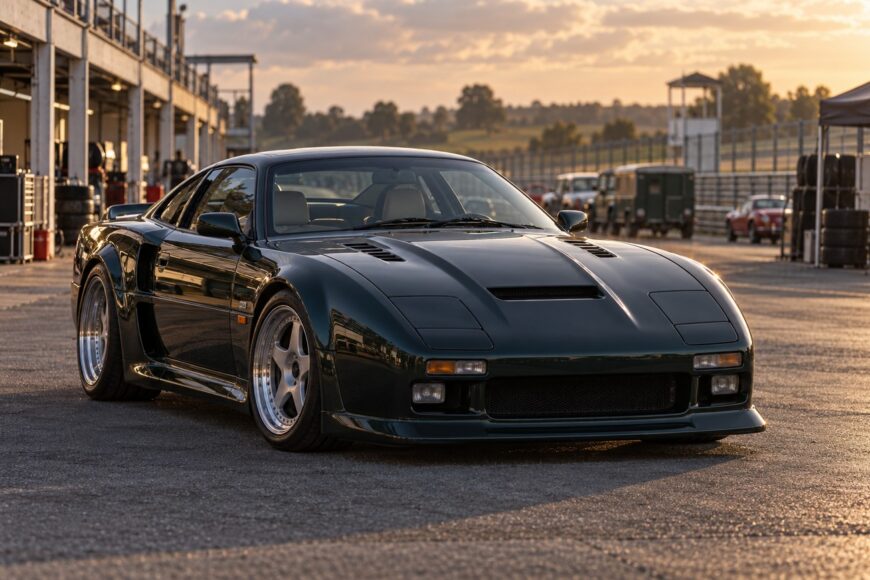
The Lister Storm is one of the most extreme Jaguar-derived road cars of the 1990s: an ultra-rare, front-engine V12 coupe with rear-wheel drive and a direct connection to the racing world surrounding the Jaguar XJR-9. Its reputation rests on huge displacement, dramatic performance claims, and a production run so small that every surviving example is effectively a separate engineering case.
That reputation also needs careful handling. Published technical data gives 546–554 hp, while promotional material and some press reports quote 594 bhp or approximately 600 hp. The Storm’s 1995 Le Mans appearance ended after roughly 40 laps, and ownership involves uncertain documentation, bespoke parts, and potentially serious repair costs. The road car and the Le Mans racer share important lineage, yet they were not identical machines.
- What the Lister Storm actually was
- Lister Storm road-car specification: published figures and caveats
- Performance on paper versus performance on the road
- The Le Mans story: race-bred image, difficult result
- Why owning a Lister Storm is harder than owning a rare Jaguar
- How to assess a Storm before purchase
- Frequently asked questions
- What was the price of the Lister Storm?
- How many Lister Storm road cars were made?
- Which Jaguar won Le Mans, and how does it relate to the Storm?
- Was the Lister Storm a practical 2+2 grand tourer?
What the Lister Storm actually was
Road-going Storms were built around 1993–1994, during a period when Lister was using a competition-derived image to create an unusually powerful grand-tourer-sized coupe. The car used a front-mounted Jaguar-derived V12, rear-wheel drive, and a 2+2 body configuration. That layout gave the Storm a distinctive character: a long, heavily loaded nose, substantial cabin, and the physical presence of a high-speed road car rather than a compact mid-engine sports car.
The engine displaced 6996–6997 cc and had 24 valves. Its conception was closely related to the Jaguar XJR-9, the Group C racer associated with Jaguar’s endurance-racing success. That relationship describes engineering lineage and the use of Jaguar V12 knowledge; it does not mean that a complete XJR-9 engine, chassis, or race setup was transferred into every road car.
This distinction matters because “Le Mans car for the road” is a persuasive description with limited technical precision. The road Storm had its own cooling, electrical, transmission, trim, safety, and drivability requirements. Race-derived thinking influenced the project, while road-car compromises remained unavoidable in a front-engine machine intended for registration.
Approximately four road cars are commonly reported. The number is small enough to make general model descriptions less useful than the specification and history of the individual chassis. Even the often-repeated claim that three survive has not been confirmed by a complete independent public registry, so it should be treated as a reported figure rather than a definitive inventory.
Lister Storm road-car specification: published figures and caveats
The figures below separate commonly published technical data from promotional or alternative claims. They should be checked against the documentation of a particular car, especially because a short production run can include later mechanical work and differing specifications.
| Item | Published or commonly reported figure | Caveat |
|---|---|---|
| Engine | 6996–6997 cc, 24-valve Jaguar-derived V12 | Front-mounted; related in conception to the XJR-9 |
| Power | 546–554 hp, or 407 kW | Commonly published technical range |
| Alternative power claim | 594 bhp or approximately 600 hp | Promotional or alternative figures without one consistent factory technical sheet |
| Torque | 790 N·m at 3450 rpm | Claimed figure |
| Transmission | Six-speed manual Getrag | Related to the BMW 850i application; full interchangeability is not guaranteed |
| Drive | Rear-wheel drive | — |
| Mass | Approximately 1664 kg | Reported road-car figure |
| Acceleration | Approximately 0–60 mph in 4.1 seconds | Claimed result; test method and car specification may differ |
| Top speed | 208 mph or 335 km/h | Principal published figure; some sources cite 211 mph |
Performance on paper versus performance on the road
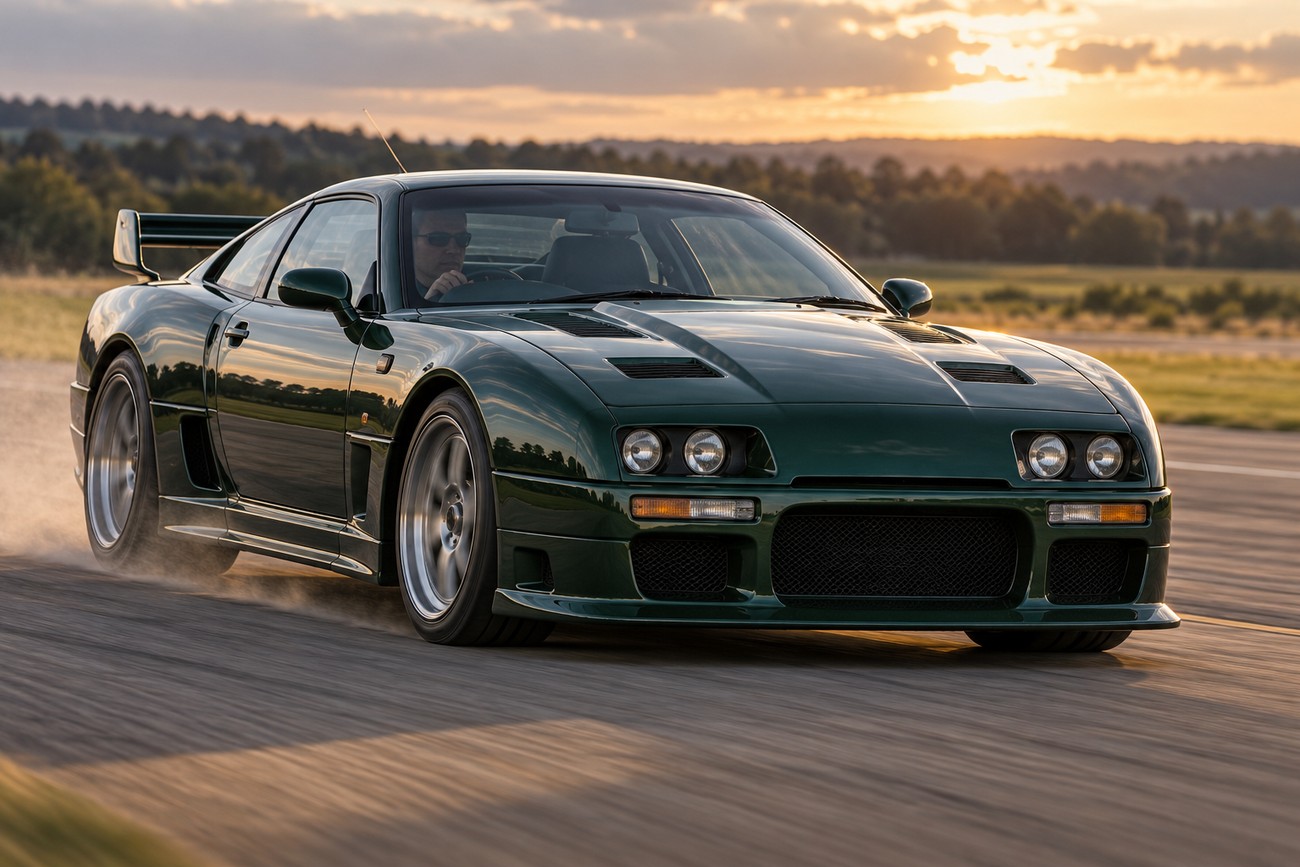
The Storm’s headline numbers are credible as an expression of its intent. A 6996–6997 cc V12 producing several hundred horsepower and 790 N·m gives the car forceful acceleration at almost any road speed. Rear-wheel drive allows that output to reach the road through a conventional performance layout, while the six-speed manual transmission gives the driver direct control over the engine’s substantial torque.
The approximately 1664 kg mass changes the character of the car. The Storm can deliver exceptional straight-line pace, yet it does not become a light, neutral, mid-engine sports car simply because its engine has racing ancestry. The front-mounted V12 places considerable mass ahead of the cabin, and that affects turn-in, braking balance, and the amount of work required on a demanding road.
Its claimed 0–60 mph time of approximately 4.1 seconds and principal top-speed claim of 208 mph, or 335 km/h, belong to a period when manufacturers and small specialist firms often presented performance data in different ways. Some publications quote 211 mph and approximately 600 hp. Those numbers should remain source-dependent claims rather than being combined into a single unquestioned specification.
In ordinary use, the surplus is easier to feel than to exploit. A driver can experience the V12’s torque with a brief throttle opening, while the car’s full-speed potential belongs to controlled conditions and a suitable circuit. The practical test of a Storm is therefore its mechanical integrity and throttle response, rather than whether a historical magazine figure can be reproduced on public roads.
The Le Mans story: race-bred image, difficult result
The Storm’s racing image has a genuine foundation, although its Le Mans record is often simplified. The car debuted at Le Mans in 1995 and retired after approximately 40 laps. That result places the Storm in the category of ambitious endurance projects that reached the event without achieving the reliability required for a full race distance.
The wider racing programme was repeatedly affected by mechanical failures. Such failures are relevant because endurance racing exposes weaknesses in cooling, transmission, electrical systems, and ancillary components that short demonstration runs may conceal. They do not, by themselves, prove that every road car was unreliable or that a particular restored example is unsound.
The XJR-9 connection also needs a precise description. The Jaguar XJR-9 represents the racing lineage behind the Storm’s V12 story and the car’s dramatic identity. It does not establish that the road Storm was a fully homologated XJR-9 with license plates, nor that every race component carried over unchanged.
Later achievements in other series should be kept separate from the Le Mans result. They may show that the underlying concept had competition potential, yet they cannot turn the Storm into a Le Mans winner. For collectors, the distinction protects both the historical record and the quality of the car’s provenance file.
Why owning a Lister Storm is harder than owning a rare Jaguar
A rare Jaguar can sometimes be supported by established clubs, specialist workshops, and a recognizable parts supply. The Storm sits outside that normal ecosystem. There is no dependable mainstream service network or regular stock of Storm-specific parts, so a fault may become an individual engineering project rather than a routine repair.
The engine requires knowledge of Jaguar V12 systems, but that is only the beginning. A suitable specialist must also understand racing modifications, unusual cooling arrangements, non-standard electrical work, and the way a low-volume road car may have been altered during its life. A technician who knows ordinary Jaguar maintenance may still lack the information needed to diagnose the complete Storm installation.
The Getrag six-speed manual and the BMW 850i-related rear axle provide useful starting points when researching repairs. They do not guarantee complete interchangeability. Mountings, ratios, cooling, driveshafts, controls, and bespoke surrounding parts may differ, and a component that appears familiar can still require adaptation or specialist rebuilding.
The racing history adds context rather than a verdict. Repeated mechanical failures in competition make cooling, lubrication, transmission, and electrical inspection particularly important, but they cannot substitute for evidence from the road car itself. A documented, healthy individual example matters more than a generalized reputation built from race reports.
Running costs also resist conventional classic-Jaguar budgeting. Unique bodywork, trim, transmission parts, and electrical components may need repair or remanufacture instead of an order from a warehouse. The owner needs access to engineering capability and patience, as well as money; the absence of a standard price list makes casual ownership assumptions dangerous.
How to assess a Storm before purchase
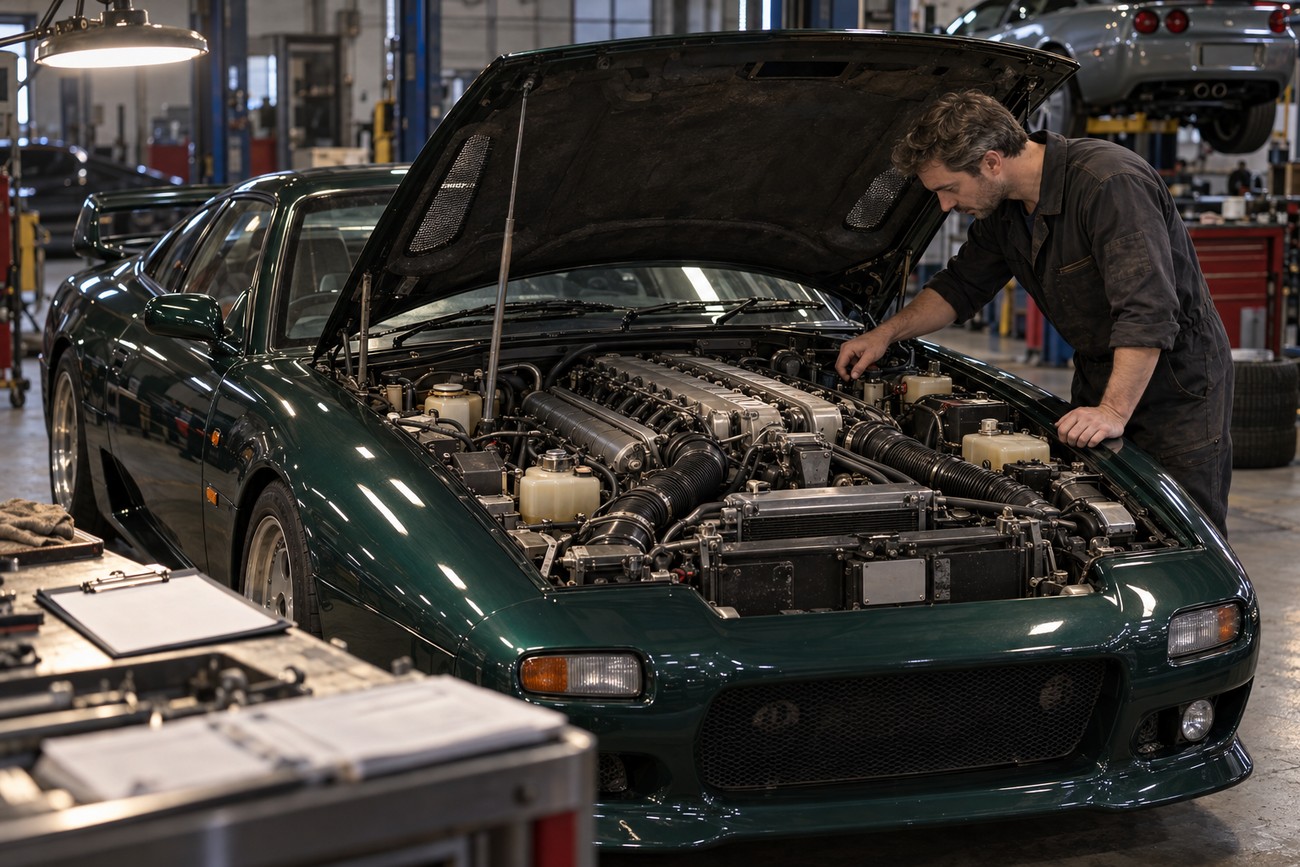
Begin with identity and provenance. The VIN, build history, ownership record, export or registration documents, and continuity of maintenance should be checked independently. A photograph of a dramatic engine bay proves very little if the chassis identity, specification changes, and storage history remain unclear.
Inspect the car from cold, and arrange a running test that allows the engine, gearbox, rear axle, cooling system, brakes, and electrical systems to reach operating temperature. Cold-start behavior can reveal issues hidden by preheating, while a warm inspection may expose cooling instability, charging problems, gearbox noise, or differential wear. Compression and leak-down testing can help, but they should form part of a broader examination.
Cooling, bespoke wiring, and the differential deserve early attention because they can be harder to source or recreate than ordinary engine service parts.
Examine the six-speed Getrag installation and rear axle for leaks, backlash, abnormal noise, and evidence of improvised repairs. Check hoses, radiators, fans, brake hardware, fuel systems, and wiring for age-related deterioration or undocumented modifications. The V12 may receive all the attention in photographs while less glamorous systems determine whether the car can be used safely.
Hand-made body and transmission components require their own scrutiny. Look for accurate panel fit, corrosion or distortion, repaired mounting points, missing trim, and evidence that a replacement was fabricated without preserving original geometry. A missing bespoke part can cost more in design and production than a familiar Jaguar component costs to replace.
Finally, compare the car in front of you with its records rather than with a generic Storm specification. Approximately four road cars are commonly reported, and that small number does not prove identical equipment, completeness, or documentation. The statement that three of the four remain operational appears in a single modern review and requires registry-level confirmation. A specialist inspection should end with a written list of verified components, uncertain claims, and likely fabrication risks.
Frequently asked questions
What was the price of the Lister Storm?
There is no single dependable public price that applies to every Lister Storm. Period pricing, later private sales, condition, provenance, completeness, and the quality of technical documentation can produce very different valuations. With such a small population, an advertised figure may reflect a specific negotiation rather than an established market rate.
A documented car with a credible service history can command a different assessment from a partially dismantled or mechanically uncertain example. Buyers should therefore avoid inserting an old magazine price into a modern ownership budget. Inspection and parts risk may matter more than the headline transaction value.
How many Lister Storm road cars were made?
Approximately four road cars are commonly reported as having been built around 1993–1994. Three are often reported as surviving, but that figure is not confirmed by a complete independent public registry.
The production total is more useful as a starting point than as proof of availability. Each chassis needs separate verification of identity, specification, completeness, and current condition, because a tiny production run does not ensure that all cars remained intact or documented.
Which Jaguar won Le Mans, and how does it relate to the Storm?
The Jaguar associated with the Le Mans-winning lineage is the XJR-9, not the Storm road car. The Storm drew on Jaguar V12 engineering connected in conception to that racing family, while its own 1995 Le Mans appearance ended in retirement after approximately 40 laps.
The relationship is therefore historical and technical rather than an identity claim. The Storm’s road and race versions were related projects, with different requirements and components, so the road car should not be described as a Le Mans winner.
Was the Lister Storm a practical 2+2 grand tourer?
The 2+2 label means that the cabin nominally provides four seats. It does not guarantee the rear-seat comfort, luggage capacity, refinement, or everyday usability associated with a conventional grand tourer.
For an owner, the useful interpretation is occasional additional seating within an exceptionally powerful and rare coupe. The front-mounted V12, substantial mass, unusual packaging, and specialist maintenance demands define the Storm more strongly than the seating count does.







