
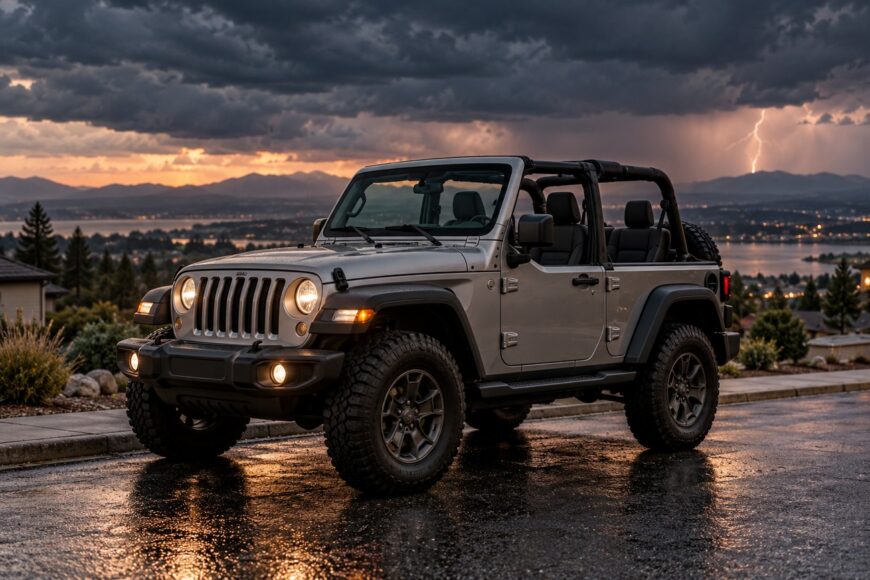
A thunderstorm is approaching, and your Jeep Wrangler’s soft top is off. You can keep driving, pull over and raise the top, or look for shelter. The safest choice depends partly on what you can reach without increasing your exposure to lightning.
The familiar advice to shelter in a car applies to a fully enclosed vehicle with a continuous metal shell. An open Wrangler does not have that enclosure, and a soft top does not create it. Being in the cabin may keep you off the open ground, but it should not be treated as a reliable lightning shelter.
- Can a roofless Jeep Wrangler protect you from lightning?
- Does putting the soft top up change the answer?
- Thunder catches you with the top off: what should you do?
- What can happen after a strike or nearby flash?
- Three reassuring ideas that can put you at risk
- Frequently asked questions
- What should I do if my Wrangler stalls after a suspected lightning strike?
- What are the downsides of a soft-top Jeep?
- Which Jeep Wrangler should I avoid during a storm?
Can a roofless Jeep Wrangler protect you from lightning?
A fully enclosed vehicle with a continuous metal shell generally reduces occupant exposure by conducting lightning current around its exterior. That protection does not guarantee freedom from injury or vehicle damage. It also depends on occupants avoiding contact with conductive parts connected to the outside.
A Wrangler with its soft top off lacks the continuous metal enclosure assumed by standard enclosed-car lightning advice. Its roll bars provide structure, but they do not guarantee a protected cabin. An electrical arc could follow a path through or near metal components; its route in an individual strike cannot be predicted from the presence of the bars alone.
A typical cloud-to-ground lightning peak is around 30 kA, with wide variation; this is not a prediction for an individual strike. The large, brief discharge helps explain why an open roof and contact with exposed metal matter. It does not mean every strike near an open Wrangler will injure its occupants.
Rubber tires are not the primary reason an enclosed metal vehicle can protect people. The conductive exterior is central: it provides a route for current around the occupants. Removing the roof changes that arrangement, even though the Wrangler still has a metal frame and body.
Does putting the soft top up change the answer?
Raising the soft top helps keep rain out of the cabin. It does not provide the continuous metal lightning shield associated with better protection in a fully enclosed vehicle. A dry seat and an enclosed feeling are poor measures of electrical safety.
The hazard in a soft-top Wrangler varies with where a discharge travels, the vehicle’s metal structure, and what occupants touch. That uncertainty cuts both ways: it would be wrong to promise safety, and equally wrong to claim that every nearby strike will send current through the cabin. Keep hands and other body parts away from exposed metal if you are caught in the vehicle.
A fitted hardtop changes the physical cover over occupants, but it should not automatically be treated as equivalent to a verified continuous metal-roofed vehicle. Its protective behavior would depend on the vehicle’s construction and the strike path. If better shelter is safely accessible, do not rely on a Wrangler roof configuration as a substitute.
Thunder catches you with the top off: what should you do?
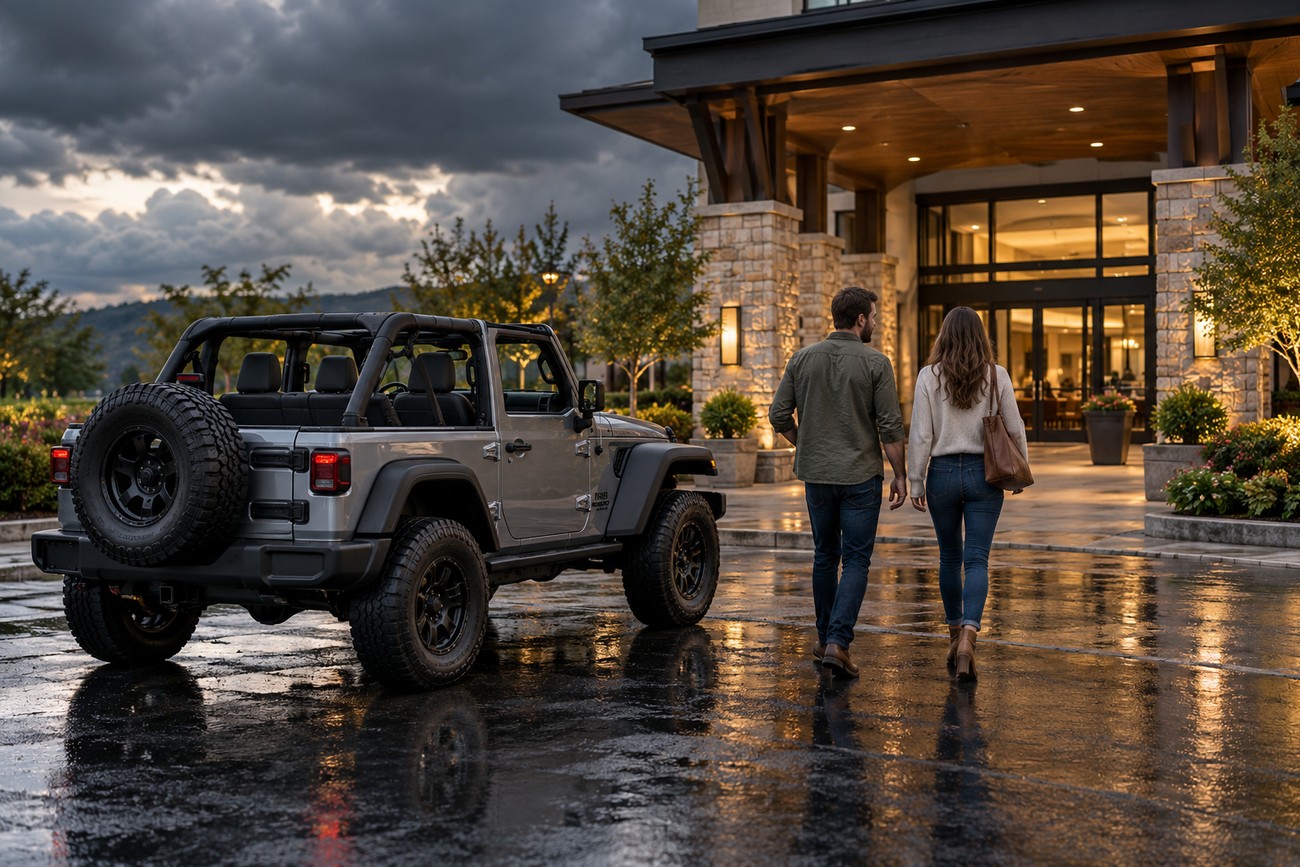
Act before the storm reaches you when possible. Head toward a substantial building or a fully enclosed metal-roofed vehicle that you can reach safely. If you are driving, concentrate on the road, then stop in a safe place rather than making an abrupt maneuver to put the top up.
A tree, utility pole, or isolated roadside structure is not a substitute for shelter. Lightning can strike a nearby object and travel sideways, so a flash need not hit the Jeep directly to create a hazard. Raising the soft top may make the cabin drier, but it does not turn the Wrangler into a continuous metal enclosure.
Leaving the Jeep helps only if the route to better shelter is safe. A distant building is not a reason to cross exposed ground during active lightning.
If no better shelter can be reached safely, stay away from exposed metal parts and avoid contact with accessories connected to the outside of the vehicle. This is a way to limit one possible contact path, not a guarantee of protection. Reassess your options as conditions change rather than treating either the open Jeep or an exposed run on foot as automatically safe.
What can happen after a strike or nearby flash?
Lightning can cause electrical injury, blast-related effects, hearing symptoms, fire, and damage to vehicle electronics. A person may be shaken or have ringing in the ears even when there is no obvious burn. Check occupants for injuries and look for immediate hazards before deciding what to do with the vehicle.
A loud report, burning smell, or sudden electrical fault does not establish whether the Wrangler took a direct strike. A nearby flash can also create hazards, and the outcome depends on the discharge path and vehicle construction. Likewise, a direct strike does not mean every electronic system will necessarily fail.
If there is smoke or fire, move away when you can do so safely and contact emergency services. Seek urgent help for anyone who is injured, confused, or experiencing hearing or other symptoms after the event. Avoid handling damaged wiring, and have the vehicle inspected before relying on it again, even if it still runs.
Three reassuring ideas that can put you at risk
“Any car is safe” overlooks the construction behind enclosed-vehicle guidance. A continuous metal exterior can carry current around occupants; an open or soft-top Wrangler does not provide the same enclosure. Sitting inside the vehicle alone is not the deciding factor.
“The tires insulate me” points to the wrong protection. Rubber tires are not the primary reason a fully enclosed metal vehicle can reduce occupant exposure. This distinction matters because tires remain on the Wrangler when its protective roof enclosure is absent.
“The top is waterproof, so it shields electricity” confuses weather cover with a conductive shell. It can also encourage an occupant to lean against a roll bar or hold an exposed metal fitting because the cabin feels closed. Contact with conductive parts can affect risk, while the path of a particular discharge remains uncertain.
Antennas and aftermarket metal accessories may complicate possible current paths, but they should not be described as proven lightning magnets. Their presence gives you another reason to avoid touching exposed fittings during a storm, not a way to predict where lightning will strike.
Frequently asked questions
Roof choices and post-storm vehicle problems call for different decisions. During a storm, prioritize reaching appropriate shelter safely. After a suspected strike, deal with injuries and immediate hazards before troubleshooting the Wrangler.
What should I do if my Wrangler stalls after a suspected lightning strike?
Check for injuries, smoke, and fire first, and contact emergency services if anyone needs help or the vehicle is burning. Do not handle damaged wiring or repeatedly try to restart the engine. Once the scene is safe, arrange recovery and an electrical inspection: wiring, sensors, and control systems may be damaged even if the Wrangler later starts.
What are the downsides of a soft-top Jeep?
A soft top offers weather cover, but it can leave you managing wet fabric, leaks, or an exposed cabin when the top is down. For lightning decisions, its limitation is specific: even when raised, it does not create the continuous metal enclosure assumed by standard enclosed-car shelter advice. Plan a route to a substantial building or suitable enclosed vehicle when storms are forecast.
Which Jeep Wrangler should I avoid during a storm?
There is no basis here for naming a particular Wrangler model year as uniquely unsafe in lightning. For storm shelter, avoid relying on any roofless or soft-top Wrangler as though it were a fully enclosed metal-roofed vehicle. Do not assume an unverified hardtop offers equivalent protection, either; seek better shelter when it is safely accessible.







